Wednesday June 13, 2017
AJ, B and TwoSon were back on the Tube early the next morning, rubbing elbows with soulless-looking, rushed people on their way to work, nary a smile or smirk among them. Because of a fire in Grenfell Tower in Central London, trains were being diverted and the Tube was especially crowded.
As the family came out of the station opposite The Tower of London, a salesman accosted them, promoting a kiosk which sold tickets to The Tower without waiting in line. B took the bait, and used the machine to buy tickets.
“I wonder if we had just been taken?” he wondered out loud.
“We’ll find out soon,” AJ said.
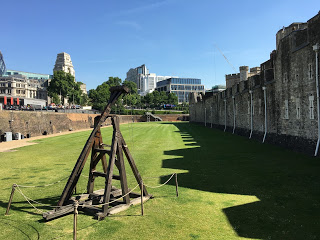 |
| The Moat |
Turns out, he wasn’t, the tickets were legitimate, and he saved some money to boot.
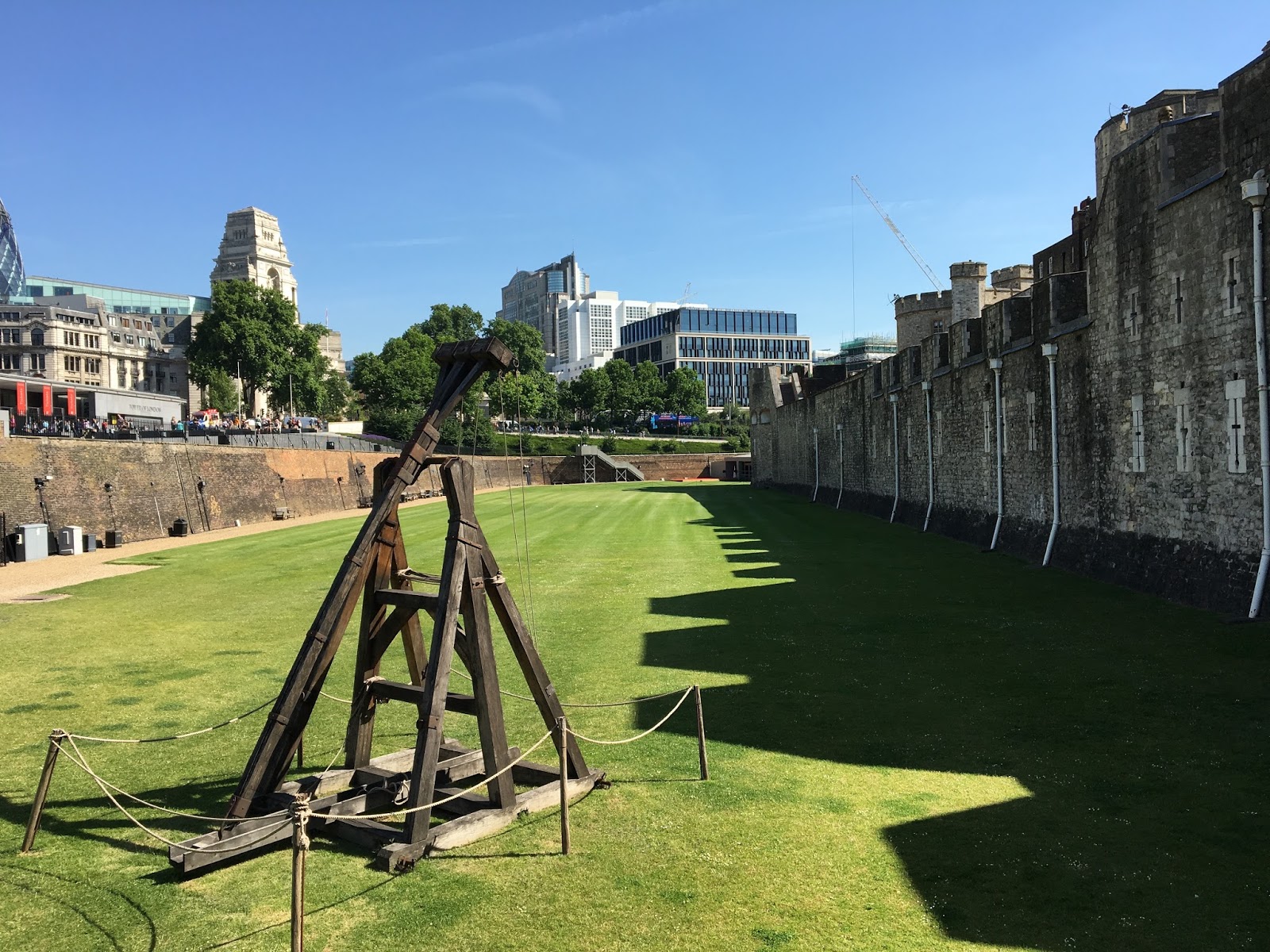
They walked into the great walled spectacle that is the Tower of London, over a bridge spanning a grass moat, past the battlements into the inner courtyards. On the way to the Crown Jewels exhibit, an unmistakable, deep croak floated through the air to awaken wonder in AJ. To any other ear, it would have sounded coarse and cacophonous, but to AJ it was a most beautiful sound.
“Ravens!” she said, turning and turning, trying to find out where the sound came from. “Tower Ravens!” she pointed in the distance to a railing atop a stone embattlement. Two Tower ravens sat preening, posing and calling. “We’ll be able to see them, right? Close up?” she asked, looking longingly at the birds.
“Yeah, they’ll probably be around, they never leave,” B reassured her. The birds couldn’t leave. In order to artificially fulfill a prophecy that said that the tower would never fall as long as ravens lived there, the birds’ wings were clipped.
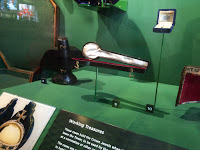 |
| Coronation Spoon Case |
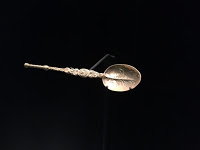 |
| Coronation Spoon |
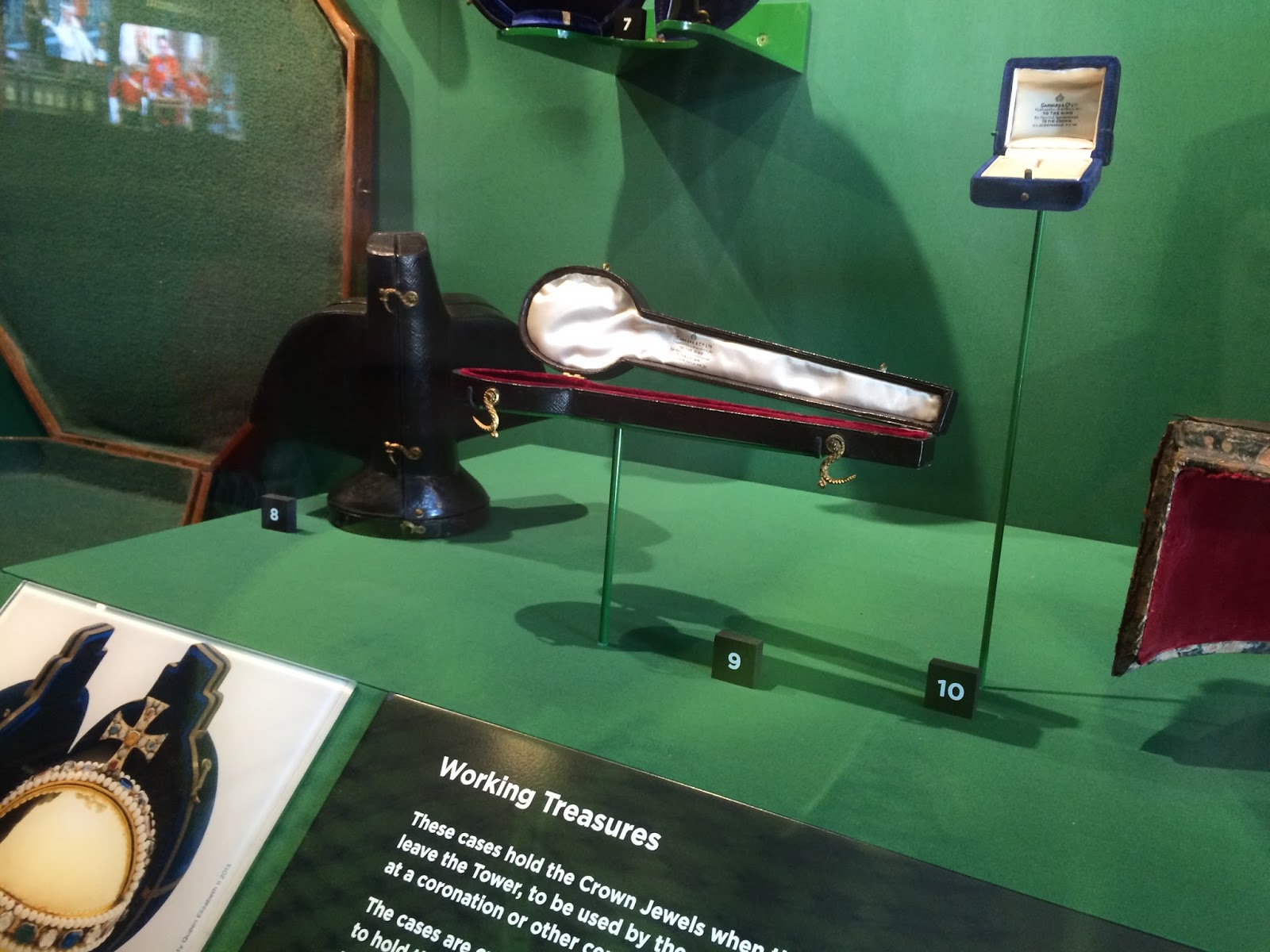
The family breezed through the beginning of the crown jewels exhibit easily and quickly since it was early. The large rooms that usually held long lines of tourists were empty. Displays of sparkling gold swords, drinking vessels and coronation spoons lined the walls leading up to the main jewels holding the actual royal gems.
As she stood on the platform that moved past the glittering royal treasures, AJ looked in awe at the sparkly, cold, motionless gems–in awe because she wasn’t impressed. Cut glass would have been just as pretty, although not as indestructible.
“They\’re are of no use to me. They are pretty, but … useless, really,” she said, aware that her sentiments were contrary to most people’s.
For AJ, the real gems were the obsidian feathers and low, intelligent croaks of the ravens who stole her attention earlier. Gold and sparkles were dull, they had no life compared to the clever, mysterious black-feathered enigmas that were ravens*.
After admiring the jewels, they climbed up to where the ravens were perched and watched them preen and groom. Ravens are big birds, and as the brochure warned, “are still very wild.” AJ was a little intimidated to stand close for a picture, she didn’t want to know what a raven bite felt like. After saying goodbye to the black beauties, they walked down from the wall, where AJ discovered a down feather from one of them and tucked it into her notebook.
On the Beefeater tour, a soldier-turned-tour guide lead them and about a hundred other tourists through The Tower complex, pointing out highlights and lowlights, shouting history and information at the crowd. AJ had watched a few documentaries that involved the London Tower, one which featured how King Henry the VIII used the place as a prison to get rid of wives he didn’t like.
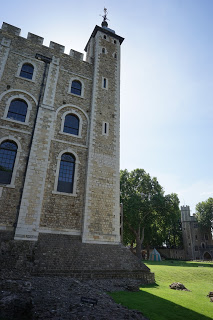 |
| The White Tower |
Inside the tower of London (or officially, Her Majesty\’s Royal Palace and Fortress of the Tower of London), stood a square stone tower, or the White Tower (after which the whole complex is named). It was built on the spot 1078 by William the Conquer because of it’s strategic military position for defending the city from invaders. It was used as a prison shortly after completion up until 1952. All the beheadings, disappearances and the glorious and goried past of the place surrounded them as they trod the walkways and cobbled stones with the tour ending in the Chapel.
Next, the family reluctantly trudged up the 200 steps through war-themed exhibits in the White Tower, marveled at the 15-foot thick walls, complete with “toilet,” then on their way out, passed through the museum of torture in one of the battlements.
The history didn’t grab AJ, but the birds did. The place was old, very old and filled with so much royal history bad and good, but although fascinating, it seemed too big, too important to impress her. The things that really fed her awe and wonder were usually small, lonely, domestic antiqueness–plebeian and well-worn. The tower complex was so flooded with modern-day people, it relayed more of a carnival atmosphere than hallowed history.
After lunch at Pret A Manger, B lead them to St Dunstan Church, a literal shell of a church, walls with no ceiling, filled with garden beds, beautiful flowers and business people lunching on the pleasant lawns. The Church of England building carried a storied history of burning in the Great Fire of London, being rebuilt poorly, bing patched up and finally, after being bombed in the Blitz of 1941 in WWII it was turned into a public garden.
 |
| Leadenhall Market |
|
 |
| St Dunstan\’s |
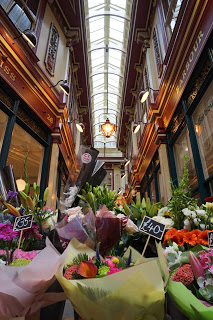
Next they strolled down the cobblestone streets of Leadenhall Market, past restaurants, shoe-shiners, taverns and stores, all the facades elaborately decorated in gold, silver, cream and burgundy.
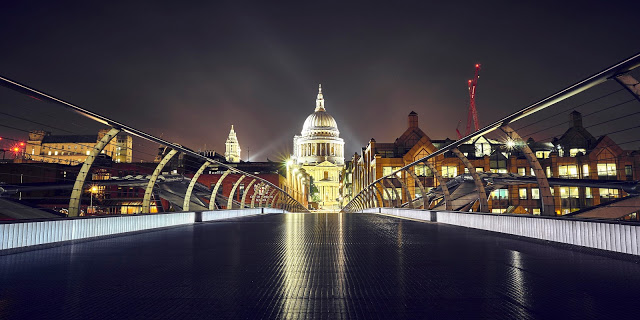
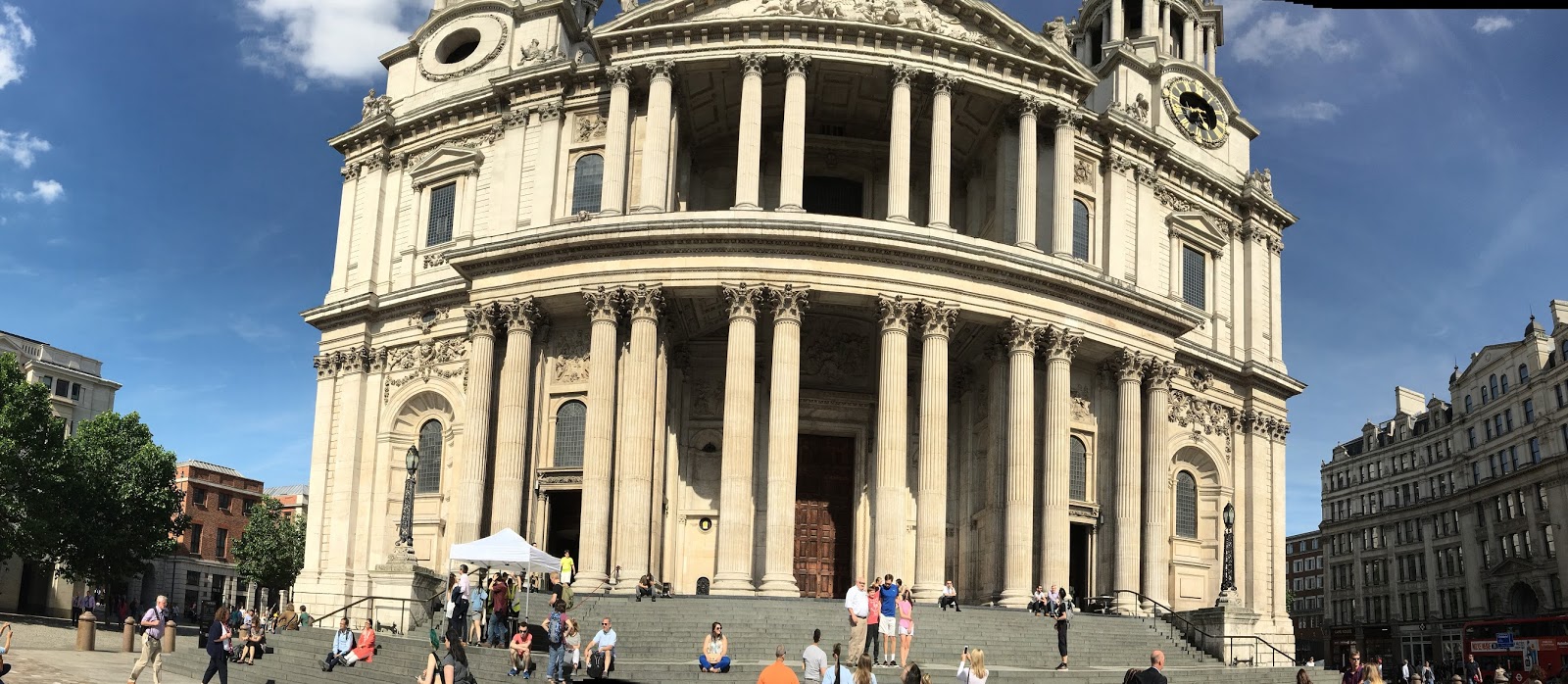
St. Paul’s Cathedral is so big, a gigantic behemoth of a building that when AJ, B and TwoSon finally found the front entrance, they stood looking up in bewilderment at what to make of the spectacle. It was too big to get into the frame of the camera when standing on the square in front of it. Covered with a glut of detail inside and out, stories were packed in every space, every color, every glint. History hung in the air and hovered around all the monuments to brave men, holy men and dead men. In a small chapel off the main building stood a memorial to 28,000 American soldiers who died for England in WWII.
The family joined a guided tour then walked around admiring the many splendors of the vast place.
The present Cathedral was finished (depending on what you consider “finished”) in 1708, designed by the architect Christopher Wren and included many domes, not spires like the first had (which burned in The Great Fire of London in 1666).
The steps up to the first level of the dome were shallow and numerous as the family trudged around and around to get to the middle of the top. The first real landing opened to an expansive dome with a narrow ledge, bench seats and a railing around the edge for viewing purposes. Up there, they could see the mosaics, paintings, statues and other magnificent works a little better. After walking along the wall and finding a place to sit, AJ realized that TwoSon really, really didn’t want to be there, so after a few minutes, they found the exit and walked back down.
 |
| A distorted, abridged view of St Paul\’s Cathedral |
“It wasn’t the height that I didn\’t like, it was the wide open space in front of me,” TwoSon said as they were safely on the ground level again.
The basement held just as much interest as the rest of the church–there were people buried there. As an American it was odd to see graves in the basement of the church, but it wouldn’t be the last time the family saw it on their trip.
AJ took an interest in one John Rennie from Phantassie, East Lothian who was, apparently so talented and appreciated as a Civil Engineer, he was buried there. Other cerebral minutiae AJ took away and treasured from her trip to the cathedral included the fact that a lot of the earlier popes in the church had the word Aelf- in their names, which reminded her of elf, which reminded her of The Lord of the Rings trilogy.
There was something about the “muchness” of the place that prevented AJ from connecting anything there personally to Christ, or faith in God. It all seemed so far away, in many senses, from her. But it was built for Him with the utmost talents of so many people, for worship to Him and that was something she could appreciate.
After they had their fill of the cathedral’s greatness, and the use of the very nice restrooms, the family exited out the gift shop and wandered down Regency Boulevard to browse shops. They perused an everything-M&Ms store, then, of course went into the The Lego Store.
While waiting for a seat at The Flat Iron restaurant, AJ visited the Doc Martins store, and a few other small shops.
The Flat Iron restaurant served steak–that was it–and a few sides, and maybe a special dish or two. Tiny cleavers were provided to cut the steak. B ordered Fentimen’s Ginger Beer and found it too “bitey” so AJ finished the bottle for him.
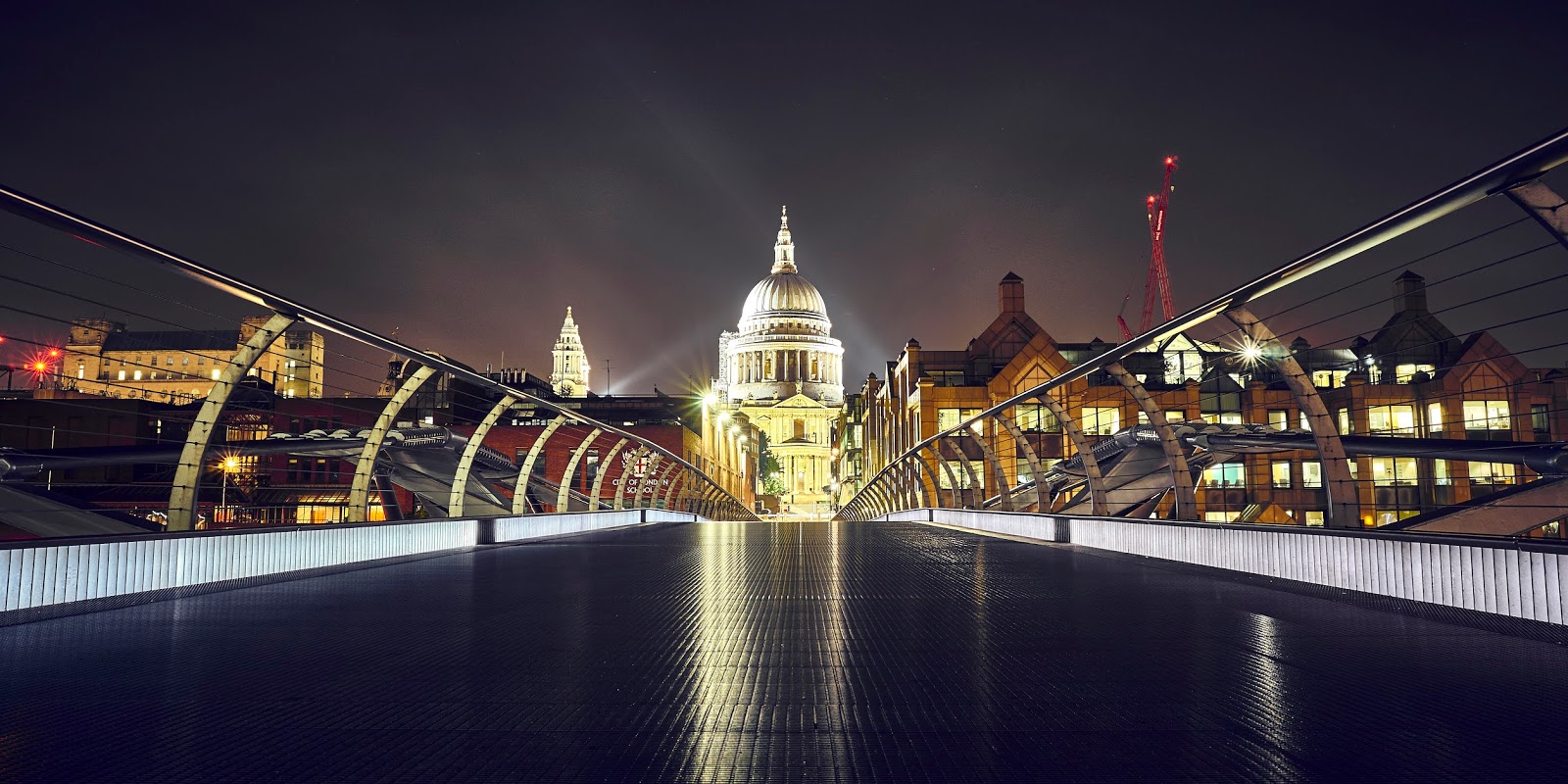
After dinner in their last night in London, they split up, AJ and TwoSon returning to Balcombe street B&B to try to get the tiny washing machine/dryer to dry clothes without cooking them, while B took more pictures of London at night.
AJ had dozed off and woke a little after midnight to find that B still wasn’t back, which made her angry for worry, and sleepless. Eventually she heard him trudging up the 53 steps, late because he had to ride The Tube a lot farther because of limited service at night.
 |
| View of St Paul\’s at night |
|
*AJ’s favorite book on corvids: Mind of the Raven by Bernd Heinrich





 Not I
Not I 