Astrid’s hearing is variably hypersensitive. Bjorn insists it is so pathologically acute that a lady bug sneezing on the lawn would wake her. But it wasn’t a lady bug sneeze that woke her in the night at the AirBnB, it was a crying newborn baby. She wasn’t annoyed at the disruption, but thankful. It was a reminder of how far time had brought them, from years prior when she was waking to the screeching cry of her baby every night, her baby who would be going off to college the week after they returned from the trip. Also, she was impressed the family ran an AirBnB while taking care of a newborn.
Toledo, WA may never make it to the top ten of America’s Most Beautiful Cities, but it is home, it is the America most United States Americans know from day to day and it’s a little bit sad, but hopeful.
It was cool the morning they set out to visit the famous broken mountain/volcano, Mt. St. Helens. The winding roads were intermittently wrapped in fog as they headed higher into the mountains. At Mt. St. Helens Vista Point, the family got out and watched as the mist rallied around the broken peak in the distance.
Mountains, in general, are slow to change before humanity’s eyes. It is said that at one time, the mild Appalachians were as wickedly tall and ferocious in height as the Alps or the Rockies, but it took a gazillion years to whittle them down to the mountain nubs they are today. Mt. St. Helens and the peaks around it are not as ambitious as the singular Mt. Rainier, nor are they as mild as the Appalachian Mountain chain, but they are younger, faster, taller, more volatile; angrier, disillusioned with the world, and wear a more consistent covering. The trees covering the slopes were by human design (90% farmed pines) and sometimes nature’s: conifers, creating an uninterrupted pattern of dark green triangles adorned with a silvery glow in the weak morning sun and dew.


The road that ran closest to the broken peak was closed, so the family went to the Mt. St Helens Learning & Science Center where Astrid learned more of how this mighty mountain was hoisted by its own petards when it literally lost its top. She was in kindergarten when the event took place but it remained as fodder for many science class geology sections in her school career.
After centuries of sedentery threats of smoke and rumblings, Mt. St. Helens moved fast and broke things on May 18, 1980. The forces that exploded it pushed the mountain peak apart and threw it down, burnt and melted, flattening everything for 230 square miles. It erupted at 8:30 am and spewed ash as far as Idaho by noon the same day. People died, towns were buried, the land was changed. It is still an active volcano, part of the Pacific Ring of Fire Tectonic Belt.
There is something odd, numbing, and helpless about learning of very natural disasters like volcanoes. Human endeavors might affect our world-wide climate to varying degrees, but volcanoes are not part of the atmosphere above us, we can in no significant way admit human fault for a volcano or an earthquake. We either heed its warning shots and get out of the way, or let the mountain take us with it as it breaks.
###
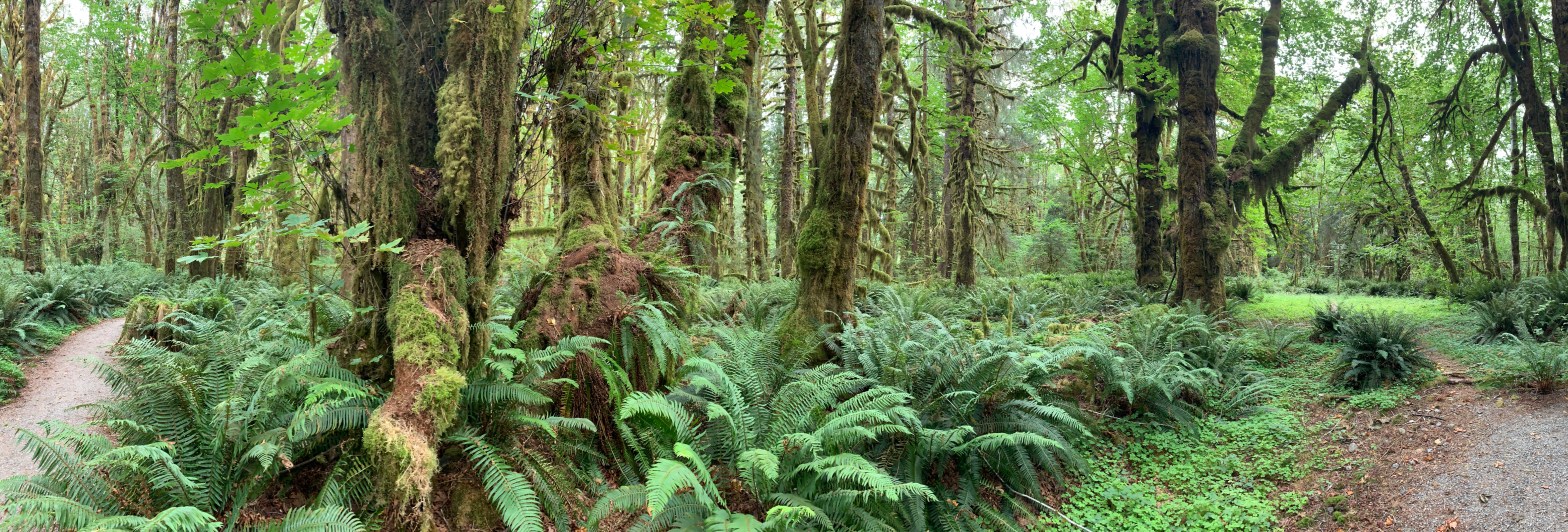
The first thing Astrid did when they arrived at the Quinault Rainforest Ranger Station in Olympic National Park was to take off her jacket. It was very warm and humid. If she had been more observant on the long ride there, it wouldn’t have been a surprise: the flora had changed. They left the evergreen covered mountain sides and were plunged into a land of moss-draped deciduous trees, forest floors thick with ferns and cushiony moss.
Olympic National Park is a very big park. When Astrid started visiting national parks, she was surprised at how much driving it entailed. The parks she knew in her youth were all walkable. A visitor parked and enjoyed all the scenery on foot, whether a raucous amusement park, a quiet forested and pathed state park, or a playground at the local elementary school. Visitors needed transportation to see most national parks.


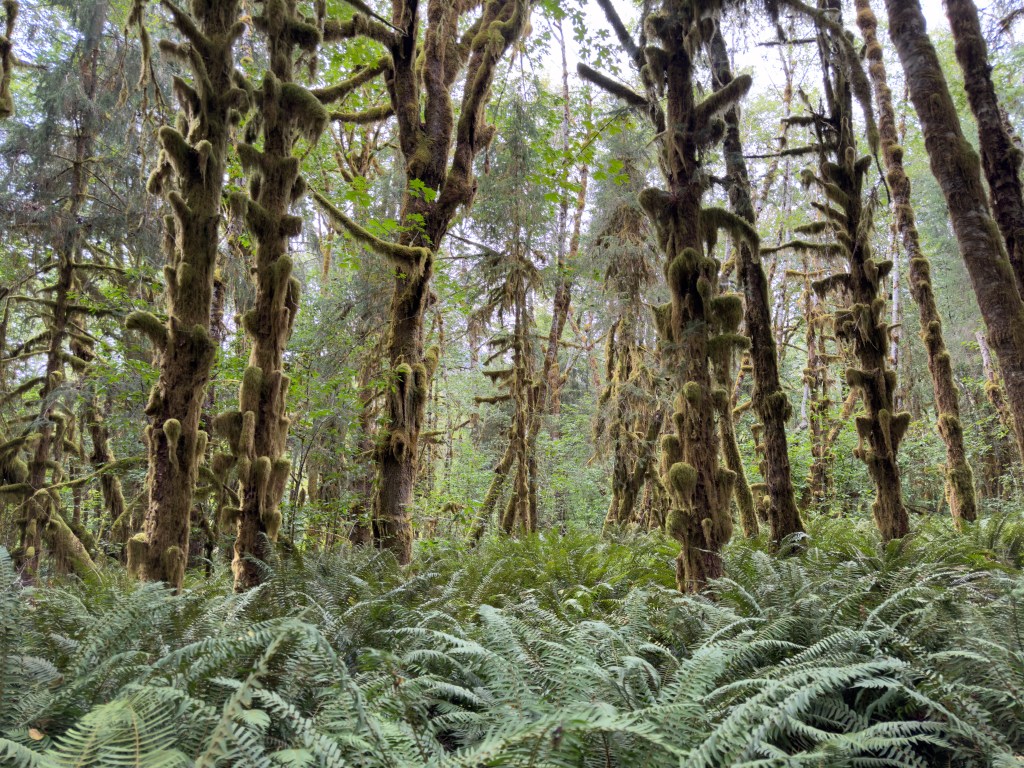
They took a short 1.3 mile hike on the Kestner Homestead Trail, a trail crowded with thick ferns, leading to the remnants of long-ago homestead. Then they drove to Merriman Falls, just a few miles away and a few steps off the road. The road around Olympic was dotted with residents, villages and houses fronted by beautiful blue hydrangeas.
After a light dinner at Creekside Restaurant, where Kalaloch Creek flows into the ocean, they walked along the beach, to visit a very resilient, precariously perched tree. The Kalaloch Tree of Life on the Pacific Coast Beach stands as a living monument of persistence, suspended by its roots across a chasm.
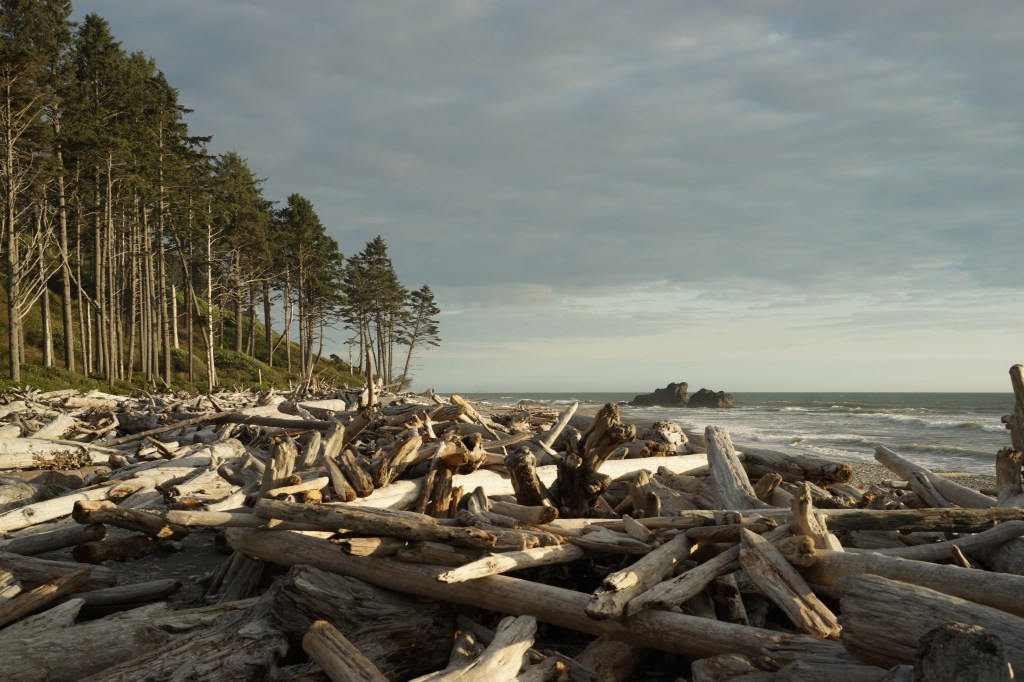
Ruby Beach was the perfect place to watch the day end, where they stretched out the visit, so they didn’t have to spend the time waiting in their car to get into Hoh Campground, one of the most poplar spots in the park, because it was the closest a visitor could drive up to Mount Olympus. After exploring the sand, then raft-like patches of drift wood and admiring the giant rocks, Astrid warmed herself in the car while Bjorn captured the sun’s bedtime ritual.


“It takes so long to get anywhere!” Astrid said after fifty minutes of driving in the murky dark, and still not arriving at camp. The road ran through thick forest and along swamps. But as they approached the entrance kiosk to their campground for the night at 9:30pm, they drove right in, without even slowing down.
Hoh Campground is rife with dense ferns (so cougars can hide behind them), furry trees (to make it super-eerie), and thick tree canopy (to shut out even star light). The family set up tents on hard ground without a rock in sight with which to pound in their tent pegs.
After zipping up the tents and clicking off the lights, Astrid lay awake despite fatigue and the full, busy day. She tried to convince her mind that it was okay to fall asleep, let down her guard and forget. Besides, statistics implied she was safe. She stared into the dark–the very dark, dark–listening to the quiet until the sound of an illicit generator running somewhere in the distance purred through to touch her hearing, as loud as a ladybug sneeze.
If you’ve read this far:
1) You are probably my mom.
2) You were looking at the pictures and maybe read the bold type, then this list caught your eye.
3) You are oddly persistent. In a good way.
Thank you for being you.
-AJ
 Not I
Not I 