CO: Rocky Mountains to Great Sand Dunes

The next morning in Manitou Springs, Astrid and Bjorn ate breakfast at the counter of Moe’s Diner and Grill, a small restaurant next to their hotel, and once again were treated to the colorful bits and pieces of humanity that make up the world. There was a couple there, both of them more tattooed than not, drinking Bloody Marys with their sausage and biscuits before continuing their cross-country motorcycle journey to somewhere. 

In Travels with Charley in Search of America, John Steinbeck wrote about his trip across the nation. He wanted to look and listen to America.  “One of my purposes was to listen, to hear speech, accent, speech rhythms, overtones, and emphasis. For speech is so much more than words and sentences.” 

The waitress, on learning of the motorcyclists’ carefree journey said, “Wow, I wish I could do that. That’s my dream.” The cyclists appeared pleased for a moment, but as they paid and left, there seemed to be a weariness and lack of verve about them that hinted at a desire for rest and grounding. 

By the time Astrid and Bjorn made it to The Garden of the Gods in Colorado Springs, most of the good parking spots were taken, so they drove until they found one, on a pull-off to an over-look. They hiked to get a closer look of the giant shards of red boulder jutting out of the earth, crunching over the dry gravel trails. Bjorn had been at an overlook at the park earlier that morning before breakfast, to take sunrise pictures. There, he encountered some friends. 

These friends were extraordinarily unafraid deer, who didn’t mind cars or people being around them as they grazed. Being so close to the cities, there probably wasn’t a lot of hunting around that area, so they had nothing to fear. 

Astrid had no idea where they were going next, because it was an anniversary surprise. Some years, Bjorn and Astrid marked their anniversary with a just a verbal acknowledgment, sometimes with a dinner out, but sometimes they celebrated with a significant event. This year, Bjorn had planned a treat at Glen Eyrie, a hotel/museum/retreat/historic house in Colorado Springs, CO. 

Glen Eyrie is owned by The Navigators, who are “an international, non-denominational Christian organization” with a call “to advance the Gospel of Jesus and His Kingdom into nations through spiritual generations of laborers living and discipling among the lost.” (Reference from the Glen Eyrie informational pamphlet.)

First on the schedule was the tour of the house. It was built (after the first one burnt) in 1903-ish. One of Astrid’s most favorite things, besides walking/hiking for ridiculously long hours in natural beauty, was visiting and touring very old houses. She loved, most of all, the smell of old wood. Like old-book-aroma, it held so much meaning and unarticulated memories, that she kept some old rag books, not for their print content, but because they smelled so good.

Some of the elements which Astrid loved to see in these houses included: transoms (windows above doors for air circulation), fireplaces, two sets of stairs (back and front), carriage houses (garages), servants’ quarters, ornate staircases, stained glass, ballrooms, ghost doors, turrets, the all-natural materials (no plastic), wood-paneled hallways and above all–the ornamentation that most modern design lacked. Some old houses still had weird elements that never quite caught on, like the pit under the outside stairs for building a fire to melt the snow and ice on the steps. 

Glen Eyrie had a very unique feature: a tunnel from the carriage house at the bottom of the hill to the basement of the house, for transportation of luggage and materials. The house had unique and plentiful fire-fighting equipment, a feature emphasized because of the first house burning down.   

After the tour, they had afternoon tea, which included little sandwiches, little desserts, anniversary cupcakes and … tea. All of it served on fancy dinnerware, in an old, ornate room. 

After walking the pleasant, orange boulder-pocked grounds, they hit the road again, through rain showers and rolling hills, then over a very, very flat, wide countryside to Alamosa, CO to another National Park, this time with no timed-entry, or lines of cars waiting to get in. 

In fact, there was no one. They passed one car on the way in on the long flat, (very smooth) road. 

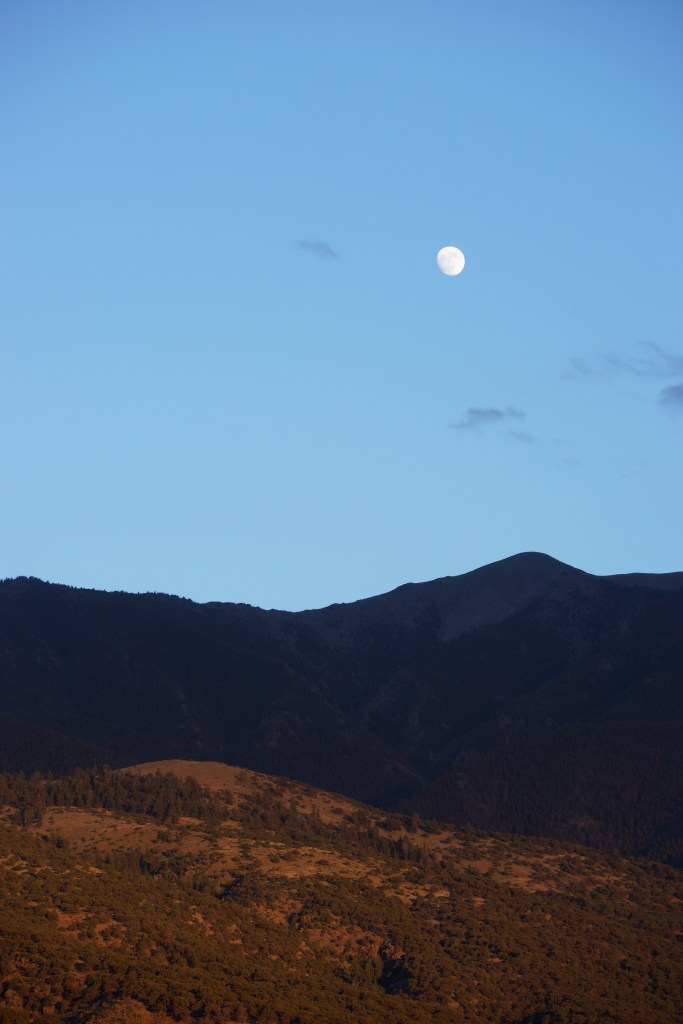
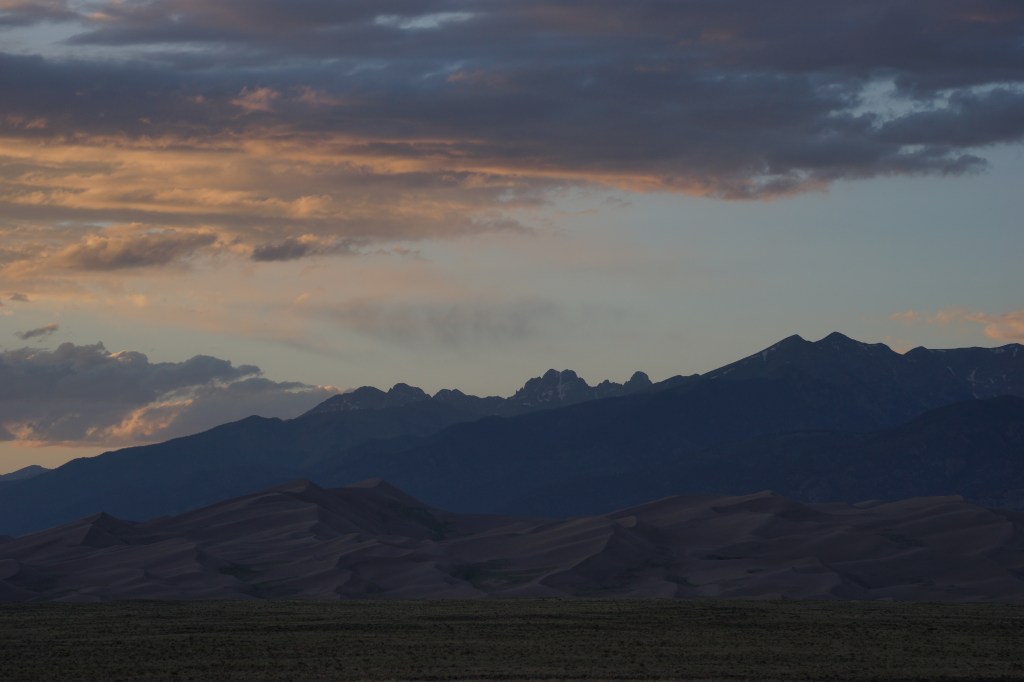
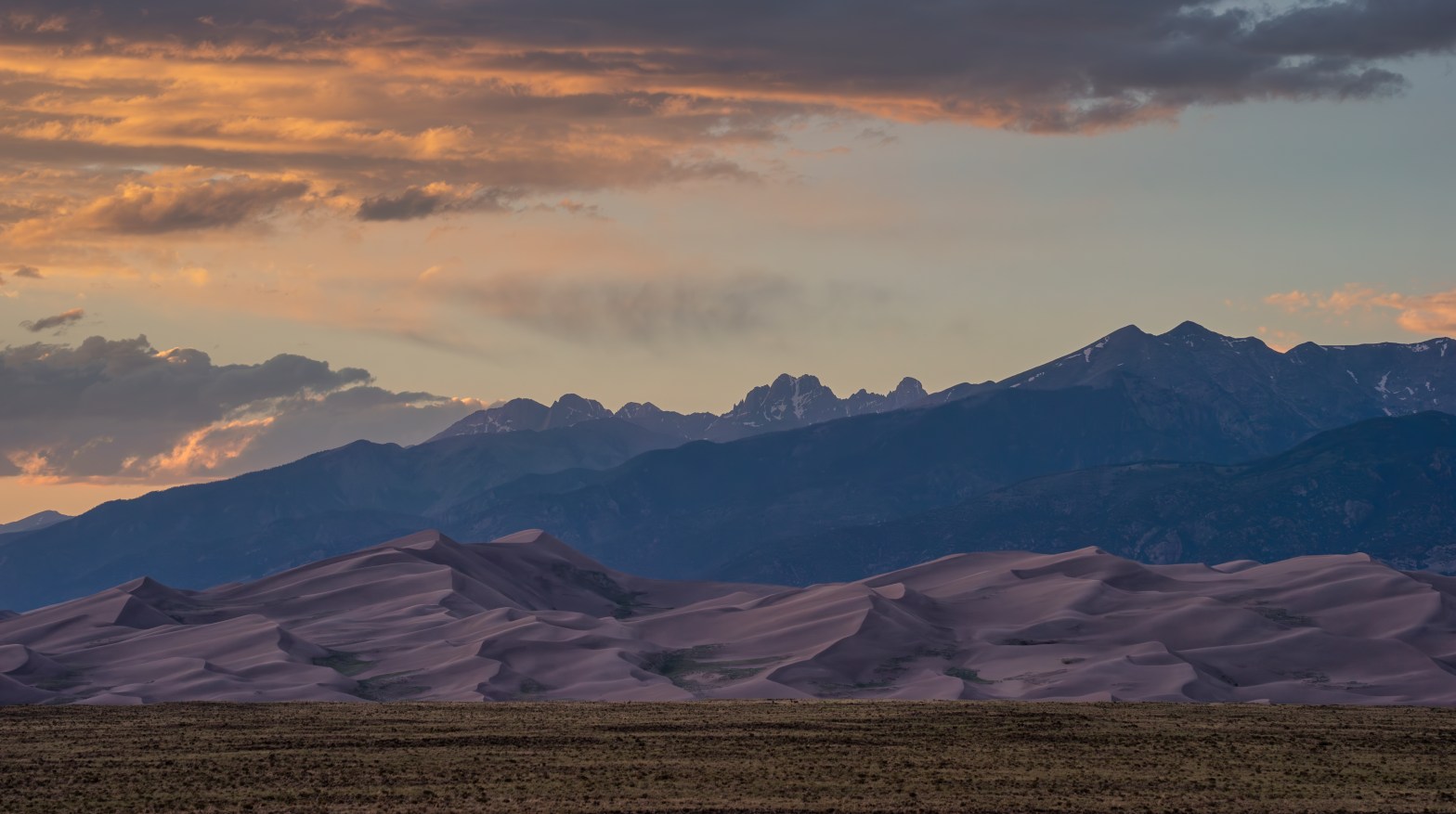
A mile or two outside the Great Sand Dunes National Park, Bjorn parked the car on the side of the deserted road, by a long flat prairie. Before them was  a grand view of a one-tree horizon, great sand dunes off to the right, clouds hovering at a distance and the sun slowly sinking, gold and clear. The area was pocked with sagebrush, brown, dead grass and yellow-flowering cactus. The uneven ground was dry, and covered with hare and deer droppings.  A flat, dry stream bed, marked by larger rocks curved through the plain.

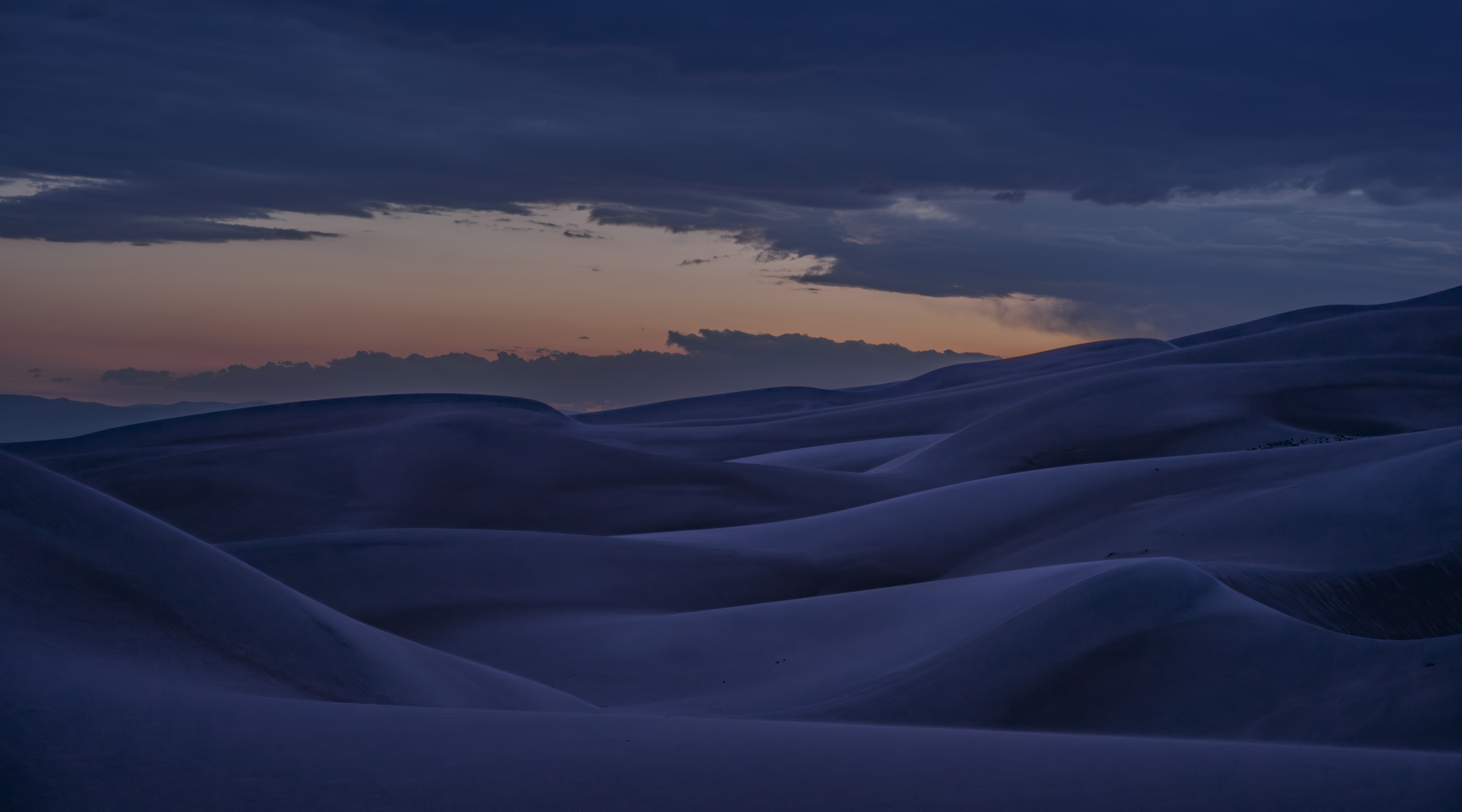
The colors were exquisite: gold, tan, brown, rich yellows that marked the day’s end. The sun created intricate shadows on the prairie, but especially on the dunes, which looked like someone brushed them with a charcoal smudge in places. 

It was a time of “Looking and Waiting” with which Astrid was so familiar, a feature of traveling with a photographer. It was time to look about her with an eye to detail, near and far; to let ideas, observations, thoughts and prayers simmer and grow in her consciousness; to think about what was right in front of her at the moment and what it meant in the big picture of her life, and of the world. What she saw was in glaring contrast to the verdant abundance of rock and water and plants of Rocky Mountain National Park. It was a dusty, senescent kind of peace. 

Astrid only wished she had a stool, because there was nowhere to sit safely among the prickles and droppings. 

When they drove into the actual park, there was no one at the entry station. They proceeded to the visitor’s center to get the lay of the land; there were no cars there. But lots of mosquitoes. Between the Sangre de Cristo Mountains and the Great Sand Dunes, there is sometimes a small creek perfect for mosquitos. 

On the long, lonely road back to their wind-whipped prairie AirBnB, while discussing if they should buy bug spray, the only other thing they encountered was a hare, who unfortunately did not make it across the road before intersecting with their car. 

CO: A 12er and a 14er

It was sunny and beautiful and Tuesday. She was at the point in her trip where Astrid usually thought of her children (if they weren’t with her), her cats and home, and felt a little homesick. But remembering home added a heightened awareness of the garish contrasts of the landscape around her. The differences were the attractions; sheer-rock cliffs instead of sand bluffs, water rushing down mountain sides instead of lapping sandy shores, Stellar’s Jays instead of “regular” Blue Jays, snow-streaked black mountain peaks instead of shadows of big cities, ravens instead of crows. 

To reduce car pollution, traffic and parking problems, some national parks provide shuttle service within the properties. Astrid and Bjorn had used shuttles in Yosemite, Grand Canyon, and this time, in Rocky Mountain National Park. They drove to a very large Park and Ride lot the first thing that morning and joined a queue of excited hikers, then squeezed onto a bus that took them up the mountain to Glacier Gorge Trailhead.

The Glacier Gorge Trail was the plan for the morning, with stops at Mills Lake and The Loch. Astrid and Bjorn traipsed through dry sparkly-dirt paths through pine forests, on hot, rocky, high ledges, crawled over boulders and over snow covered trails to chilly, sparkling mountain lakes for a round trip of 6.6 miles, fighting the wind every moment. A pleasant mountain view surrounded them at every turn through the whole hike.

After a mid-day nap, and dinner, they forced their little, cigarette-smoke-smelling Jeep Liberty rental up the mountain again on Trail Ridge Road, past herds of elk, to where the Tundra Communities Trail started at 12,090’. It was a short paved path, bordered with little cushions of tiny tundra flowers, and no shelter except a grand pile of boulders at the end, which looked like the ruins of a giant’s castle. At the top of the incline was a vista point worth spending some time at, despite the cold and buffeting wind. Astrid could see the snowy tops of the surrounding mountains and the black of the mountain lakes formed where once were glaciers. 

Looking at the map of RMNP that night, Astrid sighed. “This park is so big, we hardly did anything here.” The Glacier Gorge and Bear Lake Trailheads were the most interior into the park a car could go, the trails took a hiker a little bit further in, but from a map’s-eye-view, it still wasn’t much. If one really wanted to see more of the park and the many mountains within, it would take long hikes, possible even back-country camping to see it. But if there is a mountain, man will want to climb it, it is in his nature. And sometimes he won’t make it back.

***

The next day, after packing up and checking out of their Estes Park abode, they took breakfast on the go, ate at the shuttle Park and Ride lot of RMNP, then rode the shuttle back up the mountain and followed the Emerald Lake Trail to Lake Haiyaha, and Dream Lake, a “moderate” hike, over a rocky trail with 800” elevation gain. It was a fitting, last hike in RMNP, with all the Rocky Mountain elements from the previous day: rocky trails, snow, boulder crawling and sparkling blue mountain lakes. 

There are fifty-eight (depending on your source) mountains in Colorado over 14,000’ high. They are often referred to as “The 14ers”. Astrid and Bjorn were going to the top of one–probably the most popular of them all: Pike’s Peak, which is measured to be 14,115’. But much to Astrid’s chagrin, they weren’t hiking up. (In reality, the 13.5 mile hike would have taken more time and energy than she had.) They weren’t driving up either, but taking the train, Pike’s Peak Cog Railway, which was nice change. With just a few minutes to spare because of slow traffic in Manitou City, they pushed through a crowded train to squeeze into two facing window seats (assigned), just in time for the ride up the mountain.

The ride up the mountain started with a track through a forest, then opened up to bare tundra pocked with marmot-topped boulders. At the top, snow was still obstructing steps and parts of the visitor’s center. It was cold, windy and a little crowded. They walked around the visitors center, and Bjorn got a donut (a popular treat there). Raven was there, of course, playing in the updrafts and souring to unfathomable heights. Then they rode the train back down. Pike’s Peak, done. The view from the top was notable, but it didn’t leave a corresponding impact on Astrid. Maybe because she didn’t “earn” it, didn’t hike up. But she still appreciated the trip. What she would remember for a long time whenever Pike’s Peak came to memory were the couples sitting near them on the train. 

She couldn’t help overhearing the conversations, but the two couples–strangers before the ride–spoke like old friends the whole way up, and again down the mountain train ride. As well as finding plants, animals, birds and geography extraordinarily interesting, average Astrid often found her fellow average humans fascinating.

One couple had kids (but not with them) and loved going on baseball stadium tours. The wife’s mom had planned to go to Pike’s Peak, but had died before she could. The wife was a nurse and was going back to work after time off to mourn her mom. The trip was in tribute to her mother.

The other couple had dogs, but planned to have kids in the future. Both spouses ran marathons, despite not having runners’ builds. The wife, an only child of a very involved mother, was a family law student, the husband, an occupational therapist … or a PA. The husbands had much less to say in the fascinating conversation. 

All the while, Bjorn and Astrid were quiet, exhausted from the hike in the morning and mentally taxed with the stress of the drive and the almost-missing-the-train, which always raised tensions. On the way back down the mountain they were a little underwhelmed, and happy to sit quietly and learn about other people’s lives in passing. 

Before turning in for the night, they took short drive from Pike’s Peak to preview Garden of the Gods, scoping out good sunset or sunrise photography sites.

CO: Flatlanders, and Elk Like Bunnies

Astrid and Bjorn struggled to get to where they were going. The flight out of Michigan had been canceled after they had boarded and sat in the plane for an hour. Then they waited in the airport in line for an hour, then because that was a false line, they waited in another line, then in another line to board a Spirit Airline flight to eventually land in Denver, Colorado, hours and hours after their planned time. Then they waited an hour in a rental car line. Bjorn handled this all with grace and patience, which helped the fiery headed Astrid keep her relative calm. But they missed the concert Bjorn had planned. 

Olaf and Snorri weren’t with them. Olaf was working and Snorri had taken a 20+ hour train ride out to New Mexico and was having his own adventure. 

Astrid and Bjorn spent a day in the mile-high city visiting the Molly Brown House, then stopped in Boulder, Colorado for a “shake-down,” high-altitude hike at the Chautauqua Historic Landmark Park, on the Baseline Trail

The trail led them through beautiful scenery, filled with cracking, snapping insects, and steep INCLINES.


They expended significant effort and persistence to get used to high-elevation hiking. They were flatlanders. The only steep hikes they did around Michigan were up giant sand dunes. The struggle became VERY evident a mile into the steep hike. Astrid had an advantage: she had joined Snorri on his 10 mile training hikes that spring, but Bjorn had not had the same opportunity. They were both a little impressed with the difficulty they experienced.

With the little taste of hiking at high altitudes, they drove to Estes Park, CO to start their adventure in the Rocky Mountain National Park (RMNP) with a gentle stroll around Lilly Park. Astrid also started her bird-sighting adventure with the Lesser Scaup and Black-billed Magpie. They were the first of many birds she would see, then forget. 

***

It is undeniable that more people are visiting the United States’ National Parks, and this is a great thing, but, with more people come challenges to keep the masses and their varied attitudes and awarenesses towards “nature” (Leave No Trace is a good idea!!) from damaging the areas. Because GRMNP is a very popular destination, Astrid and Bjorn had to vie for a ticket in the timed-entry system. If a visitor wants to enter a particular park between certain hours–say 7AM and 3PM– he must get a pass. Passes become available online, at recreation.gov for a few dollars, at variable times in advance–months, weeks, or days before the date of entry (individual parks have different systems). To best enjoy the timed-entry parks, visitors should plan ahead. Some passes are sold out within minutes, depending on the park. 

After waiting in a very long line of cars to get into the park, Astrid and Born started with a mild hike to Alluvial Falls-a paved walking path, accessible to wheelchairs and perfect for families. The main attraction is a beautiful set of waterfalls, and many people were admiring them that day. Astrid sat and closed her eyes to the many distracting bodies moving around and in the falls, and asked herself some questions: What do you hear? What do you feel? 

She heard voices swimming in an aural storm of raging water down rocks; a nearer, muted thunder of rapids of the river that rushed down the mountain. She felt the sun warming her back, a faint breeze coming down the mountain played with the rim of her hat. The air was morning-warm fresh, a discernible difference from the cigarette smoke and cover-up cleaner odor of their rental car. In the rush to see the magnificence, Astrid sometimes forgot that there are more things to appreciate in the national parks than visual attractions.

But she didn’t have to do that on the next stop. They drove up the snow-pole lined Trail Ridge Road to the Ute Trail, labeled “easy” on the map. And it was, yes, objectively easy, but she was a flatlander hiking at 11,600’, (with minimal altitude change). Astrid used a hiking stick to move along the very rocky trail. The trail was well-marked, and flanked by tiny little alpine flowers, and a marmot or two, sunning itself on rocks. There weren’t many trees, but the views were outlandishly beautiful with snowy mountain tops surrounding the trail. The wind was constant and cool, whistling, blotting out any sound. The flowers, in most every color, were familiar to Astrid, but they were all very tiny–a way for the plants to adapt to the cold and wind that pummeled the mountain area. Astrid came off the trail filled with wonder, impacted by the beauty and rewarding effort. Bjorn was rewarded with a bloody nose. 

The Alpine Visitors Center in RMNP is the “highest facility of its kind” in the National Park Service at 11,796 feet above sea level, and has gigantic logs framed on the roof, to keep snow loads from caving it in. But it’s not the highest elevation one can go in the park. After a short stop, they drove to Coyote Valley Trail, a very flat, accessible pleasant trail around a stream, then ended the day after short hikes around the beautiful blue waters of Sprague Lake and Bear Lake. 

As they drove back to their  hotel, through rural mountain neighborhoods, they passed a house with a lawn where the trees were individually fenced off. For good reason. On the lawn lay a dozen or so animals–not wild rabbits, which Astrid would expect to see in her backyard in Michigan, but elk. Large elk with large antlers, large elk without antlers, little elk and medium elk. Elk, like bunnies in Michigan neighborhoods, infested the lawns in Estes Park, Colorado. If given a choice, Astrid would rather have bunnies plaguing her garden.

CA: The Pinnacle

Astrid was thankful and gracious for the adventure and challenge of every journey she took, but some days and places were more impactful than others. On this particular trip, she loved the car museum, appreciated the observatory, valued the experience to tour obscene, crumbling wealth, but when submerged in nature, on a trail, moving through releative wilderness, she was most content and happy. It was her decadent pleasure. 

It was a slightly cool morning, with a grey-cloud dappled sky moving overhead when they pulled into Pinnacles National Park, into the tiny lot nestled at the foot of a mountain by a creek. 

All woods lure a rambler onward …

Robert Louis Stevenson

Once on their way, the family moved through lush valleys, up trails leading to rocky, dry mountain tops opening to wide craggy valleys. The trail was pleasantly pocked with wild flowers, monumental boulders and babbling streams. A sweet subtle wildflower smell, cool and rainy, saturated the air on a constant murmuring wind and Astrid breathed deeply.

 At one point, the trail lead to steps lined with hand rails chiseled into boulders by CCC workers (Civilian Conservation Corps work relief program from pre-WWII) so long ago. Mid way through the hike, a dusty trail climbed to high heights and panoramic mountain vistas where about a half a dozen hikers were watching for California condors. 

Astrid spotted the giant majestic birds gliding in the cool breeze for a few fleeting seconds, but the ravens playing in the updrafts around the edges of the vast valley were more visible. 

A little bit on Condors: At the top of a mountain, the family encountered a woman carrying a radio antenna of sorts, looking for condors wearing radio collars. The California Condor (Gymnogyps californianus) had never been on Astrid’s “Bird Radar”-she never saw one, and didn’t know their story. It is a very big bird-the biggest in North America (by a few inches in wing span), and came to the edge of extinction in the 1980s. They are vultures, and vultures eat dead things, a very useful thing in the wild. But the poor birds, though they fly beautifully, and are the crucial garbage collectors of nature, are not beautiful … at first glance. 

Astrid tries to describe nature’s beauty with words, Bjorn tries to capture it in photos, symphonies try to emulate it in concertos, but none ever unlocks the numinous awe humans sometimes feel when confronted and engulfed in natural settings.  

“It is not the physical objects that I am speaking of, but that indescribable something  of which they become for a moment the messengers. And part of the bitterness which mixes with the sweetness of that message is due to the fact that it so seldom seems to be a message intended for us, but rather something we have overheard. By bitterness I mean pain, not resentment. We should hardly dare to ask that any notice be taken of ourselves. But we pine.”

– CS Lewis, The Weight of Glory, HarperSanFranciso, page 40.

The awe of nature overwhelms sometimes. It sings down from heaven, surrounds you in a downpour, infects you through breath, subtly assaults all senses at once, echoes in the stirring of wee animals or the flight of a feathered miracle. Its mysteries surround us as we step out into the new and unknown, small and sporadic, lapping the edges of our senses.

The positive effect of humans being in pleasant or moderately challenging natural settings is psychologically therapeutic. Biophilia is defined as literally, “love of life”, but more specifically, it describes the seemingly innate need to interact with the natural world around us. That interaction with “nature” has the power to benefit humans, physically and mentally.

After five or so miles on the trail, Bjorn used his camera less often. The pace quickened because the density of nature and the inability to take it all in overwhelmed. Astrid gave up capturing the penultimate shot or finding just the right words, and she just existed as any other mammal making its way through the unbuilt, natural world. 

Along the way were signs Astrid had never noticed before, of symbols she didn’t recognize. Eventually, with Snorrie’s help, she figured it out: climbing opportunities. Pinnacles National Park is a small national park, but judging by the number of pictures Astrid took, it held much more interest and awe for her than any stop that week. 

If it were a Middle Earth trek, Snorri would be up front, striding ahead, like Aragon. Astrid, stout and sturdy trodding along in the middle, was like Gimli. And coming up behind, introspective and observant, with a wide rimmed hat, would be Bjorn as Gandalf. 

Snorrie/Aragon lead the fellowship as if he had been there before, by cryptic signs, over hidden paths, persevering, even when it looked like the trail ended, through to Moses Well and Thallus Cave, through dripping, running water and eventually up steps hewn out of the rocks, up past a raging water fall to a manmade lake. It was a very good hike. 

As the family drove out of Pinnacles, Astrid was still aglow with awe from the overabundance of nature with which the hike showered her. They left the way they came in, among gentle sloping hills, bright green with Spring’s rain. They traveled north, then south again on CA 1 (there was a bridge/road out somewhere which complicated their navigation along the coast), with the Pacific on their right, they drove over Bixby Creek Bridge to get sunset pictures over the ocean.

The day ended at Big Sur Lodge, under giant trees and campfire-smoke scented air. It was dark, but cool when they checked into their little cabin room. 

CA: Castle Overlooking a Beach, and 4$ Tea

 Astrid watched the landscape through the rain-plashed windows as they drove out of Burbank, California, north on Highway 101. They passed the Ronald Reagan Library. “Travel by Map” is so much faster and easier than wheels-on-the-road, and if you’re not careful, it is easy to plan more than is possible in the time given. But Bjorn had a talent of planning just the right amount of activities for a day.  

“What did we do before we had GPS?” Astrid often wondered, especially after making a wrong turn. She knew–you preplanned your route on a paper map with a highlighter, or when map direction programs become popular, you printed out step-by-step directions. You budgeted time in your drive to correct a wrong turn or two. 

Lemon groves, pistacio groves, strawberries fields and acres of crops and pastures lined the road through the horticulturally rich Oxnard, CA and the surrounding environs. A few rain-flooded fields shimmered in the muted sunlight. 

Bjorn knew before-hand that their Channel Islands National Park stop would be incomplete. The Visitors Center was open, and Astrid bought a patch, but most of the park’s attractions were a boat ride away, on a series of four islands in the Pacific Ocean. The original plan was to go to Santa Cruz Island and hike, but the ocean was too choppy for the boat ride. So they ambled through the visitors center and climbed up the tower to look at where they were not going that day, sifting through the life and laughter of sixty fourth graders on a field trip. 

As they continued their drive north, the landscape became even more green and hilly, dotted with scraggly oaks accentuating the bright green hills. Expansive ranches sat safely behind complex gates and fences along the road.  

The next stop was at Hearst Castle. William Randolph Hearst owned newspapers in the late 1800s. He started to build Hearst Castle with his inheritance (his father owned The San Francisco Examiner) in 1919, and died with it never having been completed. His name is often recalled when students study “yellow journalism”, or tabloid journalism.  Yellow journalism relies on near untruths, unchecked premises, emotional pleas, exaggerations, and sensational headlines. It’s like that one friend who uses a lot of exclamation points and exaggerates all the time. And it sells–an obvious point, as Astrid looked up to what was a “compound” of extravagance on a hill overlooking the ocean. 

The La Cuesta Encantada (“The Enchanted Hill”) tour started at the Hearst Castle Visitor Center and continued on a tour bus which drove up the winding road to the castle at the top, the pre-recorded tour guide explaining how the place was built, the herds of animals grazing along the road, the architecture who designed it all, the social scandals, the famous visitors, the owner’s extravagant quirks. It all seemed so meaningless and frivolous in the big wide picture of life. Because it was built between 1919 and 1947, decay was evident in places.

The things humans build never really last, they will always decay. Humans spend their life fixing their creations, fighting Nature to the last. Nature plays the long game and will always win, eventually. Astrid enjoyed the tour, was fascinated by Hearst’s stores of wealth and collections, but felt an emptiness when she tried to find edifying, real meaning in the sprawling estate. 

For they will soon fade like the grass and wither like the green herb. Psalm 37:2 ESV

After touring the extravagance of humans, the family drove a short way down to Elephant Seal Vista Point on Highway 1 to see some extravagant wildlife. As they sat in the parking lot, preparing their umbrellas and raincoats (it was raining, again), Astrid watched tourists feeding chipmunks. 

Tourist A had been seduced by a cute, chubby chipmunk into feeding it chips. She did not see, or pay attention to a raven nearby who was waiting for a morsel. But when the morsel was not forth coming, the raven took it into its own fruition and started pecking the chipmunk, which struck Astrid’s wry sense of humor and she laughed out loud. Tourist A  did not find it funny and shooed the raven away.

Leave No Trace is a good idea #6 Respect Wildlife 

Out in the cold rain, Bjorn and Astrid followed a muddy trail along the back of the beach. A little way down Astrid finally saw them: large chunks of naked seal flesh heaped on the sand. They were elephant seals, basking in the cloudy skies, sleeping or grunting or arguing with other seals or fighting for a good spot. After some hasty photos, they hurried back to the car.

Chilled to the bone, they found a restaurant in the nearby town. It was decorated with bicycles. As well as a nice hot meal, Astrid and Bjorn ordered hot tea, unaware of how extravagant they were being until they got the bill. They paid four dollars for each tea. Four dollars for a tea bag and hot water.

CA: Rain, Cars, Tar and Stars

“And it is at this point in my trip when I am aware of a strong desire to go home. Home–what would I do there? Deep clean something, a few somethings. Get my coldframe out, start seeds. And I would read and write and … long to be elsewhere. Sigh. The human condition is never settled, always searching– and I am human.” -Astrid’s Travel Journal 

She was a little nervous about the day in Burbank, California. If the day before her were anything like her Chicago visits, her attention and awareness would be exhausted by the busyness and chaos upon which every city thrives. Some people love that cascade and crescendo of myriad dynamic details and “life.” Astrid, when not used to it, often grew disoriented, overwhelmed and stressed with all the sensory input. But the day in the city stood as a challenge before her, and challenges were meant to be met, like any obstruction in the metaphorical (or real) path of life; she would leave having learned something, whether overcome by the challenge or overcoming it.

It was pouring rain when the valet pulled up with their rented Chevy Malibu to the hotel. 

Like many Americans, Astrid had an appreciation for automobiles, but outside changing headlights and inflating tires to their proper pressure, she did not entirely understand how they worked. Auto mechanics, with their magic repairing skills, were wizards, able to bring back broken cars to life, with a little time and their iron wands of wrenches and pliers. 

The combustion engine, which drives most automobiles, is a miracle. Little explosions, controlled and contained, have allowed man to travel the world, go faster than humans were ever meant to go and gave us a life which was unimagined before the automobile. It is an amalgamation of millions of little and big inventions (and patents), from the carburetor, to fuel injector, to tire pressure stems, etc a so on. And the electric vehicle is the same scientific wonder, when considered in the vast space of history. Every time we get into a car, we are riding on hundred million little ideas and untold of number of hours of trial and error.

But as humans, we are not all science and efficiency. We seek and create beauty, harmony. Automobiles are an art form. They are attractive, or weird looking, colorful, iconic. Peterson Car Museum knows all this, and treats their exhibits as such. 

Just as Astrid learned to identify insects and plants through research and repetition, Snorri learned how to identify cars. Cars, like bugs and plants, have categories: cars, trucks, vans, SUVs, Big Rigs, etc., and these are divided further into size, make, model, engine size, piston placement, ad. infinitum. There are many different aspects to be interested in when one considers automobiles. 

A Tesla semi-truck stood by the door, in all its electric-run glory, graciously welcoming the visitors into the museum from the parking garage. 

Snorri’s admission was free that day since the local school system was on strike. But they chose to buy the extra ticket to the “Vault”, a basement where cars were squeezed in, lined up in random order and labeled with little identification cards. Some cars had plastic covering them, protecting them from the leaks in the ceiling.  

When you have been on the planet a few decades, and have been on the roads as long, cars start to carry emotional memories, as well as bodies and goods from place to place. Astrid’s memories were piqued as she came across a few particular vehicles. A 1970s Chevy Malibu, reminded her of a similar one Astrid drove in her teen years. The museum car was gold, hers was pea-green, inside and out. There was a Honda motorcycle that her dad owned which she remembered sitting on as a child.

After looking over the cars in The Vault, they walked through the Tesla Motors exhibit, marveling at the weird and wonderful design and concept of the electric cars. Then onto the Hypercar exhibit, then to the Hollywood vehicles. 

By the time they were done with Peterson Car Museum, it was dry and sunny out, so they ate at  HiHo Cheeseburger, (a very good place to eat), then walked the grounds of La Brea Tar Pits Museum marveling at the weird tar pools that smelled of petroleum. 

They found their way back to the car, then drove the crowded, Tesla-filled streets to a trailhead of a path that lead to the Griffith Observatory, and started the climb. 

“Who would have thought an observatory would be on a hill? I didn’t,” Astrid said as she puffed up the dirt path full of switch -backs. The Griffith Observatory overlooked the city of Burbank and some of Los Angeles, with the Hollywood Sign visible in the distance. As they reached the top, a fine mist was starting to fall. The concrete building was what one thought of when “Observatory” was suggested— pillars, marble everything, and a rounded dome pointed away from earth and humanity, into space. Inside, crowds sought shelter from the rain in soggy chilled masses. 

The planetary show, combined with the exhibits highlighting the vastness of space and the collected observations of it, put Astrid in a pensive mood, as she tried to wrap her mind around the knowns and unknowns of the universe she inhabited along with 7 billion other unique humans.

Science, to Astrid,is not a stationary thing. It is a tool with which humanity uses to measure itself and its surroundings, with the aim to better understand itself and the universe. To “believe in Science” was to believe that the process, used properly and honestly, will help us understand our life and world better and use that information to ultimately live better. Science is self-correcting, that means that sometimes, it needs to be updated, corrected, i.e. sometimes Science, (more, the humans using it) doesn’t know that is it is missing something, and gets it wrong. But correction of past inaccuracies is built into Science. That’s what she trusted.  

Stars above Badlands National Park

Just when they decided it was time to leave, the wind and rain picked up, but they decided to risk it, and fast-walked down the sidewalk this time to their car at the bottom of the hill. 

The impact of the uncommon rain was everywhere. Unlike the ubiquitous drainage systems which hide in plain sight in the more rainy areas of the country, in Burbank, the water just ran down the streets. Sandbags were piled here and there, trying to block or reroute large quantities of water through the landscape. Large eroded ruts lined the walking path up to the observatory. A veritable stream of water ran down the paved road from the observatory. As the family jogged through the rain, a car, unused to or naive to the phenomena of hydroplaning drove fast, right through the stream of water.

The family arrived at their hotel soaked and chilled. After a very good Door Dash dinner from a local Mexican restaurant, they called it a day. Despite her dread of large cities, Astrid enjoyed her day, and was thankful for the experience. She didn’t want to go home yet, there was so much to see.

CA Intermission: Short Hike, Long Drive

The next morning after a big breakfast, the family set out once again to hike in Death Valley National Park, this time at MosaicTrail. Bjorn was worn out from an early morning search for sunrise photos at the dunes, but the light didn’t cooperate and he came back with an empty camera. Their first hike was much like the day before–high rock walls with dry stream beds of scree–, but the day was dry, warm, with strong sun. Snorrie and Bjorn stopped half way in, but Astrid persevered a half mile more. She turned around when the path called for climbing over large boulders, since she didn’t want to go rock-crawling alone, without a spotter.

And at the end of the hike, they said goodbye to the valley part of  Death Valley National Park and followed a long winding road through wide valleys and winding switchback roads to Father Crowley Vista Point- Rainbow Canyon. A pair of ravens played in the updrafts at the edges of the drop-offs and overlooks as the family walked on the edge of the vast valleys. Astrid marveled as a gigantic military cargo plane (maybe a C-17 ?) flew over the valley, and disappeared into the horizon. The R-2508 airspace complex overlaps Death Valley National Park.  

When traveling, especially in and around national parks, a visitor sometimes travels along with many of the same people, unintentionally. One tends to see a lot of the same people, going from stop to stop at the park. Certain memorable characteristics bookmark people in one’s mind– unique cars, the weird yellow lights on a motorcycle, red hair, an extra nice camera, a shirt from your alma mater, someone who looks like a family member … 

It was a “travel” day– a day spent, for the most part, in getting from one place to another. The original plan was to go to Joshua Tree National Park next, but the forecast called for a unique situation there: rain. Rain that would wash out roads, and make the best part of the park impassable. So the plans were preemptively changed, which involved driving along side a long, high mountain range, to get to Burbank, California. 

The road to Burbank was picturesque, lined with sparse farmland, acres of pasture, dry deserts, lots and lots of Joshua trees, small shanty-type towns crowded with junk, all on a back drop of rugged mountains in the distance. 

Just outside Los Angeles, they stopped at Vasquez Rocks Natural Area, where giant slabs of red boulders jutted out of the ground at a 45 degrees up toward the sky. Then it was on the road again

Astrid had traveled highways with a different people and they all have their own ways of coping with the journey. Miles take time to traverse, whether one is in an automobile, airplane, boat or train, and we humans often crave a distraction to ease our boredom of the monotony. Some travelers constantly nibble on snacks or sip on drinks when they drive. Some need music. Some passengers read, which boggles Astrid’s mind since, as a rule, she wore Sea-Bands to prevent motion sickness in even the best of circumstances. But she could listen to an audio book, and when driving, she sipped tea every so often, rarely stopping during the first 4-5 hours of driving.

As they drew closer to Los Angeles, the car population grew more varied, but with distinctive notes. The Porsches, Maseratis and other sports cars still zoomed past the family’s Chevy Malibu on the highway, but now they were in Tesla territory. The electric cars were getting more popular in the family’s Michigan hometown, but in California, they were everywhere.

It was pouring rain as they pulled into the hotel in Burbank.

CA: Rules for Hiking, Rain in Death Valley, and Dune Walking

Mel’s Diner in Beatty, Nevada, an hour’s drive outside Death Valley National Park, is a cash-only restaurant, and offers a variety of hearty, well-prepared breakfasts; it’s a great place to fuel up for the day before hiking. That’s where the family ate after checking out of their adequate motel the morning before their longish hike that day. 

The drive back to Death Valley was relatively green-not eastern-US-spring-green, but more green than the area would see for a while. Average rainfall in Death Valley is less than two inches per year, with some years seeing zero rain, but not this spring. As they drove, a fine mist gathered on the windshield. The landscape was sprinkled with ragged shrubs, and along the road grew a sparse carpet of tiny plants-all green.  

The first stop of the day was at Zibroski Point, a viewing hill, which offered a grand vista of rolling hills, in soft shades of brown. The wind pushed and pulled at Astrid as she stood looking out at the hills, to the point she sought shelter below the top of the hill. Their next stop was at a trailhead to a trail that would wind, dip and soar within that landscape. 

Astrid’s Rules for Hiking

In the trailhead parking lot, Astrid took some time to prepare for the hike that was before them. She loved nothing better than to immerse herself in the forest by following a trail into a tunnel of trees, and made a point of doing it often. But this was different. There were no trees, only dirt, stones, earth. As she would be hiking for about five miles–planned for with Bjorn’s help–she wanted to make the most of it and that meant getting ready. She had some things to keep in mind. 

1.Be Prepared. Give thought to: where you are hiking, when you will be hiking (what time of day or season), weather predicted during your hike, who you are hiking with, and after considering these things, think about what to bring.

At the very least, bring water–more than you think you need, within reason. The extra weight will help you build strength and will decrease as you drink. Bring a First Aid Kit.

The goal is to not let any personal lack, severe discomfort or need interfere with your hike. Plan so that your physical needs are all anticipated and taken care of, enabling you to move through the landscape, over the trail with full attention on what surrounds you … or doesn’t. 

Thirsty? You got water. Sunny? You have a broad rimmed hat and applied sunblock before you started. Bugs? You have bugspray. Blister? You have mole-skin in your well-stocked, efficiently packed First Aid Kit, and won’t have to suffer a painful hike out. Rain? You got a raincoat (if you care about getting wet, and you might not under certain conditions). 

2. Start Cold. This is a rule Astrid often violated, because she hates to be cold. Being cold was one of the things she feared. It was difficult for her to trust her metabolism, strip off the layers of jackets, put on her pack and walk off into the frigid air. But experience was teaching her, hike by hike. Interrupting a hike a mile or so in to take off her pack, then take off a jacket, or two, then put on her pack again was tedious and disruptive.  

Why start cold, especially when carrying a pack? Everyone knows, but might not think about it when starting a hike. Working, moving human bodies generate heat even in cool or cold environments– a lot of it, especially when moving loads through challenging terrain. A hiker should be just right (depending on temperatures, load carrying, particular metabolisms) if he is a bit cold when starting a hike. 

3. Keep Moving Forward. This rule is subjective. Astrid was a “slow and steady” hiker. On trail, she liked to move at a slow or moderate rate (depending on how long she had been on trail), constantly, never stopping longer than a few minutes every two to three miles if she could help it and never stopping for more than 20 minutes. As opposed to the “sprint and stop” hiker, who moved fast and took a lot of breaks. 

That day the family hiked the Golden Canyon/Gower Gulch Loop Trail. Soon after starting, they dispersed along the trail, Snorri first (of course), Astrid second and Bjorn last, because he was a sprint-and-stop hiker, the “stops” made to take pictures at just the right angle, shutter speed–photograhy-things. But there was another sprint-and-stop type hiking party who Astrid leap-frogged multiple times along the trail, walking past them as they stopped for breaks, then having to move off trail for them to pass, etc, repeat until the end of trail. 

4. Don’t Get Separated. If you have to make a choice of paths, make sure everyone in your hiking group makes the same choice. Snorrie’s hiking style was sprint … and rarely stop. So, he would go on ahead, but with practice and warning he knew that when he came to a fork in the road, he needed to be sure we were going to follow him, that we were going to make the same choice. It’s easy to assume that everyone in your hiking party knows everything you do. Staying within eyesight of one another is another good rule. 

5. Stop to smell the … rocks? Despite Astrid’s love and need of being surrounded by green, the stark, barren landscape through which she moved eventually disclosed its beauty to her. As she struggled through the gravel, up and down hills, she looked around and realized the natural magnificence of the dirt engulfing the trail. The geological pleasantness seeped into her consciousness, along with the rare, light rain, and she loved. She loved the moment, the people she was with, loved the place where she was, loved the dirt, the rocks, the scree and she loved her shoes*. 

*If your shoes hate you (blisters, pinching, pain), or vice versa, and you are in a place where you can’t take them off or get new, it will stick in your memory, tainting your experience, for good or for personal enrichment (see #1). 

6.Passing rules/Snorri’s interpretation. When hiking, and your party encounters another group on a trail too narrow to pass with ease, it is recommended that the party heading down hill step off trail and let the party hiking up the trail pass. “But, what if the people hiking uphill want a break?” Snorri asks, challenging the rule. Which makes sense. In reality, if only a few know the “rule” of passing on hiking trails, hikers will make it up as they go along, and to fit circumstances. So, just be polite.  

7. Do not make Astrid the leader. Through her many frustrating experiences of getting lost, Astrid discovered and came to accept that she had no directional intuition. If left to her own devices (and without navigational devices) to get from Point A to Point B, whether in a car, on foot, or bike, she would get lost at least once … probably five times. But there is hope, she discovered. In the lecture series, Nature Watching: How to Find and Observe Wildlife (Wondrium), the instructor explained that, as with so many skills at which a person may not be naturally adept, with practice, and by keeping a compass and referencing it frequently, she could learn and develop this skill. But it would take effort. 

Minor considerations. When hiking, if you move with your arms down, fingers and hands may swell. If you are wearing rings they may get tight. Consider walking sticks to keep your arms moving and bent to prevent swelling.

***

The best hiking trails are packed dirt or fine, thin stones where a hiker can stroll along with not a care of tripping over rocks, tree roots, weeds or prickles, so that they are free to turn their eyes skyward, or tree-top-ward, to gaze and appreciate their surroundings outside the earth at their feet. But as in life, not all trails are smooth and challenge-free. 

The first part of the loop trail, Gower Gulch Trail, weaved along small gulches and dry stream beds between hills, which had them struggling through deep scree–thick layers of small pebbles that had eroded from the surrounding hills. It was a lot like hiking in sand. But then the trail lead up hill and down, on sturdy smooth compacted dirt where the hikers could move more efficiently. 

As they headed back toward the parking lot, the rain started, light and misty at first, but then surprised them by actually raining to the point where Astrid put on her rain coat. 

After the satisfying Death Valley hike in the rain, the family had some time, so drove the Twenty-Mule Road, a scenic and slightly challenging driving road through and around what used to be a major mining area. 

Stovepipe Campground was like the other campground-a stoney lot, with scraggly trees and signs designating campsites. But there were two restaurants, a gift shop and a camp store there, also. The family ate a late lunch/early dinner at The Toll Road restaurant, where the walls were covered with posters of the movies which were filmed in the valley. These included; Return of the Jedi, Star Wars, a few episodes of The Twilight Zone, and a whole slew of old spaghetti westerns. 

The last stop of the day was at a place Astrid had doubts about. Not because it was a new and challenging thing, but because it was a familiar and challenging thing: sand dunes. Southwest Michigan had some magnificently beautiful dunes, but to walk through, around or up/down them, it took a little more effort and struggling. Walking in sand is walking on an unstable surface, for every step forward, or up, there is a sliding back or down because of the moving sand. You quickly become aware of the great inefficiency of movement. You expend more energy to go less distance. 

But sand dunes are very photogenic. And the Mesquite Flat Sand Dunes were no different that evening. Unlike Michigan’s lake-side grass-dotted dunes, these mesquite-pocked dunes were in the middle of a desert, being formed and unformed by strong winds blowing over mountain ridges. Compared to Michigan’s dunes, they were gently undulating, and low, with bare spots of solid ground, but as they were still mounds of sand, they were still challenging to walk through. 

CA: Walking in Death Valley

Astrid, Bjorn and Snorri were flying into Las Vegas, Nevada … again. But, to Astrid’s relief, it was only to land, get lunch, buy gallons of water and leave again, to travel to California’s Death Valley National Park.

They chose the Chevy Malibu rental car because it had an app that connected to Bjorn’s phone –with all the GPS information and pre-programmed maps, but once on the road they immediately felt out-of-place. The highways were a sea of exotic cars-Porsche, Mercedes, Maserati, Rolls Royce–along with a bunch of domestic muscle cars, and lots and lots of Teslas. 

“Did you see that car? It’s an {insert fancy car name here}. It has a Toyota engine, but a Volkswagon chassis,” Snorri would say as the flashy marvels of human engineering passed by. 

“No, no, I didn’t. How do you know all these cars? How can you identify them? How do you know this?!” Astrid asked, a little amazed that he knew, by sight, the make and sometimes model and year of so many high-end cars. 

Olaf the White, Astrid’s older son was the same way, except with military tanks. She was the same with plants. To put a name to something, to categorize it in one’s mind, is a way to orient oneself in the world, and start to understand particular systems in one’s environment. And when one spends time studying cars/tanks/plants, one can identify them with just a glance.

Their first stop in Death Valley National Park was at the bottom of a mountain, by a frighteningly wide and expansive valley which, at a glance, looked like it was covered in water, but was almost the opposite: it was salt. They were at Badwater Basin. High on the mountain behind the parking lot there was a sign, “SEA LEVEL”. They were standing at -282 feet below sea level.

It was hot, but not yet Death-Valley-hot. It was the weirdest hike. The first quarter mile was a wide trail of flat white cement-like ground, the bright sun beating down, making it glow. 

The further she went, the more bumpy and ridged the ground became, until at the end, where it ended into a wide white-floor valley of nothing. The ground was covered with white angular tile-like crystalline-covered, angular, geometric plates–and people, lots of tripods, lots of posing, putting on a temporary happy face for a few seconds for the camera to capture.

After sufficient admiration they returned to their plebeian Malibu and headed off down the road. The carspotting which had started in Las Vegas continued and wouldn’t let up until they got back home to MI. Californians, and its visitors loved their “fancy” cars. There was a pack of Porches in the parking lot, and as they were leaving, a Corvette Stingray pulled in, scraping the undercarriage on the pavement as it turned.  

***

Next was the Artist’s Palette, where Astrid and family followed a trail into mounds and small hills of layered, multi-colored soil, and a place where Star Wars was filmed. As they drove back down the curvy road, a pair of Ravens flew over the car. 

There was wildlife in Death Valley, and of course, that included the sturdy, ever-present Raven. Down the road as they approached an intersection, they watched as a lone coyote looked both ways before crossing the road–a wily one, not doubt. 

At the Furnace Creek Visitors’ Center they milled around with other visitors–including a Scout troop, to refill water, and of course buy a patch. 

Death Valley NP is not all salt, heat and thirst; at The Oasis, an area with patches of green grass between palm trees, hotels and shops, the family grabbed some dinner and sat in the shade for a rest.

Because of high cost and low availability, they didn’t stay at the Hotel at the Ranch at Death Valley that night, but instead had a room at a motel in nearby (1hour drive) Beatty, Nevada. Beatty is a quaint southwestern town, reminiscent of Radiator Springs in Cars, the Pixar movie.  The motel was clean, with decor trying not to be so blatantly 1970s, but failing, and a sufficient place for sleep and a shower. 

***

On the flight into Las Vegas, Snorri and Astrid sat toward the back of the plane, next to a young man, probably military, who, during the flight, requested and consumed an above-average amount of alcohol–so much so, that the flight attendant cut him off. During the flight, he watched movies and grooved to his music, but when the plane landed, he became audibly upset on a phone call. Astrid couldn’t block it out: she heard distress in the man’s voice (and many spicy expletives) as he talked about how he couldn’t believe some person was gone. 

Someone in his life had died; it may have been the reason he was on the plane. He started to get an emotional strain in his voice as he talked. He was trying to find a way out of death valley, trying to understand, to distract himself from the vast, dry, despair into which a death of an acquaintance had put him.

Death valley-the metaphorical- is a wide open nothingness, disorienting in its vastness. One is sure of nothing but the cruel, dry, lifeless ground beneath them. It is difficult to see a way out of the seemingly infinite void. Any hope of help lay on the far, far horizon, a journey for which the sorrow-worn soul seems poorly equipped. A person can’t usually get through it alone.

Why Remember?

In Why Write?, Astrid tried to answer the question, “Why write?” for herself. She wrote to be a better thinker, because writing well takes more thought than speaking. But she also wrote to remember. 

And, as is many times the case, answers lead to more questions. “Why remember?” 

Why did she carry a pencil and notebook into the wilderness and record reactions, observations, impressions? Was it worth the trouble just so she could remember the finer details of her adventures?

“One of the drawbacks about adventures is that when you come to the most beautiful places you are often too anxious and hurried to appreciate them…”

The Horse and His Boy, C S Lewis, page 132, Harper Trophy. 

Was it because: “Those who forget history are bound to repeat it”? Sure. Remembering and reviewing her adventures made her better prepared for future visits to the wilderness.

C S Lewis and J R R Tolkien could write realistic tales about characters going on long “walking tours”  with groups, because they did it. They didn’t walk into Narnia or Mordor, but they knew what it was like and could convey the dynamics of traveling long distances on foot or by canoe with a group of acquaintances.

Did Astrid do the same–to better document experiences so she could use the details to craft fiction later?  Maybe. Only the future would tell. 

Did she want to seal herself a place in history, to leave a legacy, so her name wouldn’t fade from the earth when she died? That would be a hard, laughable, NO. She was not that deluded.

Did she want to craft an “examined” life?  Maybe. She would not go so far as Socrates is thought to have said, “The unexamined life is not worth living,” but, to grow in mind and body, one should learn from one’s past, and to do that, sometimes we have to document and examine it. If you have kept a journal in your youth, and read it in your adulthood, you understand this.  

Did she remember so she could re-live the experiences, the objective situations, sensations, feelings, perspectives, surroundings, reactions, atmospheres, struggles, wonders, fears and marvels that left small indents on her consciousness which would fade and heal if she didn’t get them down in writing? Yes, yes, and yes. She wrote, not nearly enough, futilely trying to encage her surroundings in words, and failing. She wrote thousands of words to go with the pictures she took.

As humans, we make a point to remember some things–the parking garage level where we left our car, the dentist appointment in two weeks, a loved-one’s birthday–but do we try to remember everything? Every item we bought at the grocery store last Tuesday? The color of the car that just passed us? No. Why?

We make an effort to remember experiences that are unique, rare and valuable, things worth keeping. We keep tangible mementos from events we want to remember, in efforts to somehow keep a place marker in our minds. But mementos weren’t enough for Astrid, she wanted to remember more–more accurately.

Astrid wrote to grow and remember. She wanted to remember, to re-live and study the life she’s living. She wanted to remember so as to keep the experience as authentically as possible. If an adventure pushed her pen to paper it is was as valuable as jewels to her.

Last June, she once again headed north to a part of The Boundary Waters Canoe Area Wilderness of Minnesota with an intrepid group of acquaintances.

The last page from her field notebook: “I don’t want to lose it–that strength–physical and mental, that wonder, that leaning into physical and mental challenges. You will lose it. But, because you wrote it down, you might get some of it back, bit by bit, you might draw strength from it because you can turn to your notebook and at least be reminded of the more subtle feelings and observations of the challenges, beauty and contentment that surrounds you now.” 

***

The jewels she tried to remember: 

-Self-talking her way through long, rocky, downed-tree-crossed portages, over moose droppings (they’re oval), and intersecting game trails.

-A pair of Loons hydroplaning toward her canoe.

-Despite the physical exertion of the days, sleep abandoning her at 4:30AM everyday, but waiting until 6:00AM to leave her tent, out of consideration to her voyage mates. 

-Tiny leeches.

-“Sailing” with canoes across a windy lake. 

-Loons popping up to the surface from their deep dives. 

-Using rocks or downed logs for chairs, counters, tables and pillows. 

-Not seeing another group of canoeists for at least a day or two. 

-A campsite with a peninsula of large boulders jutting into Lake Winchell.

-“Latrine” on top of a mountain. 

-Clearest night sky, bright shining stars and the Milky Way, with shooting stars and Loon calls. 

-Clear, loud, most cheerful Chickadee songs (White-Throated Sparrow?).

-Aroma of cedar burning in the campfire, rich smells of compost in swampy areas.

-Tenacious sensation of swaying in the canoe when she shut her eyes to sleep. 

-Sunburn, the result of not bringing her tried-and-true sunblock. 

-Wet boots, everyday.

-Reading C S Lewis on the boulders of Lake Winchell.

-All the pictures she took were almost always clear and weirdly beautiful. 

-Seeing something so perfectly beautiful, but keeping her camera in her pocket. 

-Turtles, nosey grouse, rabbits, beaver, moose, unseen chewing insects. 

“I don’t know if this is worth it,” she said a few weeks before the trip, in her home in SW Michigan. She was sweaty and a little frustrated as she dumped the contents of her backpack on the floor for the 5th time, trying to get her stuff packed as efficiently as possible as she prepared for the trip.

She remembered that question on the last evening of the trip. In that moment, resting in her tent, listening to the wind whisper a hint of rain through the trees, watching the sun dapple through the leaves, her boots drying outside the tent, she had a definite answer. “Yes, absolutely. Absolutely, thank you Jesus. Thank you God of all Creation, yes, it was worth it.”

At the end of the week, like a broken-hearted child crying because she had to leave the playground, Astrid reluctantly prepared to leave Boundary Waters. But just as a child can’t live on a playground, she reminded herself that she could not live in Boundary Waters. 

But she could remember it. 

***

An Inconvenient, Very Long, but Beautiful Night Symphony:

Trying to Describe Nature’s Music in Words

June 20-21, 2022

As the evening progressed, a weird, dry, oppressive heat descended on the camp. Weird, because the canoeing group was in the middle of Minnesota’s Boundary Waters and the nights had been cool until then. A storm was headed their way. 

As she zipped up her tent for supposedly the last time that evening, the air was still and hot. She tried to read herself to sleep in the uncomfortable heat when it began. The Night Symphony started with a low, grinding, rasping sound from the log nearby, a sound which she had been hearing intermittently since she set her tent up near the pile of firewood. Insect larva were busy eating away at the slowly rotting logs, evident from the holes and sawdust. 

“My socks are still out there,” she suddenly thought. So she unzipped the tent, snuck out, grabbed her damp socks off the tree branch and headed back to the tent, but not before rain-proofing some items left around the camp. 

In the stifling, still darkness, the mosquitoes moved in, their numbers creating a high-pitched buzzing as they tried to find a way into her tent. 

The breeze picked up to a loud whisper through the trees, drowning out the sound of the chewing insects. 

The patter of rain drummed the tent–lightly, then harder, louder–and lightning cued the thunder to build slowly to a breathtaking crescendo of deep, dramatic rumbling which drowned out all other sound.

The first stormy movement of that symphony ended gently with the most magical of bird calls–a Loon, somewhere out on the lakes in the oppressive and complete dark, crooned, eerily and sweet. The bird was likely just saying, “Hey, you ‘good’ over there?” to his friends or his mate, but their voices were so beautifully mournful, we humans are either mesmerized or creeped-out by it. 

And the chewing insects kept chewing, then she fell asleep.  

Astrid woke to the second movement of the symphony, which began with another storm, drumming rain, lightning-cued thunder, then the strong whisper of the wind in the trees, then slowly, over hours, calm again. 

As a faint light grew on the eastern horizon, cheerful songbirds sang up the rain-soaked sun. 

The Night Symphony was over, but the chewing insects chewed on.