AZ: Four Birds, and The Last Hike

“What are your four favorite birds?” Snorri asked Astrid as they walked the paved path that wound through the landscape of the natural museum. 

“Hmm, let’s see. Raven, Loon, Crow and Chicken.”

“You can’t have two Corvids,” Bjorn said. “And why chickens?”

“It’s my list, I can have any bird I want. Chickens are of the utmost utility to humans, and some varieties are absolutely beautiful,” she replied. “What are your four favorite birds, Snorri?”

“Chicken or Seagull, Blue Jay, then … I think, Crow,” Snorri replied. 

It was a scorching day, but it was worth it to be out in the sun, strolling around Arizona Sonora Desert Museum. They had just watched a spectacular bird show where trained birds–great horned owls, Harris hawks–flew inches over their heads between trainers holding treats of raw meat. A pair of ravens flying by delayed the show,because sometimes, in their true, “trickster” spirit, they would interfere with the trained birds. 

The family spent the morning ducking in and out of the Arizona sun, into the shade of the mammal exhibit, with desert foxes, coyotes, and wild cats, then into the cool caves of the underground animals exhibit, then to the aquarium. When they imbibed all the Arizona desert wildlife tutelage they wanted, they left for lunch. 

“Those police cars are right at the place we want to eat,” Astrid said as they turned onto the street of their intended restaurant. Multiple police trucks with lights flashing were parked there, so they turned off at a strip mall to rethink their lunch options. A Tuscon crime scene police van drove by and stopped at the restaurant. “Well, we’re not going to that one,” Bjorn said and searched the phone for another option.

At the East Saguaro National Park Visitor’s Center, as they refilled water bottles and perused maps, Astrid overheard a park ranger advising a family about backcountry camping. Nature’s spell beckoned to her once again: to go out into the wild with only the things she put in her backpack, to experience the wilderness in the still or storms of the night. It whispered to her, but this time, the dry, severe heat burned up that thought. It was 95+ degrees Fahrenheit in the park, and she didn’t see many water sources on the map.

West Saguro National Park, the park they had visited the day before, was magical–with a dry, rocky, arid kind of magic, but magic, nonetheless. Roads were crowded with saguaro and a grand variety of other cacti, trails climbed into rocky, bouldery hills full of interest and spotted with tough but beautiful wild flowers. But East Saguaro was a little different. 

East Saguaro National Park had tall cacti spaced out among what looked like prairie grass and small trees, with dry stream beds cutting through the land. The family hiked a mile or so into a trail on the park’s loop road, then back tracked, a little underwhelmed at the landscape.  They stopped at a significant rock outcropping called  Javelina Rocks, named after the little not-pigs-but-peccaries native to the area. 

As the sun started its descent, they drove out of the official park, to an unofficial entrance down a road lined with long lanes leading to big ranches. This part of the park was a little different. More cactus, more rocks, more inclines. A grazing deer wandered across the path in front of Bjorn. The family walked about a mile up the cactus-ed slope as the sun hurried behind the distant hills.

As Astrid walked down the trail back toward the car through cactus, gravel and quickly darkening shadows, she could feel the numinous awe of the natural outside world, Nature’s whisper returning, reaching through the stress of illness and tedium of travel to touch her senses ever so lightly, to spark a wonder that spread through her mind. But also, since it was getting dark and mountain lions are real things, she was hyper vigilant and a little scared, which added to the experience. 

Before heading to the airport the next day, they stopped off to see an “old building”- the Mission San Xavier del Bac in Tucson. The beautiful creation was under construction, but they toured the premises, with reverence, awe and hushed voices. 

***

When pressed, Bjorn finally submitted his four favorite birds. “Sam the Eagle, Woodstock, Porgs and Daffy Duck, with Pigeon Toady (from the movie “Storks”) as a runner-up. 

AZ: RedRock Cathedrals and Prickly Spires

“If it is avoidable, the meaningful thing to do is to remove its cause, for unnecessary suffering is masochistic rather than heroic. If, on the other hand, one cannot change a situation that causes his suffering, he can still choose his attitude.

Man’s Search for Meaning, Viktor Frankl, Simon and Schuster, page 148.

Give me until noon, and I think I’ll be ready,” Astrid said the next morning when asked about her fitness to hit the trails again. 

And at noon, Astrid joined Bjorn and Snorri on a hike on the Baldwin Trail in the Cococino National Forest. A few yards onto the trail, the illness suggested itself, but she had in mind some acquaintances she knew, who, while ill, kept moving through physical challenges in the wilderness to finish a trek, without the help of a 24 hour respite in a hotel. So she hiked on, tried to forget herself, focused on her surroundings and hoped the illness didn’t return.

The trail was lined with plants and trees surviving just fine in the arid conditions, to fill in gulches and gullies between enormous red rocks. The trail was not rigorous and eventually opened out into wonderful, curvy red rock formations which created an open cathedral-like atmosphere.  

The next day, they packed up and headed to the Red Rock Secret Mountain Wilderness of the Coconino National Forest, where they climbed a rocky mountain-side to a hidden arch at the top. 

After a fruitless search for penny-smashers in the touristy-merchanty area in nearby Sedona, AZ, the family headed to their next destination per The Agenda: Saguaro National Park. Between them and a forest of cactus lie Phoenix, Arizona, which, to Astrid, was a nightmare, because on the strong recommendation of Bjorn as a precaution against car-sickness, she was driving. 

The mill towns, with all respect, are knots of worms. You come out of serene country and suddenly you are tossed and battered by a howling hurricane of traffic. For a time you fight your way blindly in the mad crush of hurtling metal and then suddenly it dies away and you are in serene and quiet countryside again.

John Steinbeck, Travels with Charlie, Kindle Location 1187

To drive through a “knot of worms” on a moment’s notice only increased her stress and worry. But she did it, even stopping at an In-N-Out Burger for lunch. She did it, not without some worried, anxious, and aggravation-laced words, and without saying, “I was recovering from being sick and you made me drive through Phoenix, AZ.” 

Saguaro National Park flanks Tucson-one part is on the West, one on the East. It was hot and dry when they drove into the visitor’s center of West Saguaro where they picked up some maps and refilled their water bottles before driving to the trailhead loop. As they left the car at Hugh Norris Trail, a condor or buzzard swooped low to see if the family were something it could eat, then flew on into the great expanse of hot, dry sky. The trail wound through a forest of varied cacti, then up steps on the side of a mountain. Along the way, signs warned hikers to stay on the path, but Bjorn, in pursuit of a very good picture, stepped a few feet off, and was promptly met with Nature’s Wrath.

On his way back to the path, he brushed against a small, cute, soft-looking cactus (Teddy Bear Cholla) that left dozens of very sharp spines in his jeans and in the soles of his shoes. “Serves ya right,” Astrid said as she picked the spines out of his jeans cuff. As they walked he stopped to pick more out. Nature will always win, eventually. 

Luckily, this wasn’t one of the super-special protected cactus, and this cactus survived and spread by the very thing Bjorn did: it hitched rides from unsuspecting animals to spread itself.

Prickly spires of muted green cactus cascaded down the mountain side, dotting the sun-parched terrain among low brush, scraggly trees and rock formations which filled in the spaces between. 

As they drove the loop, they encountered more wildlife than at any other spot that trip: rabbits, bobtails, lizards, birds.  The road was crowded with saguaro cactus, it is all one can see at spots on the road, like driving through a short forest.

The sun met the undulating horizon as they drove out of the park, and a quail-like bird ran across the road in front of them. 

“What kind of bird was that?” Astrid wondered out loud.

“A road runner,” suggested Bjorn. 

“No it wasn’t, it had a little thingy on its head, like a quail … bobtail?” 

“It was literally running on the road,” Bjorn insisted. “It was a Road Runner.” 

When traveling, illness and its epilogues create an opaque film over one’s senses, blocking out the “magnificent” from the details, the “grand” from the vistas, and the “edifying” from the experiences. It shrinks the self down to feel every miasma, pain and exhaustive pang, and pulls the attention away from the wonderful differences of the external here and now, to the small world of “I”, trapping the traveler within herself. 

But at the end of the day, Astrid was almost free from the mental confinement of illness and she could begin to see and appreciate the wonders and fascinating differences around her. 

AZ: TreeRock-Seeing, and Ill in Sedona

Let everything happen to you

Beauty and terror

Just keep going

No feeling is final*

Rainer Marie Rilke

*This quote/poem was used at the end of Jojo Rabbit, a poignant, strange, fascinating movie. 

The family drove into The Petrified Forest National Park under a dreary, overcast, chilly, windy sky. At first, it seemed like the road snaked through just another desolately beautiful badland. But when Astrid looked closer, she noticed patches of peculiar rocks scattered randomly throughout the landscape. These rocks and small boulders were, at one time (~218 million years ago as per the educational sign along the trail), living trees, and they still held the shape of trees. They were TreeRocks**. 

When she got out of the car and strolled the trails for an even closer look, Astrid found the TreeRocks fascinating and beautiful, and the scientific explanation for them interesting, but not as interesting and beautiful and fascinating as the dynamic, living vertical specimens she was so accustomed to when she visited forests. It was a nice diversion, and a National Park to check off Bjorn and Astrid’s to-do list. 

On the road out of the park, they passed many signs advertising “Petrified Wood for Sale.” What they thought was a rare, localized thing, wasn’t. The petrified wood was everywhere in that area, not just in the National Park. 

They stopped for lunch in a Mexican food dive in a little town, then moved on toward Sedona, Arizona, with the scenery growing much more rocky and red, the road much more curving and winding and … more motion-sickness-y.  Despite wearing Sea-Bands, Astrid was succumbing to the nausea and couldn’t enjoy the scenery except to snap a few pictures out her window.

Before the illness took over, Astrid gathered some observations. Sedona felt like the weird sister-town to Gatlinburg, Tennessee and Mackinaw Island, Michigan. Along a portion of the curving road in, there were hand-written signs: “Jerky.” Then a little bit down the road: “Don’t be Afraid,”  “Very Good” “Try Some????” And then in a pull-off, there was one man–presumably the meat jerky man–dancing weirdly. The family didn’t stop.

There was something more to Astrid’s bout of motion sickness. By the time they arrived at the hotel in Sedona, she was shivering with chills, and the nausea and pain would not abate. 

That day, as Astrid lay under every blanket in the hotel room, Bjorn visited stores for anti-nausea medicine and electrolyte. When Astrid was settled and took all the medicine she could, she urged him to go out and explore local hikes around the area. 

For the next 24 hours, Astrid lay in the hotel room, willing the pain and nausea to pass (without success), and wondering where the illness came from. Bjorn blamed the dive they ate at after visiting the TreeRocks. But Astrid had been feeling bad since lunch in Las Vegas, which was unfortunate, because it just fueled her dislike of the city (even though the sentiment was a composition logical fallacy).  

“It will stop hurting, eventually,” was one of Astrid’s favorite sayings, especially after stubbing a toe, cutting her finger or some other clumsy-induced accident. “… in 4 minutes, 4 hours, or 40 years,” she added for the more persistent pains. And through the stomach pain and all-around malaise, she tried to remember this.

**TreeRocks: Astrid made up this word to describe petrified wood in this blog. It is neither grammatically nor scientifically correct.

AZ: Outside Expectations

From Las Vegas, the family drove to Kingman, Arizona to stay a night, then started out toward Grand Canyon National Park in the morning. The landscape slowly became more green, but the rocks, boulders and gravel were a constant along the route. Once at the park, they left their rented car in lot C, by the mule stables, then strolled down a paved path toward the Bright Angel Trailhead

At the first overlook condors were circling and soaring in the vast nothingness between the canyon walls. Condors where interesting birds, but not the best bird in Astrid’s personal rankings. Then she saw them–ravens. The first one she spotted flew up and up and up on the updrafts coming out of the canyon. It flew so high, until it was just a speck of black on the blue sky. The presence of ravens was a blessing to her on that cold chilly day, and later as they hiked part of the Rim Trail, she would get a closer look at the beautiful birds.  

How to Tell a Raven from a Crow: The more subtle differences, as observed by the author.

There is a group (or murder, if you must) of around six crows that frequent Astrid’s neighborhood in Michigan. They hung around the neighborhood, perching on rooftops cawing and looking for food, chasing red-tailed hawks, eating dead bunnies, and small vermin. Astrid liked to see them, she even fed them at one time (but stopped because Leave No Trace). 

Both crows and ravens belong to the family Corvidae, are all-black in adulthood, and are very intelligent birds, but there is something subtly different and set-apart about ravens. Anthropomorphically speaking, Astrid would say they are more soul-intelligent. They play, they soar, they seem to love being alive. At times, their behavior seems to sing a song of praise to their Creator. They love updrafts. They love their mates (for the most part), and usually stick by them. They are poets of the wilderness, but not through their rough croaky cricks and growls, but visually. They move like dancers, jet black on a background of the canyon colors–muted by snow, enhanced by mid-day sun, accentuated by the dim of dusk–soaring up and up until they are only a speck of black, then sailing back down into human territory. 

In true trickster fashion, around noon, one raven circled down from the sky, blotting out the sun, drawing Snorrie’s attention. He looked up and winced. “It tricked me into looking right at the sun.” Ravens often play “The Trickster” in folklore and fables.

Marzluff and Angell, in their book, In the Company of Crows and Ravens, describe the difference more concretely: “Ravens are large … with prominent beaks, diamond or wedge-shaped tails, and broad wings spanning more than 4.5 feet (1.4 meters). Crows typically weigh less than 1 pound, with shorter and narrower beaks, fan-shaped tails and wings spanning less than a yard. … Ravens often soar in flight, but crows usually flap …”(pg 54). Ravens live in extreme areas like California’s Death Valley, the Himalayas, or the northern Arctic. Crows are rarely far from humans. “Ravens scream, trill, knock, croak, cackle, warble, yell, kaw and make sounds like wood blocks, bells, and dripping water. … At a higher pitch, crows can scream, rattle, whine, and coo, but nine times out of ten, they caw (and caw and caw!)” (pg 55).

Further down the trail they stopped in at the Kolb Studio where the Kolb brothers lived as they explored and photographed the Grand Canyon. Further on down the trail, at the Bright Angel Trailhead, Astrid stood looking down at the dry, gravely switchbacks leading into the canyon and noticed three backpackers standing nearby, all bedecked and ready for a backpacking trek into the canyon. She had been backpacking for a week at Porcupine Mountains Wilderness State Park the previous June, and despite the low mileage, high-joint pain adventure, she would do it again, with even more miles (and more preparation), in a heartbeat. There was a draw to living out of a backpack, with not much else to do but survive, deal with yourself, appreciate your surroundings and read a book if you remembered to bring it. There is a richness of experience one gets while backpacking-even for a few days-which can’t be had on a day hike. As she watched these backpacked and walking-sticked adventurers, the desire to go whispered, called to her.  She wanted to go down the trail, hike through the soreness, sleep in the wilderness. But she wasn’t prepared, they weren’t there for backpacking that day, so she tamped down the impulse and looked around to appreciate the tiny slice of the canyon she could see. 

They ate an early lunch at Arizona Steakhouse, along the Rim Trail, then the family walked two miles on Trail of Time. It was a paved trail with archeological displays explaining the geological history of the area. Before she was too far on the trail, a familiar sight floated down from the sky–snowflakes. Then snow, then downright white-out conditions. But they were in Arizona.

As a slightly naive Michigander, when she thought of the Southwest, and especially Arizona, she thought of cacti, deserts, hot, dry, sun. The white storm blotted out the canyon for half an hour or so, then ended with a rainbow. 

They hopped on a shuttle at the Geology Museum and got off at the Grand Canyon Visitor Center where Astrid searched for a patch at the Park Store. It was still snowing significantly, so the family joined an older couple in a corner of benches to wait out the snow storm. The couple had been traveling in an RV, with a group of people, some of whom were family. 

The gentleman was a pilot at one time, a Vietnam War Vet. Bjorn and Astrid talked of their parochial travels, of Michigan and how the snow that was presently pelting the Canyon wasn’t all that novel to them, but they sure didn’t expect it in Arizona. The couple spoke of how they lived in southwest California, how years ago the husband had taken a white water raft through the canyon and the wife had ridden mules through it. As the snow and conversation waned the older couple’s group was seen outside the window and they said goodbye, Astrid thanking the gentleman for his service to the country, and thanking God for friendly people who like to make good conversations with strangers.   

The rest of the day was spent watching out a bus shuttle window, seeing the edge of the canyon, deer, and popping on and off shuttles as it made its way up and down the Hermits Rest Route in the park. National parks often have shuttles that travel around the park, to cut down on car traffic and pollution.

After the shuttle, they said goodbye to the canyon and drove to a potential sunset spot for photos, but the sunset had already been magnificent there, and had disappeared below the horizon, so they headed south toward Flagstaff, where they would be staying that night. 

Arizona snow was not done with the unsuspecting Michigan family. On the way, a shorter route was suggested by GPS lady, so they took it. As they drove, they noticed they were going up – 6000, 7000 feet of altitude. But before 8000 feet, Michigan revisited them, calling them back to mind with the snow falling thick, whiting out their view, adding to the tall piles on the side of the roads.

___________________________________________

AZ: Thinking in Las Vegas

Thinking is done in language, and, understanding, a result of thinking, is expressed in language, but when we simply adopt and recite what has been expressed, we have committed neither thinking nor understanding.

Richard Mitchell, The Graves of Academe-pg. 28

“I hate Wednesdays,” Astrid used to say, or think, repeatedly on the dreaded day’s eve, or morning. But little mantras, especially negative ones, tend, as Richard Mitchell wrote, to omit thought, reason and understanding, and increase negative attitudes. Knowing this, Astrid tried to articulate exactly why Wednesdays were so uncomfortable to her, and has come to understand that Wednesdays, because of their slightly shifted schedule and interruption of routine, made for a challenging day. But these were challenges she could handle. 

When Bjorn revealed that the plans for Spring Break included flying into and staying in Las Vegas for about two days, she couldn’t help it, it just came out, “I hate Las Vegas.”

But she knew that anytime “I hate –” crossed her thoughts in an unthinking automatic way, it was a sign that she must dig deeper, articulate the reasons why she felt that way–in a sense, she must “show her work, give her reasons.”

In the fall of 2006 the family, Astrid, Bjorn and Olaf (who was nine at the time), explored the area, staying in Las Vegas for a day. Astrid learned some good lessons: do not walk around the city with a child at or after sundown if you are not ready to have a candid “birds and bees” discussion and the industry Nevada allows related to it. Also, be prepared to discuss gambling, statistics, prudent alcohol consumption, and the importance of making good choices in life. See “Beautiful Nothing,” her very first travel blog, inspired by that trip.

To Astrid, Las Vegas contained and celebrated everything superficial, harmful and potentially destructive about human nature, for sale, advertised and pushed upon all eyes that travel the roads and highways around the city. It was all so gilded and fake. Driving through the city, a person will see a fake pyramid, a fake statue of liberty, a fake sphinx. The horizon is gilded with gold-leafed skyscrapers. 

But, again, she was willing to “show her work,” articulate the reasons for her sentiment, and weigh the negatives and positives. 

When they landed, the family navigated through the hustle, bustle and miasma of the airport and car rental stations, then checked into their chain hotel on the outskirts of the city–an almost-residential area. After resting, they ventured out along the wide, smooth roads, through housing districts with school kids walking home, over bridges spanning “washes” (dry river beds) to a burger place.

The landscape may have been “magnificent desolation” at one time, but now is covered with paved streets and housing developments with rocks for lawns and palm trees brought in from who-knows-where.

The next morning started with a drive through Las Vegas, past billboards no human should ever have to lay eyes on, to Meow Wolf, Area 15 (not Area 51 … get it?), an interactive art display with a mission “To inspire creativity through art, exploration, and play so that imagination will transform the world.”

 It started with a mini-mart-like area full of Andy Warhol-esque products with freakish twists, like a corn drill. (In real life, the term “corn drill” means a machine that plants corn seed.) As the family delved deeper into the art/sci-fi experience, they were immersed in fluorescent lights, glowing paints, artful black lighting. It was an interesting and fascinating experience, kinda like being in someone’s giant diorama. 

To Astrid, the experience felt a lot like City Museum, in Saint Louis, Missouri, except a little more … space-aged. 

Micro Review: Meow Wolf, Las Vegas (and other cities) vs City Museum, St. Louis, Missouri (Industrial Recycled Art).  Meow Wolf: Digital, fluorescence, projections, science fiction story line. City Museum: Analog, metallic, mirrors, reclaimed architectural and industrial elements, creative playgrounds, any story line you want.

 Meow Wolf fit well in Las Vegas. So much of the attraction is florescent, gaudy and contrived, of an imaginary alien future, where City Museum is derived from spent pieces of actual architectural and industrial elements of the past. Both places are well worth a visit when a traveler is in the vicinity, but if given a choice, Astrid would choose City Museum. 

After Meow Wolf the family drove to Mandalay Place Shops for lunch at a Mexican restaurant, then strolled through the mall. It would be some time until the Blue Man Group show started, so they sat in the car, resting from jet lag and watching people come and go.

Las Vegas attracts a diverse mix of tourists. The sampling Astrid saw consisted of: families there for young girls’ soccer tournaments; older people donning fanny packs, over-sized sunglasses and fedoras; gamblers mesmerized by and unthinkingly plinking money into a slot machine; probably tipsy, over-enthused concert goers; unwell people speaking to inanimate sign-posts; adult families taking pot-smoking breaks in the back of their mini-van in the parking structure. Whether you have just a few bucks and over-worn clothes, or plan to drop thousands of dollars, there is a place for you. You will fit in. 

Show time drew near, so the family filed into the The Luxor Hotel Auditorium for a performance of The Blue Man Group. Earplugs in place, Astrid actually enjoyed the music, less the clever (sometimes ridiculous) antics of the odd cerulean men, but appreciated the entertainment.

After the performance, they filed out of the hotel/convention center/fake pyramid, to their car and drove out of the city. Astrid was glad to get away from the cheap glitz, empty glamor and bad habits for sale, to head out to the countryside, however parched and bare it looked. 

To one who has been long in city pent,

         ‘Tis very sweet to look into the fair

         And open face of heaven,—to breathe a prayer

Full in the smile of the blue firmament.

Who is more happy, when, with heart’s content,

         Fatigued he sinks into some pleasant lair

Of wavy grass…

John Keats, One Who Has Been Long in City Pent

They drove to Kingman, AZ through what looked to her like a lifeless desert, which put fear and anxiety of a different kind in her mind if she thought too much, but it was preferable to the shiny, gilded deceptions of Las Vegas. She still disliked being in LasVegas, but now she could pinpoint why. 

Not a “… lair of wavy grass” but just as nice.

Why Write

I write because I don’t know what I think until I read what I say.

Flannery O’Connor


My* Because

I saw a bulletin board titled, “My Why”, which showcased all the reasons why the employees in the building did what they did. After overthinking it a few hours, I thought, “Shouldn’t it be, ‘My Because?’’’ ‘Why?’ is the question, ‘because’ is the answer you are sharing with the world, it is your reason, your answer to the question “Why?” 

Fast forward a year or so and a co-worker expressed how she preferred a certain online platform because, unlike another social online platform, it didn’t showcase peoples’ “perfect lives, perfect kids and perfect trips.”

After a bout of self-reflection, I had to admit, by posting my travel blog on the social platform, I was a little guilty of showing only the happy-shiny. (Although, if anyone has read them all, they will find tales of conflict, fear, confusion, distress, illness and chronic near-hypothermia.) 

All of this led me to examine my motives, “Why do I post my travel blog?” 

In short, because it is, right now, the only practical outlet and available focus of my writing. 

But, why write? Why breath?

My desire to write and to learn how to think clearly comes from a deep lack of ability to express myself. From my early childhood of selective mutism, to my school-days of almost-pathological shyness, I have been trying to understand the world and be understood in it. I write to learn how to think and to order my thoughts and reactions to the world. 

“….here is the real value of teaching everybody, everybody, to write clear, coherent, and more or less conventional prose: The words we write demand far more attention than those we speak. The habit of writing exposes us to that demand, and skill in writing makes us able to pay logical and thoughtful attention. Having done that, we can come to understand what before we could only recite. We may find it bunk or wisdom, but while we had better reject the bunk, we can accept the wisdom as truly our own rather than some random suggestion of popular belief.– Richard Mitchell, The Graves of Academe, pg. 29 Little, Brown and Co., Boston

I write to think, I think so I can determine if something is “bunk or wisdom.” I write to think, but I also write so I can better speak more precisely.

The best thing you can do is to teach people to write, ‘cause there’s no difference between that and thinking. And one of the things that just blows me away about universities is that no one ever tells students why they should write something. …You need to learn to think because thinking makes you act effectively in the world. Thinking makes you win the battles you undertake, and those could be battles for good things. If you can think and speak and write, you are absolutely deadly, nothing can get in your way. So, that’s why you learn to write.” –Better Chapter. (2021, May 30). Jordan Peterson-How to Outsmart Everyone Else [Video].YouTube https://www.youtube.com/watch?v=td0GqMp0CSE

Like Flannery O’Connor, I also use writing as my mental scratch paper, to untangle entwined and harried thoughts, to think things through, to plan, to ponder. 

I’m not good at it. But I persist because even though one is breathing badly, one shouldn’t stop breathing. 

Along with tomes of fiction and nonfiction tucked in boxes and cabinets, I also carry a tiny spark of hope that someday I will get published–not self-published, but really published, if only I keep practicing, keep polishing, keep creating. And these blogs, because I don’t have a fictional world brewing in my mind at the moment, are something I can practice with. 

Lacking a fictional world, I must write about the real one.

I do apologize if my travel blogs incite jealousy or envy. I am genuinely sorry, because I do sometimes have the same reaction to my friends’ posts, and then after some self-reflection, I rejoice in their joy. (Except when people post Florida pics … you can have Florida-it’s a very nice state with premier attractions-but it will never be my first choice.)

Travel is more than shiny happy people photo-ops. It is wonder, ever-present opportunities to learn (even if it is sitting in the car for hours, watching the changing landscape fly by and wondering at the underlying geology), it is challenges to overcome, family time and discovery, observations to make and ponder as I continue to try to understand my world and the people who populate it, including myself. 

My because? Because my blogs are practice. Because travel is a stand-in for creativity.

*Every so often, especially in prologues and introductions, Astrid will revert to writing in the first person point-of-view. She doesn’t prefer to use the first person often, because it seems overly self-involved, and carries an authority–“I think … I know … I do, I, I, I …”–which she does not deserve to convey. Also, it is because, as mentioned in the Out of Myself I Go: Prologue, she does not like to be confined to the inside of her head for very long. 

158 Years Ago

July 8, 2021

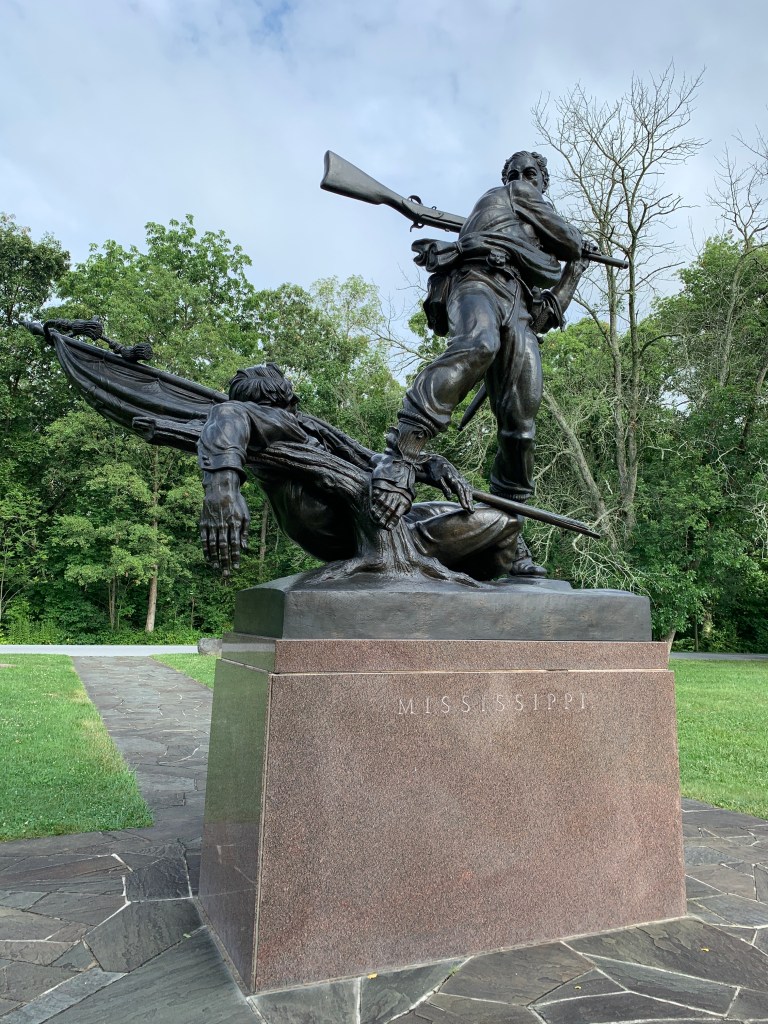
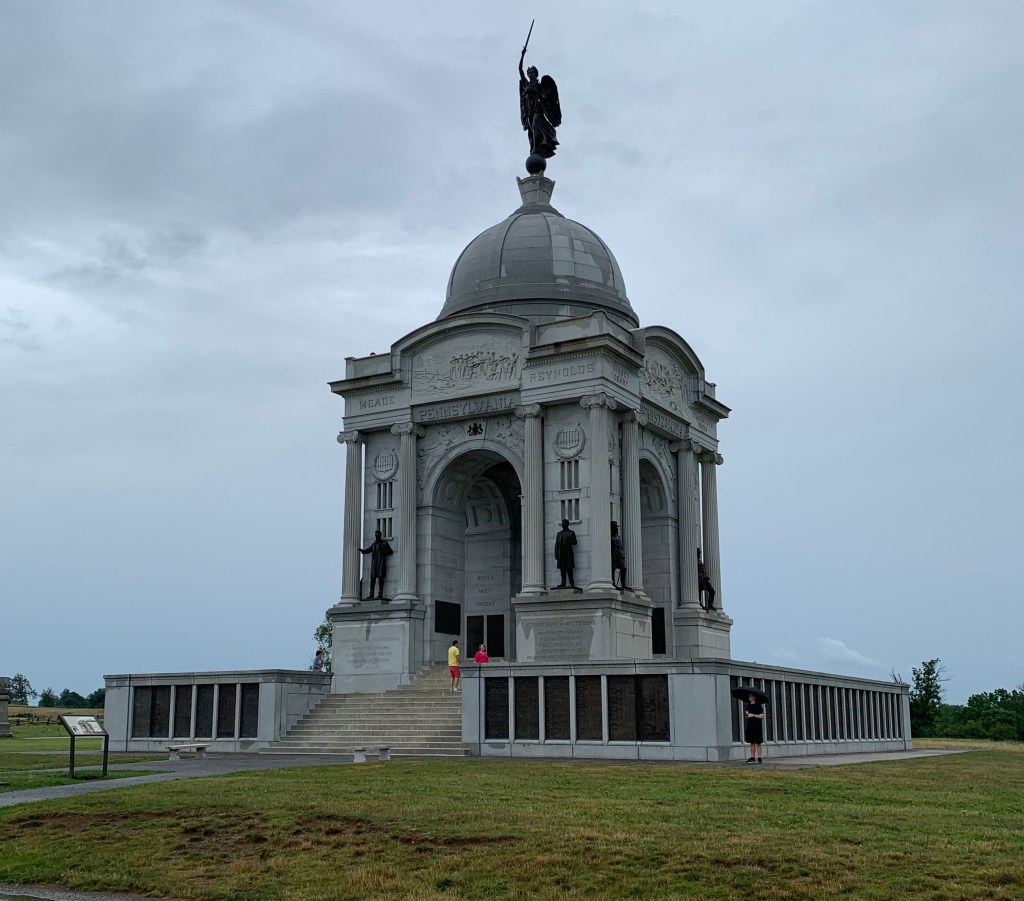
It was their second day in Gettysburg, Pennsylvania. After packing up from a rainy night at the local campground, Astrid and Snorri drove south on West Confederate Avenue, past dozens of cannons pointed east to where the Union Army had been mustered in the American Civil War, then past South Carolina’s war memorial, to park at Virginia’s war memorial, where a bronze General Lee sat on his bronze horse, overlooking the battlefield. They started down the grassy path mown between fields of soybeans, toward where the map said Pickett’s Charge was attempted. 

Astrid watched as Snorri strode on ahead of her, but she slowed down. It was not a common thing to visit a battle field in America, and she wanted, as the Gettysburg National Military Park guide encouraged, “to reflect and try to understand what happened here.” 

On that day, 158 years before, she would have found a much different landscape. It would have been strewn with the rotting corpses of Confederate soldiers, who had no one to bury them properly.  It would have been pock-marked with cannon craters, strewn with the wooden wreckage of military wagons, and dead horses. The three days of fighting had occurred on July 1,2 and 3, but the carnage and destruction would have been left for months afterward. 

The opposite of love is not hate, it is indifference. People often go to great lengths to stop a loved one from ruining their soul with evil. And so it was with the United States in the 1860s. Despite many other elements that incited the Civil War, the United States as a whole, which was  “conceived in Liberty, and dedicated to the proposition that all men are created equal*” needed to finally fulfill that declaration.

Frederick Douglass in An American Slave, and Booker T. Washington in Up From Slavery both expressed the horrific fact, which they experienced first hand: slavery is a dehumanizing evil, for all who are involved. It demoralizes and oppresses the enslaved, but absolutely hardens and corrupts the slave-holders, too**. 

War was the length the United States would go to correct this great evil and save the country from this sin of slavery; war against part of itself, its brothers, its family. It was, undeniably, hell. Astrid did feel gravity and meaning as she walked, but knew she could never understand the hell that was invoked on that ground 158 years before. But she did begin to understand some things. Like why Lincoln wanted to restore the Confederate States to the Union, not crush and isolate them. 

Grace, mercy, empathy, infatuation, desire, charity, tolerance, preference–many things can be called “love” and it can be insisted that all those definitions of love “win.” But in that park, walking on the ground consecrated by violence, blood, death and strife, combined the previous day’s experience of visiting all the monuments–Union and Confederate–Astrid was overwhelmed with the feeling that grace, truth and forgiveness win more often and more completely. 

To beat a foe because they are wrong, to stop them from evil acts, and then to extend a hand to lift them up and bandage their wounds is mercy and love. It is what Lincoln wanted (as Astrid understood the history). Separation, severe punishment and despair in beaten foes (as the world has seen in WWI & WWII), comes back to haunt the victor, it makes things worse, every time. And we have lived it. 

Astrid knew that to write this, in the margins of her map, while walking those fields, was easy, but to live it out in her personal life would prove more challenging. 

If one does not have an inkling of understanding of the depth and possibility of human depravity in oneself, of a potential inhumanity lying not-so-deep under our modern niceties and manners, one will not understand why there are hundreds of Confederate memorials in Gettysburg. A person might want them erased, because they lost, they were wrong, they must be punished by obliteration. But we must remember the hurt they caused, the humanity they denied, and the price America paid for it.

Every state that sent soldiers to the battle in Gettysburg has memorial there–from Mississippi, Florida, Arkansas, Texas on the Confederate side, to Maryland (both Union and Confederate soldiers fought), New York, Minnesota and Wisconsin on the Union side, just to name a few. The Confederate soldiers remembered by their memorials were fighting for a wrong cause, for states’ rights to enslave human beings, but they were our countrymen and that makes it all the more important that we remember: America loved its founding principals of freedoms and wanted them for all the inhabitants, to the point of war against itself. It is a tragedy worth trying to understand.  

If you have 5 minutes, go read the Gettysburg Address by Abraham Lincoln. It takes under two minutes to read, but it is one of the most poignant, powerful speeches in American History. 

***

*The Gettysburg Address, Abraham Lincoln, 1863

**I pity from the bottom of my heart any nation or body of people that is so unfortunate as to get entangled in the net of slavery.” -Booker T. Washington, Up From Slavery, Kindle Loc 312

Thus is slavery the enemy of both the slave and the slaveholder. … Slavery proved as injurious to her as it did to me. … Under its influence the tender heart became stone, the lamb-like disposition gave way to one of tiger-like fierceness.” An American Slave, by Frederick Douglass, Page 31-34 Yale University Press.

Walking in the Cold To See a Beautiful Thing

Iron Mountain Ski Jump Veterans Memorial Overlook

Astrid was in Iron Mountain, Michigan, a town in the Upper Peninsula of Michigan, just north of the Wisconsin border. The family was there to see Olaf for Thanksgiving. That day the family drove up to see the “Ski Jump” and Veterans Memorial, then came back to the apartment to watch movies and prepare Thanksgiving dinner. 

But Astrid needed exercise. Her genes forbade her from a life of sitting, and her mind kept whispering, “You need to take a walk.” To which she would whisper back, “I’m tired, in an unfamiliar town and I don’t want to.” Eventually, and by sheer mental will, she pushed these words out, “I’m taking a walk!” and left the apartment heading north. 

It was cold. Colder than where she lived. Not a hypothermia-is-an-imminent-threat kind of cold, but almost. Sparse snowflakes where flying out of the North, right into her face. Once outside, she had to make a decision: go see that beautiful thing that popped up on the map (a mile each way), or just take a short walk around the neighborhood? A cold, icy hike or a short jaunt? Beauty, or convenience and safety? 

She chose beauty. It was a longer walk, she didn’t know exactly where this beautiful thing was and would have to use GPS, but it was a small challenge in thousand different challenges she faced which she was excited to take. 

Like any good small Michigan town on a cold Thanksgiving day, no one was out and about. The quaint, small shops she passed were closed, only the gas stations were open. The cracked sidewalks–and this town was very good at having sidewalks along most of its roads–were patched with ice and snow. Astrid slipped and slid as she hurried along, and she had to hurry to get back in time to help complete the Thanksgiving meal. 

The sky was covered in sheets of blue-grey November clouds, the trees on the hillsides were brown in their winter clothes. Snow accumulated in corners and ledges as the wind blew the chill air down from the north. 

After zig-zagging through a grid of streets, she came to M-95, a four-lane road that crossed Chapin Mine Lake, with the nearby attraction (or horror, depending on who considers it) of Millie Hill Bat Viewing Area on the other side of it.  

Astrid cut across a closed Hardees parking lot to keep zig-zagging through the cozy neighborhood. Most houses had more than a few cars parked in the driveways–familes gathering for dinner. She watched as a dog was put out, but it quickly did its business and ran back inside. She passed an old school which was now apartments and a tired Italian restaurant or wine shop. She couldn’t be sure which it was.  

Finally, with chilled hands and wind-whipped hair, she saw it in the distance. Immaculate Conception of Our Lourdes Catholic Church. Info here It stood tall over the surrounding houses, with a meticulously groomed walled-garden area with a fountain in front. Astrid stopped for a second and took a picture, then a few more steps, another picture. 

Side of the Church

She walked around to the back, where a dome-topped tower stood flanked by doorways. 

The building shape and style in the front whispered of Spanish mission facade style, but its sturdy, native redstone blocks framed with a light brick reminded her of the Richardsonian Romanesque style, though a more architecturally informed person might disagree with her. The use of the rough, native redstone gave it a more rustic look, closer to nature than the all-white gothic church she had glimpsed while out driving earlier, which was closer to the apartment (and wasn’t as good a challenge to get to). 

The Back of the Church

All Astrid knew for certain was that she had found what she had set out to see, and it did not disappoint. It was beautiful to her eyes and mind and heart, for many reasons.  

She whispered a prayer of thanksgiving for being able to see something old, and to see it with new eyes, and new wonder, simply because she’d never seen it before.

Astrid did not know anything about the church before she decided to walk to it, but if she had done a little research, she would have found that she might have gone in to see the inside. She might have discovered that it was built by the local Italian immigrant families-with their own hands. But to see the outside was enough on that blistery day, and she walked away without even touching the native red stone of the sturdy walls.

In the history of the world that church was newcomer, a runt sized baby compared to the ancient architectural marvels in Europe. It was a small walk in a small corner of a land filled with a thousand different latent adventures of a thousand different magnitudes, but that day, she chose movement over comfort, beauty over convenience, and it did her heart good.  

The Dakotas: Storms

~4:30AM MDT: After a night of intermittent insomnia, Astrid lay awake, staring up at the ceiling of her tent. The weather reports indicated a good chance that a severe storm, with “golf-ball-sized hail” may heading for the family as they slept in their tents in The Badlands National Park. She spent the next hour imagining what golf-ball-sized hail would do to a tent or an unprotected person, and trying to find more accurate radar maps on her phone through a slow cell connection. Finally pushed to action, she woke Bjorn with an important question that had shot through her busy thoughts, “Is your camera still outside?” 

The camera was still outside, left there to gather star-trail photos until the battery ran out sometime in the night. Astrid told him about the possible storm coming their way. They woke Snorri and took a survey: stay and sit out the storm or pack up and get to the car ASAP?

They chose to pack up; it was much less messy that way. They made it out to the car by 6:00 AM MDT, in time to see a clear crimson sunrise. 

A few more “Looking and Waiting,” stops along the park road–notably free from storm–gave them time to eat a granola-bar breakfast before parking in the the Notch Trailhead Parking lot to wait as the storm moved in. Astrid drifted off to sleep while the rain–not hail–washed off the car dust onto the pavement. 

When the skies dried up and the sun came out, the family came out of their car, too and headed down the Notch Trail, now with an inch of gluey clay over all the ground. This trail weaved through rocky hills, and crevices, up a ladder to higher hills and overlooks with interesting geological formations. 

 When they arrived back at the parking lot and were walking to another trail, they passed a car with a soggy tent spread on the car hood to dry, and for once, Astrid was glad she wasn’t a heavy sleeper. 

For lunch, they followed the highways signs to Wall Drug, in Wall, South Dakota, famous for its legendary business model of offering tired, thirsty highway travelers “free ice water,” and a large selection of many other things–gew-gaws, food, souvenirs–for sale. It was crowded with people just like them, wanting to see the spectacle. 

“If we are going to get COVID, this will be the place,”’ Bjorn commented as they walked through the maze of little shops crowded with people that made up Wall Drug. 

On their way back to the park, where they would be staying that night (in a cabin), they stopped at one of the more obscure National Parks–Minuteman Missile National Historic Site. During the Cold War, hundreds of Minuteman nuclear missiles were hidden beneath the fields of the Mid-West. This particular missile site included three attractions: the actual missile silo site (with disarmed missile), the launch control site, disguised as a typical house, and the visitor center and museum. Both launch control and the missile silo were mostly underground. 

The launch control facilities controlled 10 missiles spaced about three miles apart. The family visited the visitor center and museum, then visited the missile site, but the control facility wasn’t open to visitors. One of these minutement missiles had the same power of 80 “Little Boys,” the bomb dropped on Hiroshima in WWII. In retrospect, the Cold War seemed distant, a little overwrought and unneeded, and hard to understand, but at the time, the threats and tension were real.

Back in The Badlands National Park, the family checked into a cabin at Cedar Pass Lodge, where they would spend the rest of the day, except Bjorn, who would head out at sundown to catch the sunset over the park. 

The storm that missed them that morning showed up that night. Astrid and Snorri watched it move in on a TV weather station radar map, and listened as the rain, wind and thunder intensified. Though Bjorn didn’t have good cell service, he knew there was a storm coming, because he took pictures of it approaching. He just didn’t know how bad it was going to be.

“I’m going to stay out here and wait until the storm passes over,” Bjorn called and told Astrid, the sound of violent pattering of rain making it hard for her to hear him on her end.

“Okay, be safe,” she said, thinking it was already storming where he was. But it wasn’t. He didn’t know the severity of the storm. She was in the middle of it, the wind and rain pounded the little cabin, the electricity flickered regularly, thunder shook the cabin windows. He just saw it in the distance.  

Bjorn returned later that night, in one piece and a little “impressed” by the violence of the storm he sat through. Despite the hail, the car was un-dented and whole, except for a cracked windshield they wouldn’t discover until they got home two days later. 

The Dakotas: Moving Against the Herd

Magnificent Dirt

The next morning the family checked out of their cabin and hit Custer State Park’s Wildlife Loop for sight seeing. 

“What is that?” Astrid leaned forward in her seat, squinting to better see what comprised the brown mass of things which was moving toward them on the highway. 

“Yeah, one of the websites for the park mentioned that this might happen.” 

“Are they … are they buffalo? Or is it bison? Why do Custer’s signs say, ‘buffalo?’ I’m gonna look this up when I get home. Are they walking in the road? That’s a lot of bison!” 

A expansive herd of bison, ranging in size from gigantic bulls to more reasonable-sized babies, was moseying up the road, spreading to the grassland on either side and coming right toward them. Bjorn slowed the car to a stop as the wave of dark brown hairy behemoths filtered around them and the other cars. The bison didn’t seem to mind the car traffic, they just went around, which gave Astrid an up-close look: they were all branded on their backsides and had weed burs in their furry hair. These were super-charged bovines, furry, muscley animals of a beautiful, rich dark brown. They were a little scary. 

Nomenclature

Teddy Roosevelt National Park used the term “bison” for these majestic bovine creatures. Custer State Park used the term “buffalo,” for the same animal. Scientifically speaking, the creature found in these areas are Bison bison. Yep, that’s their scientific name. They are very bisony. There are two subspecies in America: Bison bison bison, (Plains Bison) and Bison bison athabascae (Wood Bison).  Buffalo is a term usually used for “old world buffalo” like water buffalo or African buffalo. Custer State Park holds an annual Buffalo Roundup and Auction every fall. You could buy a bison, if you wanted. 

They watched and waited patiently as the herd moved past, because there was nothing else they could do. Some of the bulls walked off-road and kicked up clouds of dust as they rolled and frolicked. Once able to move the car again, they encountered feral (but really they were super-tame) burros standing in the road, waiting for some soft-hearted family to feed them. Onward up the road, after traveling through rolling prairies, they stopped at a small visitor’s center/museum and learned some things, then retraced their drive. By this time, the burros had flagged down a family and were eating bread and carrots from their hands. The burros are not native to the area, but were left to run wild after they lost their usefulness as pack animals.

On their way out of the park they drove past the giant herd of bison again, but this time the beautiful beasts were on a expansive hillside pasture, dark brown patches dotting the golden meadow. 

On the road to Wind Cave National Park, signs warned of “bison”because national parks have bison, state parks have buffalo. As named, the Wind Cave attraction was a cave, but since it included a closed-in ride in an elevator, it was closed, because COVID. So they took the mostly uphill Rankin Ridge Trail to a fire watchtower (but the watchtower was closed, because COVID), where, at the top, one could see 40 miles away to The Badlands National Park, the family’s next stop. 

Back on 90 East, Astrid started to notice some interesting signs … some advertised Free Ice Water, some advertised food, some, jewelry, some were for .05$ coffee, all from a place called Wall Drug. But before they could reach the famous store in Wall, South Dakota, they came to The Badlands National Park, where they would be camping for the night. 

Because COVID, the ranger pointed a credit card reader on the end of a stick at Bjorn for payment, and they traveled down a dusty road, along a canyon-type formation filled with hills of striated colors. It was hot, with temperatures reaching 100 degrees Fahrenheit as they moved along the bumpy road to stop at pull-offs for Bjorn to take pictures. It was the start of a day largely filled with Looking and Waiting

At the Pinnacles viewpoint off the Badlands Loop Road (240), they were mobbed again by the tiny, gnat-like biting insects. They swarmed anything white, including tee-shirts.

Looking and Waiting was a big part of their family trips. It was not a bad thing, but one must plan for it, by packing something to do while waiting in the magnificent landscapes Bjorn was immersing himself in, because just to be in these places was an extraordinary experience. Snorri usually packed electronic games. Astrid packed books, pens and notebooks. The previous night Astrid went to read her e-reader and … nothing. Something had happened which erased all her books out of her e-library (huge con for e-readers, pro for paper books). She had nothing but some pamphlets and papers from their previous stops to peruse. And that she did, as she waited for Bjorn to shoot and click at the magnificent dirt. 

As the sun snuck closer toward the western horizon, it was time to think about dinner and where they would spend the night. Backcountry camping was free in the park, allowed within some of the usual parameters: 1/2 mile off a trail or road, not visible from said road or trail. The Badlands National Park is a narrow strip of hilly, dry, gullied, unusable land in South Dakota, so there wasn’t a lot of choices. But they had coordinates from a hiking website. The strange decision was made to hike (without packs) out to the site to see if it really existed. With the help of spotty internet, GPS and after a few wrong turns down dead-end small canyons, they found it: a flat, almost cement like space just big enough for their tents, marked by big rocks in a medium sized canyon, backed on all three sides by high walls of rugged dirt hills. So they trudged back to the car, signed in at the trail head, got all their gear and went back to their little canyon. Astrid warmed and rehydrated some taco meat while Snorri put up the tents and Bjorn set up his tripod.

After eating and getting settled, Snorri and Astrid went to bed while Bjorn caught some night-time light. Lightning lit up the sky in the far distance and Astrid scoured her weather apps for the forecast. The park pamphlet and website had warned her: “Severe thunderstorms are common during the summer, so are days above 100ºF (38ºC). September and early October are the best backpacking months.” and “Sudden and dramatic weather changes are common. Visitors are urged to dress in layers and be prepared with hats, sunglasses, sunscreen, and adequate water for hiking.”

As the available forecasts indicated no rain or storms that night, she put away her phone and tried to sleep. Between wind gusts, it was eerily quiet in that little canyon, and warm. On the way in, she saw evidence of rabbits, but could believe that snakes frequented the area, too. Strange, night-time bird calls echoed in the breeze. Since sleep eluded her, Astrid dearly wanted to distract her mind with a story–any one would do–but her e-reader remained empty. She opened the Bible app on her phone and read a little, but didn’t want to run the battery down. 

If Astrid had slept that night, she didn’t know it. Bjorn came in from the dark after the shining moon rose, ruining his chances of good night sky pictures. Between staring up at the ceiling of her tent and reading snippets of the Bible, time passed in the dark and creepy quiet. At about 4:30 a.m. MDT, she decided to check the weather report. It hinted at something, close, maybe. Trying to figure out what city was closest, and/or what county they were in was a little challenging with spotty internet, but the skies were hinting at something too. “Golf-ball sized hail,” the weather report said.How could she deal with that in tents? They might have to get under their sleeping pads….