OR: Incomprehensible Giants

Olaf was home, working for the summer, and Snorri was in Florida with a friend for the week. They were kidless. Not since Astrid and Bjorn had traveled to Europe in 2000 had the stars aligned for them to take a trip together. It wasn’t much different than traveling with children; Astrid still worried about her sons, but couldn’t do much about it except call and leave messages or texts when she had cell phone coverage. 

After breakfast in the hotel, they traveled 101 south again, passing into California, but not before stopping at an agriculture checkpoint. 
 
“Any fresh fruit? Oranges? Apples?” the USDA officer asked. California was very zealous in protecting their agricultural industry from introduced plant diseases and harmful insects. 
 
 Bjorn had a banana which passed inspection and they carried on down the highway to Crescent City, California, weaving their way through narrow roads, hair-pin turns and over high bridges to Jedediah Smith Redwoods State Park. 

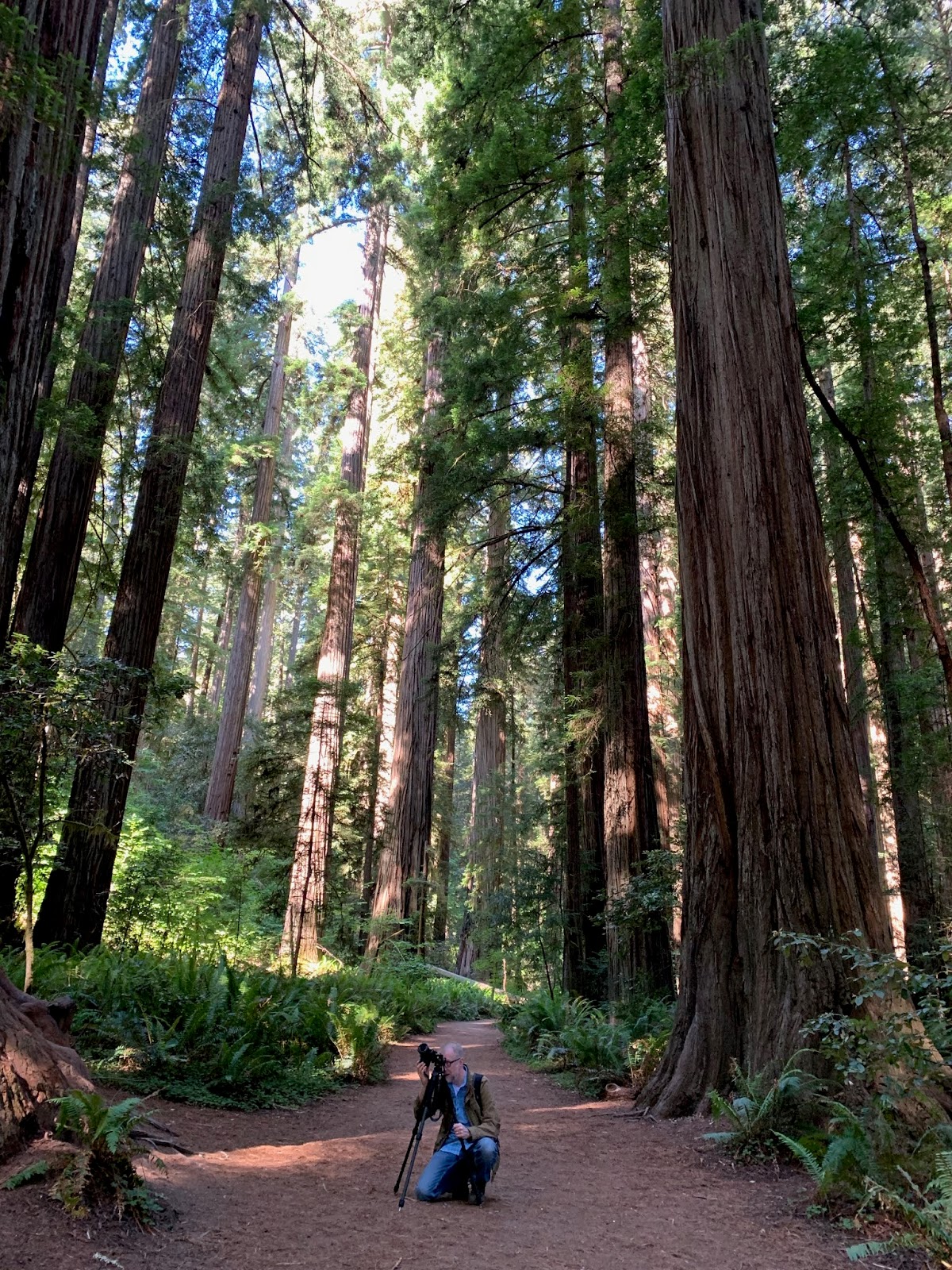
As they followed the winding road flanked with giant trees, she could feel her anticipation growing. It was like waiting to see a long-absent, beloved friend; a friend who you like because you can’t ever understand him completely, in a good-mysterious way. Astrid looked forward to seeing the giants again, to experiencing the unique awe and history ingrained in living wood. When they finally slipped through the narrow paths to a parking place between two giant trees, Astrid was already enthralled with her sylvan friends. 
 

It was a perfect day; sunny, and just warm enough to not notice the temperature. As Astrid walked down the path, she smiled. She had noticed that the farther she got into adulthood, “fun” lost its attraction, to the point where she could not define it for herself.  “What is “fun” anymore?” she asked. An inveterate bore, her sedate and nerdy list included: writing when creativity flowed, making things (excluding dinner), learning things, gaining a skill, hiking in woods, growing weird garden plants. 

Was visiting giant trees “fun”? No. Being around ideas and people and things that inspire awe was so much better than fun.

 
As they made their way through the paths, Astrid carried her notebook open, scribbling and glancing in front of her, so as not to trip; walking and writing to get all she needed in words before the effect wore off, always anxious for Bjorn to stop for a photo shoot. Her view was mostly of the prodigious brown-red trunks, because looking up risked falling over a root. 
 
Sorrel

Something was being said there in the park, to her, not with words, but with a presence of trees. It was not anything metaphysical or supernatural, but very natural, though she didn’t understand it, not in a way she usually understood things through reasoned thought via words, pictures, pieces of information. 

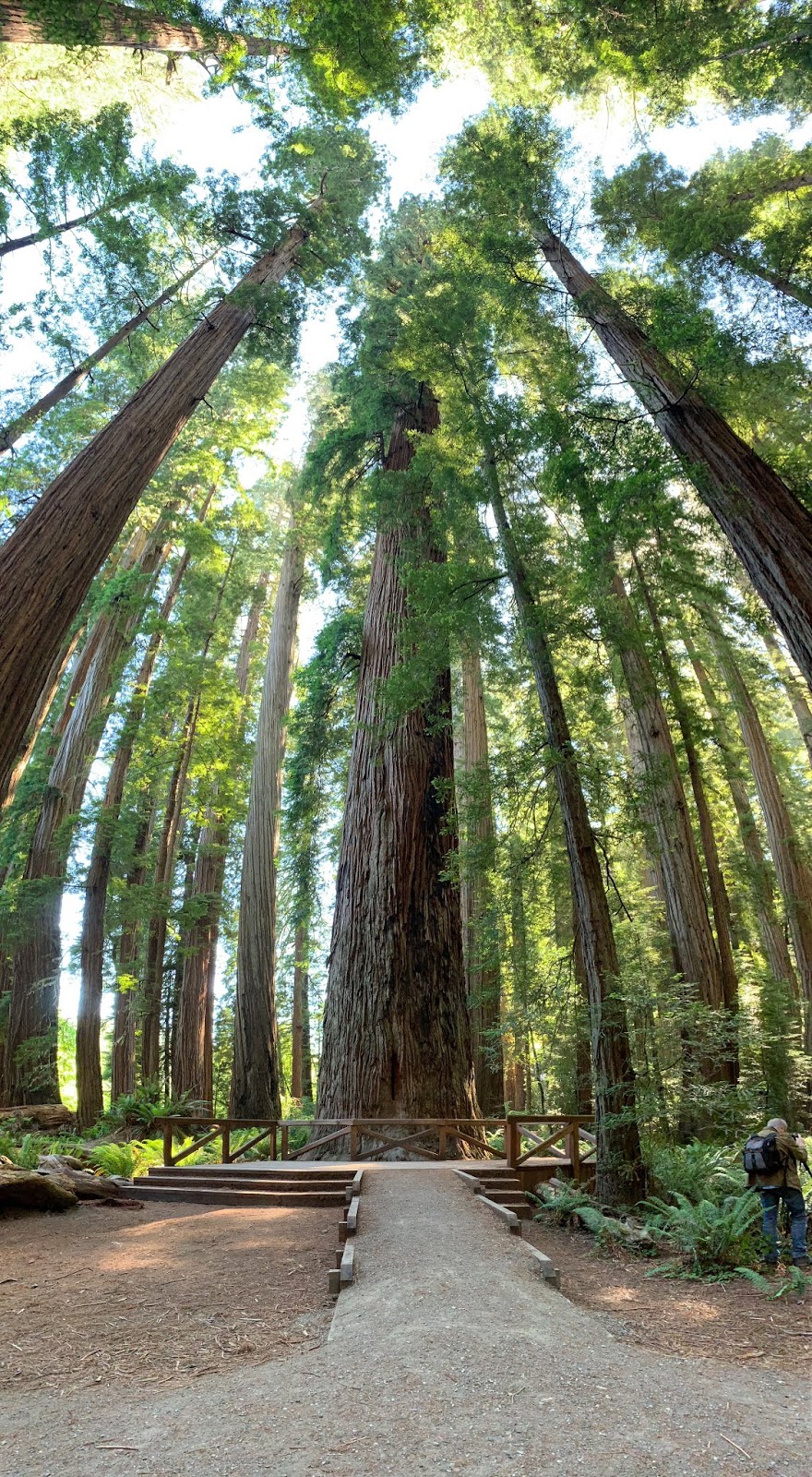
It was as if some giant form of alien life landed on this diminutive earth filled with tiny creatures and humans, and the trees decided to stay despite not fitting in. But as out-of-place, foreign, and over-big they seemed to Astrid, they felt … safe. Their intimidation lie in their beauty and size, but not in a threatening way. (Although, you can\’t deny the damage a tree that size would inflict if it fell.)

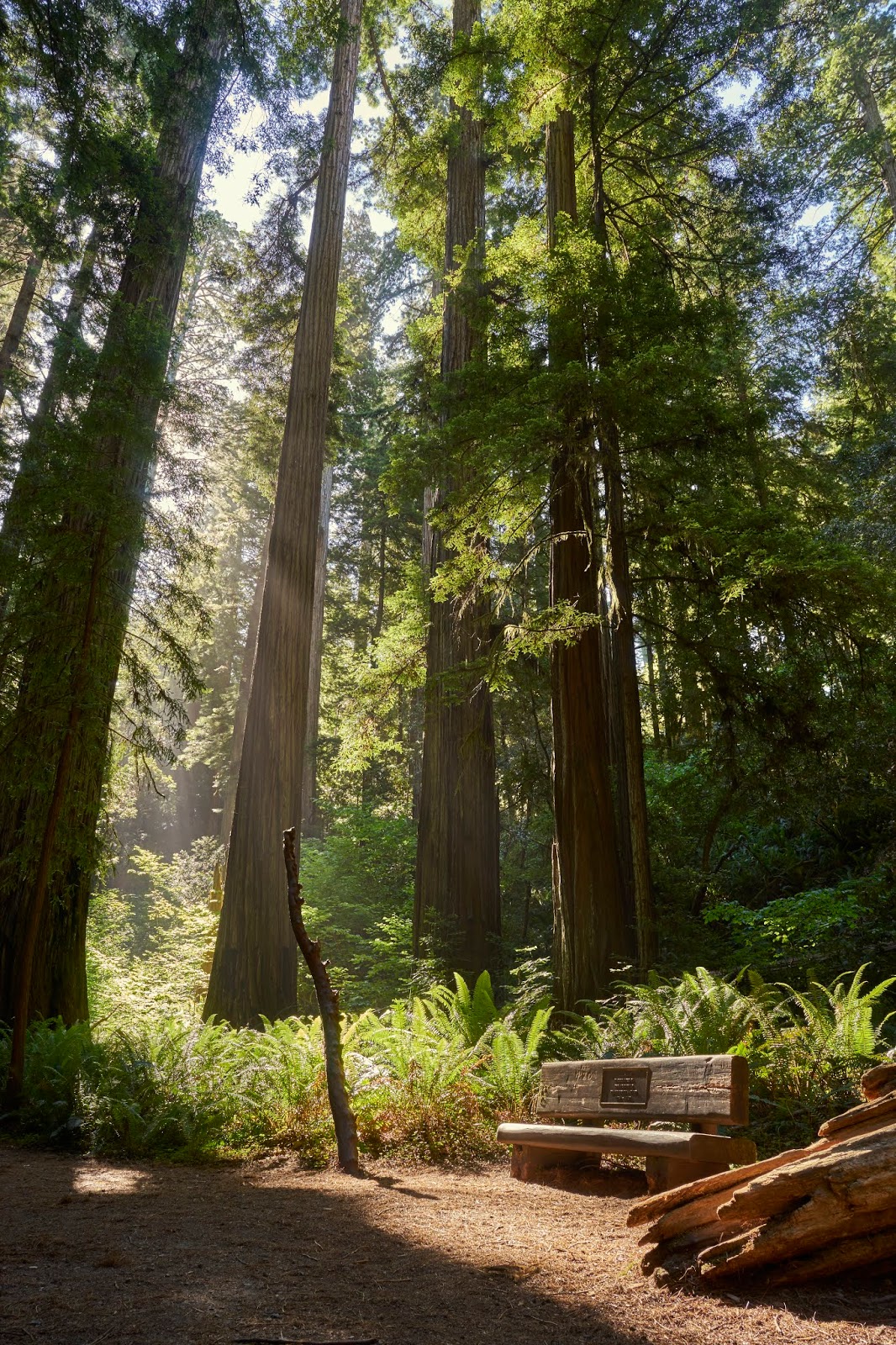
Not much grew under the trees, they were too tall and too massive to allow a lot of light to fall to the forest floor. The massive trees caught all the sun in their leafy fingers before it fell to the ground. There were patches of ferns and sorrel in the spots blessed by beams of sun that snuck through the branches. Moss grew on the lesser trees.
After walking about a mile, the path started to edge a running stream, the giants grew few and far between, their majestic aura thinned as well, into what was just an ordinary, yet still-beautiful Pacific Northwest forest. They turned back into the redwood forest.  

Walking silently, they looked up to see the tree tops, looking, looking, trying to take them all in, trying to understand, trying to keep and take away whatever these trees were saying. It was kind of like trying to see the whole mountain when you were climbing it. 

“Looking at pictures from last time (Sequoias), I realize, pictures just don’t do these trees justice,” Bjorn said between clicking the camera.  
***
“Holy cow, I look fat,” she mumbled a few weeks later when she saw a picture of herself taken in Oregon. “Well, I look … solid,” she softened the self-deprecation a little. How is it that our personal perspective of reality can differ so much from photographs? She knew she had never worn a thin or efficient body, but was surprised to see the abundance it portrayed in the picture.  
 
There is something about photographic technology that does not record the nuances that humans use to perceive each other, themselves, and their world. Maybe it involved other senses than seeing, maybe the fault was in the camera, maybe it was something else.
 
“But faces have a trick of growing more and more spiritualized and abstract in the memory, until nothing remains of them but a look, a haunting expression; just that secret quality in a face that is apt to slip out somehow under the cunningest painter’s touch, and leave the portrait dead for the lack of it.” Essays of Travel, Robert Louis Stevenson, page 145
 
It’s the same with redwood trees. Being near them adds so much more to just “seeing” them that it feels surreal. Otherwise, it’s just another picture of a tree. Unlike Astrid’s photo, trees usually looked smaller in pictures. 
 
***  
 
“Good morning,” a passerby whispered–and aptly. Whispers seemed most appropriate, as if the park were some very hallowed place. It was something about the trees–their majesty, power, age, achievements–which called for respect and reverence. The trees seemed to absorb the noise, shushing visitors to contemplation and peace.
 
To leave the park was a small heartache to Astrid, but they couldn’t stay forever, and she knew that even if she lived among them, she could never understand the spell they had over her. Better to preserve the mystery and awe, than overstay her welcome. 
 
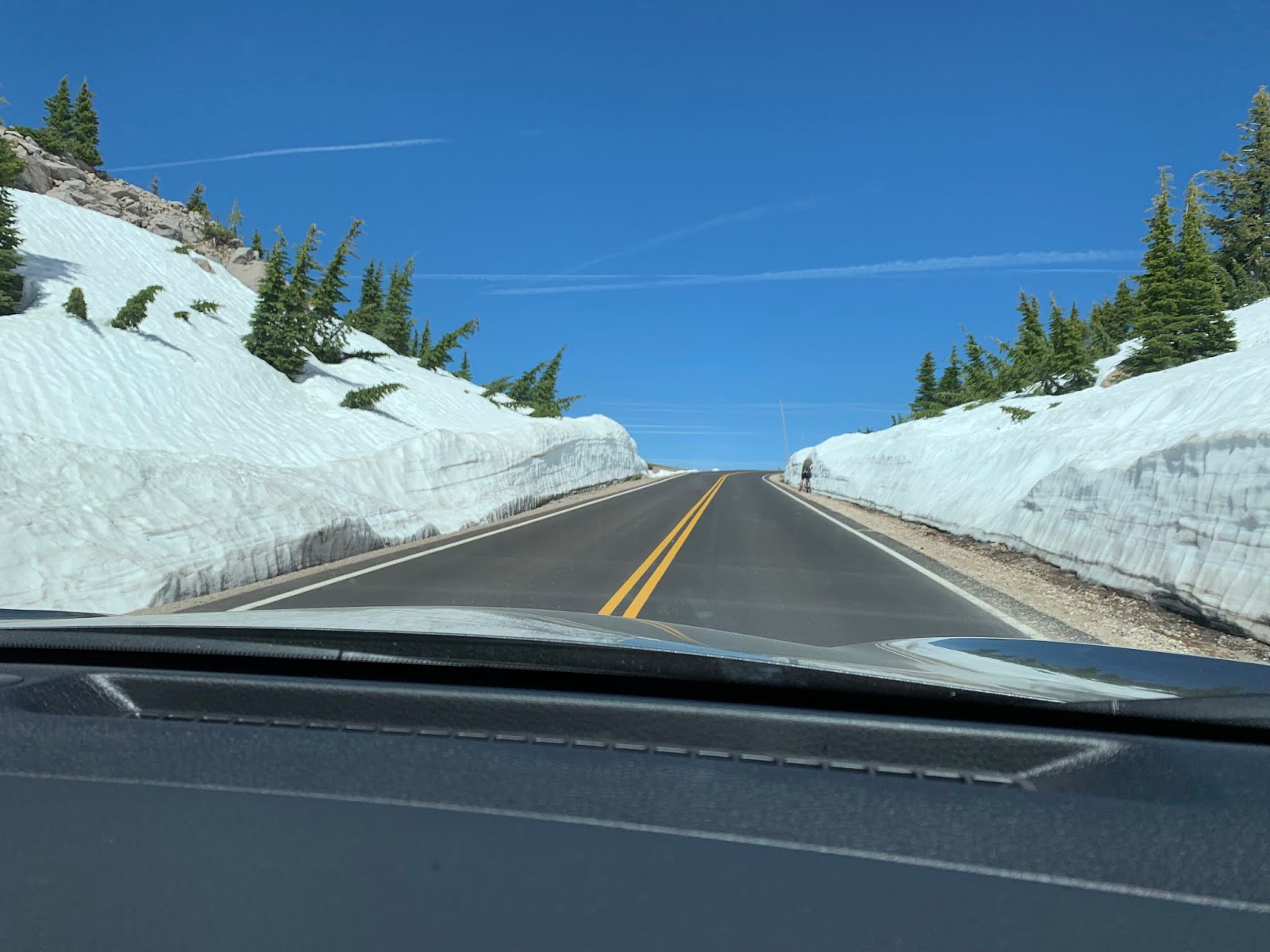
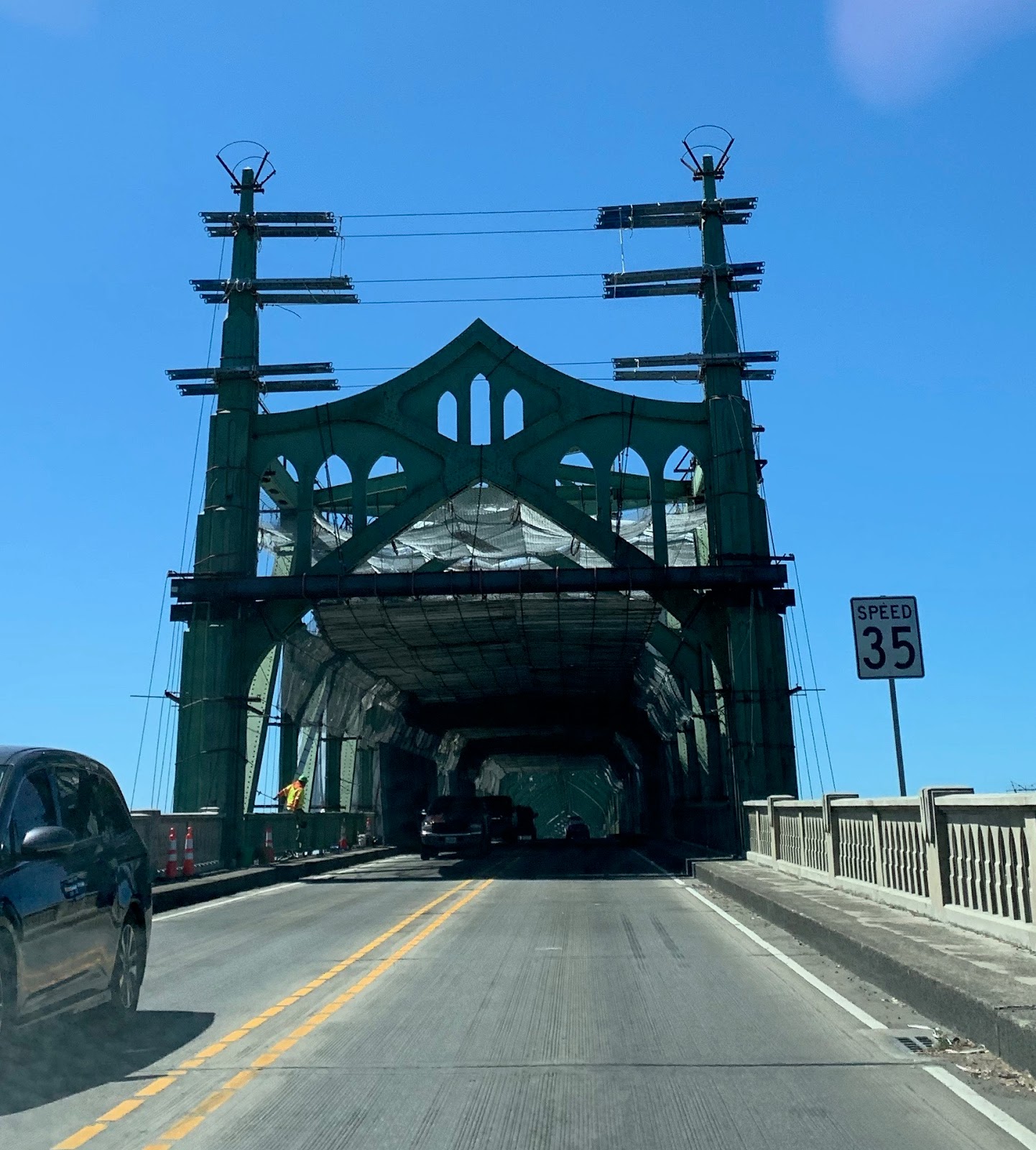
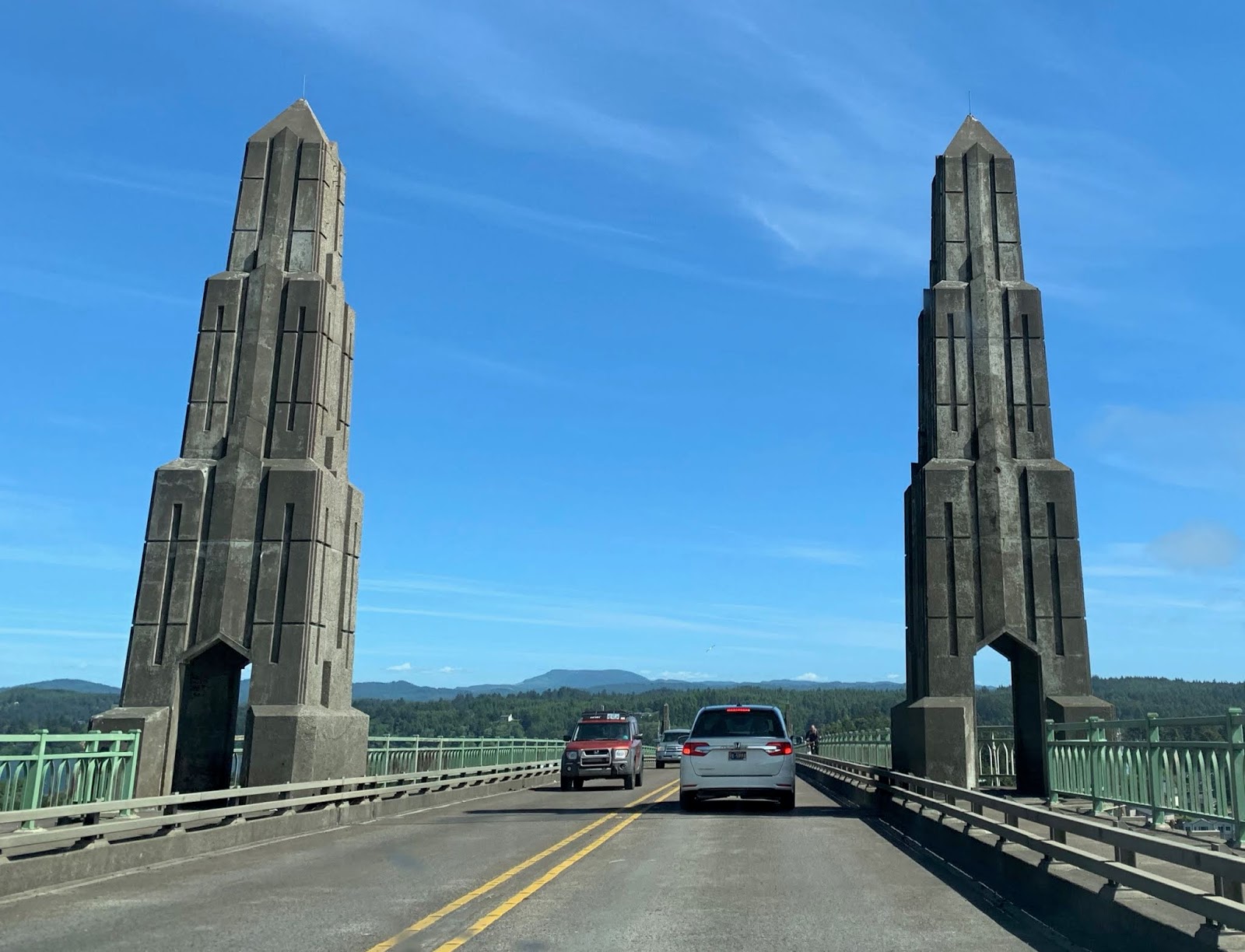
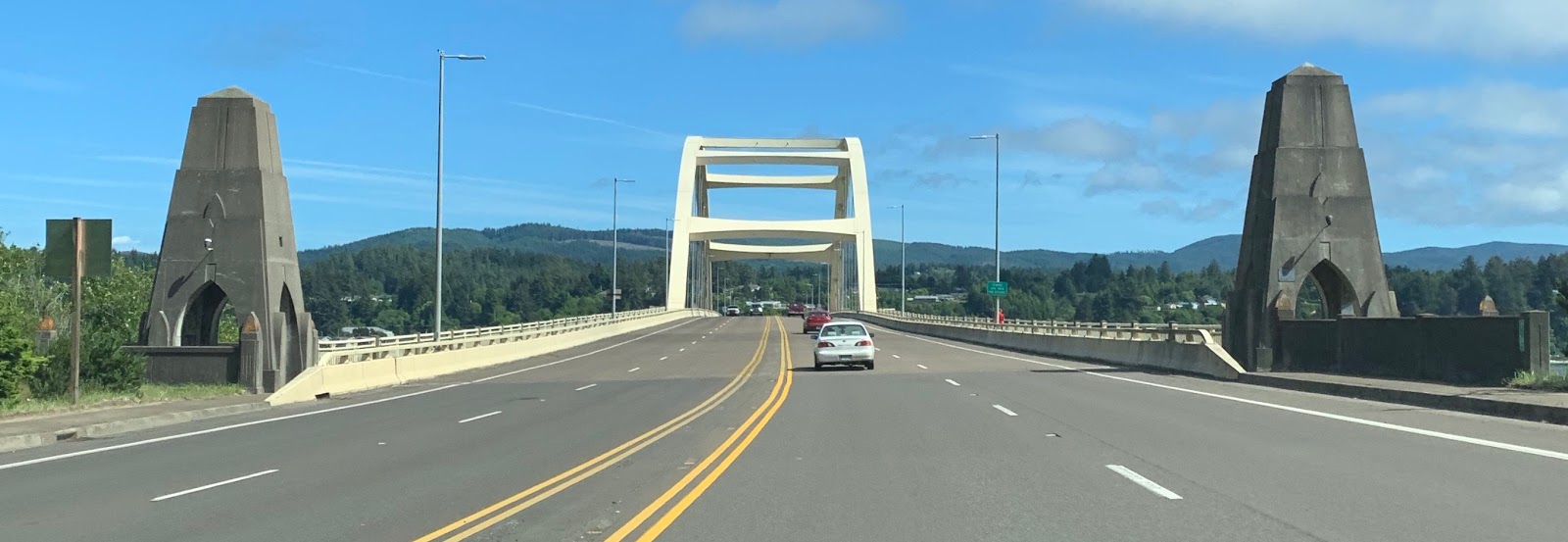
The two-hour drive to lunch through winding roads thread through mountains and small towns back into Oregon, always a tree lined “V” vista in front of them in a natural forced perspective. Oregon roads often lead the traveler over bridges, and many of the bridges had decorative columns at the ends, in the art-deco or gothic style. Every little town they passed through had a Family Dollar-type store, a Mom and Pop Coffee shop or coffee drive-through, and a dispensary. The farther north they traveled, the towns grew more scarce, but patches of snow more abundant, and fused into mountains of snow as they followed the road to Crater Lake National Park.  

OR: Thor's Well, and The Best Smell Ever


After settling into their AirBnB overlooking the ocean just outside Yachats, Oregon, Astrid and Bjorn drove into the town to eat clams and fish ’n chips at Luna Sea Restaurant, then headed out to Thor’s Well at Cape Perpetua Scenic Area.

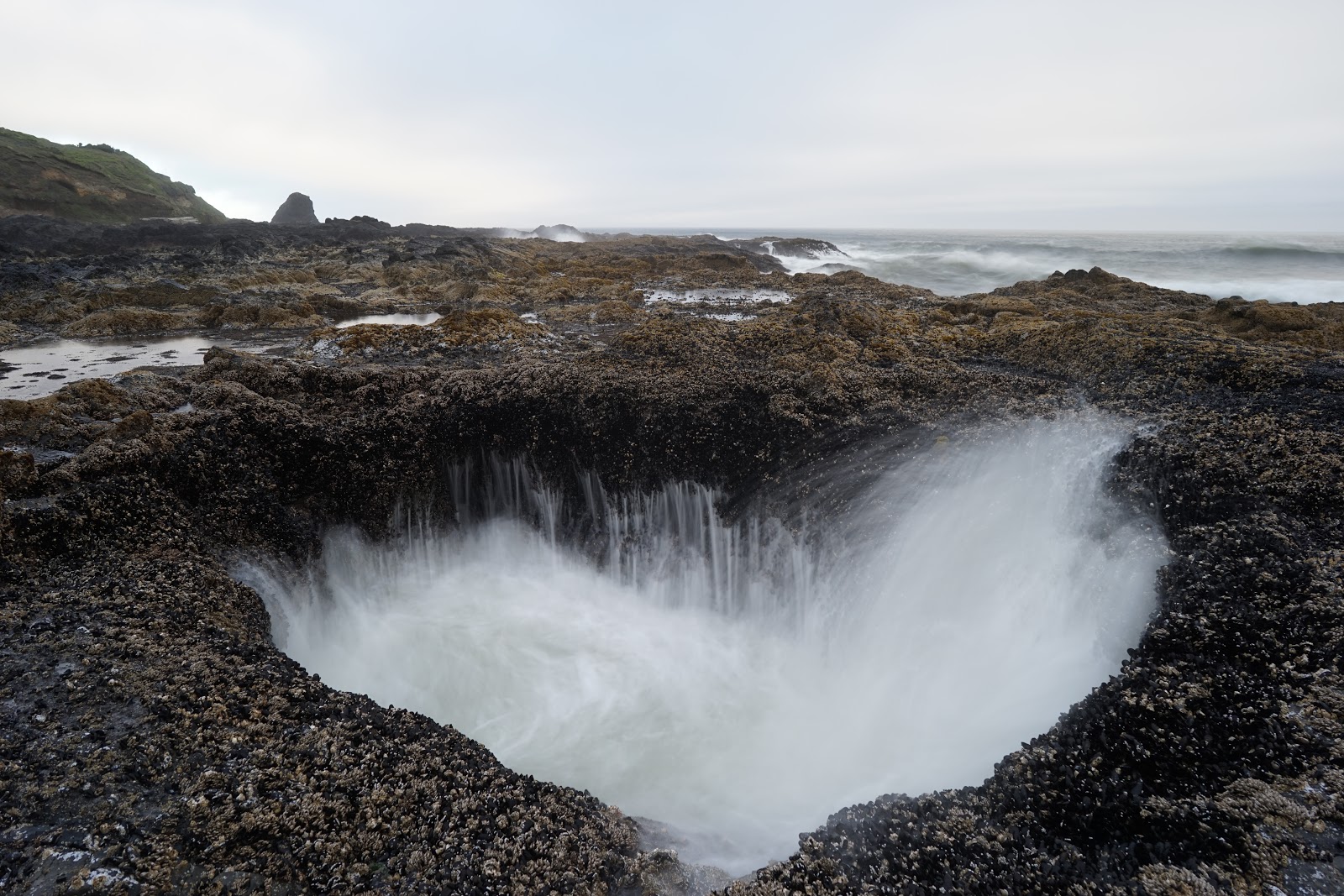
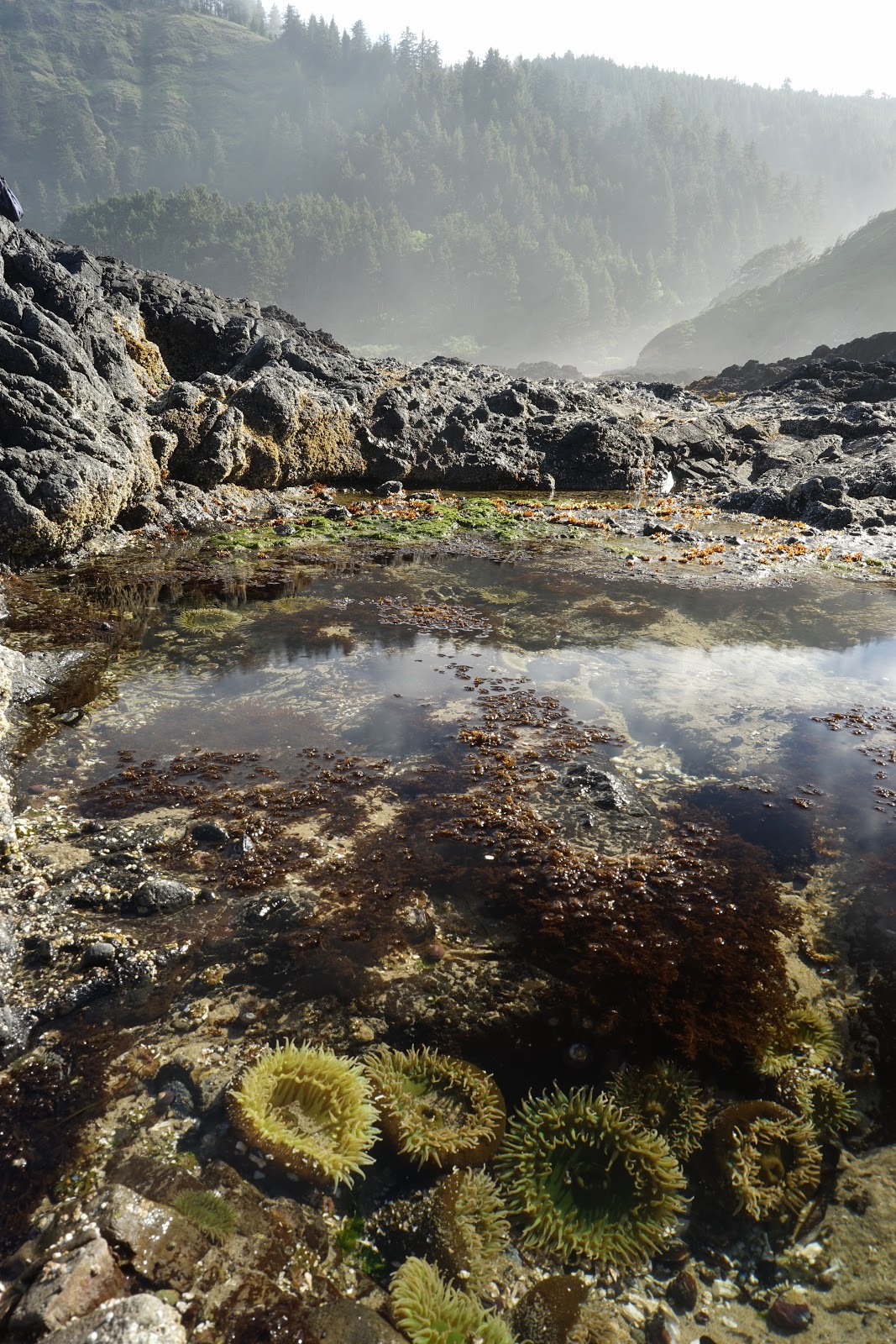
Astrid followed Bjorn over a plain of lava rock covered with barnacles, tiny clams, and a myriad of tidal pool life, to a rather circular hole in the rock bed.

“Thor’s Well has a hole in the side of it,” she said. Because it did.

Thor’s Well

But the moniker was sufficient. Half a dozen young women were standing around the stony void near the ocean edge before Astrid and Bjorn got there.  Situated down from a pull-off along 101 Oregon Coast Highway, it was a large hole in the stone, and a photographic-must. 

The sky was overcast, the wind rushed in from the ocean in chilly gusts. After about half an hour of watching Bjorn shoot pictures of the ocean waves playing in and out of the “well,” Astrid retreated to a warmer spot. 

Bjorn followed shortly, changed out lenses and gave her the keys to the car. 

“Don’t do anything stupid,” she yelled after him as he walked away toward the cold, raging sea. The ocean was waiting, grabbing at the rocks, which were covered with slippery spots, especially around the yawning cavern of Thor’s Well. 

As Astrid walked, she suddenly realized, “I don’t recognize this spot.” And sure enough, she had done something stupid and gotten lost. The path led her to a sand blow-out down to the beach again. She backtracked, found the right path, and arrived at the car just a few minutes before Bjorn. 

***

Green Salmon Coffee Co.

“What’s the schedule for today,” Astrid asked between sips of the very good house coffee at Green Salmon Coffee Co. the next day at breakfast.

“Tidal Pools, scenic highways, short hike,” Bjorn said. 

“It’s okay, all good. So much better than walking around a huge city any day.” 

“But  you give me that “Snorrie” look sometimes …” 

“Only when I’m freezing.  I have to be able to leave to go back to the car–and it was cold last night. Really though, I love being outside exploring new areas,” she reassured him. 

Before taking off back to Thor’s Well Beach, they put on more layers–all their layers. It was June, they expected a little warmth but found none on the wind-whipped ocean shores.  
Thor’s Well Beach


The morning sun was strong when they arrived back at Thor’s Well, a dozen tourists were walking gingerly over the volcanic and igneous rocks, combing the tidal pools for photographic fodder. Astrid had put on all her long sleeves and a hat and found a spot to sit and write and watch. 

*** 

Driving south on Oregon 101, they stopped in Bandon, Oregon and ate lunch at Tony’s Crab Shack, then took a sea-side walk on Bandon Beach in the sunny, but chilly weather. Astrid hid behind the gigantic rocks sticking out of the wet, flat beach. Walking on damp, flat sand was easy but the wind was whipping cold and raw, urging the visitors to take their pictures and leave as soon as possible. 

Thor’s Well Beach

In traveling, when the distraction of responsibilities and routines back in Michigan fell away and freed up space for luxuriant and random thought, Astrid always looked out for clues to the components of life–as if life were a math problem with addition, subtraction, division, multiplication, and the answer would unlock any conundrum she had. The wonder and thoughts rose from watching other people, how they looked, what showed on their faces, their actions, their words, their appearances. Strange and wonderfully new landscapes helped draw her attention to environmental influences on how people lived.  


Astrid mused that if the coast in Florida looked and acted like the one she saw in Oregon–rocks, cliffs, yes, patches of sand, but few and far between–not so many people would live there and want to vacation there. Also, it was cold.

At some point when driving south, Oregon 101 turned into the Samuel H. Boardman State Scenic Corridor, with many “view-point” pull-off-type areas. 

“Being an amateur writer, the use of the word ‘view-point’ in this instance is interesting. When we were in California in 2014, they used the word “turn-out,” Pennsylvania uses “scenic overview.” Interesting that there’s not a universally used word for it,” Astrid noted.  

A View on the Hike

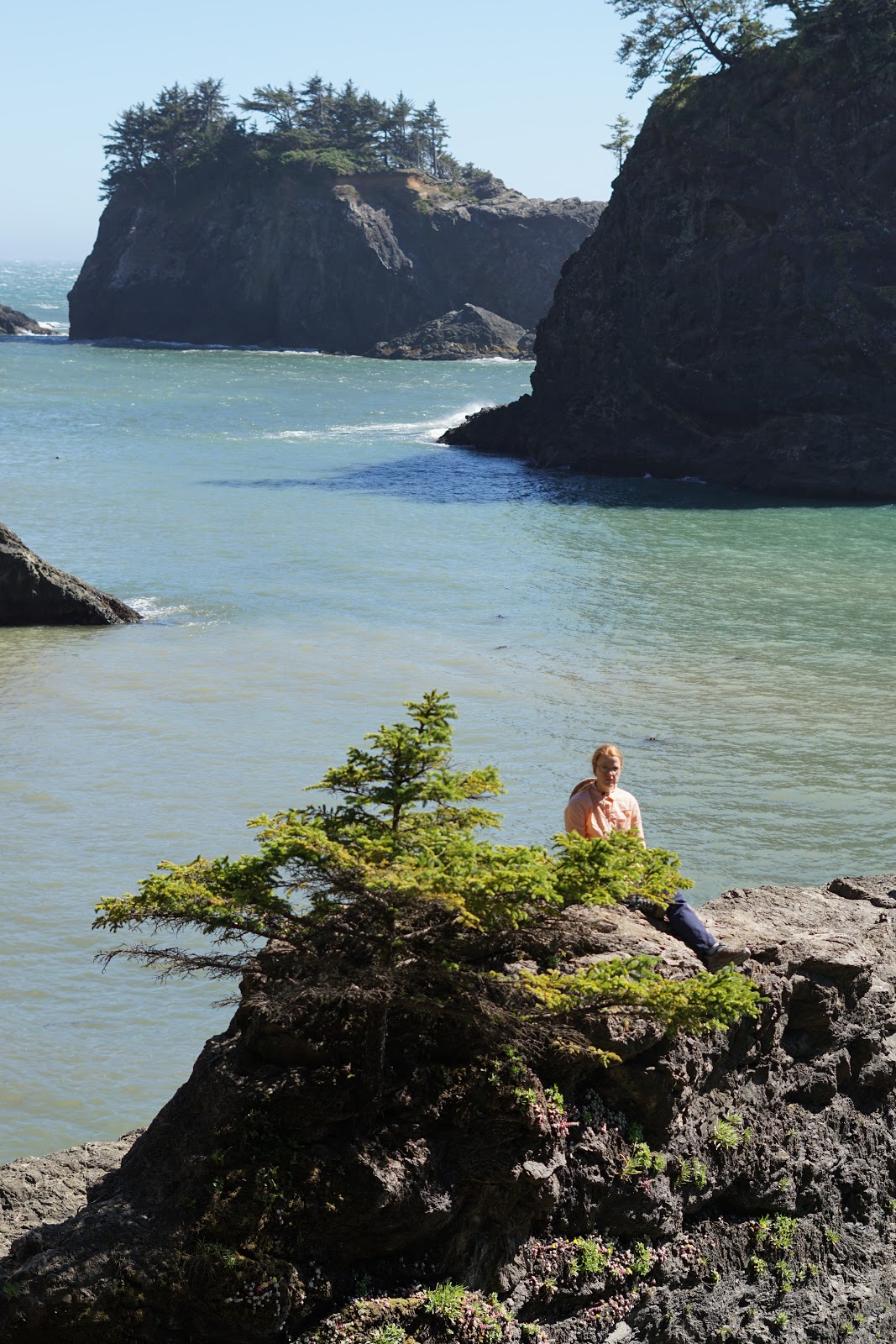
The first stop was at Secret Beach, down a trail through exquisite woods, streams, and moss everywhere. They came out on a ledge of rock overlooking a beach squeezed between two pillars of rock. 


***

The Best Smell Ever 

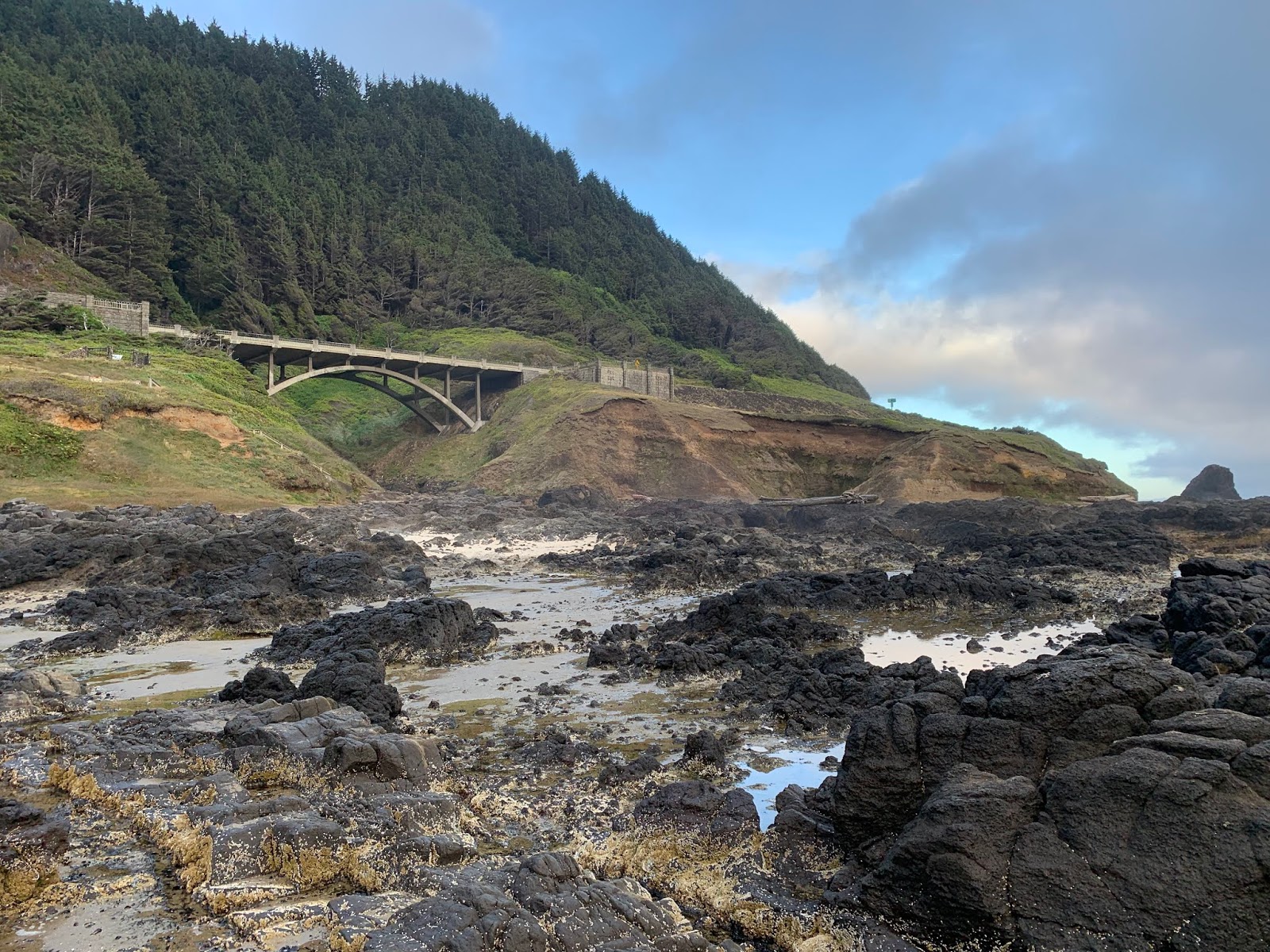
At the Thunder Rock Cove View Point, Astrid and Bjorn took a trail that undulated on the curves and rocks of the lush, coastal forest, up and down small hills, then down, down, down. 

“No, no this isn’t it ….” Bjorn said, stopping to look around. He wanted to get a sun-setting-type picture through the sparse crowd of tall rocks scattered along the coast at that spot. 

So they turned around and backtracked, Astrid pausing at an extraordinary sensory experience, but then jogged to catch up to Bjorn at a small bridge. 

“I think it’s this way, the path to get down there,” Bjorn offered. 

There was a path, yes, faint through underbrush, with dead stumps, rocks and inclines that were not meant for humans to traverse. After failing to get to where they wanted to be, they tried the first trail again, but this time Bjorn stopped at the top of a small hill. 

“Wow,” he said and inhaled. “There is a really good smell here.” 

A Boulder on Secret Beach

“Yes! I smelled it on the way in … it’s right in one spot …” Astrid joined him in the area, inhaling the fragrance. 


It was a singular spot of concentrated forest aromatics, like a swarm of gnats, but an aroma. The sun cut through the canopy of coastal cedar-like trees, allowing the evening sun to warm the otherwise cool salty sea-air, and mixed with the ageless composted tree-dirt particles to make an aromatic and singularly attractive experience. Astrid walked back and forth in the aromatic cloud, noting the edges of where it began and ended, trying to decipher what it was. It was concentrated Pacific Coast Forest scent, and it was divine. 

“I wish we could take it with us,” Bjorn said.

“You can’t take a picture of that,” Astrid said. 

 After checking into the hotel in Brookings, Oregon, they had dinner at Oxenfree Public House restaurant in the town, a restaurant that knows how to fill stomachs with very good food. 

p.p1 {margin: 0.0px 0.0px 0.0px 0.0px; font: 12.0px Georgia; color: #000000; -webkit-text-stroke: #000000}
p.p2 {margin: 0.0px 0.0px 0.0px 0.0px; font: 12.0px Georgia; color: #000000; -webkit-text-stroke: #000000; min-height: 14.0px}
p.p3 {margin: 0.0px 0.0px 0.0px 0.0px; text-align: center; font: 12.0px Georgia; color: #000000; -webkit-text-stroke: #000000}
span.s1 {font-kerning: none}

Because of fatigue Astrid stayed at the hotel while Bjorn went back to Thunder Rock Viewpoint on a night excursion-hike to the Natural Bridge beach for evening photos. 
Secret Beach/Thunder Rock Cove

Thanks for Reading!

OR: Thor’s Well, and The Best Smell Ever

 
After settling into their AirBnB overlooking the ocean just outside Yachats, Oregon, Astrid and Bjorn drove into the town to eat clams and fish ’n chips at Luna Sea Restaurant, then headed out to Thor’s Well at Cape Perpetua Scenic Area.

Astrid followed Bjorn over a plain of lava rock covered with barnacles, tiny clams, and a myriad of tidal pool life, to a rather circular hole in the rock bed.
 
“Thor’s Well has a hole in the side of it,” she said. Because it did.
Thor\’s Well
But the moniker was sufficient. Half a dozen young women were standing around the stony void near the ocean edge before Astrid and Bjorn got there.  Situated down from a pull-off along 101 Oregon Coast Highway, it was a large hole in the stone, and a photographic-must. 
 
The sky was overcast, the wind rushed in from the ocean in chilly gusts. After about half an hour of watching Bjorn shoot pictures of the ocean waves playing in and out of the “well,” Astrid retreated to a warmer spot. 
 
Bjorn followed shortly, changed out lenses and gave her the keys to the car. 
 
“Don’t do anything stupid,” she yelled after him as he walked away toward the cold, raging sea. The ocean was waiting, grabbing at the rocks, which were covered with slippery spots, especially around the yawning cavern of Thor’s Well. 
 
As Astrid walked, she suddenly realized, “I don’t recognize this spot.” And sure enough, she had done something stupid and gotten lost. The path led her to a sand blow-out down to the beach again. She backtracked, found the right path, and arrived at the car just a few minutes before Bjorn. 
 
***
Green Salmon Coffee Co.
 
“What’s the schedule for today,” Astrid asked between sips of the very good house coffee at Green Salmon Coffee Co. the next day at breakfast.
 
“Tidal Pools, scenic highways, short hike,” Bjorn said. 
 
“It’s okay, all good. So much better than walking around a huge city any day.” 
 
“But  you give me that “Snorrie” look sometimes …” 
 
“Only when I’m freezing.  I have to be able to leave to go back to the car–and it was cold last night. Really though, I love being outside exploring new areas,” she reassured him. 
 
Before taking off back to Thor’s Well Beach, they put on more layers–all their layers. It was June, they expected a little warmth but found none on the wind-whipped ocean shores.  
Thor’s Well Beach


The morning sun was strong when they arrived back at Thor’s Well, a dozen tourists were walking gingerly over the volcanic and igneous rocks, combing the tidal pools for photographic fodder. Astrid had put on all her long sleeves and a hat and found a spot to sit and write and watch. 
 
*** 
 
Driving south on Oregon 101, they stopped in Bandon, Oregon and ate lunch at Tony’s Crab Shack, then took a sea-side walk on Bandon Beach in the sunny, but chilly weather. Astrid hid behind the gigantic rocks sticking out of the wet, flat beach. Walking on damp, flat sand was easy but the wind was whipping cold and raw, urging the visitors to take their pictures and leave as soon as possible. 
 
Thor’s Well Beach

In traveling, when the distraction of responsibilities and routines back in Michigan fell away and freed up space for luxuriant and random thought, Astrid always looked out for clues to the components of life–as if life were a math problem with addition, subtraction, division, multiplication, and the answer would unlock any conundrum she had. The wonder and thoughts rose from watching other people, how they looked, what showed on their faces, their actions, their words, their appearances. Strange and wonderfully new landscapes helped draw her attention to environmental influences on how people lived.  

 
Astrid mused that if the coast in Florida looked and acted like the one she saw in Oregon–rocks, cliffs, yes, patches of sand, but few and far between–not so many people would live there and want to vacation there. Also, it was cold.
 
At some point when driving south, Oregon 101 turned into the Samuel H. Boardman State Scenic Corridor, with many “view-point” pull-off-type areas. 
 
“Being an amateur writer, the use of the word ‘view-point’ in this instance is interesting. When we were in California in 2014, they used the word “turn-out,” Pennsylvania uses “scenic overview.” Interesting that there’s not a universally used word for it,” Astrid noted.  
 
A View on the Hike

The first stop was at Secret Beach, down a trail through exquisite woods, streams, and moss everywhere. They came out on a ledge of rock overlooking a beach squeezed between two pillars of rock. 

 
***

The Best Smell Ever 
 
At the Thunder Rock Cove View Point, Astrid and Bjorn took a trail that undulated on the curves and rocks of the lush, coastal forest, up and down small hills, then down, down, down. 
 
“No, no this isn’t it ….” Bjorn said, stopping to look around. He wanted to get a sun-setting-type picture through the sparse crowd of tall rocks scattered along the coast at that spot. 
 
So they turned around and backtracked, Astrid pausing at an extraordinary sensory experience, but then jogged to catch up to Bjorn at a small bridge. 
 
“I think it’s this way, the path to get down there,” Bjorn offered. 
 
There was a path, yes, faint through underbrush, with dead stumps, rocks and inclines that were not meant for humans to traverse. After failing to get to where they wanted to be, they tried the first trail again, but this time Bjorn stopped at the top of a small hill. 
 
“Wow,” he said and inhaled. “There is a really good smell here.” 
 
A Boulder on Secret Beach

“Yes! I smelled it on the way in … it’s right in one spot …” Astrid joined him in the area, inhaling the fragrance. 

 
It was a singular spot of concentrated forest aromatics, like a swarm of gnats, but an aroma. The sun cut through the canopy of coastal cedar-like trees, allowing the evening sun to warm the otherwise cool salty sea-air, and mixed with the ageless composted tree-dirt particles to make an aromatic and singularly attractive experience. Astrid walked back and forth in the aromatic cloud, noting the edges of where it began and ended, trying to decipher what it was. It was concentrated Pacific Coast Forest scent, and it was divine. 
 
“I wish we could take it with us,\” Bjorn said.
 
“You can’t take a picture of that,” Astrid said. 
 
 After checking into the hotel in Brookings, Oregon, they had dinner at Oxenfree Public House restaurant in the town, a restaurant that knows how to fill stomachs with very good food. 
Because of fatigue Astrid stayed at the hotel while Bjorn went back to Thunder Rock Viewpoint on a night excursion-hike to the Natural Bridge beach for evening photos. 
Secret Beach/Thunder Rock Cove
Thanks for Reading!

Giant Animals, Mammoth Caves, and Mega Caverns


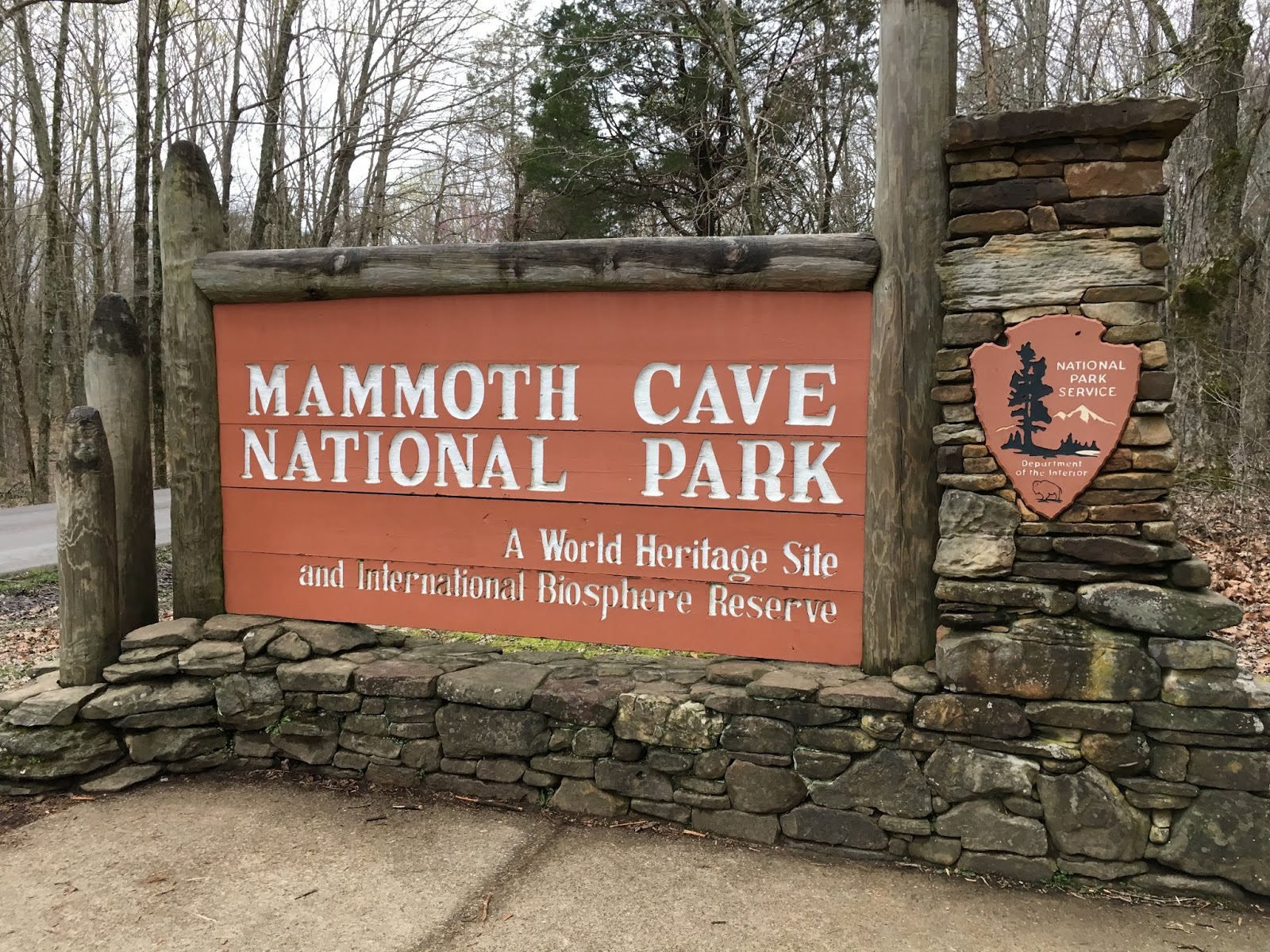
The family drove about five hours south on US 31 to Barren County, Kentucky, to Mammoth Cave National Park and took a tour of the caves. Then they took two more the next day. It was interesting.

There is one element of advice I gleaned  from the travel writing section of a “How to Write” book, which I try to utilize when writing this blog. The advice is that travel writing, to be more than a guide book, must have a soul, it must tell of a connection-or disconnection-of the author and her experiences in the place to which she travels. It must illustrate the mark it leaves, or fails to leave on the writer’s perceptions. To be the least bit interesting, it should be personal. 

Many times as I re-read these travel blogs, I am repeatedly appalled by 1) the typos and grammar mistakes, 2) at times, the drudgery-filled tedium of trying to record every move and stop and thought, and 3) the fascinating writing which shines, like tiny pins of light, through the expanse of word-tedium. 

My goal, in every case, however true I keep to it, is to avoid giving the reader a dry, running commentary on what, where, and how, but to present a vision of travel-however mundane, domestic or international-through my faulty perspective. Sure, it may be a helpful read if you want to go where I have gone, but there are shorter, easier-to-read guides on the internet. 

It is almost 2020 and I find myself with no blogs ready to publish about my travels from 2019. I have started three or four times, trying to capture the right angle, begin with a bang or a whimper …  but alas … nothing yet. I am determined to write about my 2019 travels, if only in small one-page vignettes of my experiences, because although my inspiration may not have been strong, nor the impressions I took away significant, Bjorn composed some great pictures that will say what I felt much better. So, let’s try this again. 
 
Giant Animals, Mammoth Caves, and Mega Caverns 
 
“Oreo cows!” Astrid exclaimed as they traveled south on US 31. She pointed and yelled it again, a little louder so Snorri would hear through his headphones. There was a herd of cows grazing the newly green grass of an Indiana highway-side pasture, their black fronts and black back-ends sandwiching their pure-white midsections. The family rarely drove this highway, so Astrid kept an eye out for new and interesting sights. Oreo cows were a relatively exciting visual find. Snorri glanced back with a bored expression. 
 
“What? You don’t see black and white cows like that every day,” Astrid said.  
 
A half-hour or so down the road, another visual treasure popped up. 
“A giant chicken … rooster? Yes, rooster,” Astrid exclaimed again and tried frantically to find her phone to take a poor picture of the oversized cement poultry as they sped by.  Probably a chicken farm, she thought. She had stopped trying to get Snorri or Bjorn in on the roadside hunt. 
 
For years before this, Astrid would suggest Mammoth Cave National Park as a destination, but it always lost out to other choices. But now, it was the last few days of Spring Break 2019 and they were headed to tour the many large empty spaces Mother Nature had carved out under western Kentucky. 

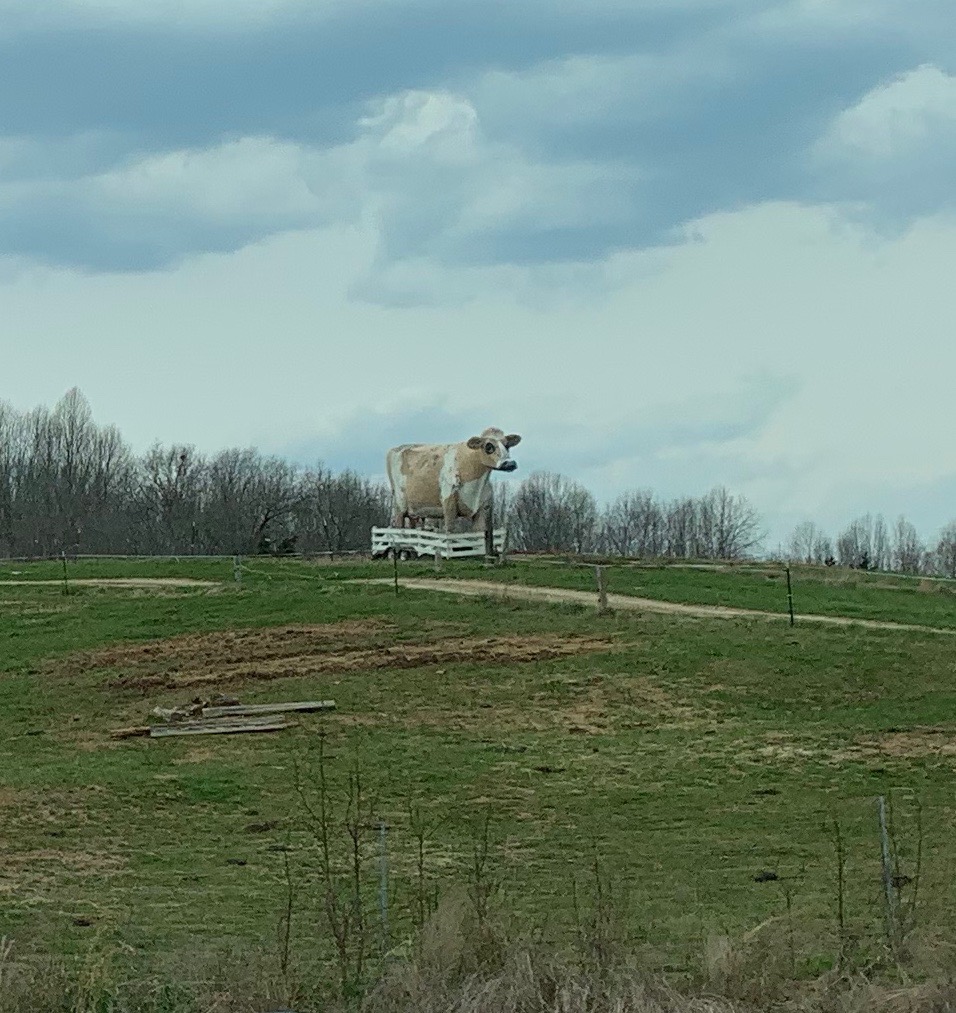
“Aaaand a giant cow …” she said out loud as they passed a giant cement bovine. “I’m sensing a pattern here. Giant animals.” 
 
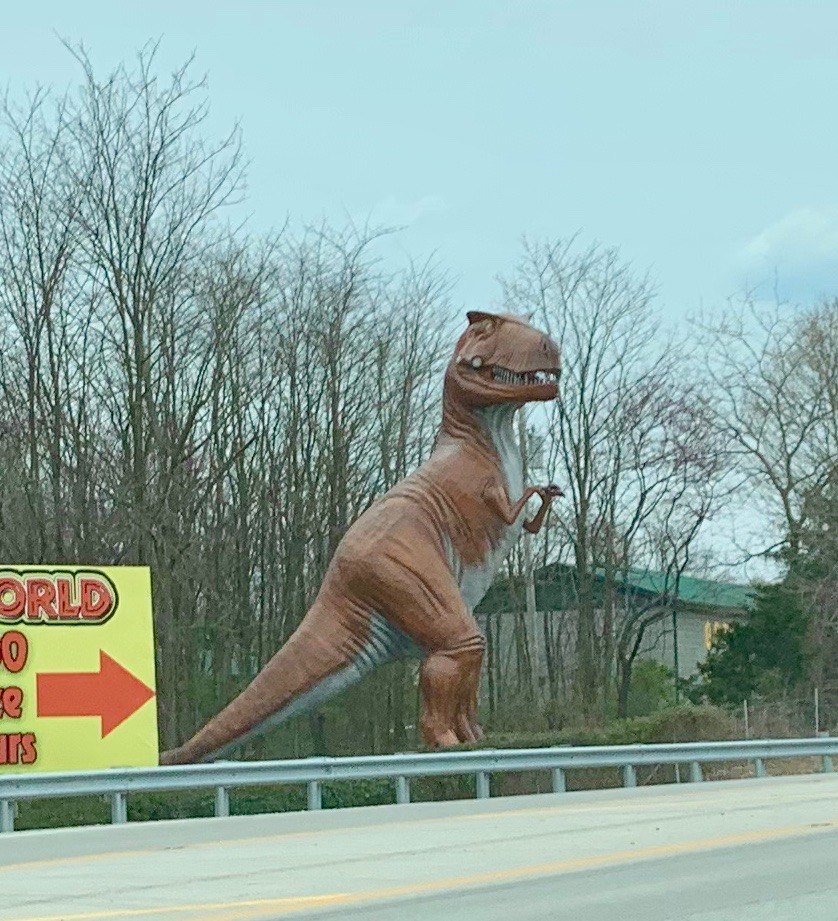
The visual theme did not end when they turned off Highway 65 South at Cave City, Kentucky, and headed toward Mammoth Cave National Park. A few yards down the road, gigantic cement dinosaurs heralded the existence of Dinosaur World, a dinosaur-themed amusement attraction nearby. 


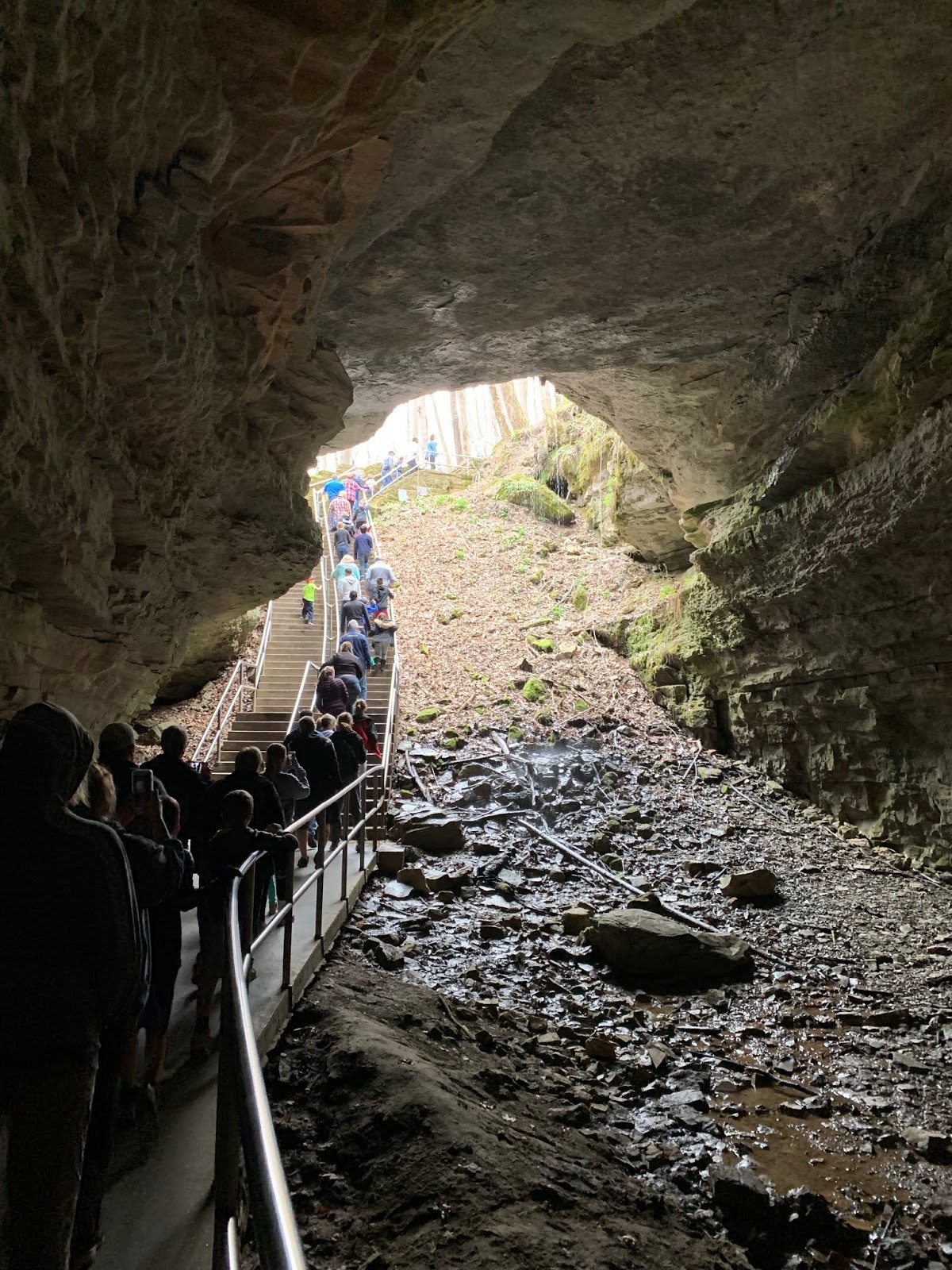
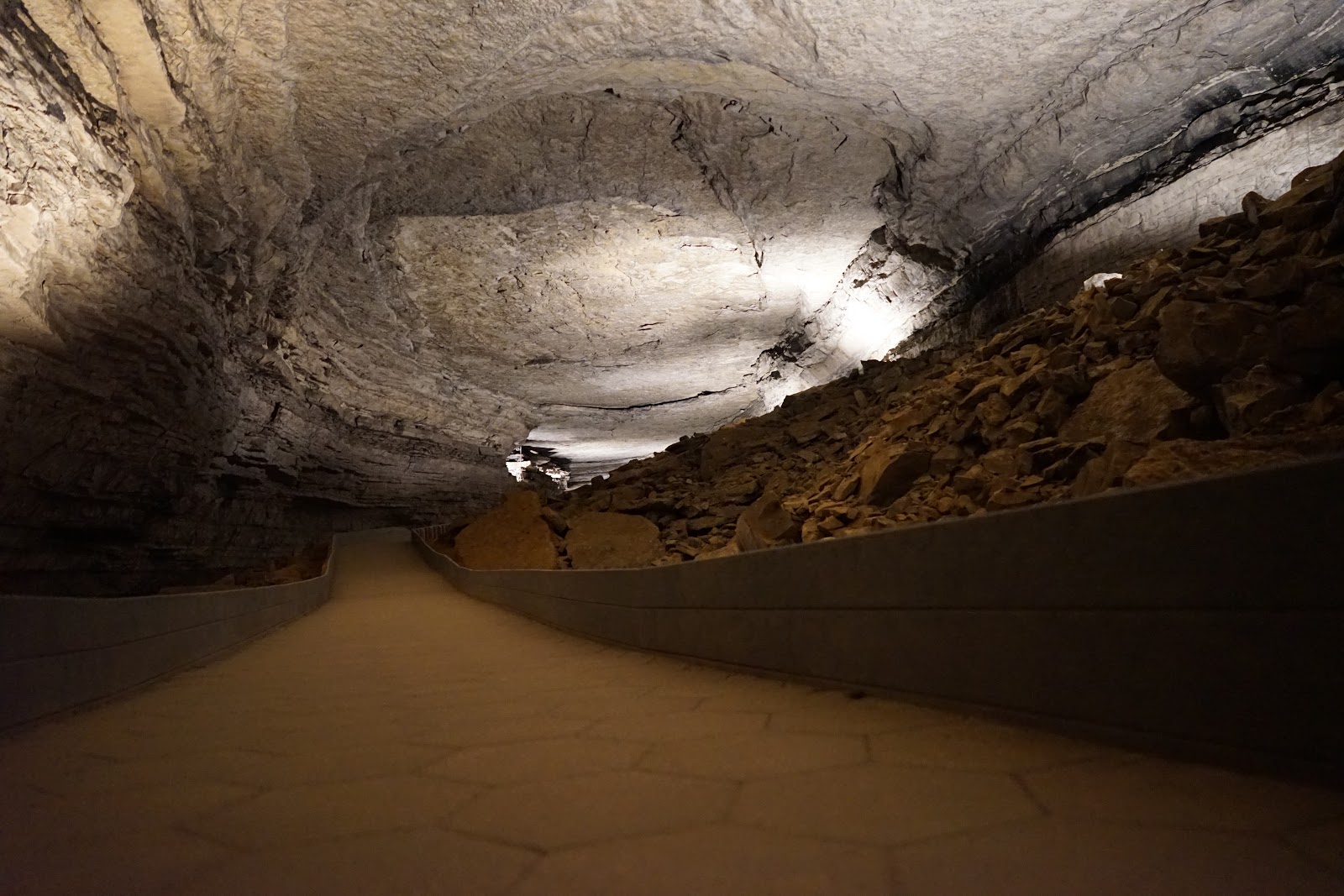
Bjorn had signed them up for three tours of the caves, one on Thursday and two in the morning on Friday. After touring the gift shops and bathrooms and literature stands in the visitors center, a red-headed ranger name Rachel lead them down into the gaping mouth of the cave. To Astrid, who loved to soak in her surroundings, noticing and contemplating every stick, stone, and fungus, the tour was a speed-walk through a unique, jaw-dropping natural phenomenon. So it was a good thing that the trail was a well-groomed, paved path, so different from the large-rock lined mines Snorri and Astrid toured in the Upper Peninsula (UP) of Michigan the previous summer. 
 
Rachel stopped at certain locations in the mine to give historical facts, figures and tales to the group of varied cave-visitors. The first one was the place where salt-peter was mined during the Civil War (for the South). There were plenty of ants-in-the-pants kids on the tour, one with an obnoxiously bright headlamp which, of course, was shone everywhere except in front of him. 


One similarity these magnificent caves shared with the UP mines was the invasion of a fungus called White Nose Syndrome, which effected bats. Because this fungal disease has such a potential to reduce bat populations, all visitors to the mines in the UP and to Mammoth Cave had to walk on mats with disinfectant before entering and leaving the caves. 
 
Many of the cavernous underground rooms looked very much like people dug them, but they didn’t; it was all Mother Nature\’s slow, steady work. The tour took them through a narrow, swerving area, a low, duck-your-head area, then up a many-storied staircase to the surface again. 
 
After the tour, they checked into their Air BnB in Glasgow, a 200+ year old hotel-like house. They let themselves in with the provided key, a little worried about the viciously barking dog on the other side of the door, but once the little guard saw that we were, in fact,  humans, he quieted down and let them settle in their room on the second floor.

Colten’s Steakhouse in Glasgow, was full of locals out for dinner. It was typical steakhouse, with taxidermied cattle horns and fish on the walls.  
 
“Boy, it’s been a while since we’ve been here, I forgot the accent is so different,” Astrid remarked after Bjorn had to have their home-grown waitress repeat a few things due to her beautiful Kentuckian accent. Bjorn and Astrid had lived in Lexington, Kentucky (east of Glasgow), years before. It was where Olaf the White was born, but they had never had the chance to visit Mammoth Caves. 


The next day, after a hearty breakfast, they checked out of their bed and breakfast, then drove past the giant dinosaurs along the road to Mammoth Cave (again),  back to the visitors center to wait to take two more tours.
 
Their second tour took them, by dark green bus, to an entrance at another part of the park. It was led by an older, more bearded ranger, who emphasized preservation of historical artifacts and added more  more interesting and detailed historical facts about the caves. Although Mammoth Cave National Park had trails underground, there were also extensive trails above ground across their property, in addition to a campground.
 
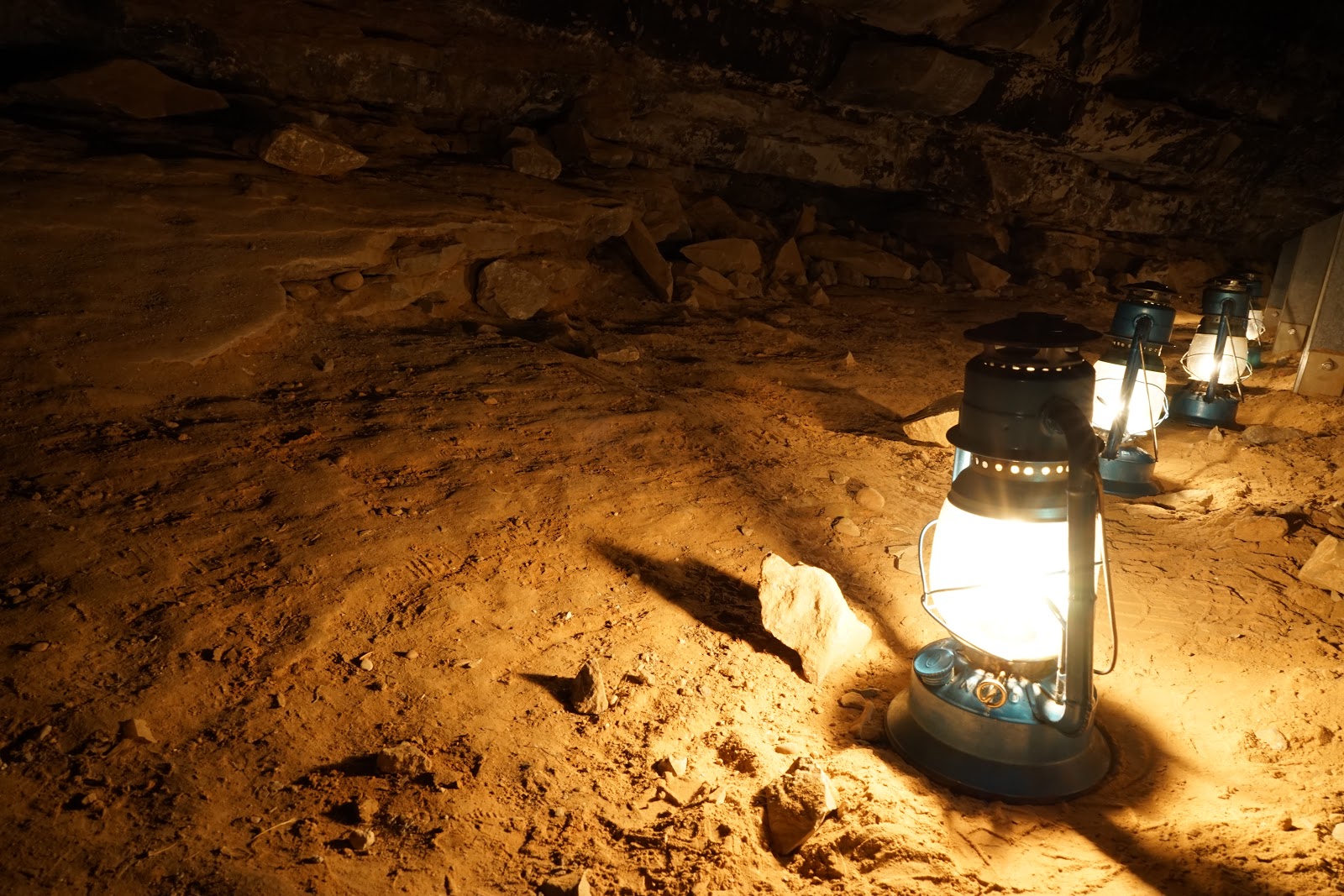
The third and final tour, The Violet City Lantern Tour started with the rangers handing out gas lanterns, as they would be the only light available in some parts of the mines, as all the electric lights would be turned off. 


“If you are sixteen years old or younger, you must stay within arm’s reach of your parent,” the tour guide said before they set off. 
 

“What if your child is bigger than you,” Bjorn asked. Snorri had grown taller than Astrid. He liked to hike in the middle of the tour group, but Bjorn liked to be at the end, to take pictures. Astrid liked to know where Bjorn and Snorri were at all times because there were cliffs, rough areas, pointy sharp rocks and lots of darkness. Also, this trail involved more than a few challenging inclines and rough trails.

As sometimes happens, the best was saved for last. This three-hour tour took visitors off the paved trails, onto the dusty, dry stony paths that weaved in and out of huge, nature-made caverns which the guide explained were, at one time, filled with pre-historic artifacts. The ancient inhabitants of the area would go in and scrape magnesium sulfate off the walls and use it for medicinal purposes. At another time, when medical science was burgeoning, little huts were built down in the caves to house tuberculosis patients. Doctors theorized that the dark, cool moist environment would benefit the afflicted. The patients never improved and often died down there. 
 
In the infantile stages of cave tourism, in the early 20th Century, the cave\’s owners would allow visitors to take cart-fulls of ancient artifacts home from the caves. Decades of tallow soot and controlled graffiti covered some of the cavern ceilings and walls. The thoughtless abuses to the caves, done with profit in mind, made Astrid wonder what thoughtless, destructive things we may be doing to our cherished natural sites today. Will the future generation tut-tut and shake their head in disbelief when they visit places we are inadvertently marring today? 
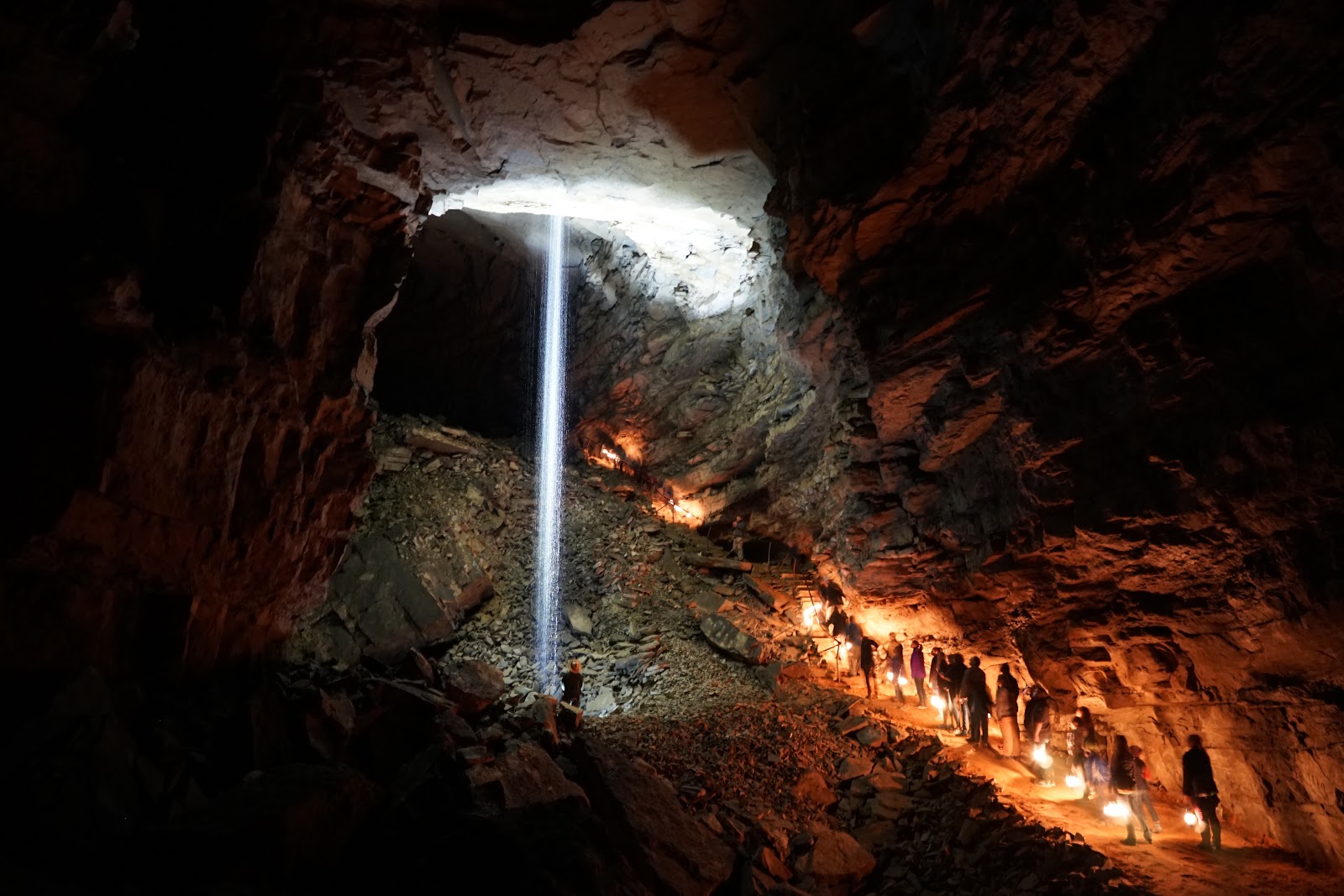
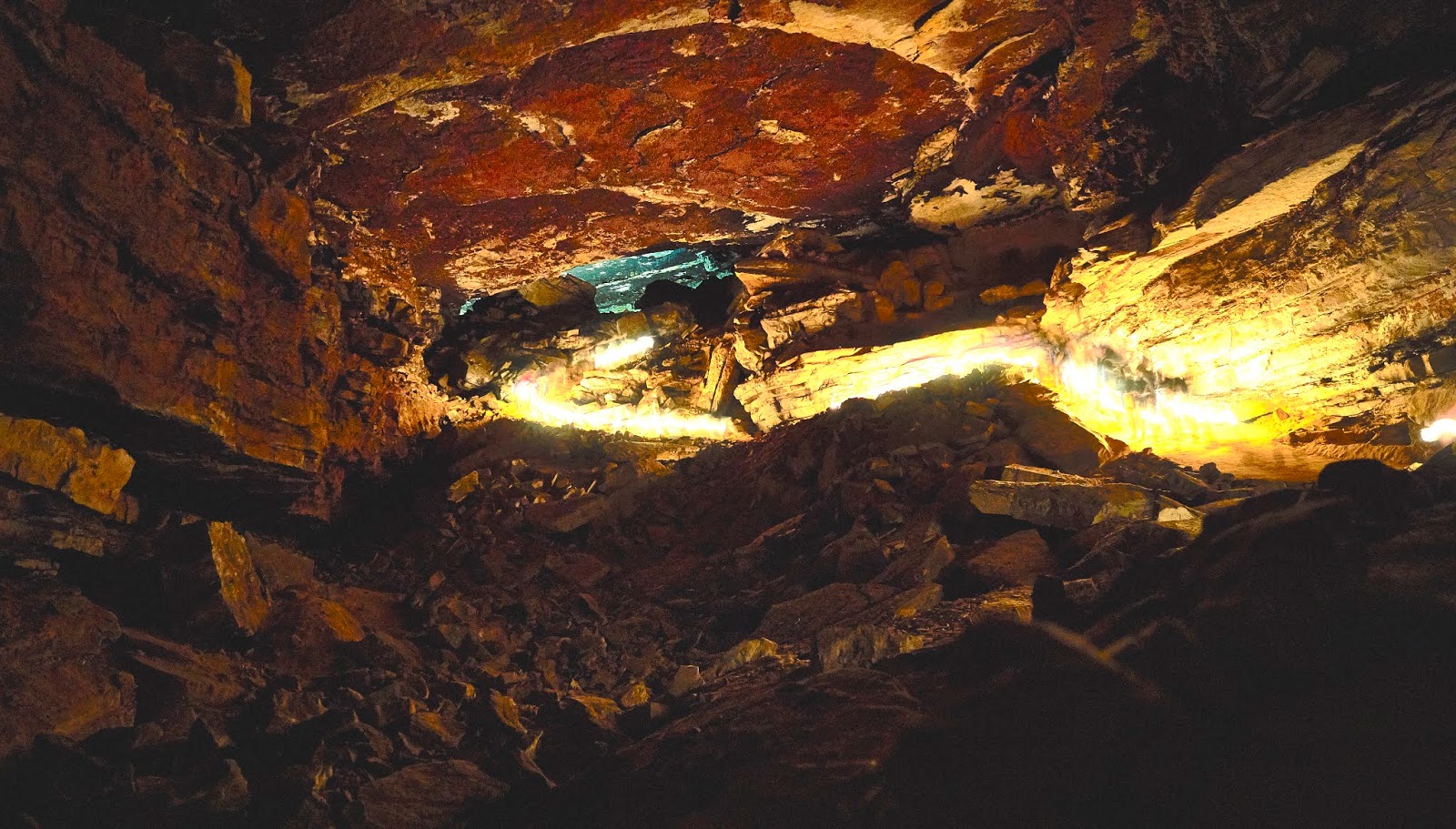
On the tour the day before, Bjorn was having trouble getting good pictures which was not hard to believe, since taking good pictures in a cave lit by reddish lights was a challenge. But on the Violet City Lantern tour, there was some hope. He hung back at the end of the line of tour group, and stayed back as long as he could, to get photographs of fiery trails of the lanterns marching through the caverns. The last part of the tour ended in a cavern with a small “leak” in the ceiling, which one of the rangers lit up with a light as the tour walked past. 

 After the last tour, they were bussed back to the visitors center, walked through disinfectant pads and left the mostly underground national park. 


Driving Kentucky highways brought back memories for Astrid. Memories of cars disabled and stopped, sometimes in the middle of the road. Kentucky, like Michigan, doesn’t have auto-inspection laws, so Astrid assumed people just drove their cars without maintenance, until they broke down on the side of the road. The passed a gold Lincoln, its front wheels sitting on cinderblocks, and farther down the highway, a lonely boat. 


Another forgotten trait of traveling Kentucky’s highway was the speed. Although the posted speed limit was 65 mph, all the cars were going 80 mph or more, necessitating speeding along with them, or becoming a traffic hazard. Kentucky was a beautifully hilly place, and the highway moved with the landscape, curving around hills, following streams. 
 
They checked into a Hilton Tru in Shepardsville, Kentucky then had dinner at Cattlemen’s Steakhouse, a crowded and popular place that night. At 7 am in the morning, a fire-alarm threw them all outside, to await firemen and fire, smoke, and traumatic excitement, but it never came. Someone had left a bagel in the toaster and it was burning up, the consequent smoke setting off the fire alarms.

Before setting off for Michigan, they stopped in Louisville {LOO-VILLE}, at the Louisville Mega Caverns. 

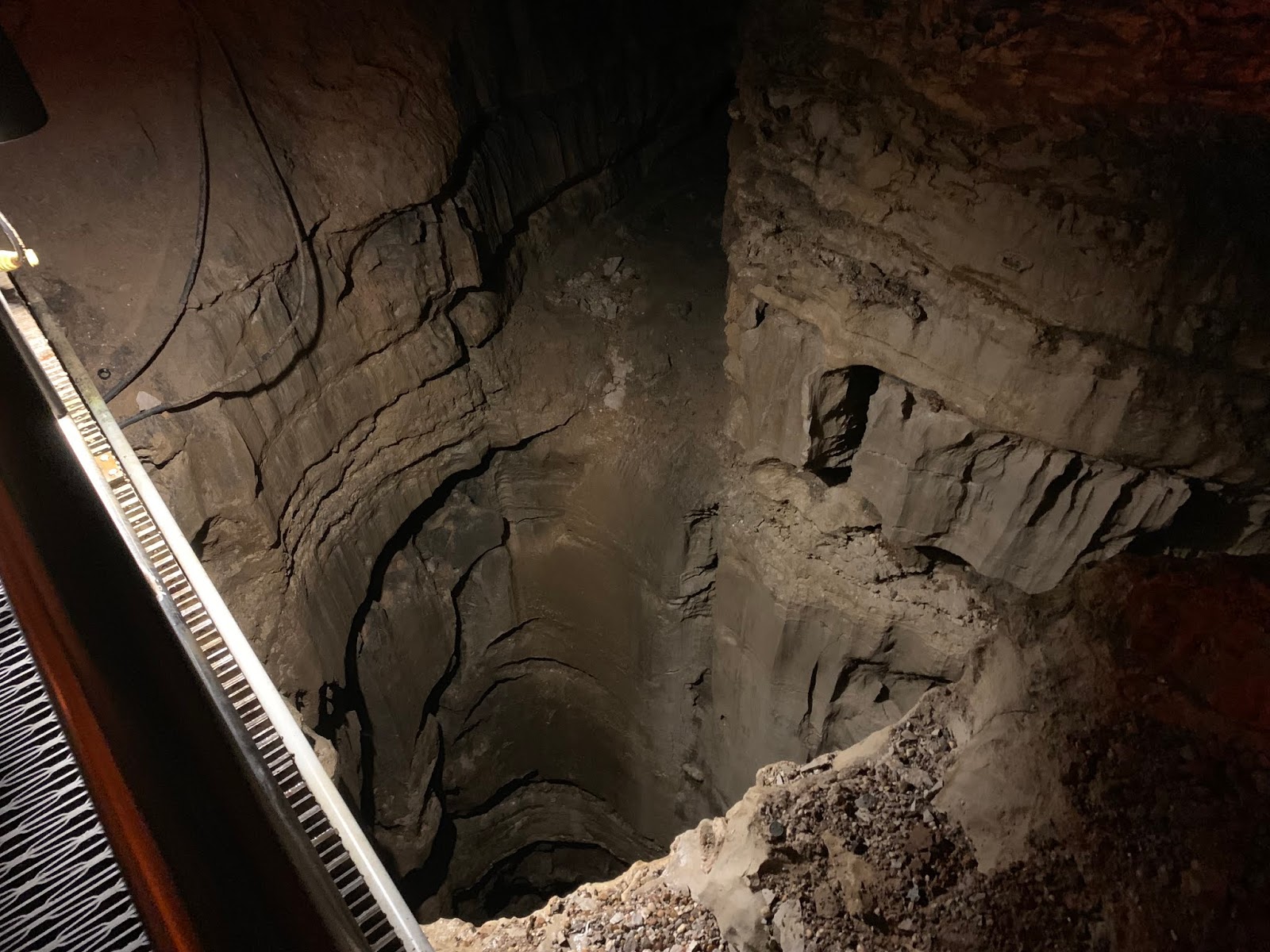
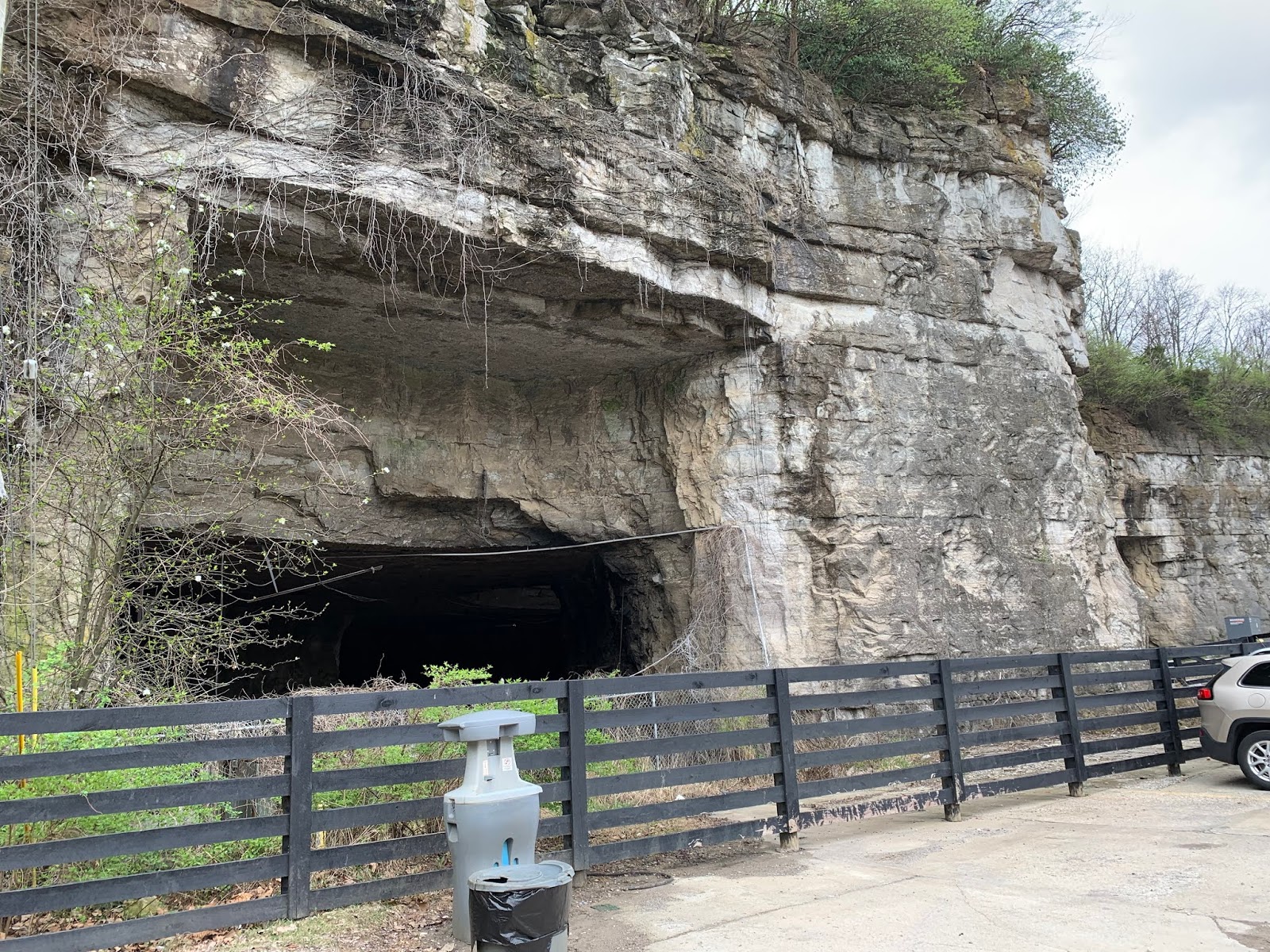
An old entrance to Mega Caverns when it was a mine
 
Until the city passed a law which forbade mining under land that a mining company did not own, it was a limestone mine. But, since the part of the land above it is owned by the state (it\’s a highway) and the Louisville Zoo, mining was stopped. In a move of innovation, the owners charged construction companies to dump non-compostable building waste (because decomposition in a closed space is not a good idea) in it to raise the floors by 20-ish feet, then rented out the constant-temperature space for storage–road salt, movies, wine, cheese, boats, RVs, and some other items that were unable to be disclosed.
 
In a few of the cavernous rooms, they set up a series of ziplines. Another zipline course webbed its way throughout the mine, with tourists zipping over dark voids with only headlamps to guide them. But the family wasn’t there for ziplining. They hopped on electric bikes and, in the head-lamp-lit darkness, whirred after their tour guide who stopped and gave informative speeches at a handful of sites. 
 
One site, illustrated by poised mannequins and army cots, was about the Cold War plans to have the mine serve as a fall-out shelter, but it was a good thing they never had to use it. After the Cold War ended, they calculated that it would never have provided enough oxygen for the amount of people it was to hold. Other sites illustrated the mining process. 

“They call it a mine.”

Of course, no underground tour would be complete without experiencing total darkness, the darkness that exists deep underground where no light can penetrate. Astrid experienced this before, in the Hawaiian lava tube, Mammoth Caves and in the mines in Michigan’s UP. It always induced a sort of panic and started her thinking of ways in which she would find her way out of the darkness. But her plans for defeating the darkness were always foiled by the click of the light switch again.

Astrid looked out for visual gems along the way home, re-seeing the large cow and chicken, but she was also contemplating the underground things she saw. It was a trip to check one more National Park off the list, a unique one. Their last stop was at a very crowded, but efficient Chick-Fil-A in South Bend, Indiana, then home to Michigan.  

After years of suggesting it as a destination, Astrid had finally been to Mammoth Cave National Park. It was interesting, but the whole experience echoed past impressions of other natural attractions which were, in essence, large, open spaces. Large open spaces of significance which she visited in the past include The Grand Canyon, the Yosemite Valley, Meteor Crater, the Thingvellir continental divide and lava tubes in Hawaii just to name a few. 

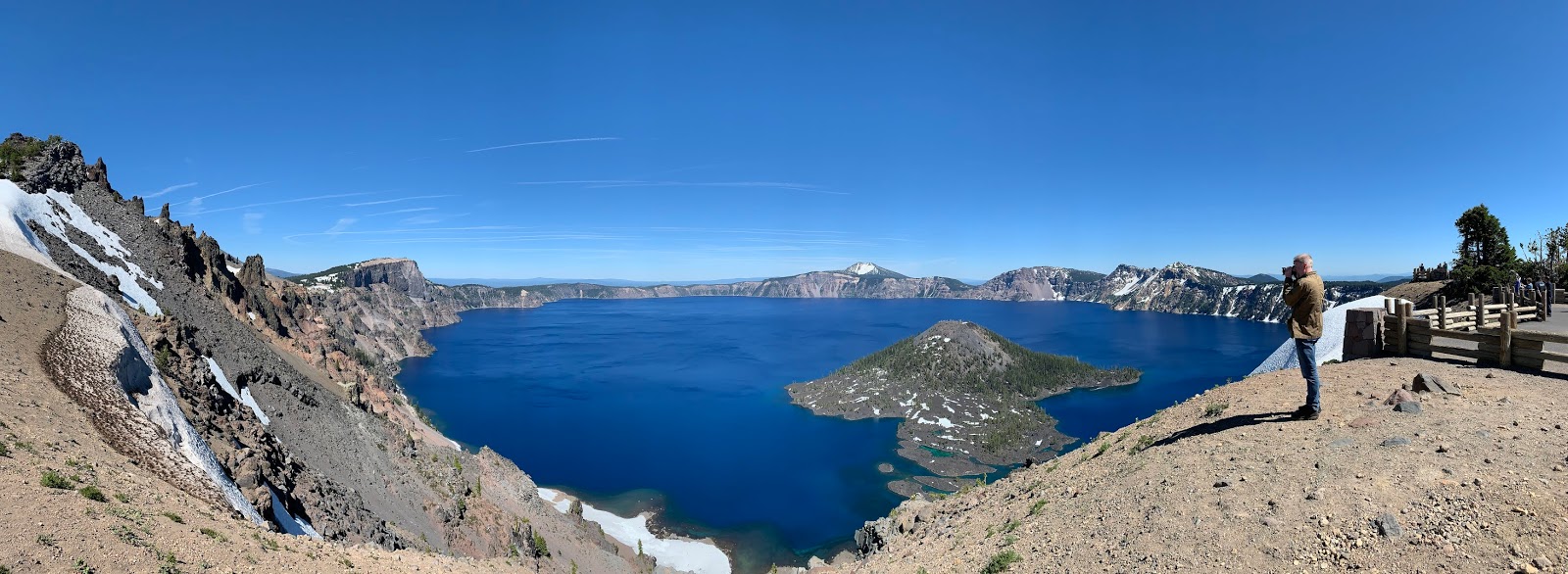
In her limited travels, she noticed humans were attracted to just a few categories of earthly wonders: water (bodies or falls), voids and the structures that define them, rocks, heights, or superlative organisms (like trees) and/or a combination of two or more of these. But because these few elements appeared in such fantastic and varied forms, Astrid never grew tired of seeing them. Her next adventure would involve all of the above.
A Giant Crater Filled with Water 
Thanks for Reading!

Wilderness in the Way UP North

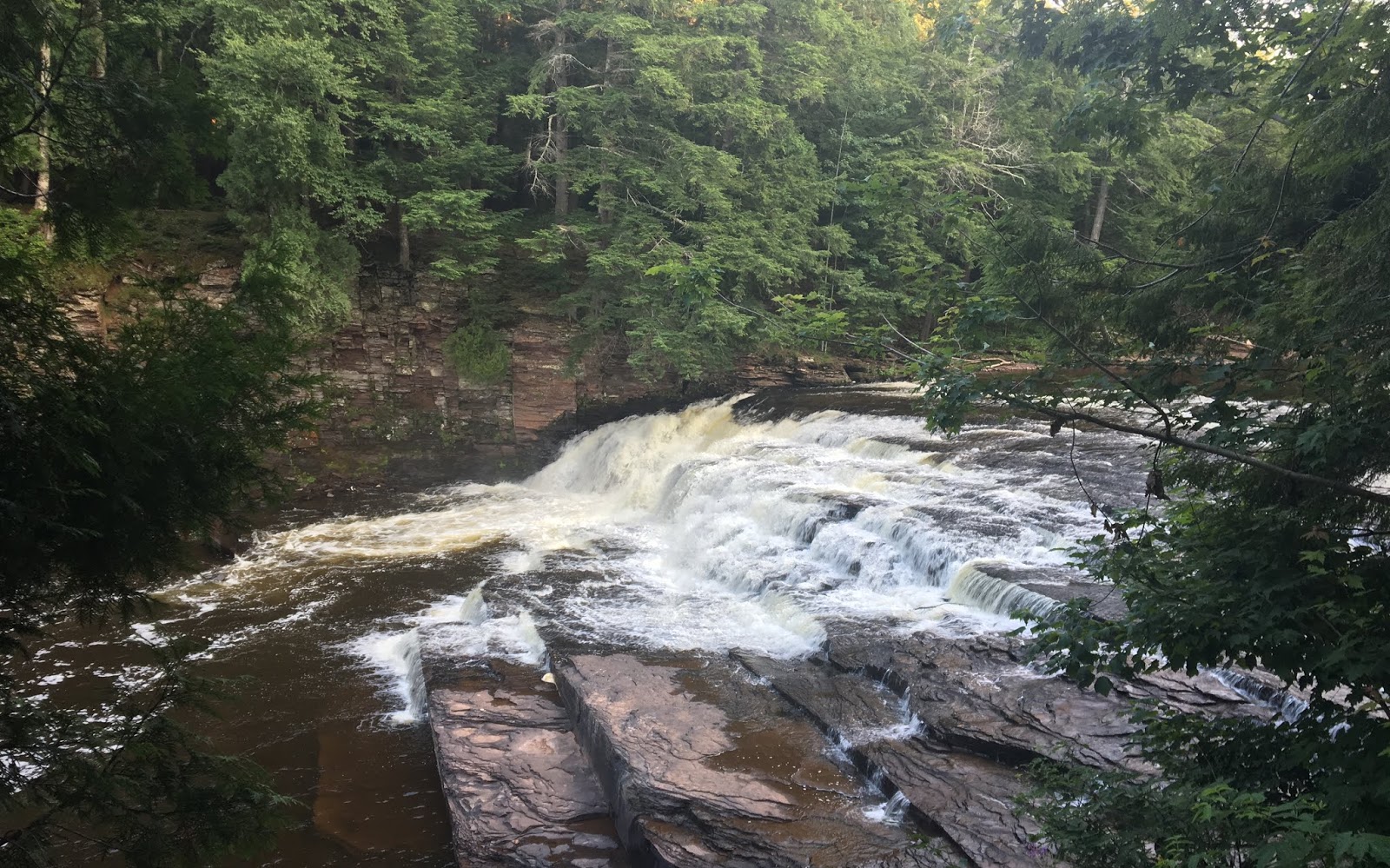
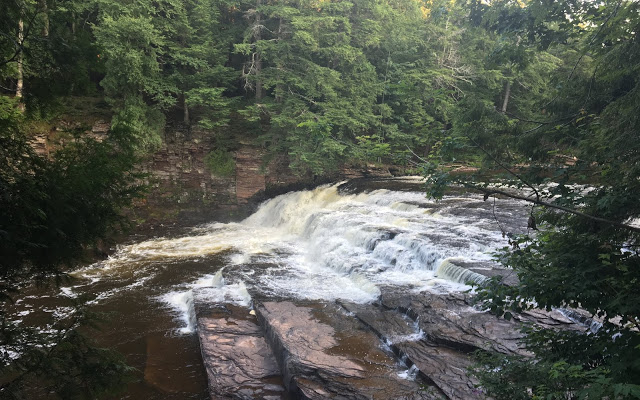
Manabezho Falls

Like so many of Astrid’s adventures, it started with a book. Except this time, it was not a book she was reading, but a book she was writing. Enchanted with folklore from eastern European countries, she had used elements from Slavic fables in her story but needed some other element, a random detail that would generate material for her fictional world, something to fill details. 

 
She settled on copper. It was the color of her hair, an unique and interesting metal and it would serve her purposes well. One of the main character’s ancestors, though not copper-topped, would make their fortune in copper mining in the industrial revolution. But where did copper come from? How was it mined? {This is how so many stories start … with questions, because what is a story, but an answer to a question or series of questions?}
 
Little did she know, she was already there. It used to come from Michigan (some of it). But more specifically, it came from the Upper Peninsula of Michigan, and even more specifically, from the Keweenaw Peninsula. 
 
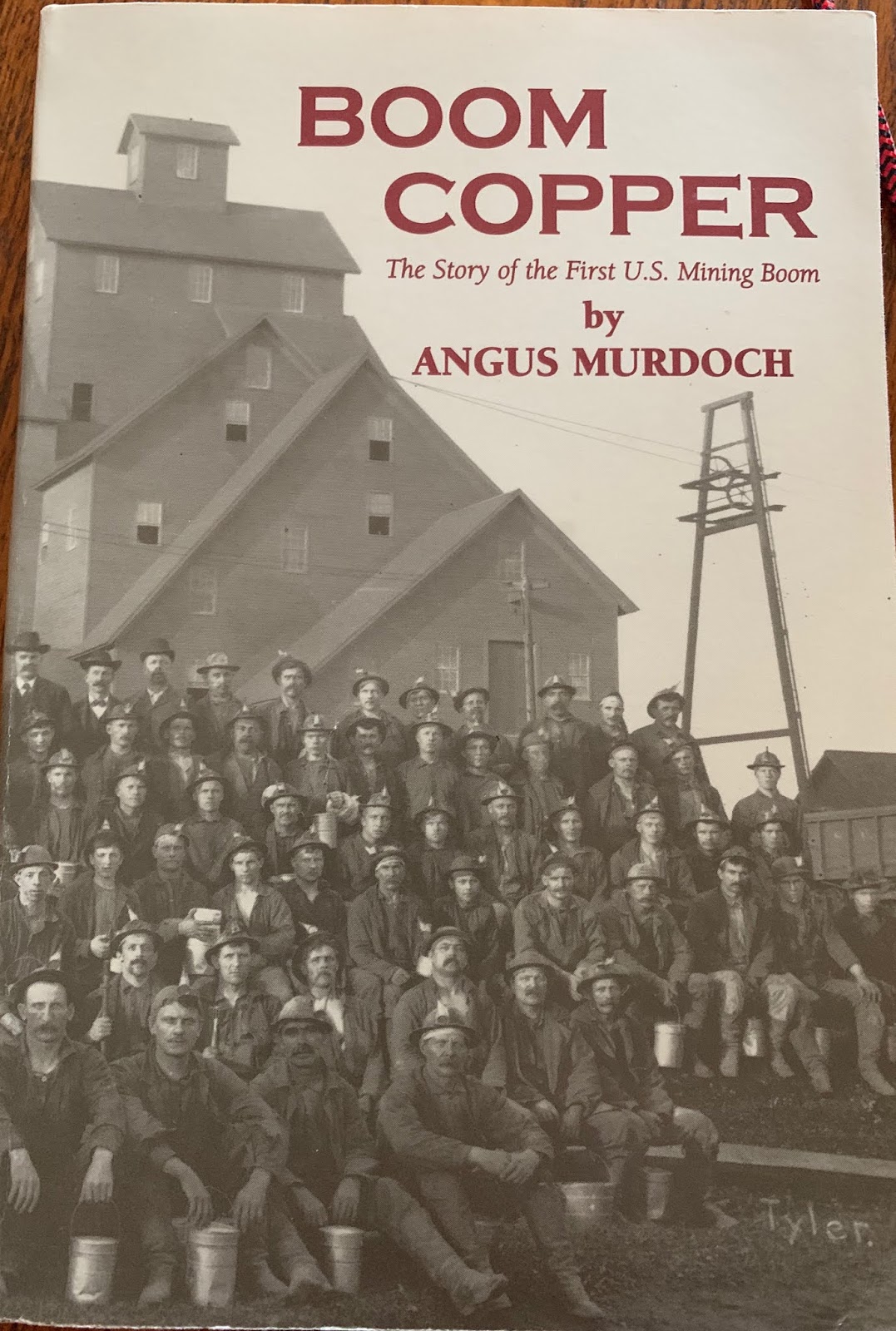
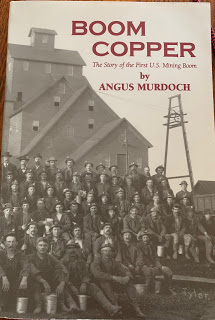
The Keweenaw Peninsula is the north west part of the Upper Peninsula (UP) of Michigan, jutting into the wicked, wild Lake Superior. The UP is a piece of land which was granted to Michigan as a consolation prize in the Toledo War, when in 1835 Ohio and Michigan came to fisticuffs over a strip of land near Toledo. Ohio kept Toledo and Michigan was given the Upper Peninsula (which kinda looks like it should belong to Wisconsin, sorry Wisconsin). In order to lend some authenticity to her story, Astrid needed to know more about it, which lead her to the book, Boom Copper by Angus Murdoch. Besides the constant misogynistic comments (he likens Lake Superior, the earth, nature in general and anything the least bit of petulant to fickle womanish-ness), the book is full of prospector anecdotes and possible tall-tales about the history of the wild, wild, west that was the Keweenaw from the 1840s to the early 1900s. 
 
Murdoch was a travel writer and, like Astrid, fell in love with the Keweenaw. He wrote of the history, from Douglass Houghton exploring the area, to the succession from the Indians, to the rumor of copper fortunes to the many prospectors that followed rumors of mineral riches in the ground. In reality, there were not as many fortunes made in The Copper Country, and in the gold rush in California as was thought, but a few notable men made off with riches.
 
In order to portray the area accurately in the story she was crafting, she scoured Google Earth online, looking at the land, noting the waterways, the tiny towns, the highways, the ports, even scrutinizing topographical maps to surmise the lay of the land.  
 
Two more novels, ten years, and an education in camping later, Astrid made up her mind: she was going to The UP to see first hand where the character in her novels made his fortune. She wanted to see the rocks, breathe the frigid, damp air of the mines, feel the dirt, see the Lake, walk in the mines, touch the famous copper nuggets. This time, all the travel planning was up to her. Although they had taken a few trips to the eastern side of the UP (Pictured Rocks, Munising) as a family, Bjorn didn’t want to spend his precious vacation days on this excursion; he wasn’t interested in defunct copper mines. 

On a Monday in August, after six months of planning, Astrid and Snorri packed the truck with tents, luggage and a sleeping-bag-wrapped cooler full of food and started on their journey to the UP. Why not hotels and restaurants? Because she wanted to be close to the outside, and save money. 

 
The journey started in driving south, because sometimes the quickest way to Michigan’s UP from lower Michigan is through Indiana, Illinois and Wisconsin. 
 
She knew they were getting closer when the cities grew fewer and farther between, and the trees and forests grew thicker and closer to the road, with verdant green obscuring most of the field of vision. A sign advertising “Deer Heads Boiled,” was a definite marker telling they were in the wilds. 
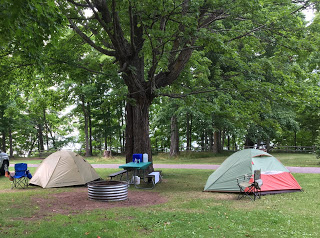
 
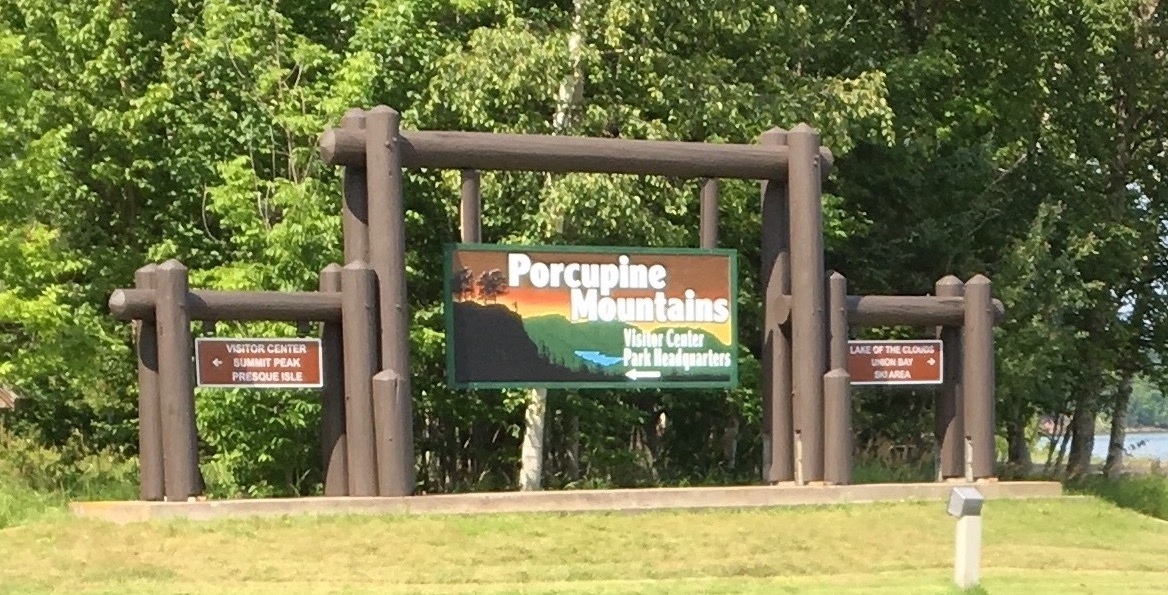
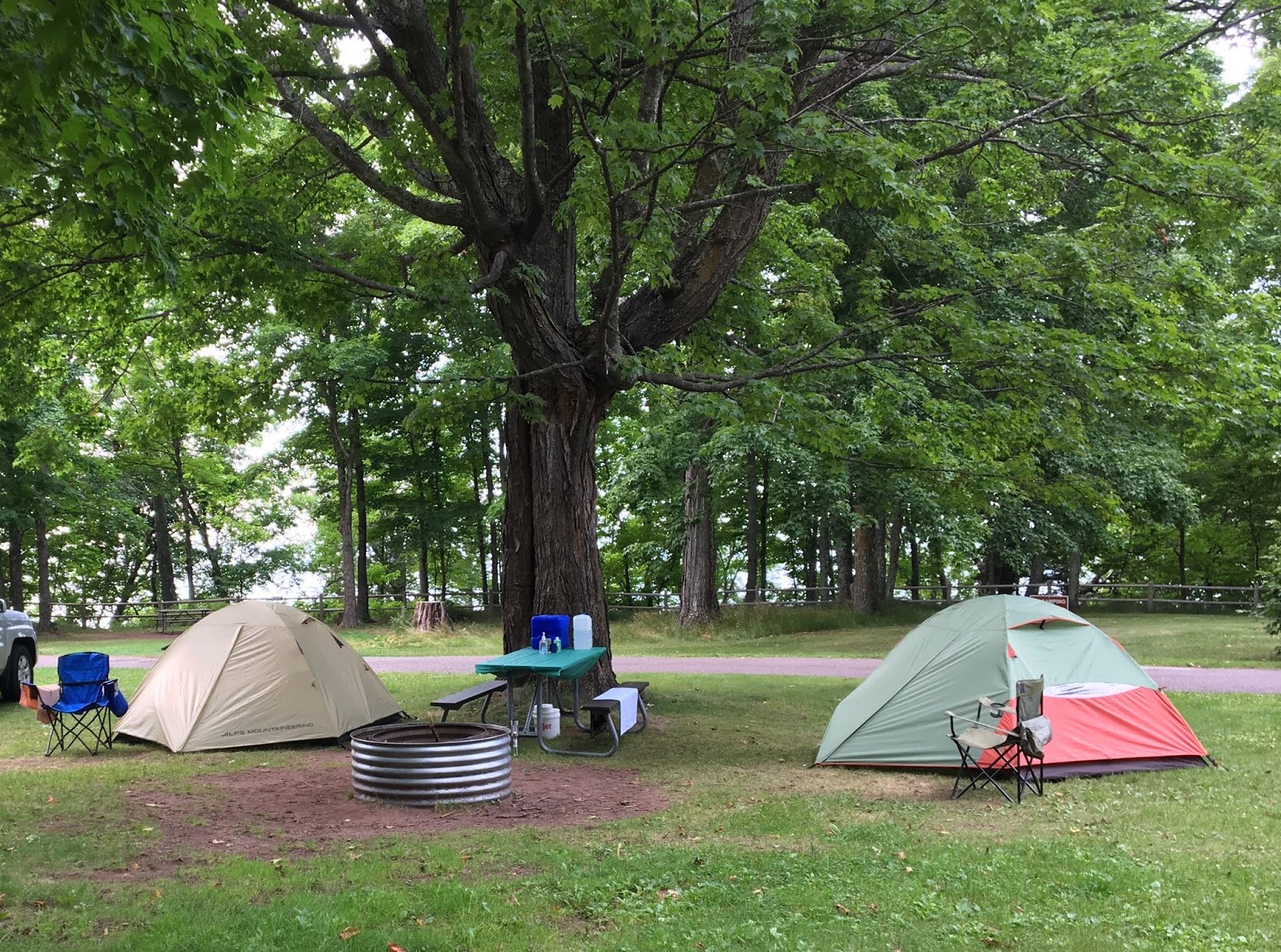
Their first stop was at Porcupine Mountains Wilderness State Park, located south of Ontonagon, along the Lake Superior lakeshore. Astrid chose the first two nights accommodations at Presque Isle Campground, the “primitive” campground (no showers or electric or cell phone coverage). It was situated on a grassy bluff overlooking Lake Superior, sparsely peppered with vehicles and tents, but no large RVs.
 
After setting up the tents, they walked to the far side of the camp, a little ways into the woods to a well with a squeaky hand pump for cooking and washing water, then lugged the big blue water jug through camp, nodding greetings to lounging campers. 
 
They took a short walk to the Manabezho Falls, one of three shallow falls in the Presque Isle River which flows out to Lake Superior near the campground. They cooked dinner over their Biolite wood-fuel camping stove and a supplemental backpacking stove. 
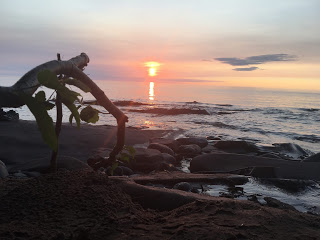
 
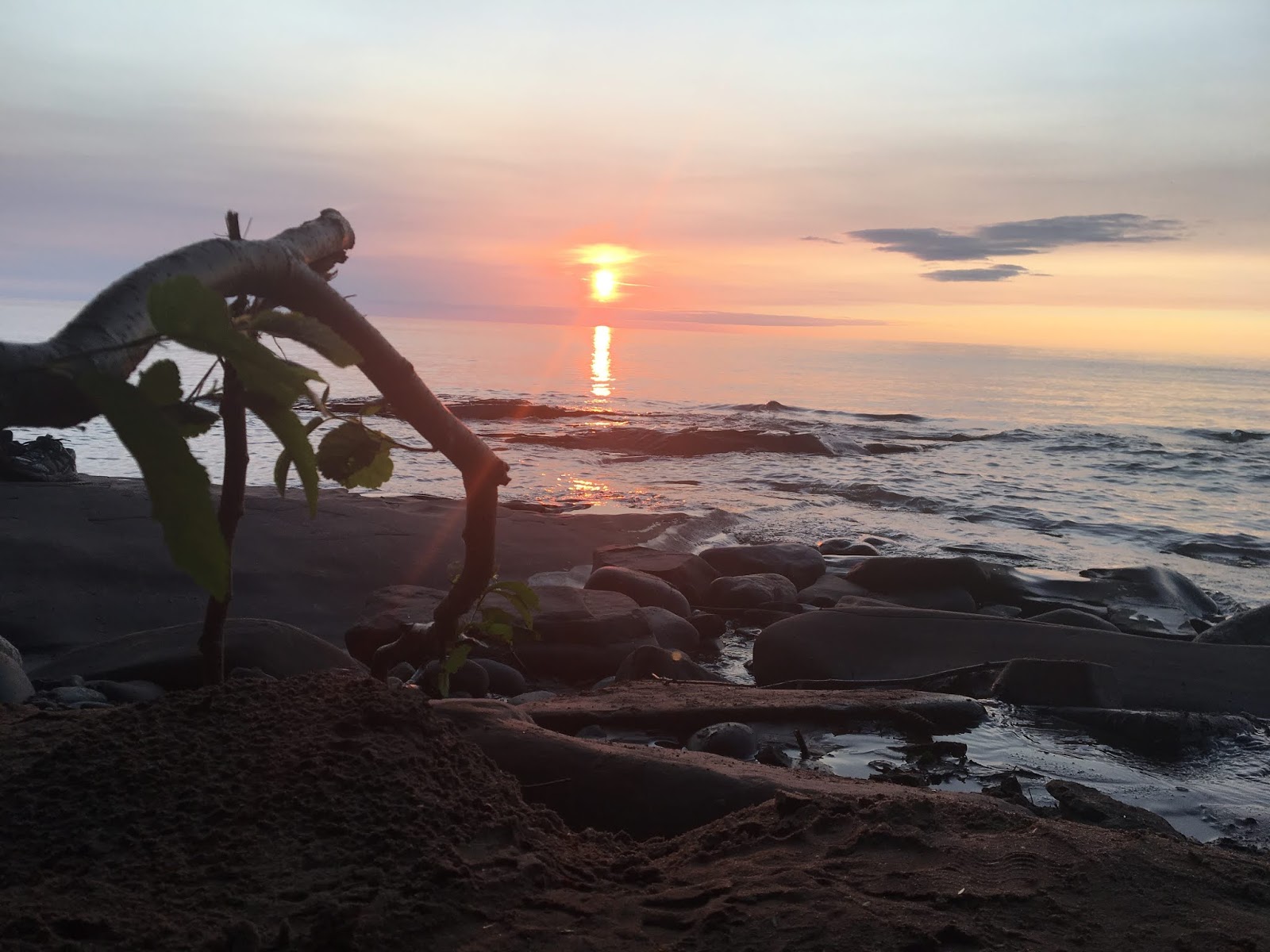
After dinner and cleanup, Astrid and Snorri walked down a long flight of steps to the “beach.” The beaches near their home in the LP (Lower Peninsula) were beige-sand beaches, with sandy bluffs, beach grass and some very interesting and sometimes copious stones. In the UP, there were boulders, bedrock, rock, rock, rock, mountains of rock. Campers swarmed the rock slabs of the shore, dipping their toes, splashing and watching the crimson sun sink into the lake. 
 
Back at camp, by the light of a citronella candle (the flies weren’t really bad), Astrid looked over the map of the Porcupine Mountain Wilderness State Park hiking trails and picked a few options.
 
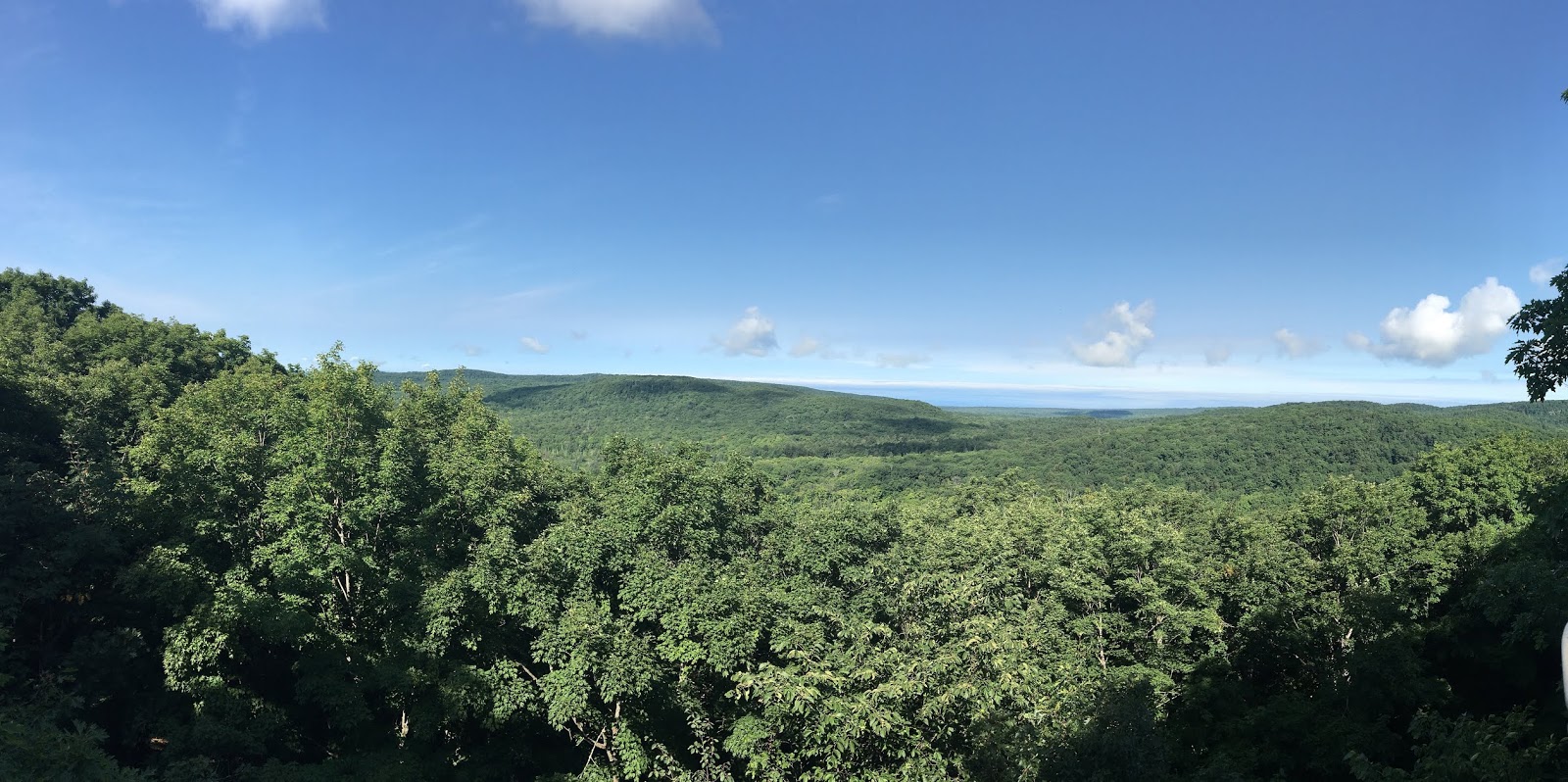
Early the next morning, after breakfast of sausage and eggs, and coffee and tea for Astrid, they threw their packs in the truck and drove on South Boundary Road to the trailhead of Summit Peak Summit Area, walking half a mile to Summit Peak Overlook. Out over the platforms was an ocean of churning green. 


Astrid was born and raised in Northcentral Pennsylvania, in a valley skirted with low, rolling mountains covered with deciduous trees and patches of rocks. It was what she saw when she looked out any window, took a walk, rode in a car, in every direction, constantly until she moved out of the state. The mountains she saw at the Summit Peak Overlook were very similar to the mountains of her hometown PA. They weren’t impressive like the naked towering Colorado Rockies, or the icy black mountains in Iceland or the bright green cliff-filled hills of Scotland. They were familiar to her as if she were seeing the back of her hand on some other person. Except in PA, there was no Great Lake glimmering in the distance.
 
To Astrid, “outside,” when conditions were tolerable (or, at most, challenging), was always preferable to “inside.” Rural “outside” was more favored and enjoyable than urban “outside.” Forested “outside” was downright magical. It was the trees, she thought: the perpendicular monuments to biochemistry, the totems of biomass accumulated through iterated years of rain, sun, warmth, growth, cold, dormancy, then budding out. They filled the forests with seemingly random but infinitely ornate architecture, and as she walked among the silvan landscape, it always quenched some unutterable thirst. 

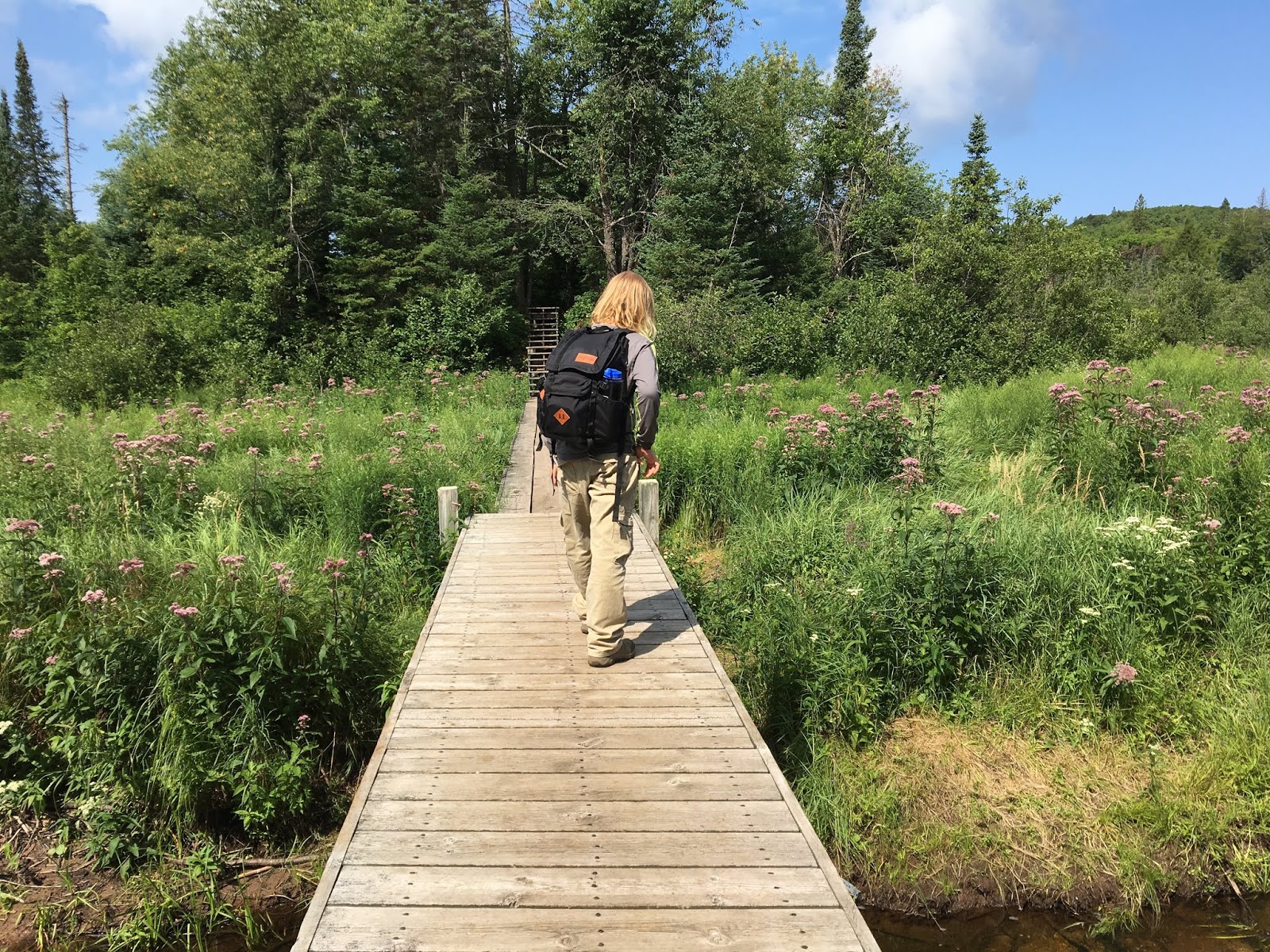
After the short hike to the overlook, they trotted back down to the parking lot then started on the South Mirror Lake Trail. The first part of the trail lead them through a heavily forested area, along a stream, then over a bridge that spanned a wild-flower adorned swamp, then back into thick woods again. They walked past backpacking camping sites with bear poles, over marshy areas on raised platforms. 
 
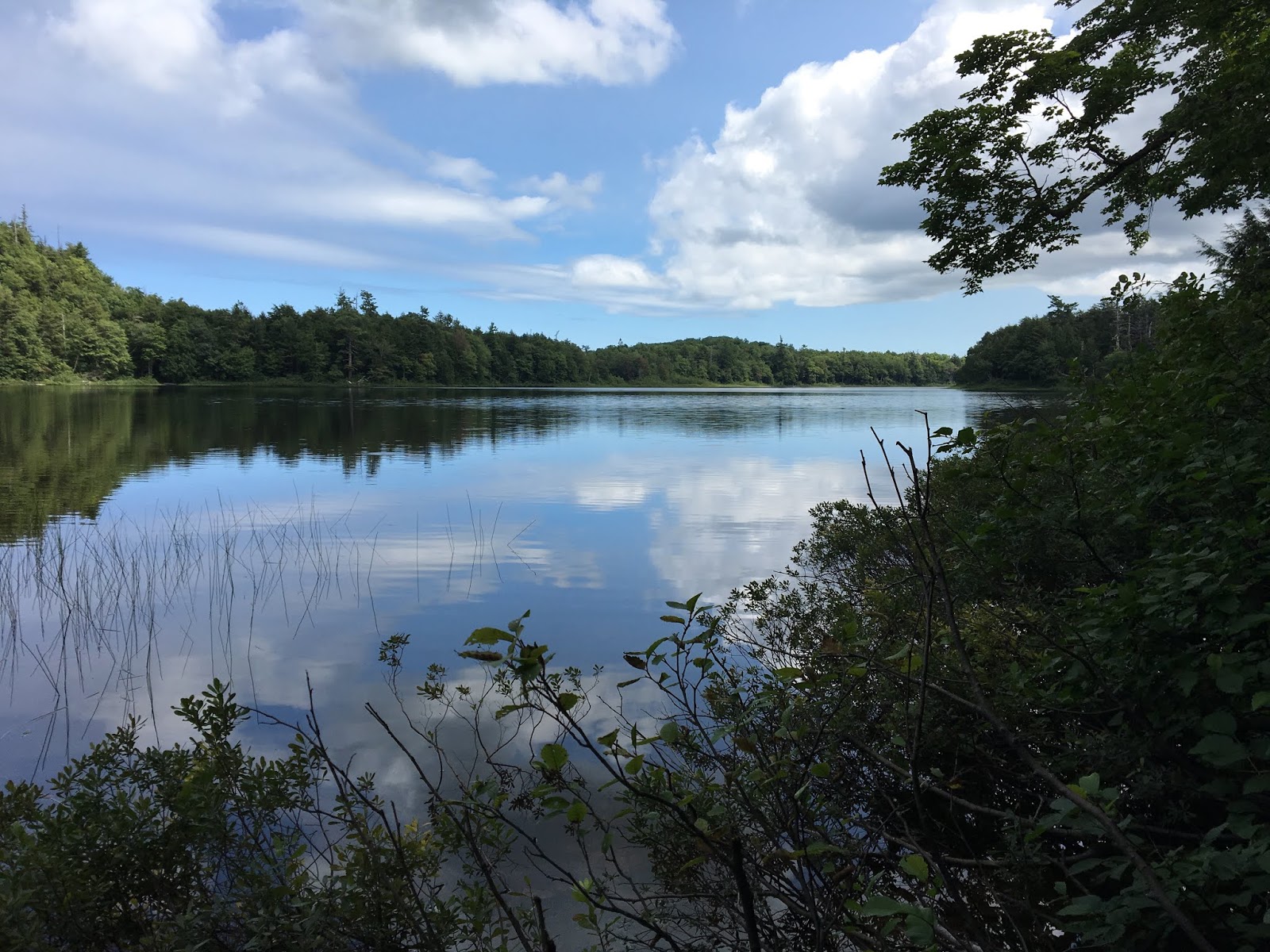
Once at Mirror Lake, they sat on a log by a dead fire pit and ate the lunch they had packed that morning. A hiker with a gigantic, furry black New Foundland, what he called “just a puppy,” walked by and let them pet the magnificently soft giant dog. 
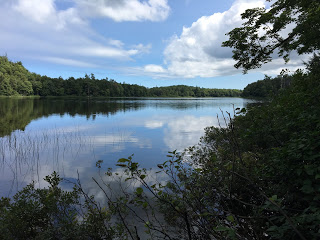
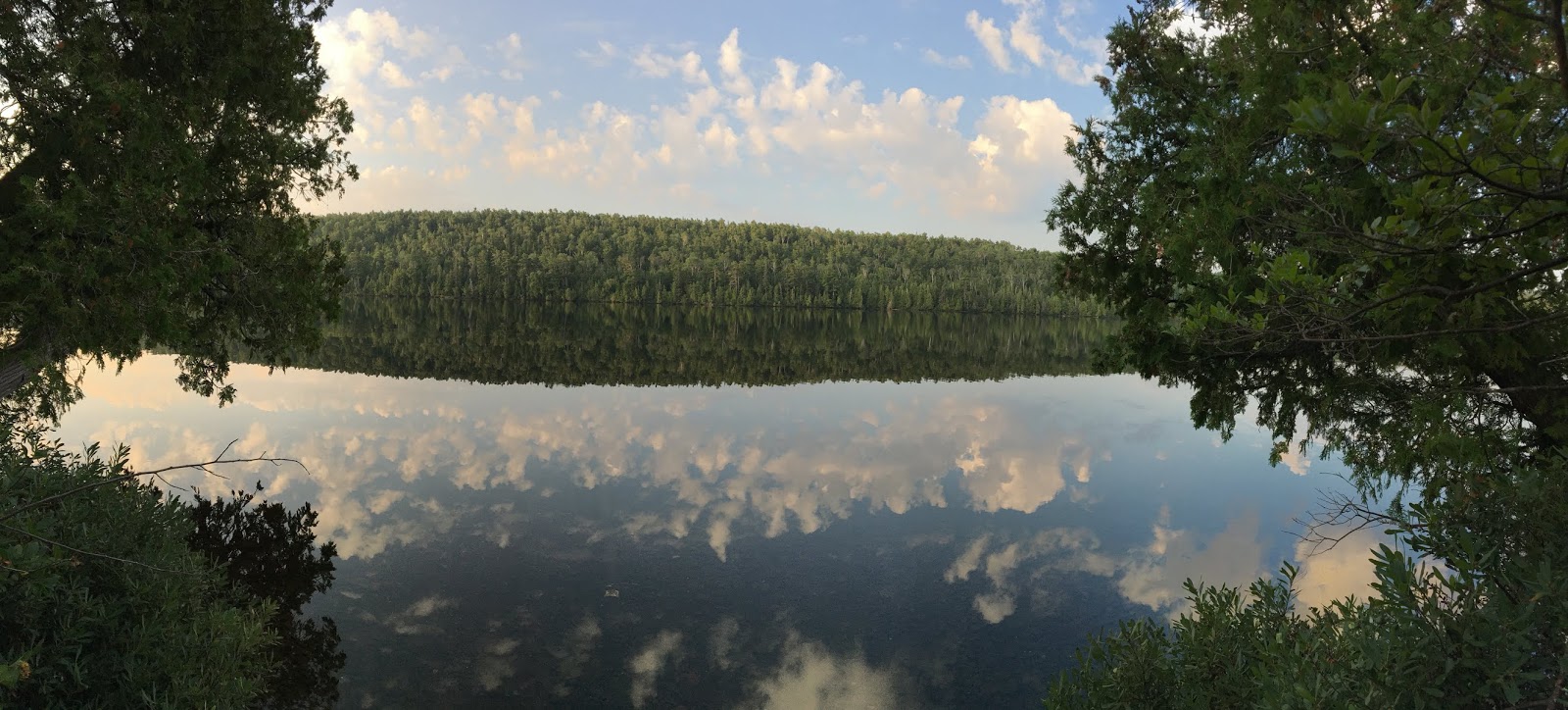
Mirror Lake

On their hike back, Snorri regularly switched his backpack to his chest, as it was agitating him in some way. When they reached the trailhead parking lot, it was full of cars, and the road in lined with vehicles.

Driving along South Boundary Road, the road that skirts Porcupine Mountain Wilderness State Park to the south, Astrid slowed at any sign of pull-offs and trailheads, taking note of possible activities for the next day, until they arrived at the visitor center and park headquarters. Here, Astrid used the Wi-Fi to communicate with folks back home, since there was no cell signal anywhere but the highest peaks in the park. 

 
From South Boundary Road, they turned onto 107 Engineers Memorial Highway and drove west, up a steep hill to Lake of the Clouds Overlook. Astrid didn’t go up to the UP just for hiking, and being outdoors. She wanted to see fragments of history, so they parked at the trailhead for The Escarpment Trail, which intersected some old mines. Snorri was tired, and didn’t hide the fact. 
 
“We’ll walk until we come across a mine,” Astrid said, encouraging the tired boy. 


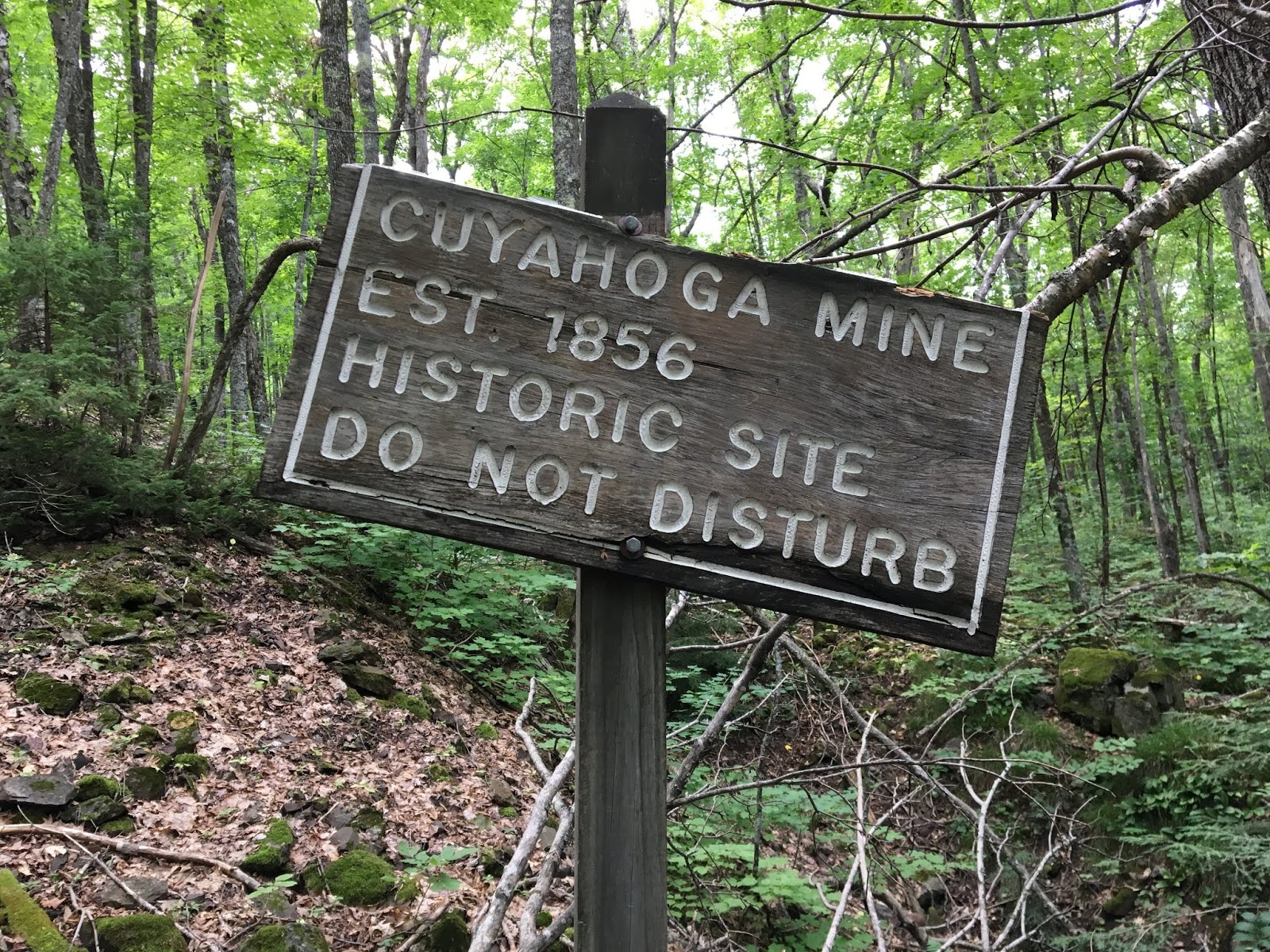
The first quarter mile of the trail was covered with large gravel (dug out of a mine) which made sense when less than a half mile up the mountain, way sooner than Astrid expected, a rotting sign stood warning of caution stood, announcing the Cuyahoga Mine. It was just a biggish hole in the ground, but to know some codgery old prospector sank all his heart and soul and future into this spot a century and a half ago was a thrill for Astrid to see. 
 
Snorri gave a look, turned around, then started down the mountain. 
 
“Where are you going?” Astrid asked. 
 
“You said, when we reach a mine …” 
 
She did say that, but wanted a longer hike. 
 
“That’s way too short. I didn’t expect the mine to be right here … let’s go up to the top … or at least until we hit one mile,” she said, turning on the GPS tracker to count the distance. 


Astrid walked up the mountain, marveling at the many birch trees, thick, white barked pillars along the trail. Some birch stood dead, the rotting insides of the trunks held together and up by the very sturdy and weather-proof papery bark. At the top was a rock outcropping that provided a cleared spot and a great view of the surrounding mountain tops. Snorri trudged up a few minutes after her. 
 
“Now, can we go down?” 
 
“Just a minute … look at the view … look at this rock here, see the vein of red … relax, we have time,” she said. 
 
After a few minutes of taking in the prospect, she said, “okay, now,” and Snorri turned tail and rushed down the mountain, reaching the car a full ten minutes before her. 
 
After a dinner cooked over the backpacking stove, Astrid went down to the rocky shore and waded in the chilled water, carefully, because the rocks were often covered with slimy moss. 
That night, they fell asleep to the sounds of a newly arrived family reading a night time story at the next campsite. 
 
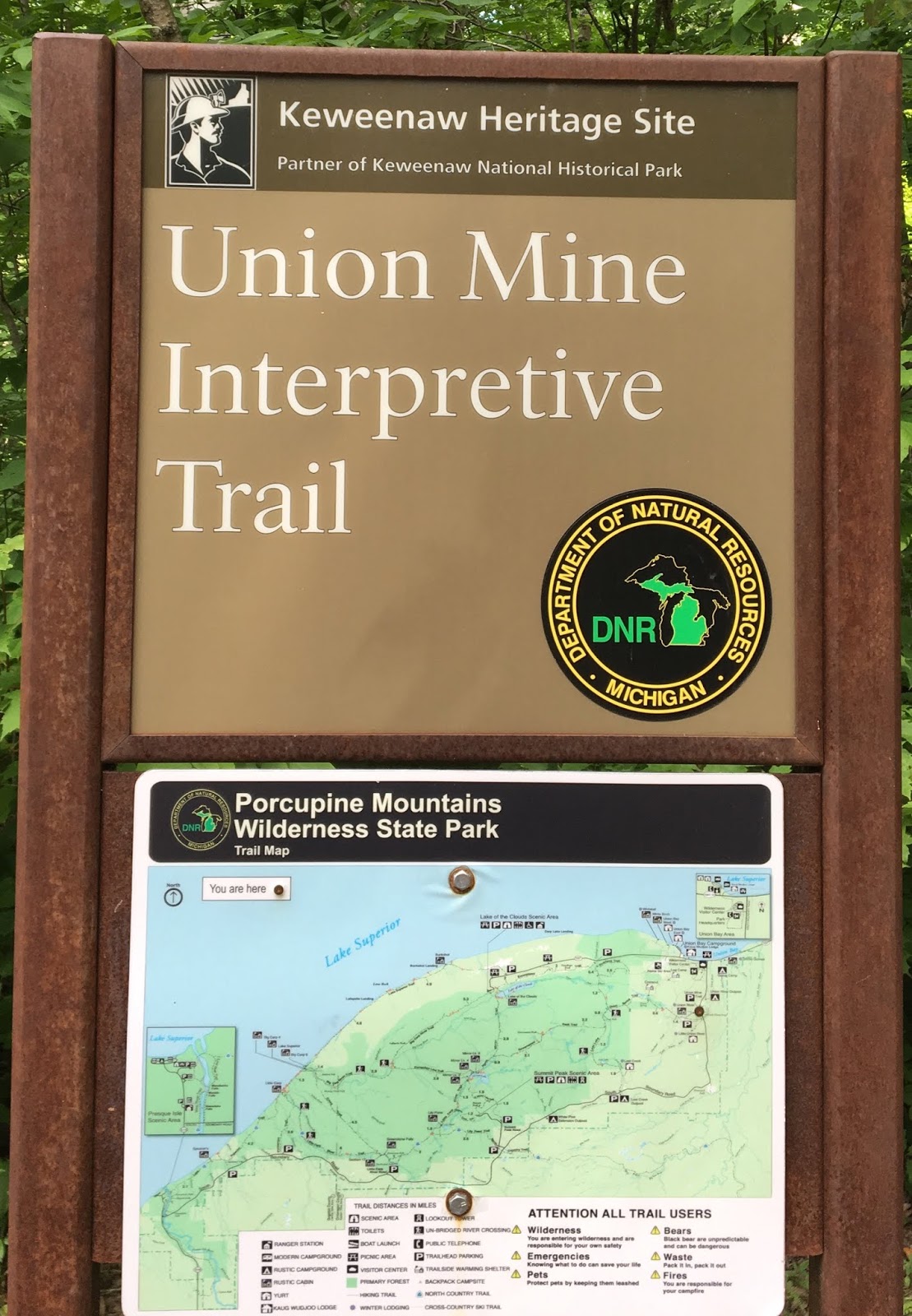
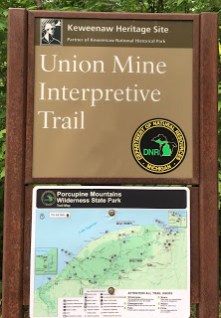
The next day’s plan involved many stops, the first after breakfast being an impromptu hike at The Union Bay Interpretive Trail, an one mile trail loop around and across the former Union Mine sight. It followed a stream, of course, because most mines needed water. Deep, wide holes in the ground were fenced off, informative signs posted at many significant spots and trail markers on trees. 
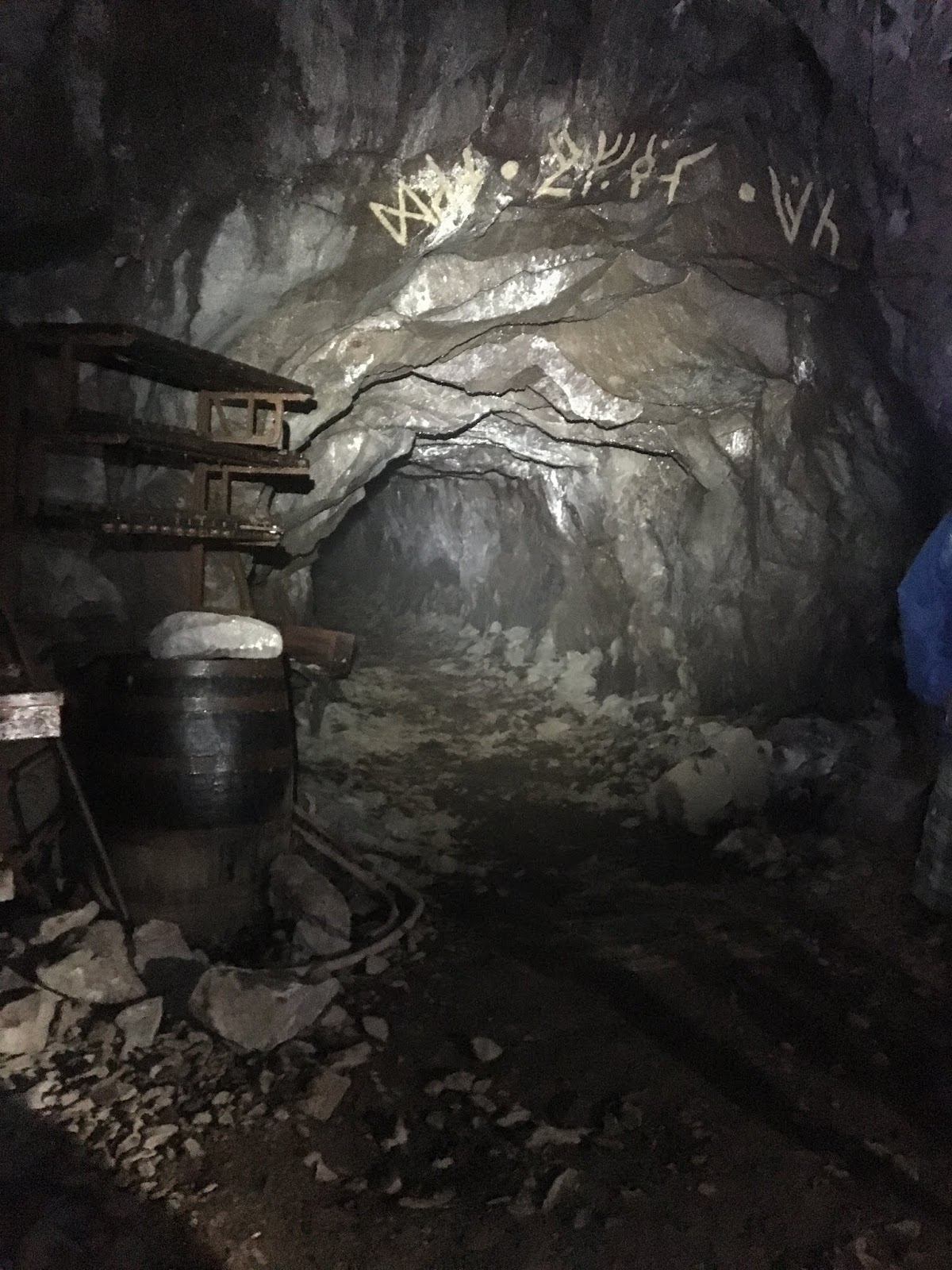
Next, the GPS lead them to the Adventure Mining Company, where they toured the dark, damp, copper-studded tunnels of the Adventure Mine in Greenland, MI. The mine, open between 1850 and 1920, took out eleven million pounds of native copper and was now used for tourism and, of all things, bike races. Yep, they rode bikes through the mine. 
 
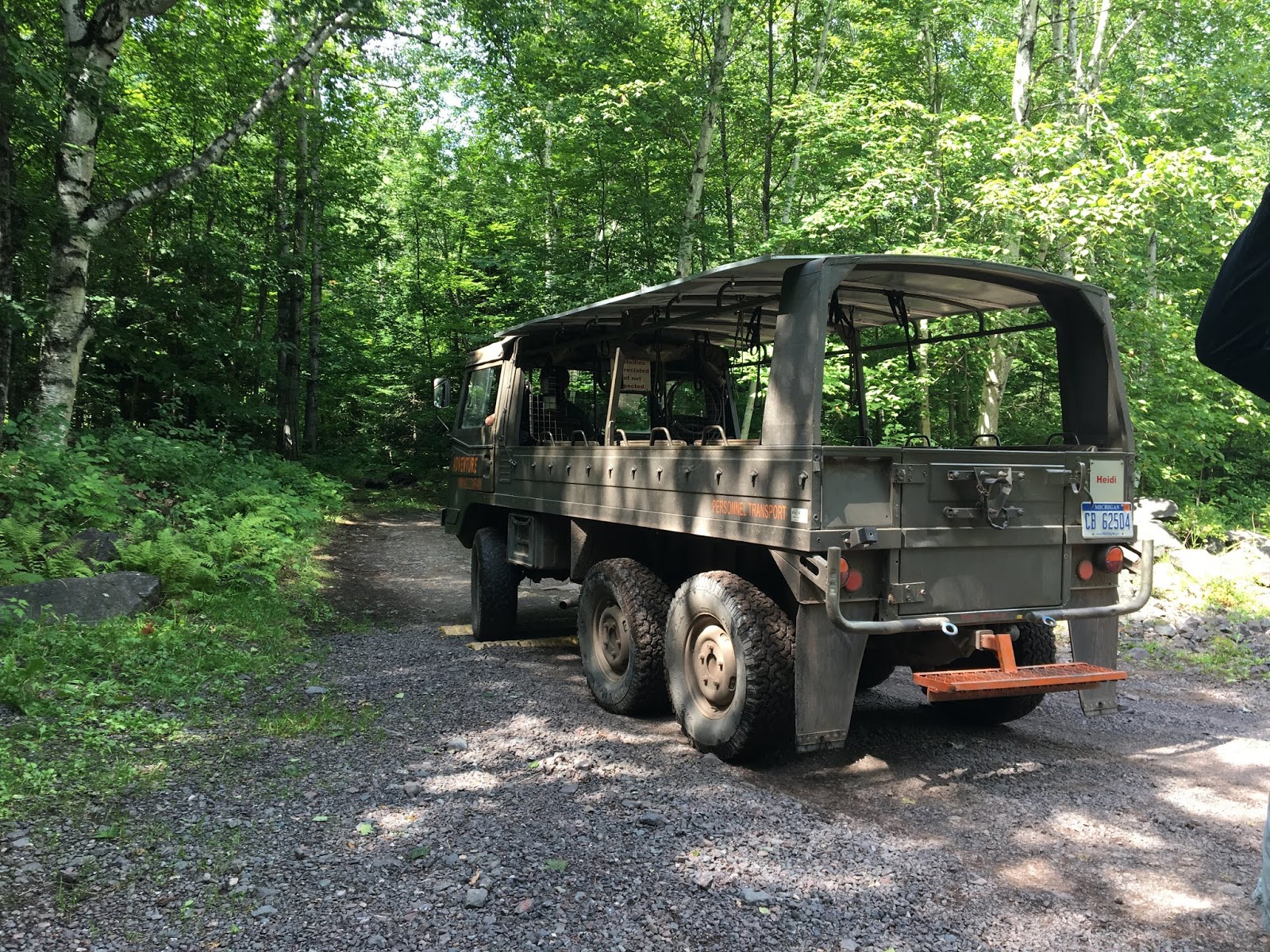
The tour guides first loaded the group up into old WWII people-moving vehicles, but not before providing hardhats, and boot disinfectants (to prevent a fungus called White Nose Syndrome which kills the mine bats). Walking over rough, gravel-lined tunnels, the guides explained the copper mining history, bats, and even the B- movie that was shot in the mine. The light-colored damp walls glistened with white calcium rock, some kind of fungus, moisture, and sometimes, copper. 


In the gift shop, Astrid bought the book that started it all, Boom Copper, and Snorri chose an old mining drill bit as a memento. 
 
Traveling further north, they stopped for lunch at Rockhouse Grill and Tavern in Houghton, MI, then restocked their cooler at a Walmart there. It was a typical Walmart with crabby customers and shopping carts jammed into Astrid\’s parked truck, but there was one other very useful thing she found. 
 
“… and one block of ice,” she said when the cashier finished ringing up her staples. 
 
“Are there some there? ‘Cause I wouldn’t want to charge you and there not be any. We run out,” he asked. 


“Oh, yeah, I checked,” she said. For three days, frozen gallon jugs of water in her sleeping-bag-wrapped cooler kept all the perishables from perishing, and it was working well. The ice was still very much ice, but it was melting, and a block of ice, rather than a fast-melting bag of ice cubes would be just the thing to help get them through another three days of the mild summer heat. 
 
They drove through Houghton proper, crossed the Portage Canal Lift Bridge into Hancock, past the magnificent Quincy Mine, one of the most successful mines in the UP, but they didn’t stop, then continued north on Route 41 with a rain storm on their trail. A few miles north of Hancock, Route 41 becomes wooded and lonely. The forests are whiter than the ones in the lower peninsula, populated with birches more abundant and larger than Astrid had ever seen. 
 
They arrived at the nicely wooded Ft. Wilkins Campground West, along Lake Fanny Hooe, and hurriedly set up their tents to avoid the rain, then head to the shower house for long-awaited showers. By the time they were done, it was evening and getting dark because of storm clouds, so they turned in early. Astrid started on her book, Boom Copper, then fell asleep to the patter of rain on the tent. 
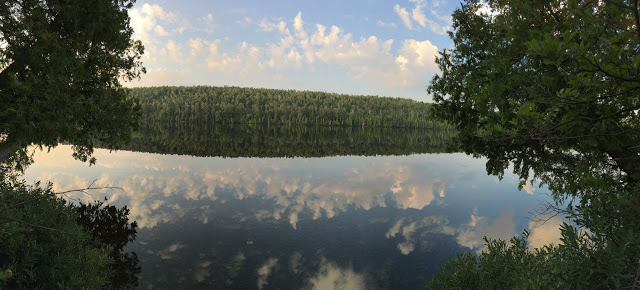
Lake Fanny Hooe

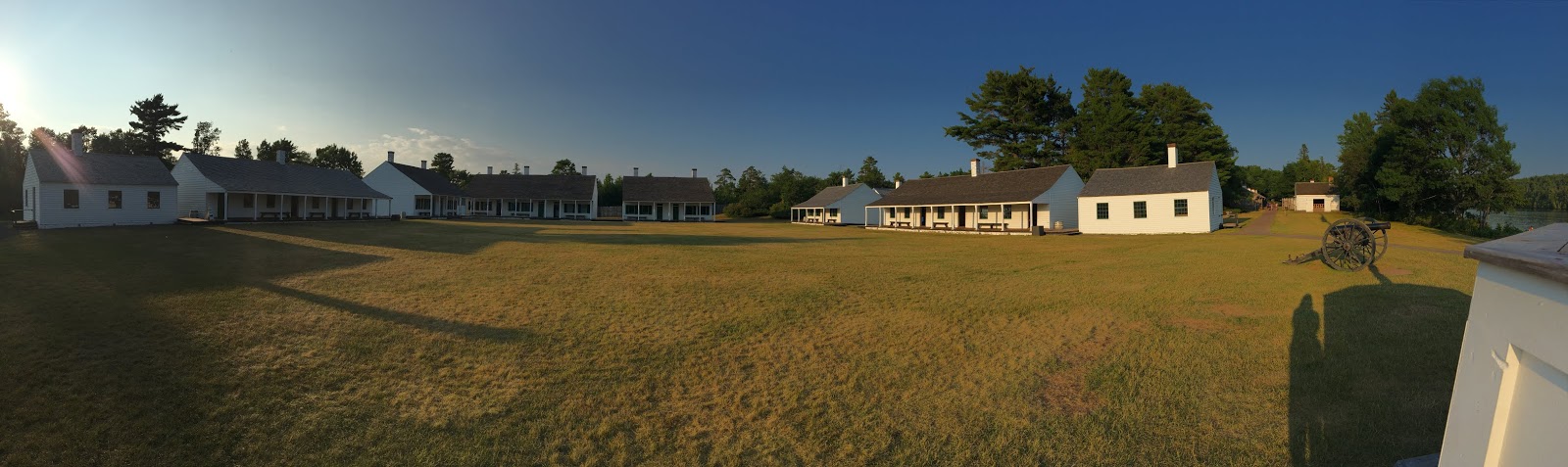
The next morning after breakfast Astrid took a good long look at the weather forecast for the day and decided to take a walking tour of Ft. Wilkins first, and save the mine tour for when it rained later that day.  Ft. Wilkins was built in 1844 as a military outpost to protect miners from Indigenous peoples and keep order, but it turned out largely to be unneeded. The buildings showcased soldiers’ quarters, kitchens, and various old outbuildings, including a blacksmith’s shop. 

 
Next they stopped at Brockway Mountain Overlook, looked over Copper Harbor and the surrounding mountains, then programmed GPS to Delaware Mine. 
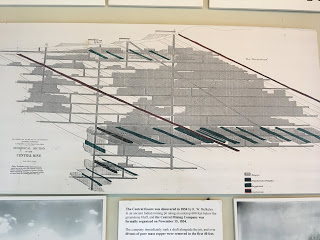
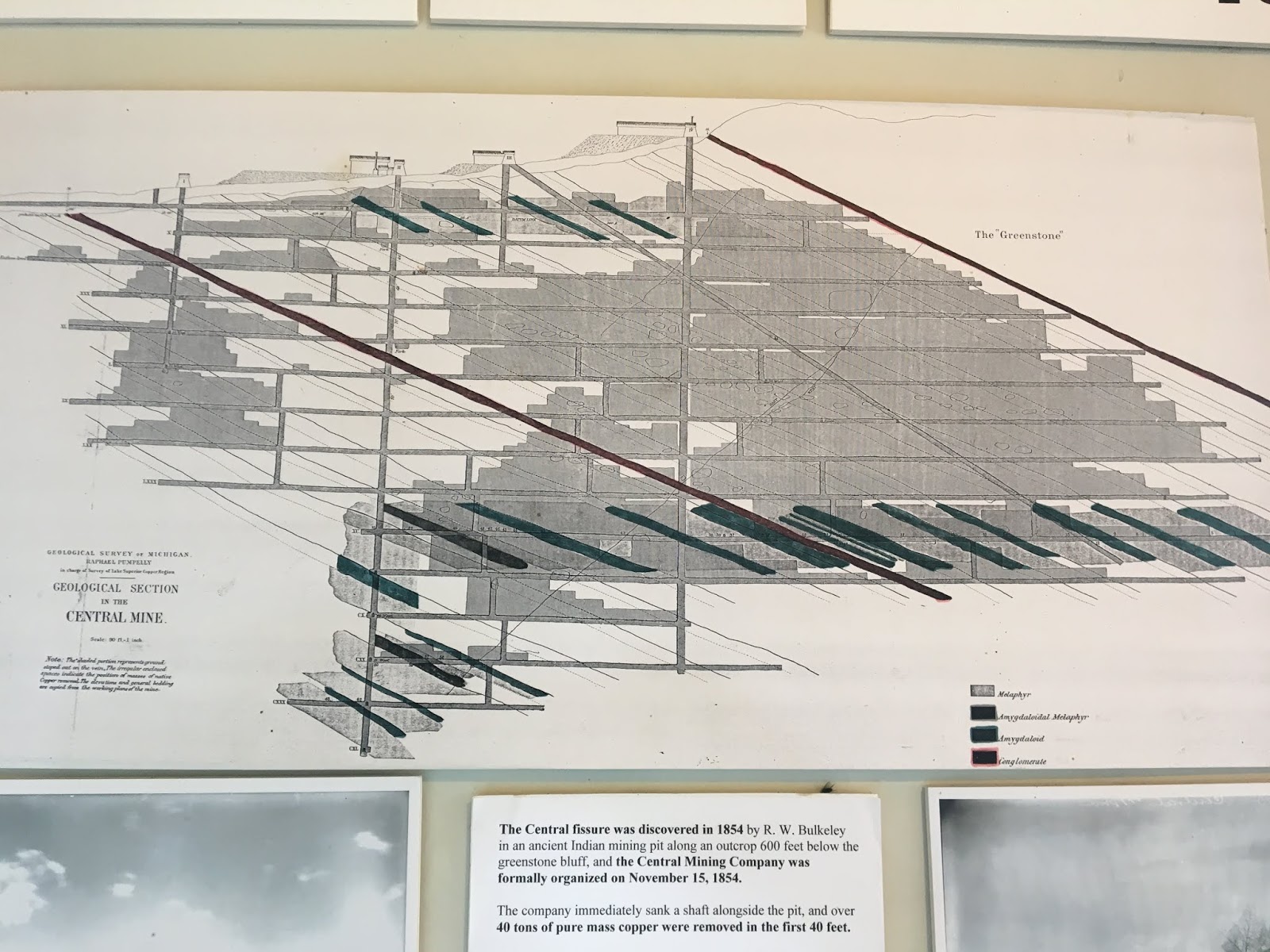
The Central Mine, 14 levels down


The Delaware Mine is now a tourist attraction, but in its day it employed hundreds of miners, primarily from Cornwall, England, and brought up eight million pounds of copper from 1847 -1887. After paying for admission in the gift shop, and petting the mine’s dog, the proprietor asked, 
 
“Wanna see my pet?” 
 
When someone is asked this question, it is best to take into consideration where one is. If someone asked Astrid this in the middle of a big, metropolitan city, she would probably say no and run. But she was in Michigan’s UP. 
 
The proprietor took a small basket from behind his desk, set it down and pushed some of the straw aside to show a furry black thing with a dark nose nuzzling deeper, away from the light. 
 
“A skunk?” Astrid asked. “Oh, so sweet! Snorri, come see!”
 
“He’s sleeping and won’t want to wake up, but you can look.” 
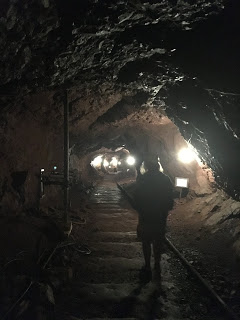
 
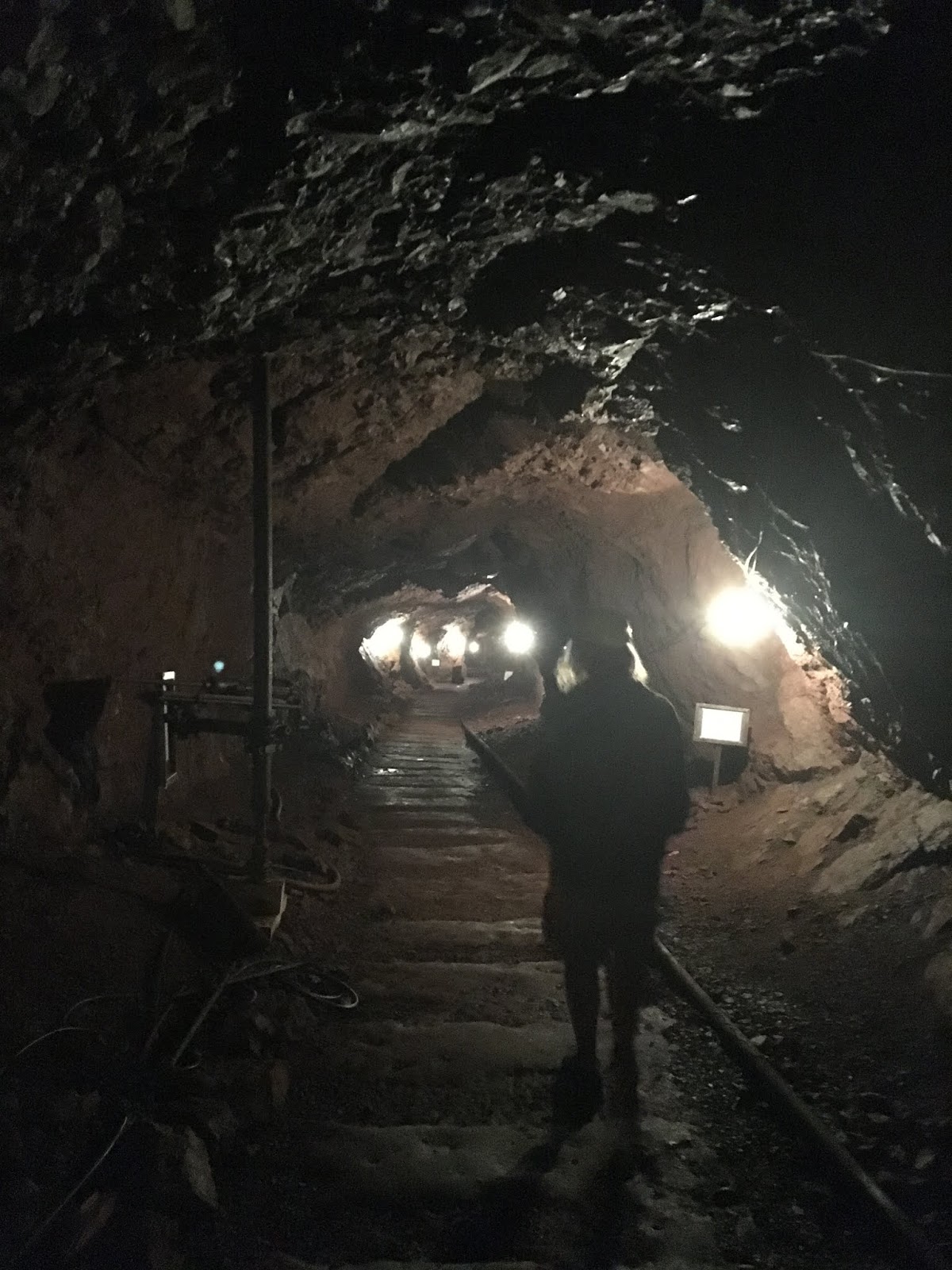
Astrid gooed over the furry little animal a few minutes, not even bothering to ask if it was still “loaded.” After watching a short film on the history of the mine, they donned hardhats with lights and self-guided themselves down steps a few stories into the mine. This mine was full of reddish rock. Huge timber beams lay here and there, some blocking deserted shafts. As they walked the length of the shafts, little bats fluttered high above them in the cold, damp air. At the very end of the level there was a shaft heading down at a 45 degree angle into infinite darkness, and to know that there were half a dozen levels, albeit, now filled with water, below them, brought on a certain claustrophobia that made Astrid shiver.
 
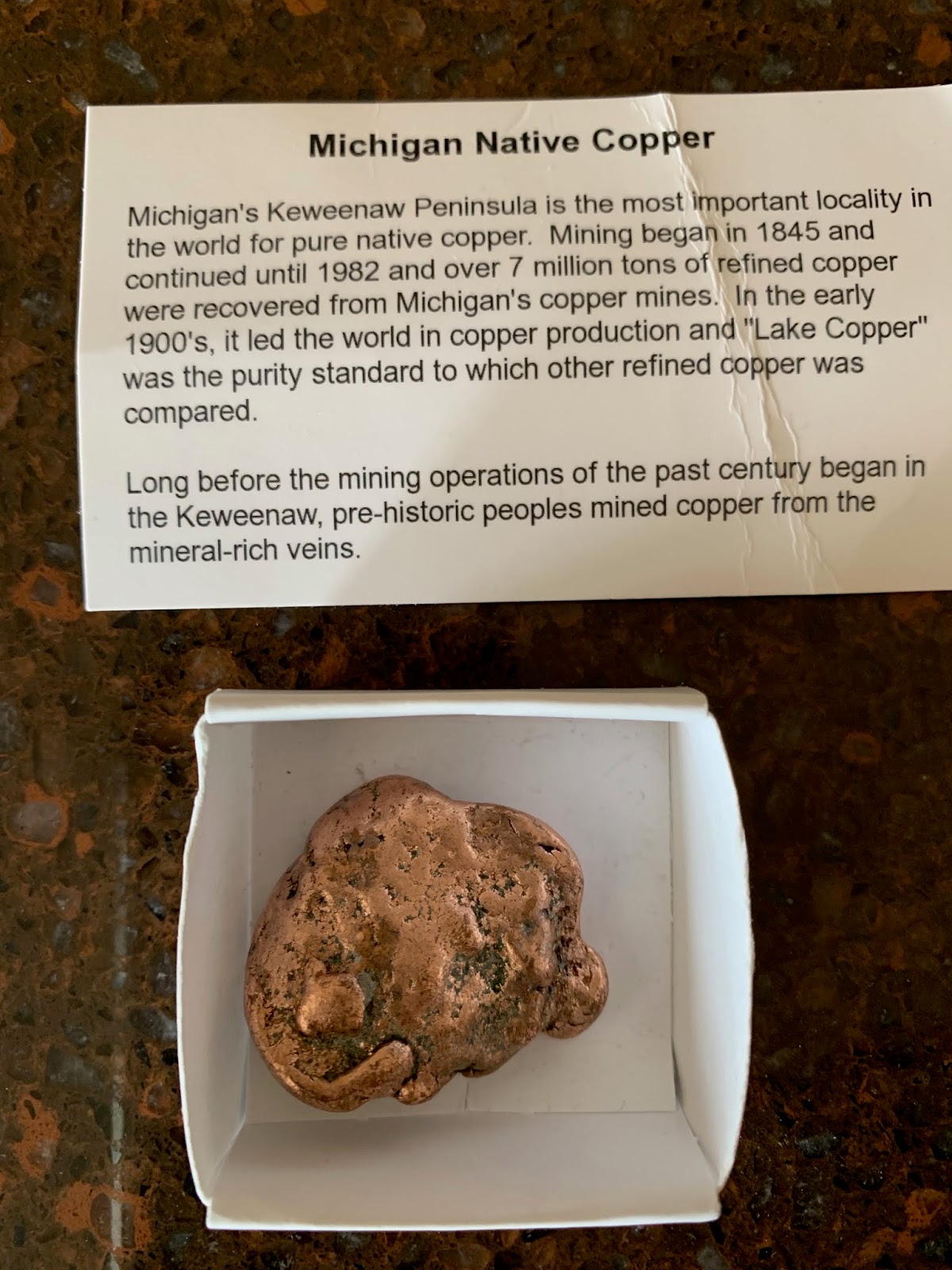
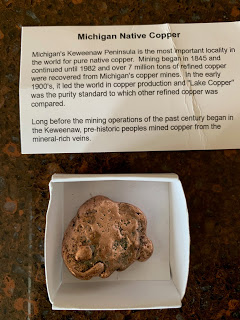
After emerging from the mine where it was a cool 52 degrees into mid-80s, they walked around the grounds, reading about the remains of stamping mills, processing buildings and whatever was left of the mine operations. Astrid bought a nugget of native copper as a memento.
 
At the Jampot Bakery, run by monks, they picked up some monk jam for Olaf, and some chocolate bars, Astrid marveling at the shelves of jam and the beautiful Eastern Orthodox icons on the walls. Snorri wanted to stop at the Blacksmith exhibit, then they set the GPS for the Laurium Manor Hotel. 
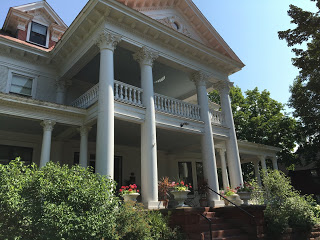
 
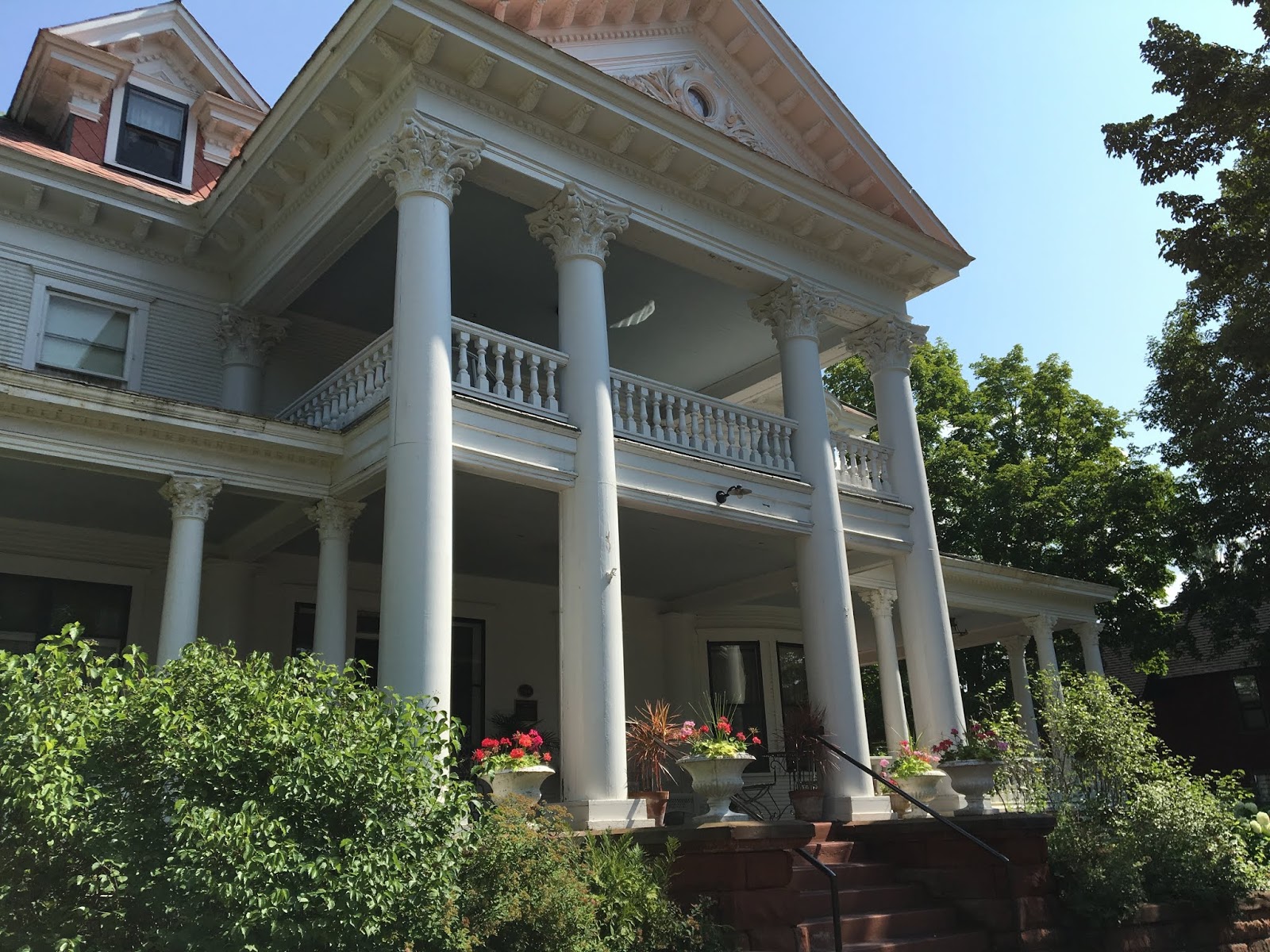
Astrid loved old houses: the smell of the old wood, the ornate architecture and the history infused into every nook and cranny lit up her mind with interest and imagination. The Laurium Manor Hotel was a working hotel, so they couldn’t go into the rooms that were occupied, but there was plenty of 19th Century opulence to see as they walked through the Manor-Hotel, marveling at the ornamental detail and craftsmanship and the old-time luxury copper fortunes had bought.  
 
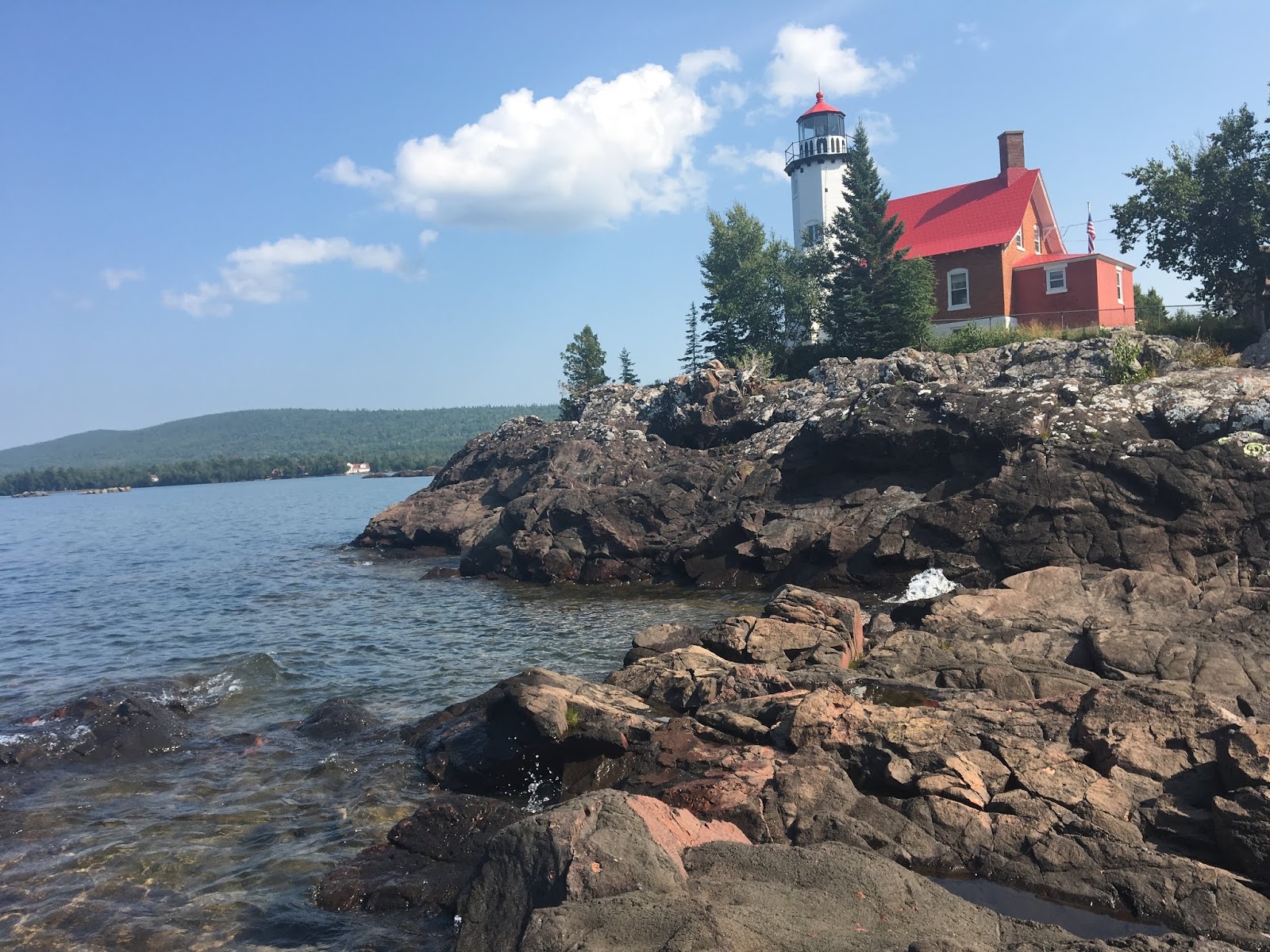
Eagle Harbor Lighthouse was very similar to the lighthouses they had toured in the lower peninsula, like Little Sable Point and Big Sable Point, etc. They were quaint houses attached to big cement towers topped with lights. After climbing to the top and back down, they explored the magnificent rock formations on the shore

Dinner was salmon fried over the camp stove at Ft. Wilkins Campground, then Astrid visited the historic fort again, taking in more detail and pictures. 
 
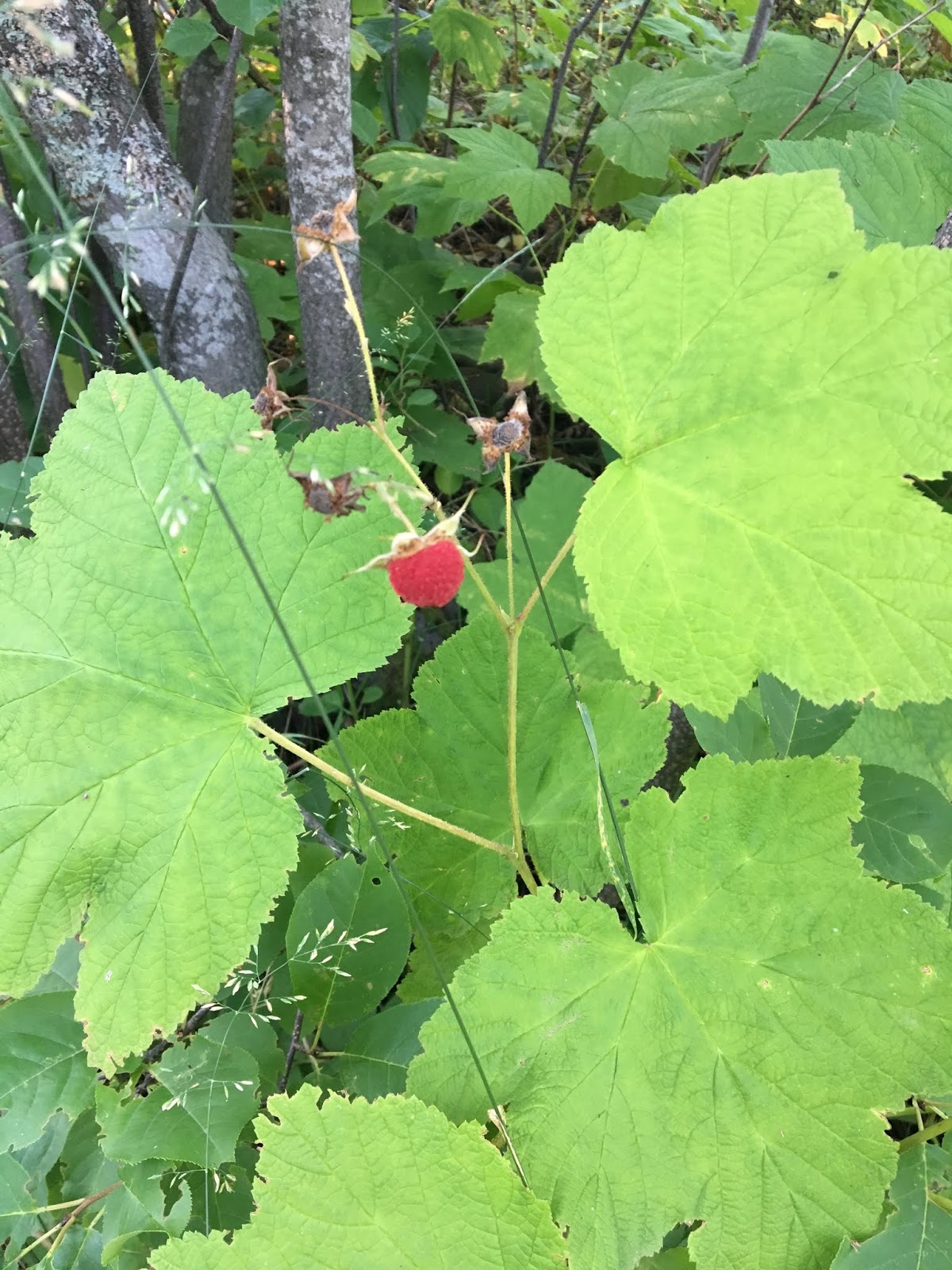
In the UP, along the road she saw signs for thimble berry jam. At the monk’s bakery, she saw jars of it, expensive at 18$ a pint. But what was this thimble berry? A little chagrined to be a plant-person and not know what it was, she made a guess. Along the path to Ft. Wilkins was a plant she had seen before, in Michigan forests and in Pennsylvania, but didn’t have a name for it. It had lobed, hirsute leaves, spiny stems,  raspberry pink or white flowers and very-raspberry looking fruit, except bigger and less copious. She guessed right: the berry that was all over the UP and sprinkled in the forests was Thimbleberry, or Rubus parviflorus.
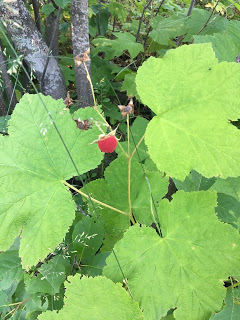
Thimbleberry


The next morning after breakfast they packed up camp and drove Brockway Mountain Drive 26, lined with plenty of pull-offs and overlooks, before leaving the Keweenaw Peninsula. After passing back through Hancock, then Houghton, they drove by Michigan Technological University, where Highway 41 hugged Lake Portage, then made a bee-line for the shores of Lake Superior, as if the road longed to be near water. Around Baraga, MI is one of the most beautiful drives, with the highway just a few hundred yards from lake and the surrounding land lay flat, with a clear view across the L’Anse Bay. 
 
They crossed the five-mile Mackinac Bridge into the LP, hung a right, drove a few miles and found their campsite at Wilderness State Park, which was a dark park. It was not as silvan or wild as Ft. Wilkins’ campground. Maybe it was because of the Perseid Meteor Showers that weekend that filled the park to capacity (a family looking for a last minute site at the registration desk was turned away). Looking down the crowded paths, one only saw trailers, RVs, huge tents, campers, cars and trucks. 
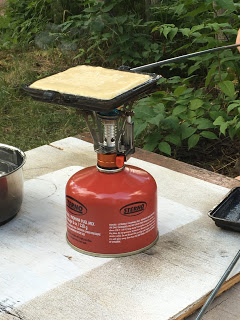
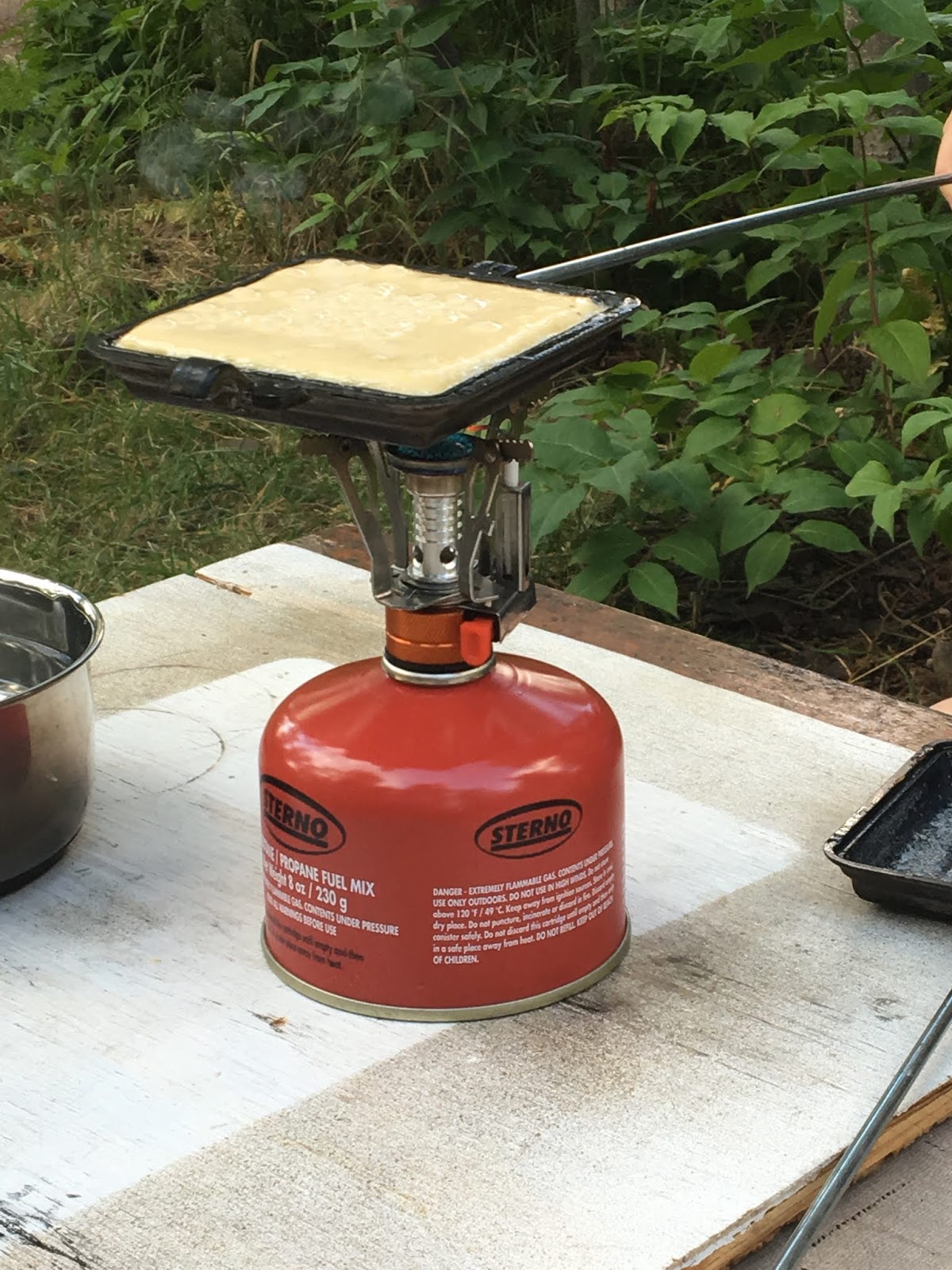
Pancake, in  pie iron, over a camping stove.


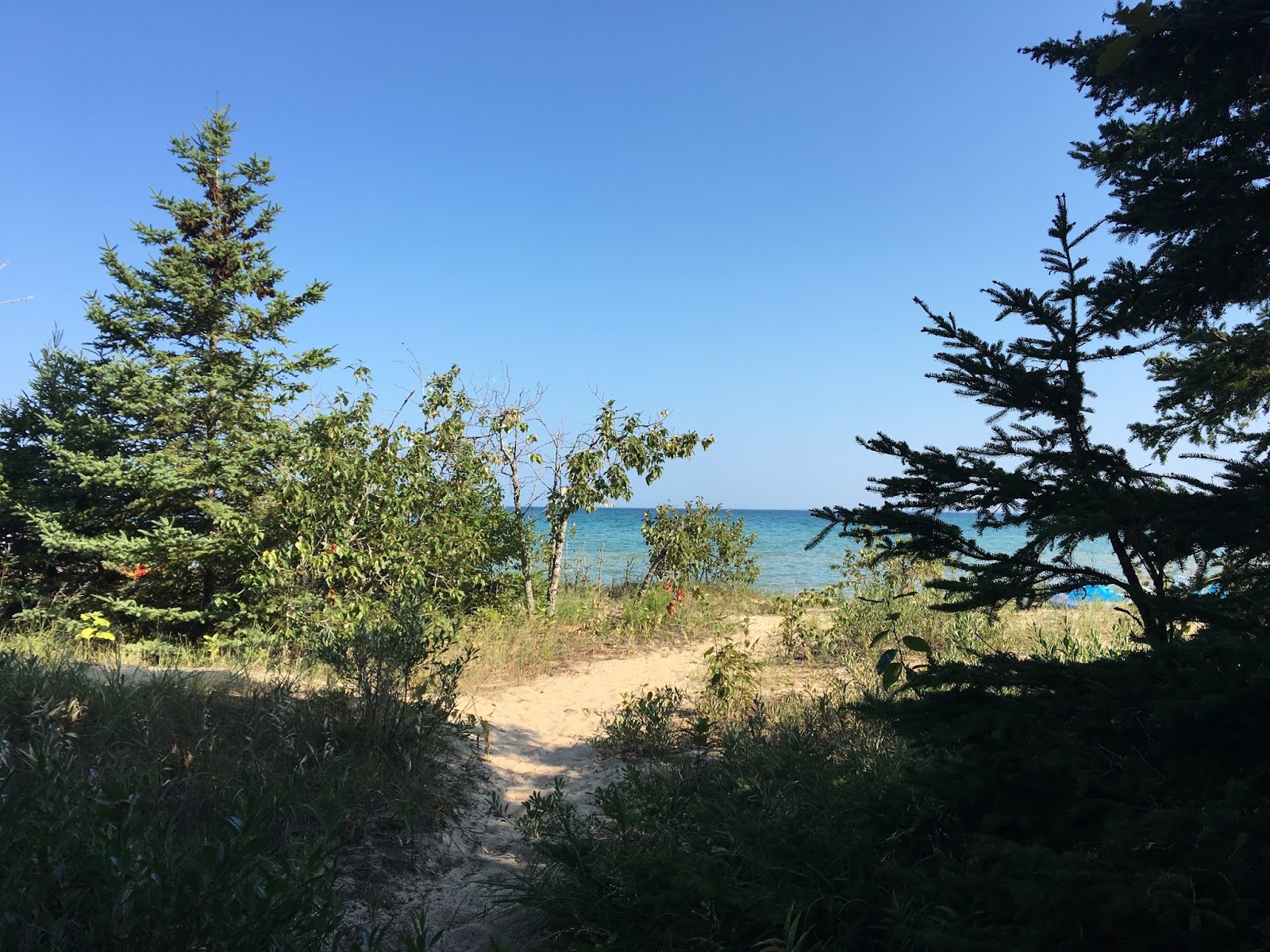
Astrid and Snorri’s campsite for the night was wedged between a huge camper and a mid-sized RV, both with all the trimmings: canopies, fire-ring, a dozen lawn chairs, strings of gaudy lights, and tents for overflow sleeping. But though the interior of the camp was packed to the gills, on the other side of the tree line at the back of their site was a section of the beach to Lake Michigan, much calmer and clearer of human traces than the front. Astrid set up her tent, Snorri his hammock (because they would only be there for one night), cooked dinner then took showers. After some reading on the beach and exploring the area, they went to bed and fell asleep to the fire-side conversations of their neighbors.
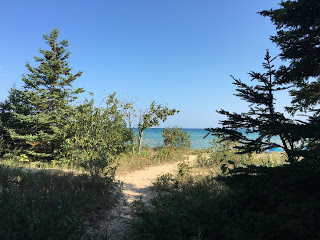
The back of the campsite


Before setting off the next morning, they stopped in Mackinaw City and picked up some Mackinaw fudge after looking through the many tourist shops there. The whole family had been there years before, took the ferry to Mackinac Island State Park and did everything that a trip to the island entailed. Astrid often referred to it as the “Gatlinburg (Tennessee) of the North,” having similar touristy auras. 
 
The five-ish hour drive back to Southwest Michigan seemed like ten because Astrid was tired, but she didn’t want to stop except for gas. By the time they drove through the cherry growing region of Michigan, then through the peach-growing region, back to the grape-growing region of the sandy shores of lower Lake Michigan, they were tired. There was still ice in the cooler. As Astrid unpacked the tents and everything that went with them, she was happy, fulfilled.
 
Ten years before, she had  questions, “What did the first copper prospectors experience up there? What does the UP of Michigan look like? What was is it like at the tippy top of Michigan?” 
 
And now she had some answers: As to what the prospectors experienced, she knew she saw only the good side of the weather: mild and kind with just a few showers to make things interesting.  Winter was often long and cruel up there. As to what the UP looked like? It is an extraordinarily beautiful wilderness with raw rocks, wonderful parks and exquisite wildernesses. 
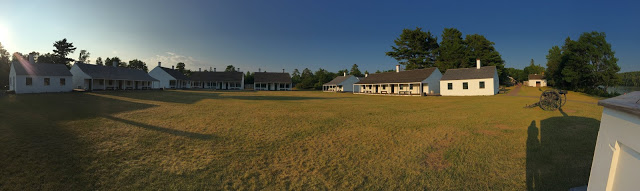
 
Fort Wilkins


Iceland's Palette, and Signs

p.p1 {margin: 0.0px 0.0px 0.0px 0.0px; font: 12.0px Baskerville; color: #000000; -webkit-text-stroke: #000000}
p.p2 {margin: 0.0px 0.0px 0.0px 0.0px; font: 12.0px Baskerville; color: #000000; -webkit-text-stroke: #000000; min-height: 14.0px}
span.s1 {font-kerning: none}


April 7, 2018

The next morning, at their last breakfast in the quaint farmhouse kitchen of the Hrifunes Guesthouse, Astrid observed what had been staring at her for the past few mornings: a stuffed raven on top of the cupboards. Relaxed a little, she now saw a lot of things she had passed up: photography of the surrounding rolling hills covering the walls, other stuffed wildlife adorning the place. 

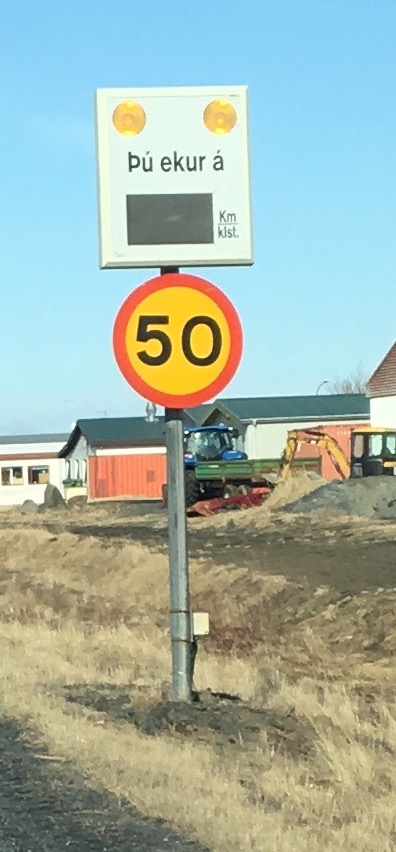
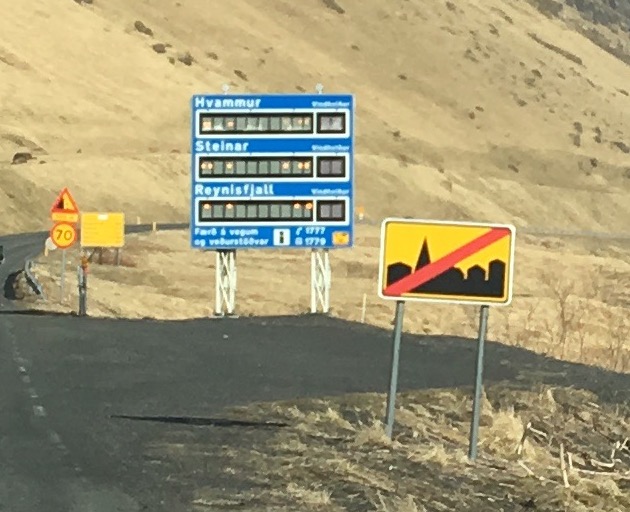
After breakfast they packed up and started their last magnificent drive in Iceland, to the Keflavik Airport. The view from the road, in this magnificent country was as affecting as walking through it, but in a car, you saw more. Before you drove through small towns, you were greeted with signs of an electronic smiley face or frowning face, depending how fast you were going. Signs let you know when you were leaving towns, when you were entering them. 

Seljalandsfoss

The beauty of Iceland, what is so bold, attractive and draws so many visitors is like a black and white photo. Most of what Astrid saw consisted of waterfalls, mountains, snow, glaciers (ice) and crystal clear water: not impressive if they were all the same, but they occurred in such a wide variety of sizes and forms, that each one had its own visual spectacle. Though there were some green patches, especially along the road in southern Iceland, it was evident that the frigid island did not capitulate to the vernal equinox so easily as did some other parts of the world. Green was a hard won, long-awaited color on that island of ice and fire. 


Gljúfrabúi

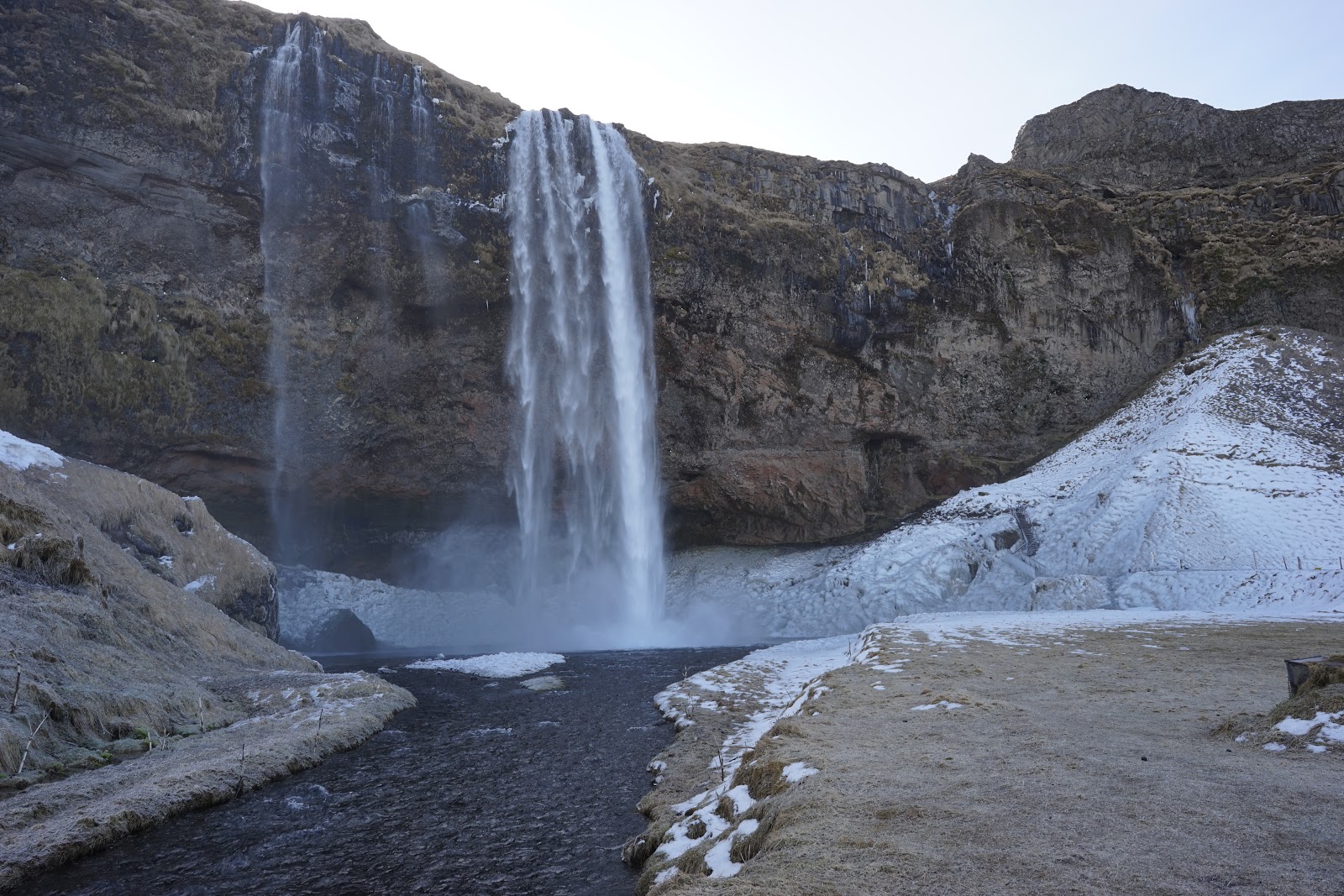
On the way to the airport, they stopped at Seljalandsfoss, the waterfall where tourists are able to walk in back of it. But the wind was blowing, it was below freezing and the family didn’t relish getting an ice bath before boarding the plane so they took a quick hike to yet another water fall, Gljúfrabúi, set back in a cavern. 


As they drew closer to Reykjavik, buildings and houses grew more common and closer together, roads filled up with more traffic. But still, volcanic nature let herself be known, by lava rock plains and steaming earth along the roadside.

At the car rental place, they bid farewell to the Viking Toe 5 with some nostalgia, then walked to the airport. There, they ate their final Icelandic meal, Bjorn and Snorri had Icelandic hot dogs, Astrid, a salad with barley. Then Astrid and Snorri took one last memento: Iceland’s water, by filling up their water bottles. 


The family left Iceland wanting to go back in a different season, when the island wore more shades of green and when the temperatures were just a little warmer (it never gets much above 50 degrees F, even in summer). 

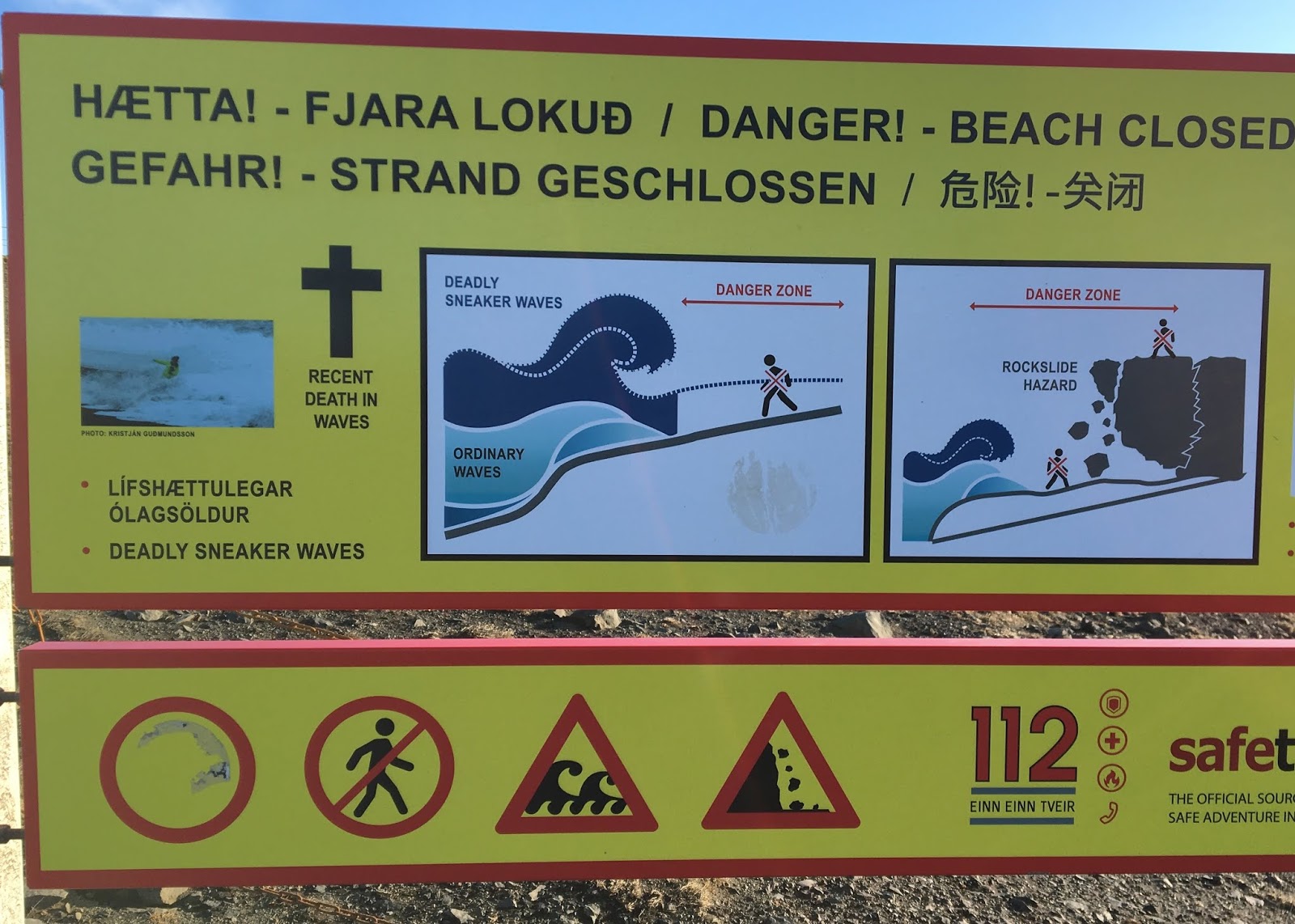
One thing that kept coming up throughout their trip was signs. Whenever traveling, but especially traveling outside one’s own country, signs, and the ability to understand them become very important, even to the point of life or death. 

Because Iceland is a relatively newish travel hotspot, tourists in the past have made sometimes lethal faux pas when visiting the wild island, which has lead tourism to put up many, many signs. Signs about things that Icelanders (and Michiganders) take for granted, things drilled into our heads about the dangers of ice, wind, water and rocks, which may not be apparent to other tourists. 
At the Geysir
At most overlooks


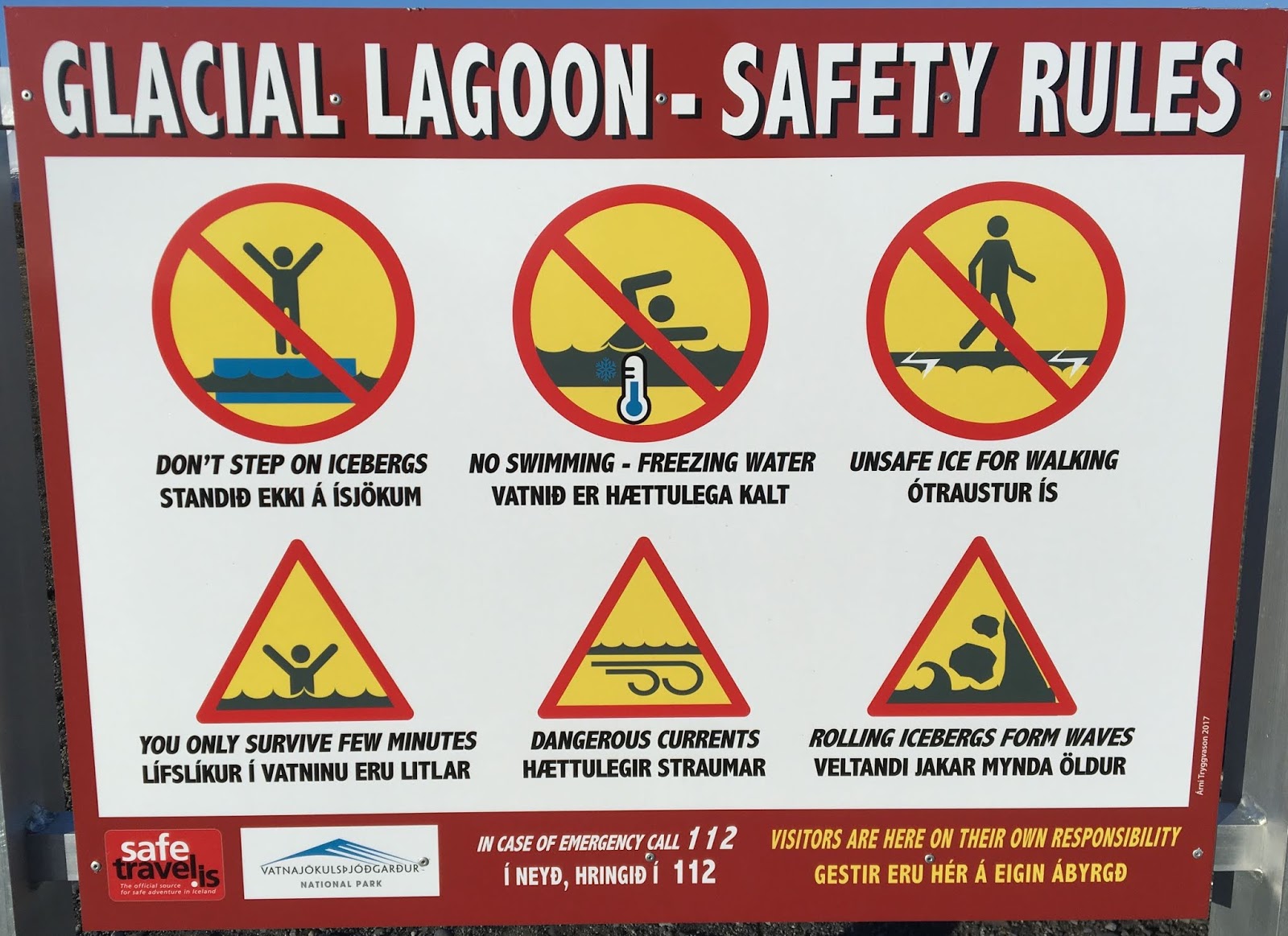
For example, the “no walking on the ice” signs. Tourists may think “I see it on cartoons all the time, I’ll just walk out on this ice floating in the glacier lagoon, it will be fun,” not understanding the real danger to their lives. It’s just cold water, right? Living in Michigan, by the lake, the family knew these dangers, they knew the gravity of the risk, it’s drilled into kids and adults with every life lost to the lake. But someone who doesn’t live in a place with ice and snow and near-frozen water temperatures may think the warning is over exaggerated. Hence the need for overly-cautious, plentiful signs. 

Other signs were reminders of respecting nature, (for Pete’s sake!), be a good tourist, don’t hurt the areas around you, and don’t let your kids do it either. And some signs were necessary to deter people skirting restrictions.

… you will need this sign.
If you have this sign …


Everywhere the family went, there were signs, and to the very good credit of Iceland, most of them were clearly comprehensible. 

The signs in Iceland were different than in most places she’d been to, though the landscape palette was the same–sky, rocks, water, earth, ice, snow, light. Iceland used these colors so ruggedly and artfully, with force and reckless austerity, that going back to the mild dunes and relatively calm Lake Michigan seemed like a small let-down. 


“The moss is flammable”

Iceland was a lot like Hawaii: an island full of plains of endless lava rock, mountains, waterfalls and plentiful bodies of water; but Iceland had the added magic of ice and snow with which to work, as well as the resilient, friendly and hardy people that lived there. 

Sitting on the plane, watching Iceland grow smaller, she tried to recall the highlights of her travel. Though cold and chilled most of the time, the open fierce landscape flanking the roads sank into her thoughts, to where she could feel something growing, like a story, a creation. There was room for it to grow and change and make something marvelous. She did not know what it was yet, and may not for a long time, but there was a seed she recognized as valuable and edifying. 


P.S. Though recreating a personal Icelandic Saga after the style of The Sagas of Icelanders seemed an interesting concept at the beginning of this blog series, it proved to be a little difficult to create the aura of those ancient stories within the family on this trip. The family lacked a certain vengeful spirit, they never drank alcohol to oblivion nor acted on their inebriated impulses, didn’t bring their swords, shield, daggers or longboats with them, steered clear of violence in general and simply could not bring themselves to pillage unsuspecting villagers, as the Vikings did in The Sagas of Icelanders. They may have expressed a few minutes of ill-will (more confusion, than ill-will, really) to the man who denied them a parking spot in the supposed “buses only lot” at Gullfoss, that was all. They did, however, take quite nicely to their Viking names, and may keep them for further blogging use. 

Thanks for reading!

Iceland’s Palette, and Signs


April 7, 2018
 
The next morning, at their last breakfast in the quaint farmhouse kitchen of the Hrifunes Guesthouse, Astrid observed what had been staring at her for the past few mornings: a stuffed raven on top of the cupboards. Relaxed a little, she now saw a lot of things she had passed up: photography of the surrounding rolling hills covering the walls, other stuffed wildlife adorning the place. 
 
After breakfast they packed up and started their last magnificent drive in Iceland, to the Keflavik Airport. The view from the road, in this magnificent country was as affecting as walking through it, but in a car, you saw more. Before you drove through small towns, you were greeted with signs of an electronic smiley face or frowning face, depending how fast you were going. Signs let you know when you were leaving towns, when you were entering them. 
 
Seljalandsfoss

The beauty of Iceland, what is so bold, attractive and draws so many visitors is like a black and white photo. Most of what Astrid saw consisted of waterfalls, mountains, snow, glaciers (ice) and crystal clear water: not impressive if they were all the same, but they occurred in such a wide variety of sizes and forms, that each one had its own visual spectacle. Though there were some green patches, especially along the road in southern Iceland, it was evident that the frigid island did not capitulate to the vernal equinox so easily as did some other parts of the world. Green was a hard won, long-awaited color on that island of ice and fire. 

 
Gljúfrabúi

On the way to the airport, they stopped at Seljalandsfoss, the waterfall where tourists are able to walk in back of it. But the wind was blowing, it was below freezing and the family didn\’t relish getting an ice bath before boarding the plane so they took a quick hike to yet another water fall, Gljúfrabúi, set back in a cavern. 

 
As they drew closer to Reykjavik, buildings and houses grew more common and closer together, roads filled up with more traffic. But still, volcanic nature let herself be known, by lava rock plains and steaming earth along the roadside.

At the car rental place, they bid farewell to the Viking Toe 5 with some nostalgia, then walked to the airport. There, they ate their final Icelandic meal, Bjorn and Snorri had Icelandic hot dogs, Astrid, a salad with barley. Then Astrid and Snorri took one last memento: Iceland’s water, by filling up their water bottles. 


The family left Iceland wanting to go back in a different season, when the island wore more shades of green and when the temperatures were just a little warmer (it never gets much above 50 degrees F, even in summer). 
 
One thing that kept coming up throughout their trip was signs. Whenever traveling, but especially traveling outside one’s own country, signs, and the ability to understand them become very important, even to the point of life or death. 
 
Because Iceland is a relatively newish travel hotspot, tourists in the past have made sometimes lethal faux pas when visiting the wild island, which has lead tourism to put up many, many signs. Signs about things that Icelanders (and Michiganders) take for granted, things drilled into our heads about the dangers of ice, wind, water and rocks, which may not be apparent to other tourists. 
At the Geysir
At most overlooks


For example, the “no walking on the ice” signs. Tourists may think “I see it on cartoons all the time, I’ll just walk out on this ice floating in the glacier lagoon, it will be fun,” not understanding the real danger to their lives. It’s just cold water, right? Living in Michigan, by the lake, the family knew these dangers, they knew the gravity of the risk, it’s drilled into kids and adults with every life lost to the lake. But someone who doesn’t live in a place with ice and snow and near-frozen water temperatures may think the warning is over exaggerated. Hence the need for overly-cautious, plentiful signs. 
 
Other signs were reminders of respecting nature, (for Pete’s sake!), be a good tourist, don’t hurt the areas around you, and don’t let your kids do it either. And some signs were necessary to deter people skirting restrictions.

… you will need this sign.
If you have this sign …


Everywhere the family went, there were signs, and to the very good credit of Iceland, most of them were clearly comprehensible. 
 
The signs in Iceland were different than in most places she’d been to, though the landscape palette was the same–sky, rocks, water, earth, ice, snow, light. Iceland used these colors so ruggedly and artfully, with force and reckless austerity, that going back to the mild dunes and relatively calm Lake Michigan seemed like a small let-down. 

“The moss is flammable”

Iceland was a lot like Hawaii: an island full of plains of endless lava rock, mountains, waterfalls and plentiful bodies of water; but Iceland had the added magic of ice and snow with which to work, as well as the resilient, friendly and hardy people that lived there. 

Sitting on the plane, watching Iceland grow smaller, she tried to recall the highlights of her travel. Though cold and chilled most of the time, the open fierce landscape flanking the roads sank into her thoughts, to where she could feel something growing, like a story, a creation. There was room for it to grow and change and make something marvelous. She did not know what it was yet, and may not for a long time, but there was a seed she recognized as valuable and edifying. 

P.S. Though recreating a personal Icelandic Saga after the style of The Sagas of Icelanders seemed an interesting concept at the beginning of this blog series, it proved to be a little difficult to create the aura of those ancient stories within the family on this trip. The family lacked a certain vengeful spirit, they never drank alcohol to oblivion nor acted on their inebriated impulses, didn’t bring their swords, shield, daggers or longboats with them, steered clear of violence in general and simply could not bring themselves to pillage unsuspecting villagers, as the Vikings did in The Sagas of Icelanders. They may have expressed a few minutes of ill-will (more confusion, than ill-will, really) to the man who denied them a parking spot in the supposed “buses only lot” at Gullfoss, that was all. They did, however, take quite nicely to their Viking names, and may keep them for further blogging use. 

Thanks for reading!

12 Stops in South Iceland

#8
April 6, 2018 Friday
 
On the way to breakfast the next morning, the family was greeted by the Hrifunes Guesthouse dog, a small, whitish, long-haired canine. As they ate breakfast, from the warmth of the dining room, they watched the sweet pooch jog here and there across the icy property. 
 
#1

1)  The first stop that morning was at a wide, snowy, icy waterfall pouring out from between two mountains. Freezing water flowed over ice and rock, and though it was a sunny morning, the water fall was still very much in shadow. As she walked, Astrid cleaned off the mud from her boots on the snow that covered the plain in front of it.

 
#2

2) On the Þjóðvegur Highway 1, running along the south of Iceland,  there were many photographic opportunities, with places to pull off, and Bjorn took full advantage of them. The second stop of the day was at a pull-off by a picturesque stream, with a little building beside it. 

Now Astrid and Snorri could have just as well stayed at the bed and breakfast and been just as content and useful, but part of this trip was to see and experience new things, albeit, even if from the relative safety of the car-seat warmers. So, Astrid and Snorri spent some of these stops in the Viking Toe 5 watching as Bjorn patiently took pictures.
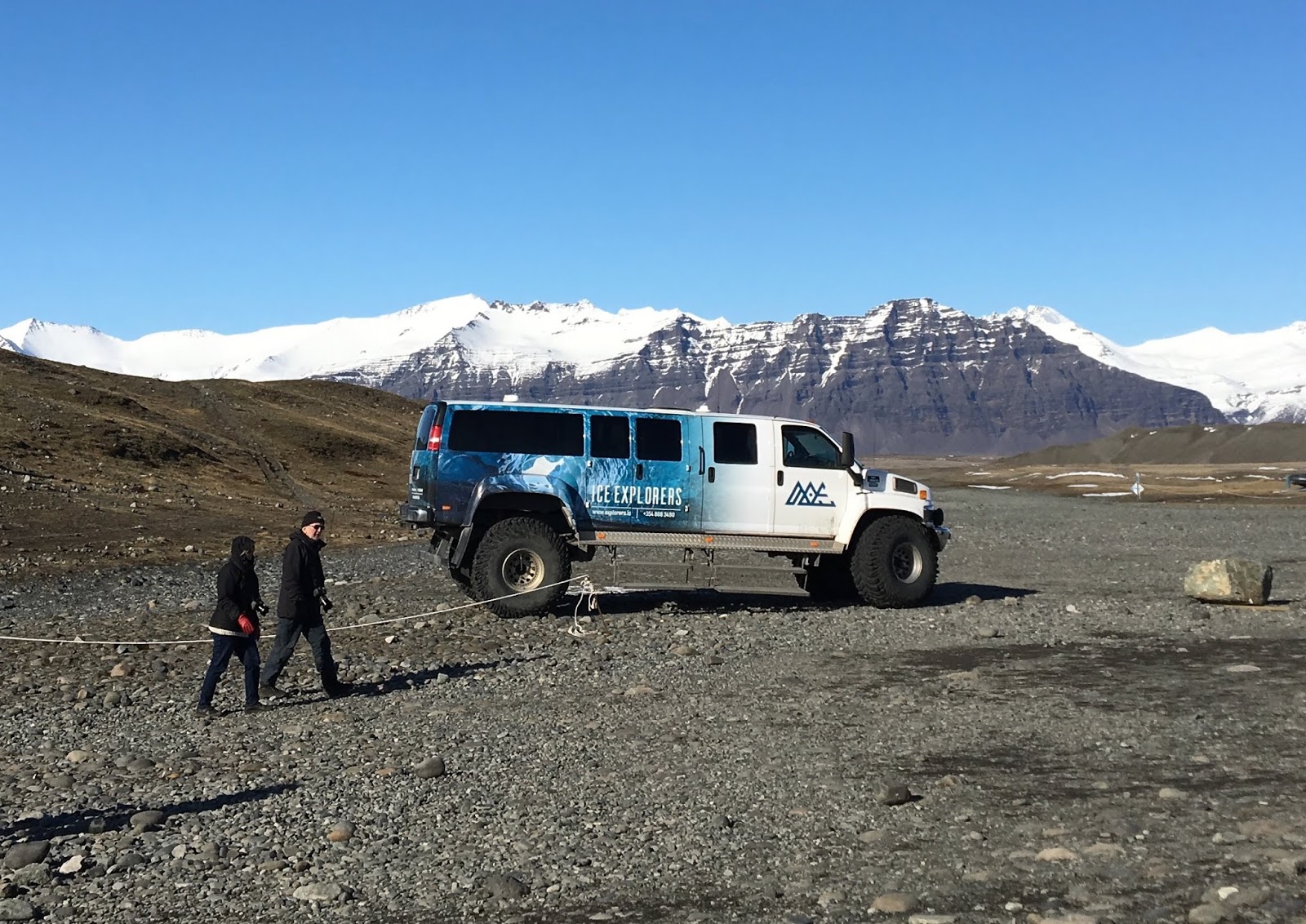
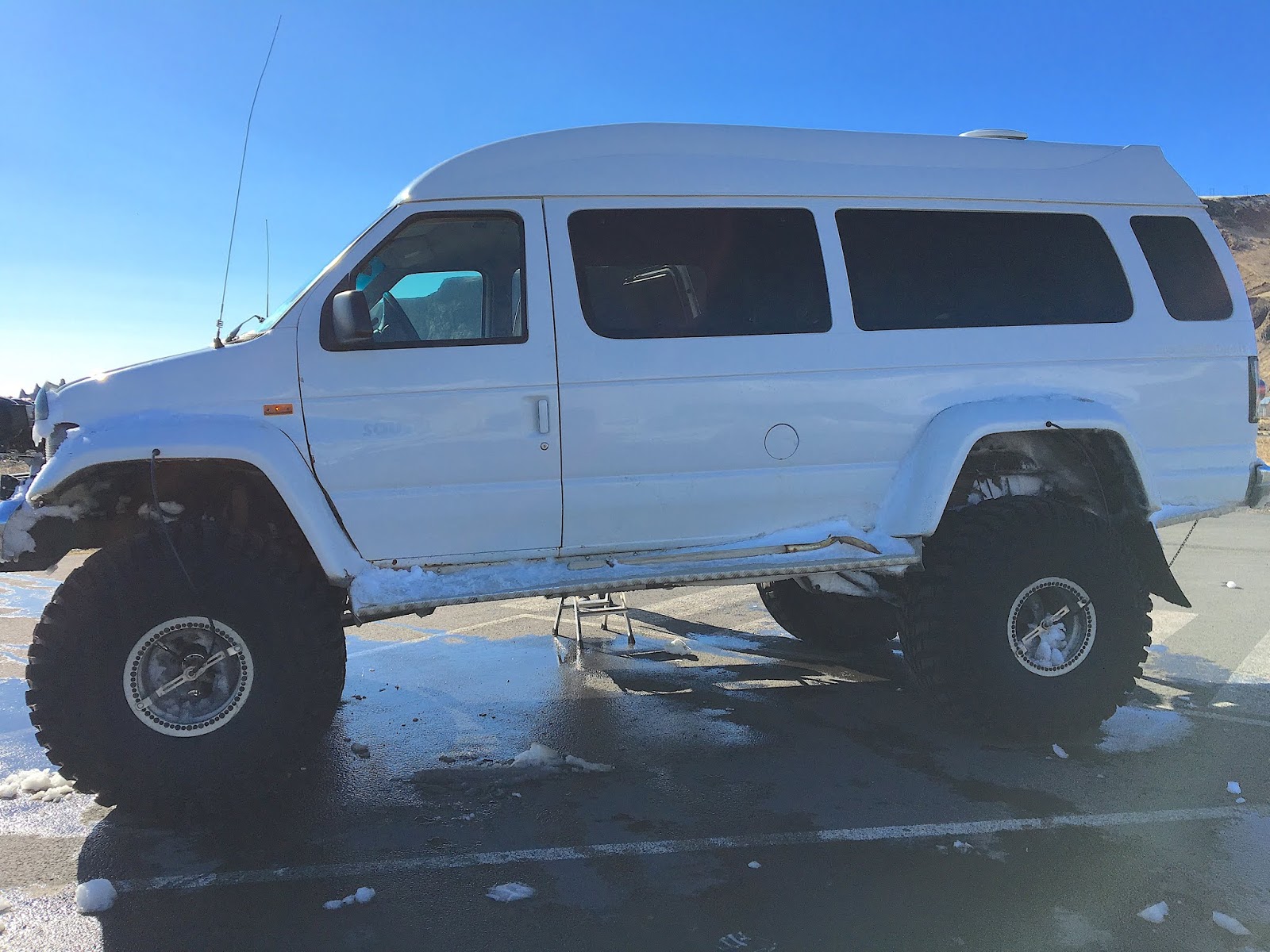
#3 The Ice Explorers \”Van\”
 3) Bjorn insisted in driving up the lane to Fjallsárlón Boat Tours building, which was situated in front of a large glacial lagoon, in order to ascertain its photographic potential. 
4) 1 1/2 mile drive east down the road to a barren, flat, wide plain of volcanic rock covered with moss, and glaciers in the distance. 
#4

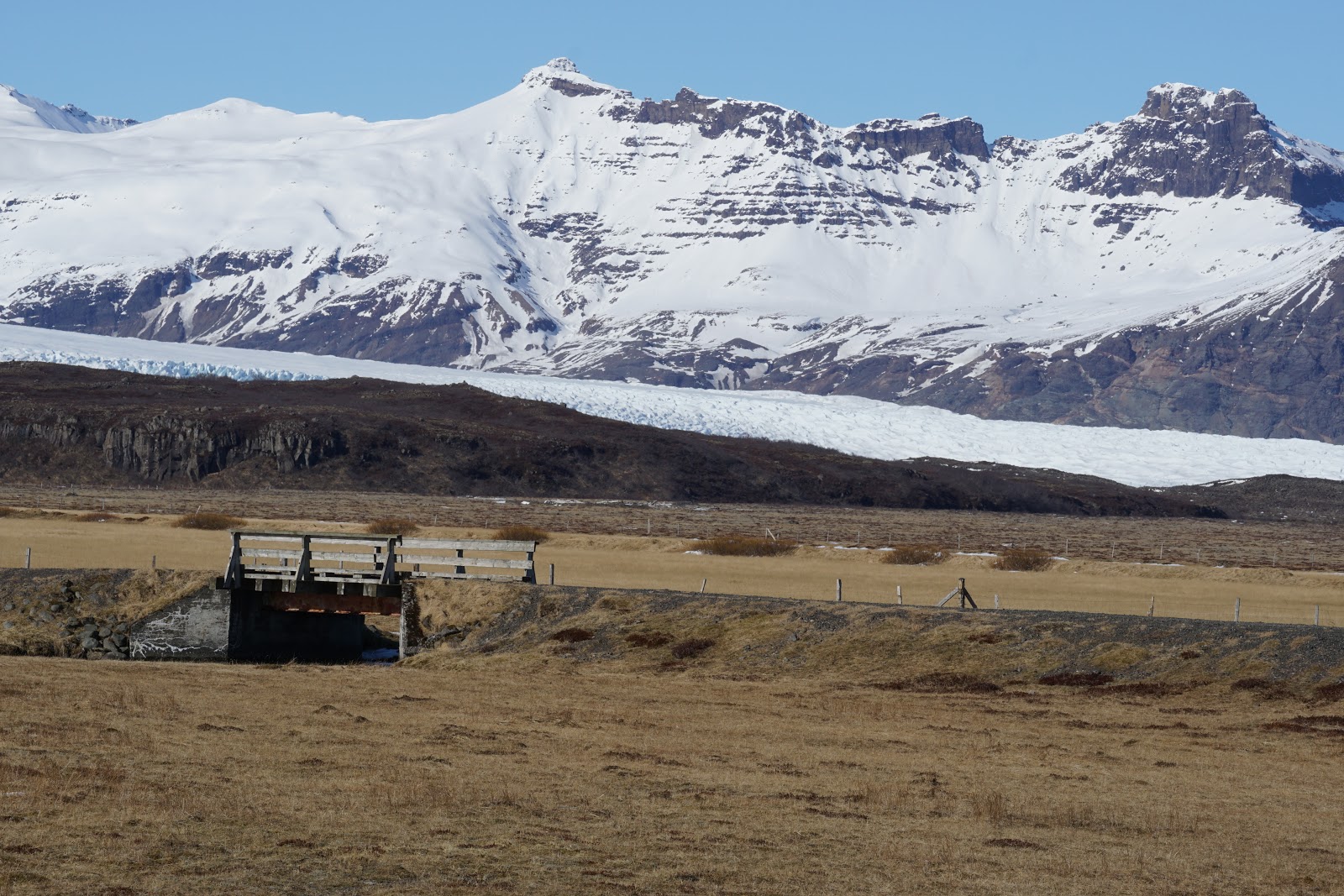
 5) Mountains with a little bridge and a glacier in the background.

 
6) Random, nondescript pull-off to decide where to go next.
#5

7) Jökulsárlón Glacier Lagoon looking for Fish & Chips for lunch. This was the third time in the whole trip they stopped there, it was the place they were greenlighted while waiting for the no-show Northern Lights. Bjorn got out, walked to the visitor center, brought back negative news. 

 
8) Drove back to Fjallsárlón Boat Tours location and actually walked into the cafe there to eat. As they were paying, the cashier, in very good English asked Snorri, “Do you know who Kurt Cobain is?”  
 
“Huh?”  (Obviously not.)
 
“Kurt Cobain, he was the singer in Nirvana, a grunge band.”
 
“Oh, he wouldn’t know Kurt Cobain,” Astrid jumped in, feeling a little neglectful of her son\’s very limited alternative music education. 
 
“Well, you look like him, a little,” the man said. 
#8 Big Glacier, Small Boat


As the family munched their lunch–Bjorn chicken, Snorri, ham and cheese, and Astrid mushroom soup–Bjorn and Astrid schooled their son a little on Kurt Cobain and the grunge music era. They overheard the cashier telling other tourists that he lived on a sheep farm a few miles from the place. 
 
Outside, they walked to the glacial lagoon and watched as a few men launched an inflated boat into the water. There was an option to take a boat ride to the edge of the glacier, but the family didn’t. 

 
#9 “You only survive few minutes” -the upside of drowning in a glacial lagoon.

9) Jökulsárlón Glacial Lagoon was next, this time with lots of warning signs and icebergs. The sun was shining bright, it was 2 degrees Celsius. Astrid and Snorri followed Bjorn as he took floating ice pics, walking along the black sand lagoon and finding cold, hard stone seats when they could. 

 
10) They stopped a few miles along the road at the same glacial lagoon (it is a very big lagoon). This time Snorri and Astrid stayed in the car, but Bjorn soon came back. 
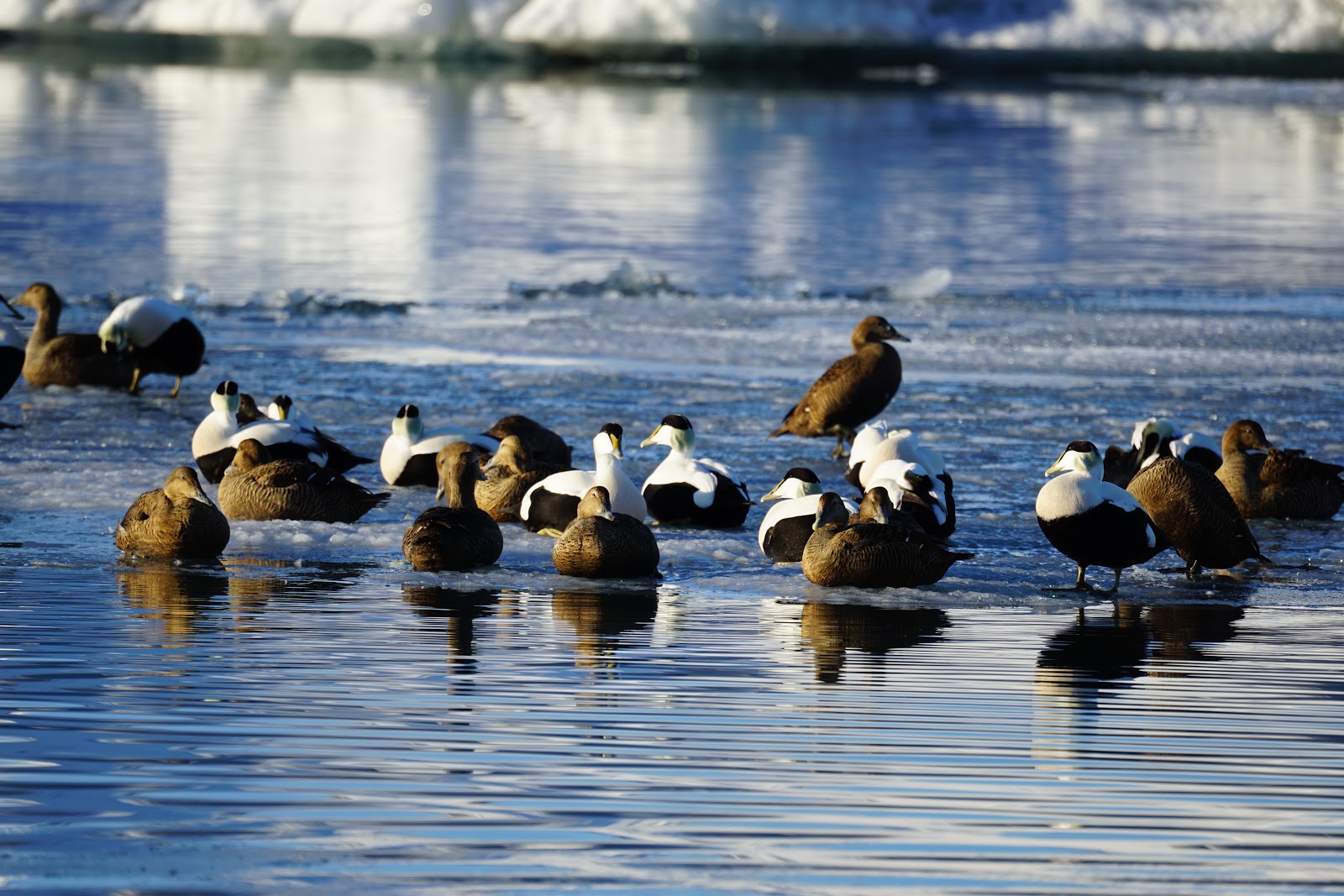
#10 Marge Simpson Ducks

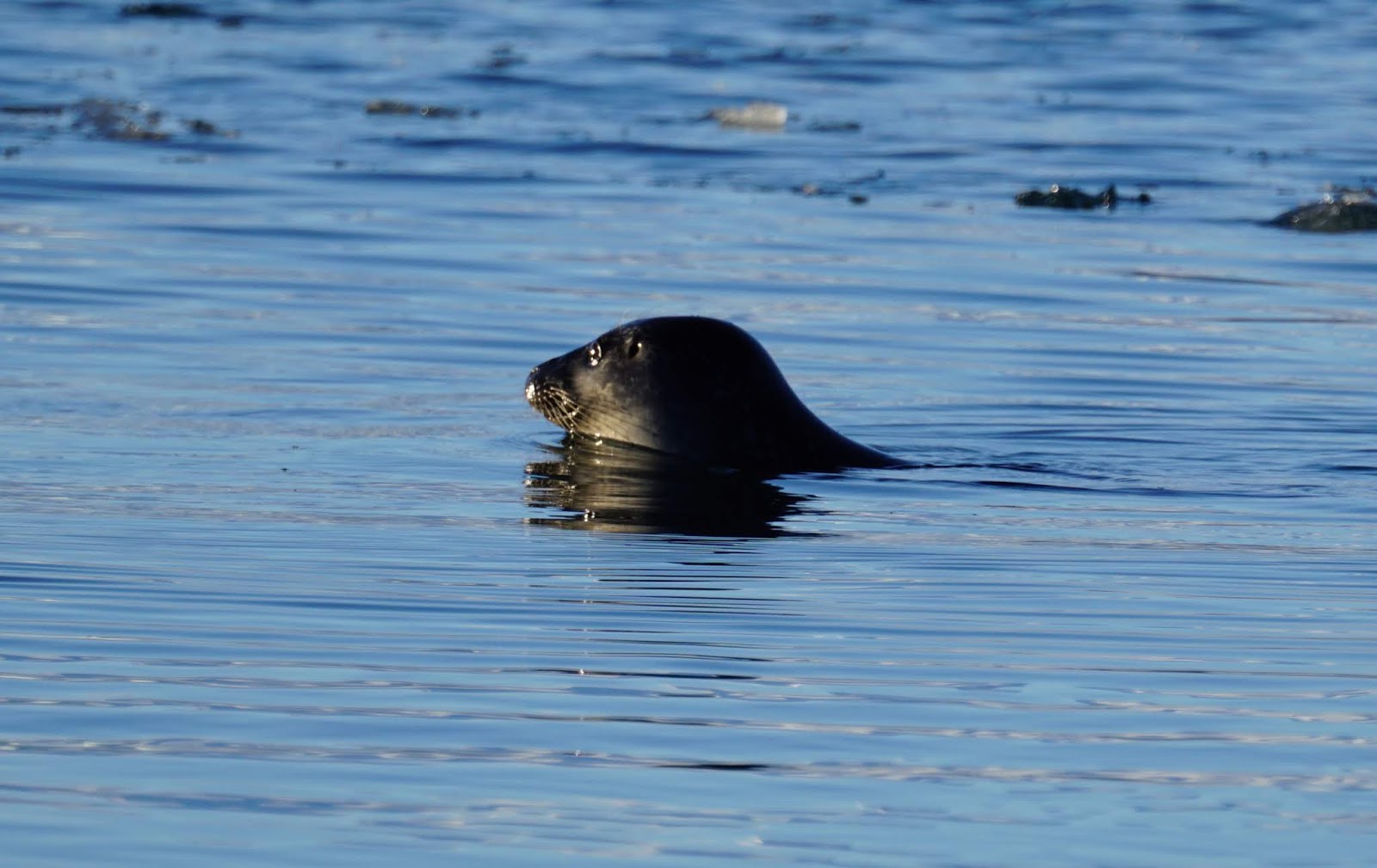
“There are seals in the water,” he said. 

 
That was enough to get Astrid and Snorri out of the warm car. 
Along with the seals, there was a flock of black and white ducks-their markings strange to Astrid’s eyes, but she still recognized them as ducks–that went to great pains to climb up on a large piece of ice which was floating in the water. The ducks didn’t “quack” so much as grunt, much like a put-out Marge Simpson. 
 
#10 A Seal

As the sheet of ice moved down the fjord, the ducks groaned and grunted and eventually moved off of it, because apparently, it was going the wrong way. 

 
The family sat on rocks on the shore, taking in the sun, watching the ducks and counting the seals as they surfaced and dived. There were about six or eight seals swimming around. 
 
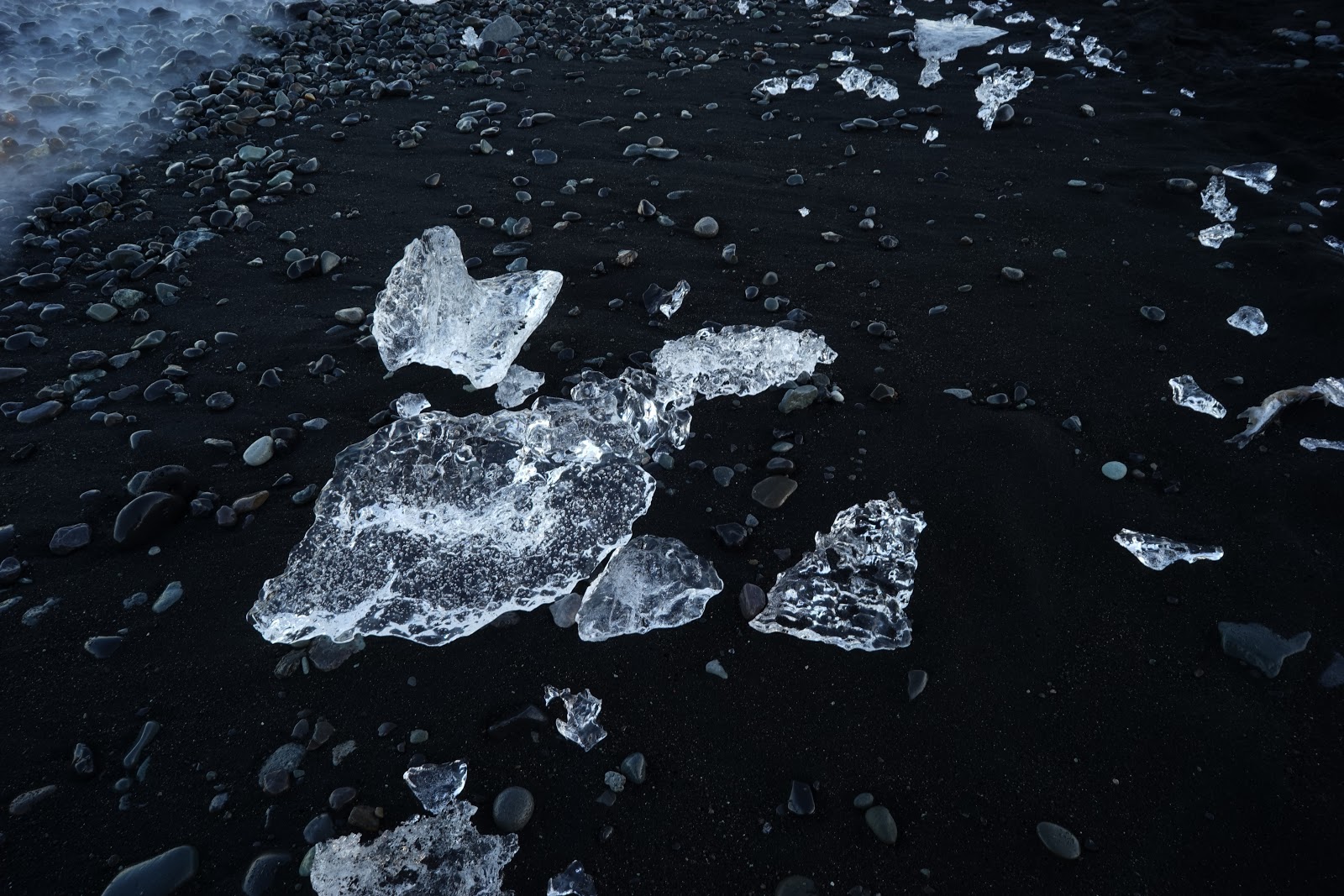
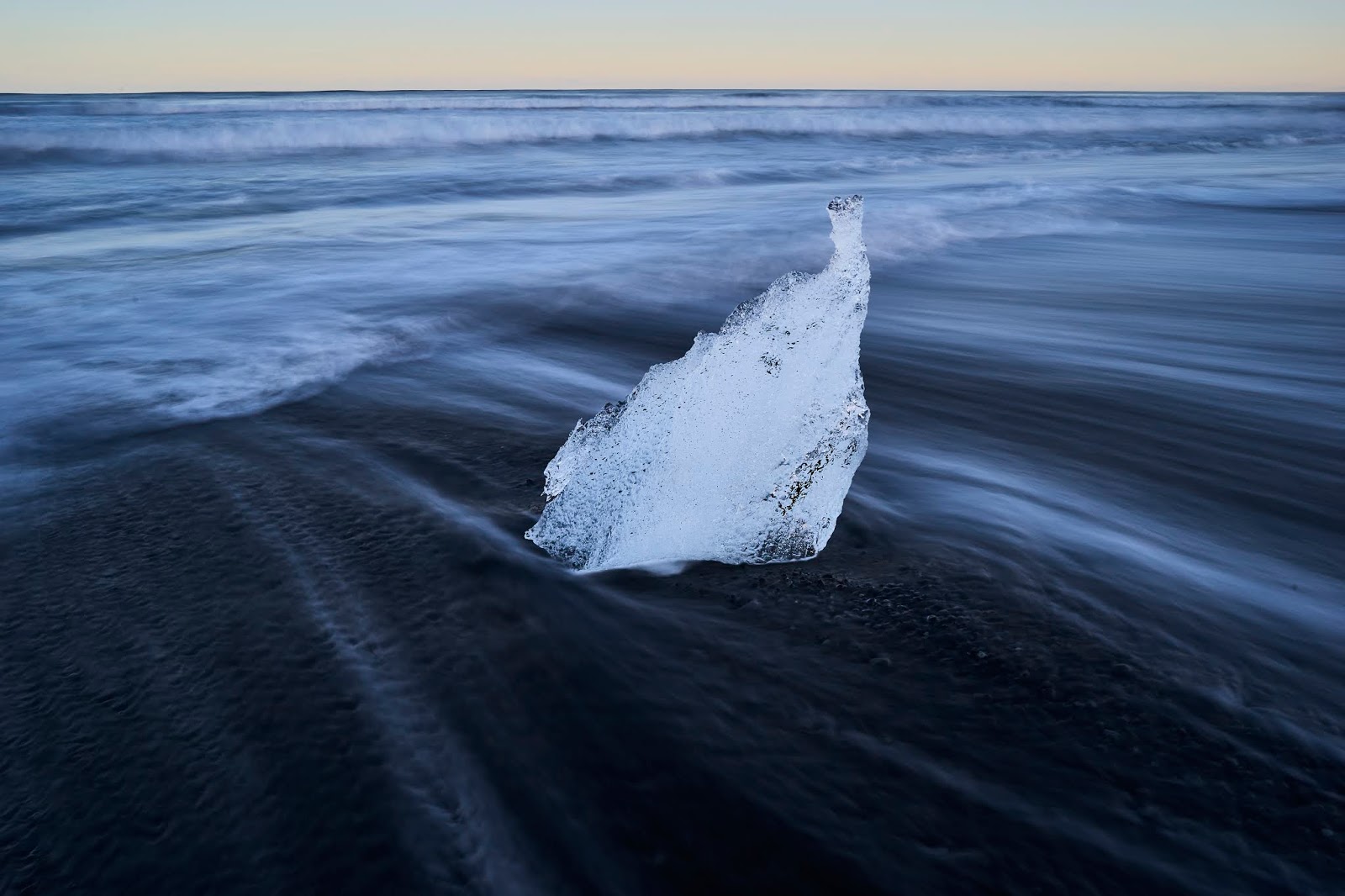
11) Next was a short drive across Þjóðvegur Highway 1 to a black sand beach called Diamond Beach. This beach was was no longer fronted by the lagoon, but was an ocean beach. Astrid and Snorri, frozen by then, stayed in the car watching people from the parking lot as Bjorn combed the beach for shots of “diamonds,” risking camera malfunction from the leaping white waves that licked the shore.  The diamonds were crystal clear pieces of ice dotting the black sand. 
#11


One pair of beach-goers that caught Astrid\’s eye was a bride and groom in full wedding attire posing for a photographer. Astrid was sure they were the same pair she saw at the Víkurskáli Restaurant/Gas Station, in one of the many photographic stops on her honeymoon. It seemed a bit excessive to Astrid, but if the bride wanted to get pictures at every beach in Iceland while wearing her wedding dress, and her groom agreed, then all the power to her. 
 
As the sun went down and the chill grew colder, Astrid started to worry. 
#11
“Didn’t I see that you packed a pair of binoculars?” Astrid asked Snorri. 
“Yeah.”
“Could I use them?” 
She watched as he rifled through his bag to bring out a small plastic pair. She combed the beach through the tiny binoculars for a few minutes before spotting a shapeless blotch that moved like Bjorn. As the spot grew, stopped, then grew again in the field of vision, she knew it was him. 
 
When he reached the car, he opened the hatch and pulled off his soaking boots and socks. The ocean had got to him, but not to the camera. 
 
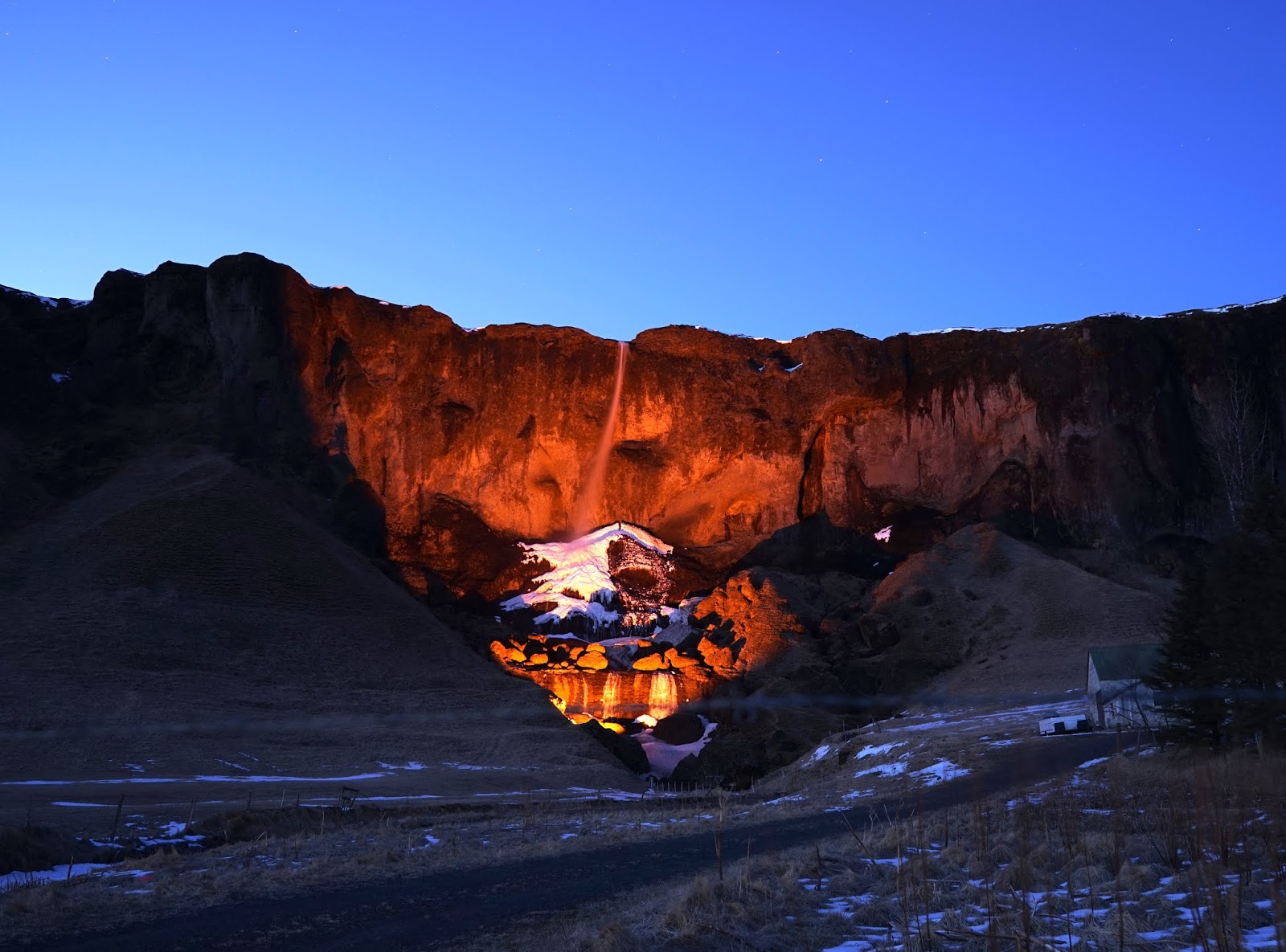
12) They drove back along Þjóðvegur Highway 1, to their bed and breakfast in the dark, but there was one more stop. Along the coastal plain in southern Iceland were many farms, often situated near the bottom of a high bluff. Bjorn stopped the car for a particularly picturesque homestead, a waterfall at the back of the property lit up from the bottom.  The wind caught the waterfall mid-way down the ledge, blowing it sideways. 
#12

Green-Lighted


April 5, 2018
In the morning, the family took a short, chilly walk to the Hrifunes Guesthouse reception area, which had been the large kitchen and living room of a house at one time. Here again, a polite sign asked that visitors remove their shoes before entering, and a basket of house-shoes stood in the corner for anyone\’s use. Breakfast was ready, including coffee, cold meats and cheeses, oatmeal, cereal and various breads. The hostess served all this on a collection of mixed and matched colorful dishes and cutlery. 
 
After fueling up and packing up for the day, they drove one and a half hours through moss-covered lava fields, past dark sandy sediment plains, past waterfalls and snowy mountains split by glaciers.  
As Astrid watched all the marvelous landscape go by, she wished she knew more about geology. It would enhance the experience of driving through what seemed to her uneducated mind, a wasteland surrounded by mountains. Maybe if she knew more about land formation another story would be available to her, one that she could read in the rocks and mountains, one that would make sense to what she saw, give a history to the magnificence and differences she observed. 
 
Their destination was Skaftafell, a part of Vatnajökull National Park, for a short hike to yet another waterfall. Despite the frequency of waterfalls on the island, Astrid never seemed to get tired of walking to them, watching them, watching the tourists watch them and take pictures in front of them. Not seeing any parking kiosks, the family walked to the visitor’s center and finally figured out that they just needed to register their Viking Toe 5 into a parking program at a computer there and pay a small fee. On such a small island-country, it was relatively easy for authorities to document and keep track of every vehicle, even the rentals. The program knew the Viking Toe was a white Kia Sportage … but then again, it could’ve guessed as much and been right, there were so many around.
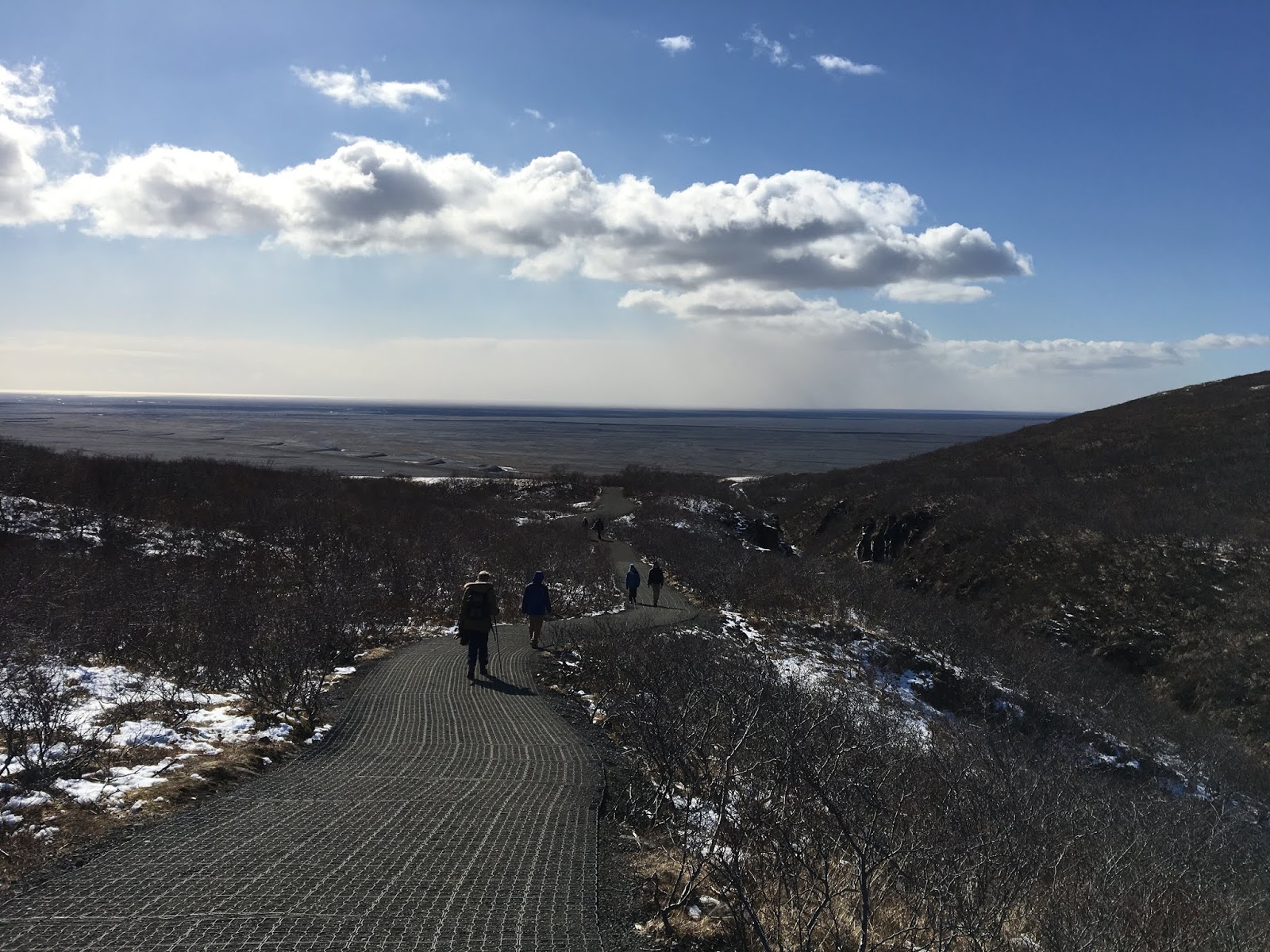
 

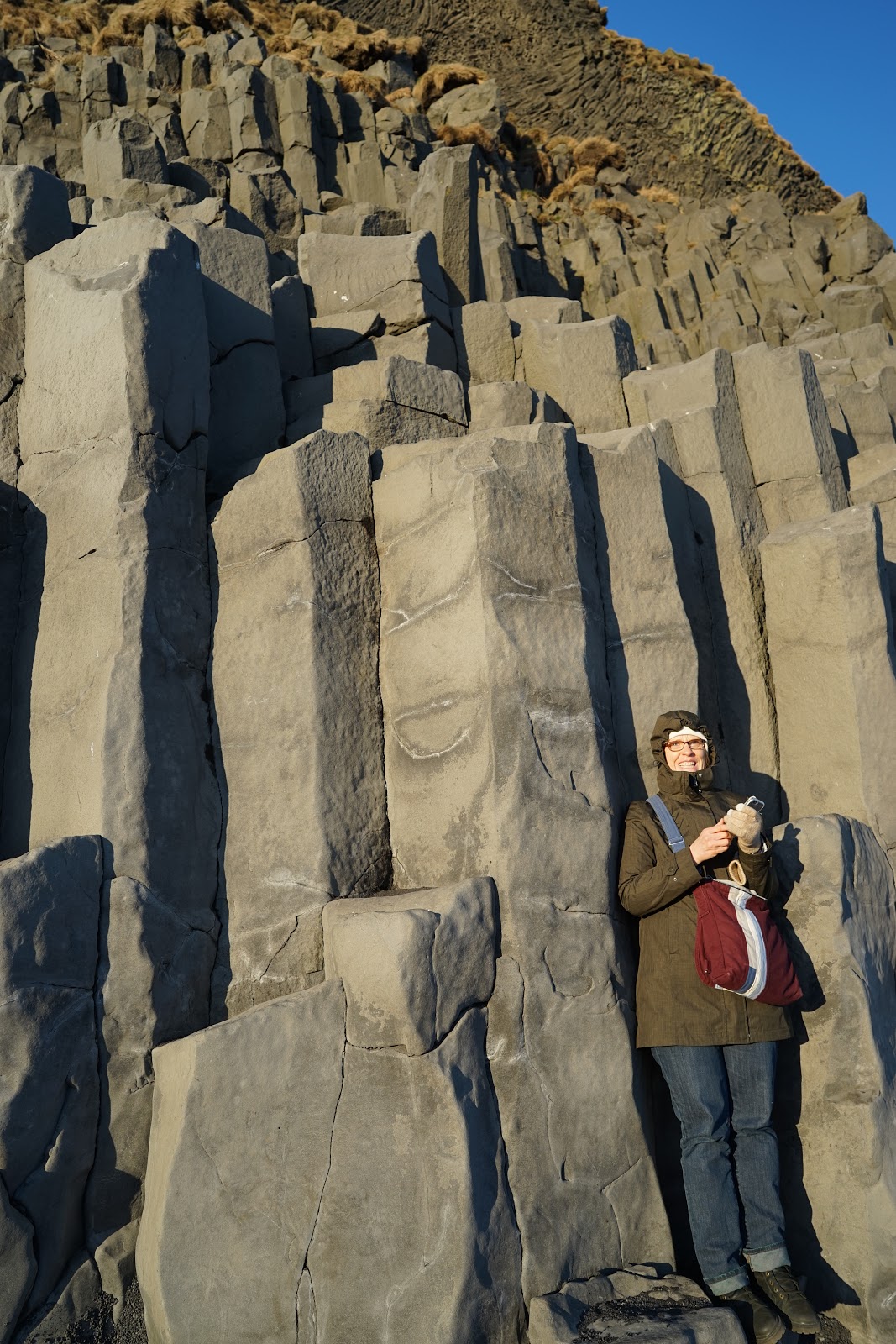
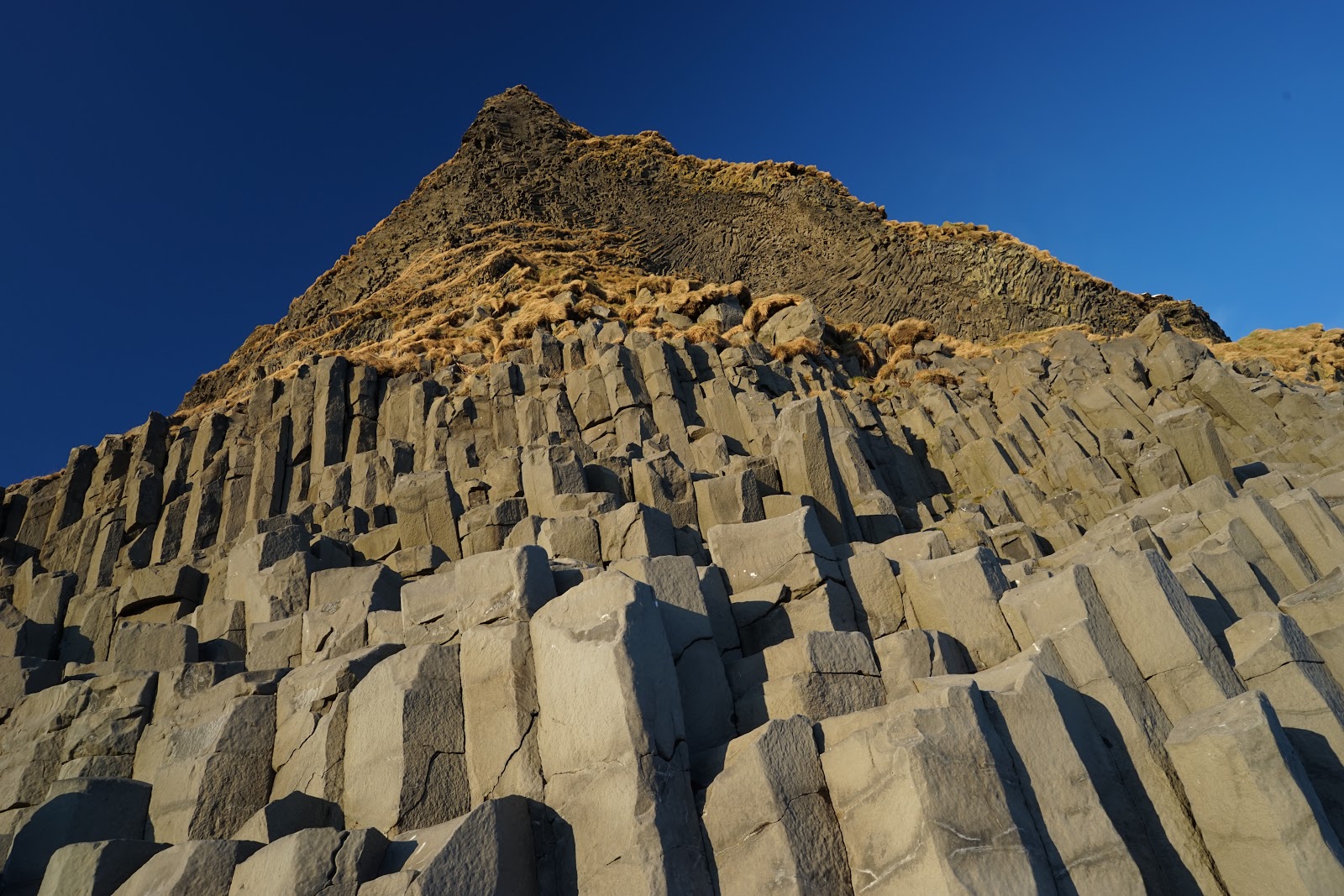
The hiking poles were assembled and they started uphill, to the Svartafoss, a waterfall nestled in some  fantastic geologic basalt columns. They walked on gravel trails covered in anti-erosion mats, then through mud, then over rocks, until they finally made it to the falls, along with a dozen or so other hikers. 

As Bjorn captured the falls in the best light, Snorri and Astrid found rocks to sit on and watched the ebb and flow of visitors. There was one couple in particular that caught Astrid\’s attention. They had set up a tripod with an iphone (and remote)  to take their glamour shot in front of the falls, but to the young man\’s dismay, other tourists would get in the shot, because he was taking so long to get the picture. 

The family did a lot of driving that day. The roads were smooth, flanked by plains of moss-covered lava, or black rocky mountains in the distance, or long glaciers flanked by black rocky mountains. Even when Bjorn was traveling at the speed limit, locals speed past, impatient with the law-abiding tourists. Eventually they stopped at a spot by Jokulsarlon Glacier Lagoon to check out the suitability of the parking there for watching the northern lights. 

 
They next stopped at Pakkhaus restaurant, in Hofn just as it opened for dinner. The restaurant is situated right next to a harbor where ships dock and unload their catches. Astrid ordered lobster, which came from the ship parked just outside. Bjorn had fish and Snorrie ate a steak.


Their next destination was to a private beach, fronted with dune upon dune of black sand. But to gain access to the private beach, one had to pay a fee at the Viking 
Cafe, around Hornhestar, Hofn. This is no sand castle building or sun-bathing beach, but is a happy hunting ground for photographers, with mountains flanking one side of the beach, and myriad black dunes the other. After stuffing what seemed like way too many Kronurs into the \”pay here\” box, Bjorn tried to drive up to the gate, but was confused, because it didn\’t open. Seeing the owner walking back to the cafe and after explaining he had put money in the box, the owner gave him an access ticket that opened the gate. 
“I was just pulling a car out of the sand … It was a small one. Your car should do okay,” he gestured to the Viking Toe 5. Just put the ticket in the kiosk and the gate will raise.” 
 
And it did. At the end of a sand-drifted stone road, the landscape opened up to a dynamic view … dark mountains, dark beach, expansive, beautiful, but chilly. Astrid imagined Viking longboats sailing into the bay, home from their long pillaging and/or trading journeys. 
 
As Bjorn snapped pics, Snorri and Astrid did what they always did: looked around and interacted with the surroundings. They poked holes in frozen top crust of  black sand dunes, climbed the hills trying to stay out of other photographers’ shots and tried to stay warm as the sun went down. 


Among others, Thor Photography was there with their van-ful of photographer tourists, the same van the family encountered their first day on the island. 
 
The next stop was back to the Jokulsarlon Glacier Lagoon to wait for the northern lights. As they waited, Snorri played Zelda on his Nintendo Switch and Astrid ate the rest of her Ikea chocolate and read the introduction to the Sagas (It was the only chapter she could get on the iPad, ‘cause she wasn’t about to lug the tome in her luggage.) Bjorn set up his tripod on the edge of the glacial pond right in front of the car. 

As time ticked toward 11pm (or 23:00) a strange, green laser-light started to dance among the cars. 
 
At one point Bjorn came back to get something out of the car, opened the door, then shut it again, but for some reason, the inside light didn’t shut off. Astrid searched frantically for the light switch, knowing that photographers shooting night scenes need as little light pollution as possible. All the while, the green laser light assaulted the car, until finally she found the inside light switch to shut if off. 
 
Shortly after that, the woman in the car beside them turned on her car cabin light to read a book, ignoring the assaulting green laser, until a woman came up and informed her, “that green light means they want you to turn off your light, it interferes with photography.” 
 
The Thor Photography van was parked across the road, close at another spot, policing the parking lot by the fjord, punishing light outlaws–naive or knowing–with their green-laser light. 
 
But it was all for nought. Hours went by and not a twinkle of magical color appeared in the northern night sky. After a while the family drove away, getting back late to their room, but not without some night driving pics. 


A note on boots: Iceland, with its icy paths, rocky trails and pushy weather is a boot-conducive island. Most, if not all visitors to Iceland wear boots, new boots, because they buy them just for the trip. One can make a pretty good guess at who are the tourists by looking at their boots. Whenever possible, Astrid liked, at the very least, to not look overtly touristy. But to her dismay, she had just retired a 17-year-old pair of leather, lace-to-toe Dr. Martens that had holes in the sides and was wearing … new boots. 

Water Falls, Ice Caves and Green Skies

p.p1 {margin: 0.0px 0.0px 0.0px 0.0px; font: 12.0px \’Baskerville SemiBold\’} p.p2 {margin: 0.0px 0.0px 0.0px 0.0px; font: 12.0px Baskerville; min-height: 14.0px} p.p3 {margin: 0.0px 0.0px 0.0px 0.0px; font: 12.0px Baskerville} span.s1 {font: 12.0px Baskerville; letter-spacing: 0.0px} span.s2 {letter-spacing: 0.0px}

April 4, 2018 


The next morning they packed the car and said goodbye to their cabin by the lake in southwest Iceland before setting off on the snowy mountain-flanked highway to Skogarfoss and the Skogar Folk Museum. 

It was sunny, with an aggressive wind blowing as they walked into the museum, which luckily had a strong automatic door that shut itself, to prevent it from being blown off its hinges. 


At the reception desk, a red-headed clerk greeted the family and issued them sticker-tickets. They wandered through Icelandic life from decades past; through exhibits of fishing and marine equipment, agricultural artifacts, domestic crafts and a natural history collection which included a mutant sheep. One or two other patrons roamed the halls. 

Before the trip, Astrid had learned a (very) little bit of the Icelandic language (Islenska) from a cell phone app, and as she browsed the museum displays, she challenged herself, trying to pronounce the various names and descriptions of the many items in the exhibits, often referencing a slip of paper on which she had written a pronunciation key. A student of language doesn’t realize how little she knows of a foreign language until she tries to speak it like the natives, or listen to the natives speak. Astrid couldn’t understand much, just words here and there. 

Poor lamb

Outside the main building, the family hurried between outdoor exhibits, fighting off the wind as they explored models of houses, a church and a schoolhouse from various places on the island. All the houses, examples of buildings in the late 19th and early 20th Centuries, had thick stone walls flanking the outside of them, to keep out the wind and wicked weather of the island. 

The houses themselves and the artifacts displayed within were a testament to ingenuity and survival, the inhabitants made do with what was available, like using braided horsehair for a rope, bunches of birch twigs for kitchen whisks, sheep wool for blankets and cloth, walls of native rock and wood salvaged from shipwrecks to build houses (because timber is and was scarce in Iceland).  

After touring the outdoor domestic exhibits, they drove a short distance to Skogarfoss (foss in Icelandic means waterfalls), a tall cataract falling off a high ledge (what used to be the cliffs off the coast) above the plain into the Skogar River for an exhibit of more natural history. This was the most popular attraction in the area and the parking lot was much fuller, with buses, vans and cars. 

After getting their eyeful of the waterfall, Astrid and Snorri watched tourists pose and take selfies while Bjorn set up Tripod and patiently waited for the best photographic opportunities. Although sunny, it was still cold and windy, and part of the floor of the cavern that housed the waterfall was still in shade and covered in a thin sheet of ice, unbeknownst to many sightseers who slipped and sometimes fell on the rocks as their eyes were turned upward to the falling water. 
Skogarfos
After he snapped his fill of photos, Bjorn summoned the family to the car to discuss lunch. They decided to go to the small diner in the technology part of the museum which they hadn’t been to yet, but when they got there, they found it was closed. Instead of eating, they took a quick stroll through the history of Iceland’s adoption of technology, through wars and peace, particularly in reference to snow removal, fishing, ocean life-saving and transportation. 

Because they had an appointment with a very big van later that day, they decided to travel to their meet-up spot and eat there. At Víkurskáli Restaurant, Bjorn and Snorri had hamburgers and Astrid chose the lamb stew again. It was booth-and-table, fast food restaurant and gas station, so when a woman in a wedding dress walked in and sat down, Astrid couldn’t help but notice. It wouldn’t be the last time she saw this woman in her wedding dress that week. 
The Big Van


After filling up their stomachs with food and the car with gas, they parked the car and waited on the sidewalk of the small shopping mall where they were to be picked up for a tour to an ice cave. After some confusion, they found their ride: a super-jacked up, white, 15 passenger van with outrageously large tires that turned out not to be over-kill. Bjorn took motion-sickness medicine, and Astrid put on her Sea-Bands (anti-car sickness wrist bands) just in case. 

These uber-vehicles could be seen all over Iceland. They were high set, large-wheeled retro-fitted vehicles, from 15 passenger vans to jacked-up F350’s, to white panel vans to mini-vans: these vehicles were built to go where no average SUV or 4WD could. 

Gudrun, the tour guide and driver, took out a step stool and the family and fellow tourists packed themselves into the behemoth. The oversized wheels whirred as she drove the beastly van down the highway, then suddenly turned onto what looked like a snowy, no-road plain. Inside the van were enough additional contraptions, gear shifts and pressure gauges to bring steam-punk style machines to mind. 

As the van left the road Gudrun shifted into four-wheel drive, let pressure out of the knobby tires and proceeded to drive down a path covered at intervals with deep snow and drifts that surely came up over the height of the wheels. This woman knew how to handle her gigantic four-wheel specialized van. 

Fearing motion sickness, the family didn\’t look out the sides of the van, they were in the front-most bench seat, hanging on to handles or anything they could, because it was a swaying, bumpy, swerving ride. 

\”Good driving!\” Astrid applauded Gudrun for her skill when they finally stopped on a plain of snow.

The tour guide handed out hardhats and set out a box of crampons and waited while the tourists wrangled the items on their heads and feet.


Trudging over what seemed like an endless snowy tundra transported Astrid to the Sagas of the Icelanders when the ancient Vikings would set out across the island on journeys to visit relatives, or dole out a bloody revenge or attend a wedding.  

The landscape was white everywhere, the mountains speckled with black where the snow had melted. Inside the cave, the frozen water on the walls gave it a blue look. Myriad icicles dripped water down on them from the ceiling. It was a quick look at how weird, wonderful and beautiful frozen water could occur in nature.

Another swaying, jolting ride through deep snow and drifts put them back at the shopping center where they browsed Icelandic tourist wares including wool sweaters, dried fish flakes, blankets and cold weather gear including very high end hiking boots. Snorri picked out an Iceland soccer shirt for his collection. 


Next, they drove to Reynisfjara Beach, a black sand beach with impressive examples of columnar basalt rock. A sign and life buoy at the entrance emphasized caution. The beach is notorious for a few deaths, the waves and wind being stronger than they looked to the poor souls grabbed from the beach. 

But it was cold, so Astrid gave the ocean a wide berth and and watched that Snorri stayed out of the water, too. They walked along the shore, marveling at the stones, hiding from the wind in crevices of the pipe-organ-like rock. Back at the parking lot, amidst an ocean of white Kia crossover SUV rentals, they located theirs with little trouble, because it was the Viking Toe 5. 

Dinner was at Halldórskaffí, a restaurant set in a house in the seaside town of Vík. Every nook and cranny of the dining room was filled with tables, chairs and guests. While waiting for their food, Astrid took a good look around. There were Germans a few tables away from them, three French gentlemen to her left eating dessert and an Icelandic couple to her right. 
After Snorri and Bjorn finished their pizza and Astrid her salad with raw smoked salmon, they got on the road again, this time headed for their second Air BnB, Hrifunes Guesthouse. Just a few minutes into the drive they came to a stop, behind blinking lights of emergency vehicles and a car flipped on its roof down off the raised road. 

“Really, I bet it took just second. Just a second to glance at the phone, or pick up something or whatever, the same second a big gust of wind came and might’ve pushed that car off the road,” Astrid said. The wind was notoriously strong in parts of the island, so much, that roads were sometimes closed because of the danger. 

Bjorn called the Hrifunes Air BnB manager to tell her they would be late while Astrid took the opportunity to review some Islenska phrases on her phone.  

They arrived a few minutes before 10 p.m., just in time for official check-in and dragged their luggage into a neat, modern room with a concrete floor. After settling in, Bjorn kept walking to the door and looking out, only to be disappointed. Around 11:30pm, he came back and gathered Tripod and camera. 


“It’s there, the Northern Lights … it’s just a green haze right now, but it’s there, you can see it outside the window,” he said to Astrid and Snorri, who where already snug in their beds. “I’m going out, you should go and see it.” He went out, leaving the door to the room open to a chilling blast of air, which had Astrid jumping out of bed to close it. 

Astrid and Snorri stood at the window and looked out,  underwhelmed by what they were seeing and foggily unaware of what it would eventually become just a few minutes later.

“Wow,” Astrid said. “It’s a green sky. That’s weird.” After a few minutes, they went back to bed, the rarity of the spectacle eclipsed by their exhaustion and sleepiness, hoping to see the Northern Lights another night, but Bjorn stayed up to capture the rare spectacle. 

Reynisfjara Beach