19,000 Feet Under the Fjord*

p.p1 {margin: 0.0px 0.0px 0.0px 0.0px; font: 12.0px \’Baskerville SemiBold\’} p.p2 {margin: 0.0px 0.0px 0.0px 0.0px; font: 12.0px Baskerville; min-height: 14.0px} p.p3 {margin: 0.0px 0.0px 0.0px 0.0px; font: 12.0px Baskerville} span.s1 {font: 12.0px Baskerville; letter-spacing: 0.0px} span.s2 {letter-spacing: 0.0px} span.Apple-tab-span {white-space:pre}

April 3, 2018


“Ready?” Bjorn asked. 

“What? You said 9 a.m., it’s only 8:30,” Astrid protested. She had just settled onto the couch with a steaming cup of instant coffee and a notebook, ready to jot down some caffeine-fueled thoughts before starting the day.

“I said I wanted to leave by nine, at the latest,” Bjorn explained. \”If you\’re ready, we\’ll leave now.\”

“Oh, alright,” she sighed. She would have to catch up on the narrative in the car and hope writing didn’t induce carsickness. 

Before leaving, they filled their water bottles with tap water, which Snorri and Astrid adored, being some of the most pure, best tasting tap water they had ever encountered. It seemed a strange habit, contrasted to the refrigerator-filtered water they used at home. 

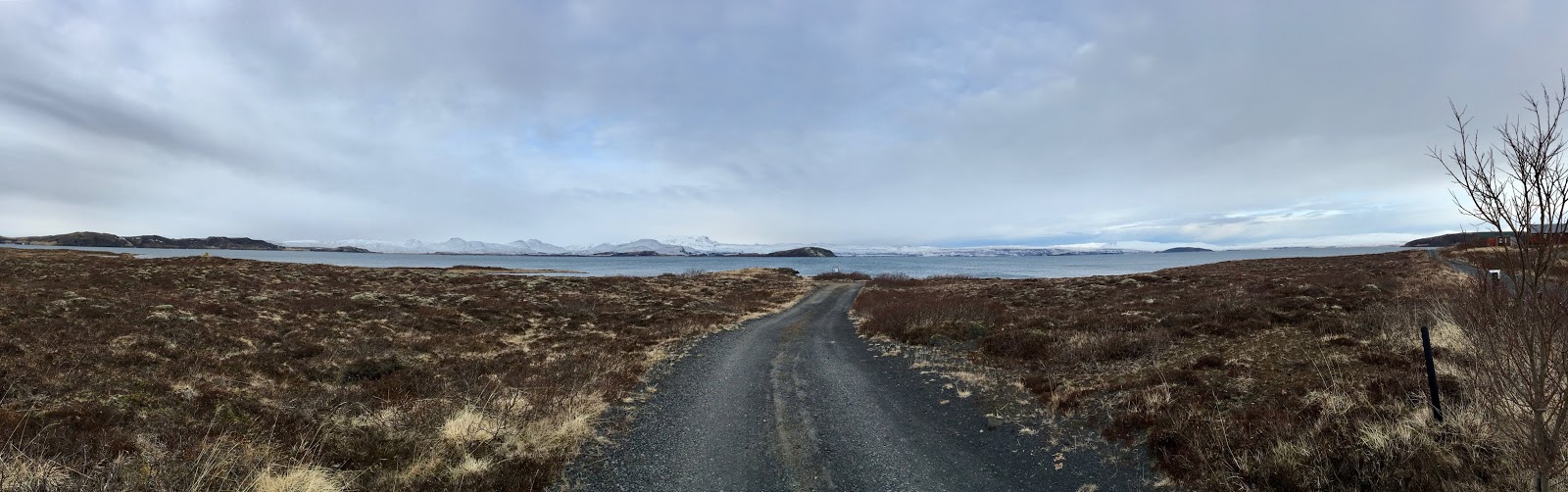
Once in the car, out of the icy air, they drove two minutes down a gravel lane to the lake for a picture. The door window on the Viking Toe had frozen shut in the night, so Astrid  had to open the door and get out into the cold to take a picture.


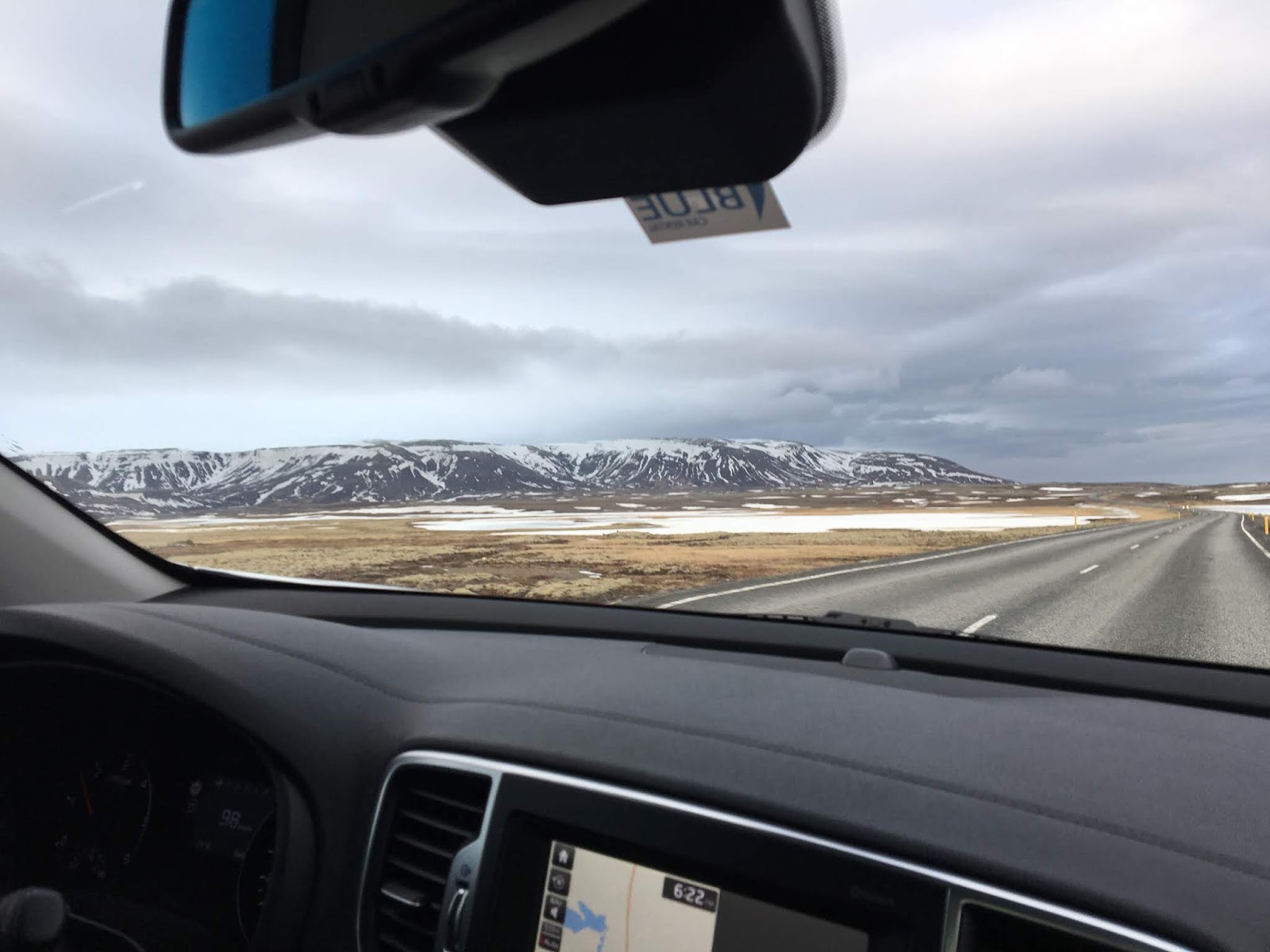
Then they headed onto the highway again, this time for a long drive to a snowy, windswept western part of the island nation. Half-way through their journey, they came to the Hvalfjörður Tunnel, a 19,000 feet long tunnel under the Hvalfjörður fjord, which reaches a depth of 541 feet. It had been constructed by private company, so there was a toll to pay each way.  The first part of the tunnel sloped down, then the car went up-grade to the end. It shortens the route around the fjord by about 50 minutes and is a fascinating experience to drive through. 

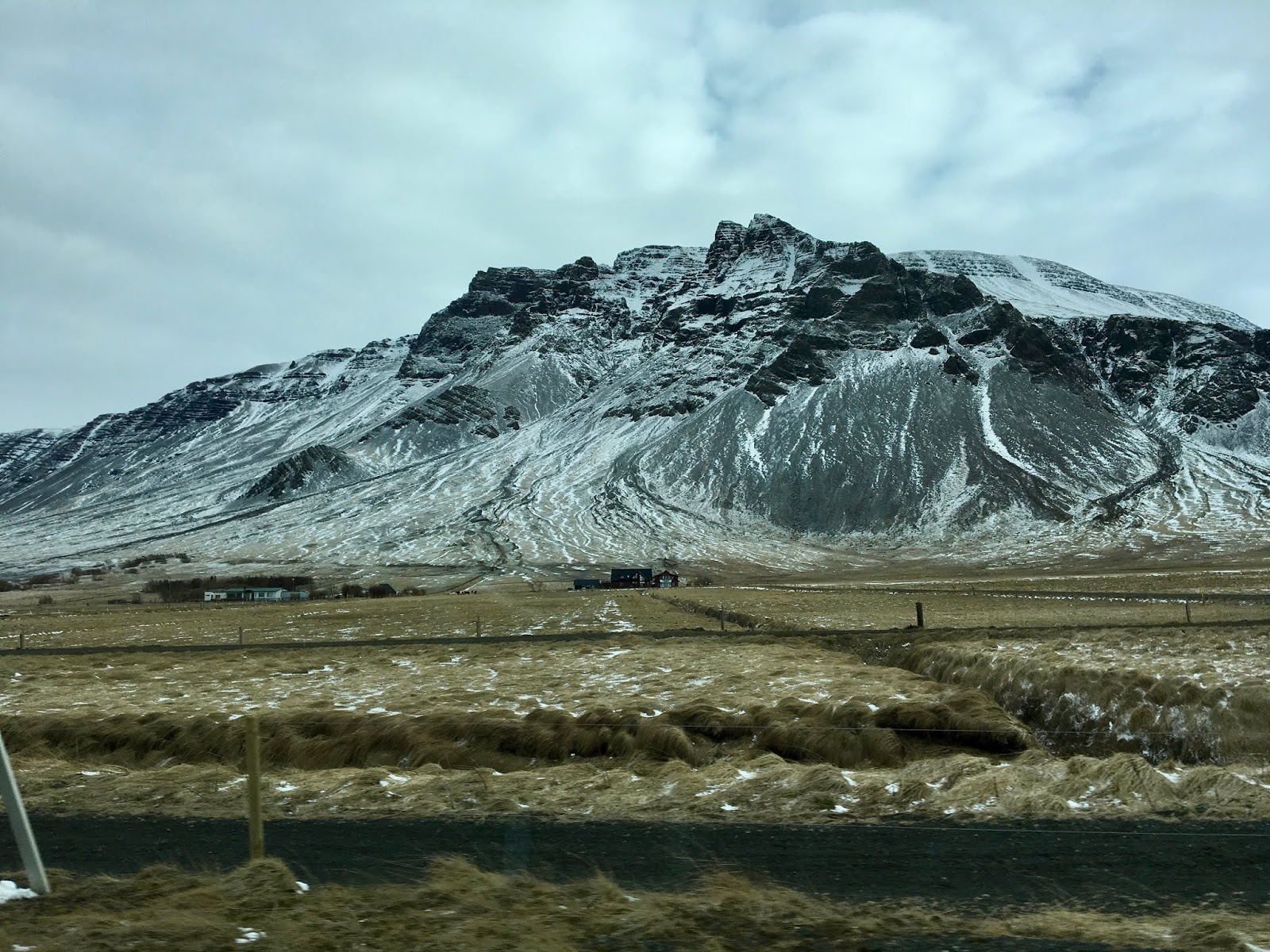
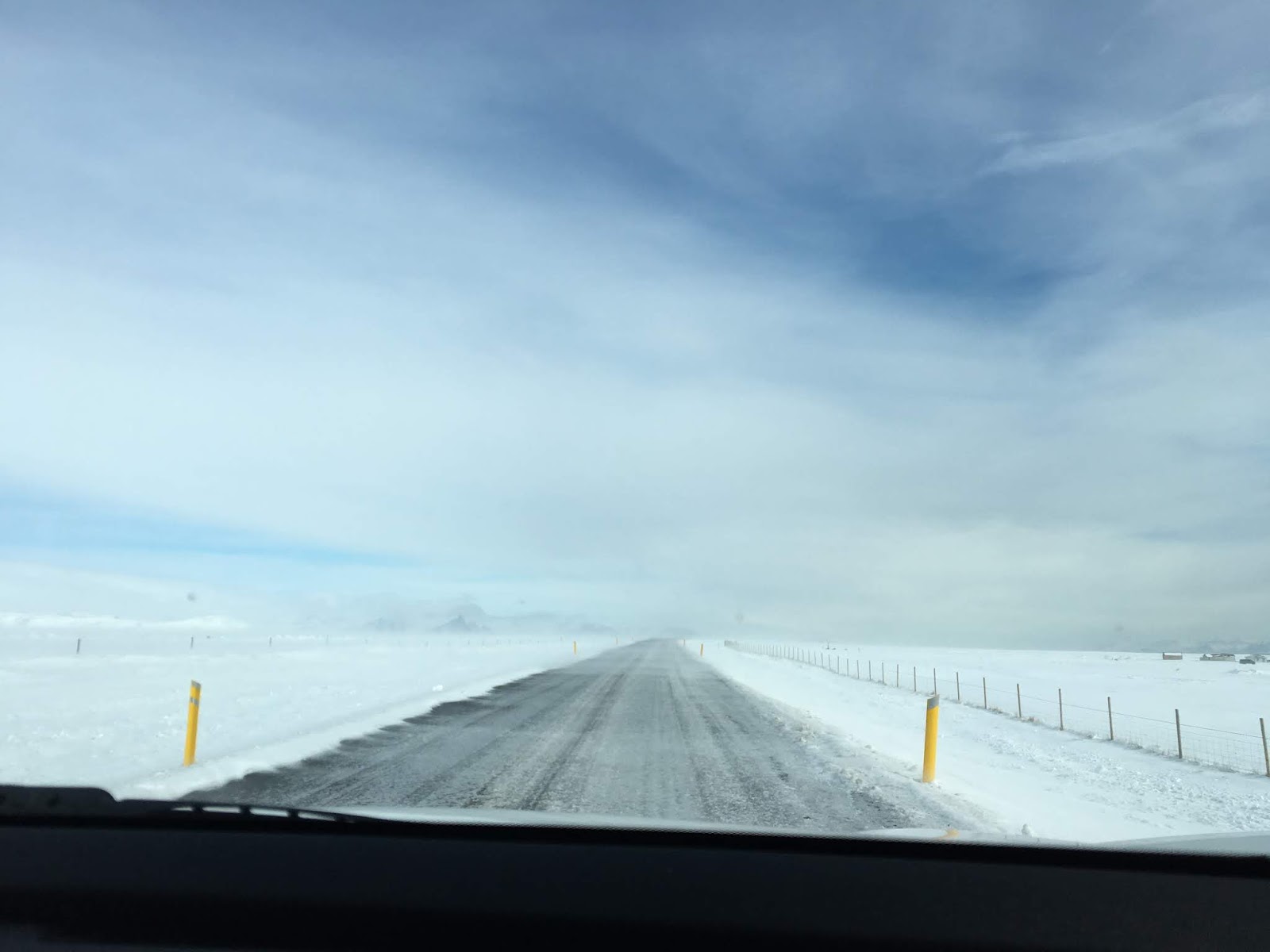
The landscape passing on both sides of the car consisted mostly of bleak, black bare stone mountains accented with snow, expanses of icy blue water, flat plains with wisps and patches of dormant brown grass peaking through, small herds of stunted horses clumping together for warmth, and birch and willow trees doing the same. Signs of visible spring, the life-giving, green, vibrant season, were nowhere to be seen. Warm weather was a long way off, but there was still beauty in cold, sleeping nature. As they approached their first destination, the wind started to gain strength, whipping sheets of dry snow across the road in front of the Viking Toe, nudging the vehicle this way and that. 


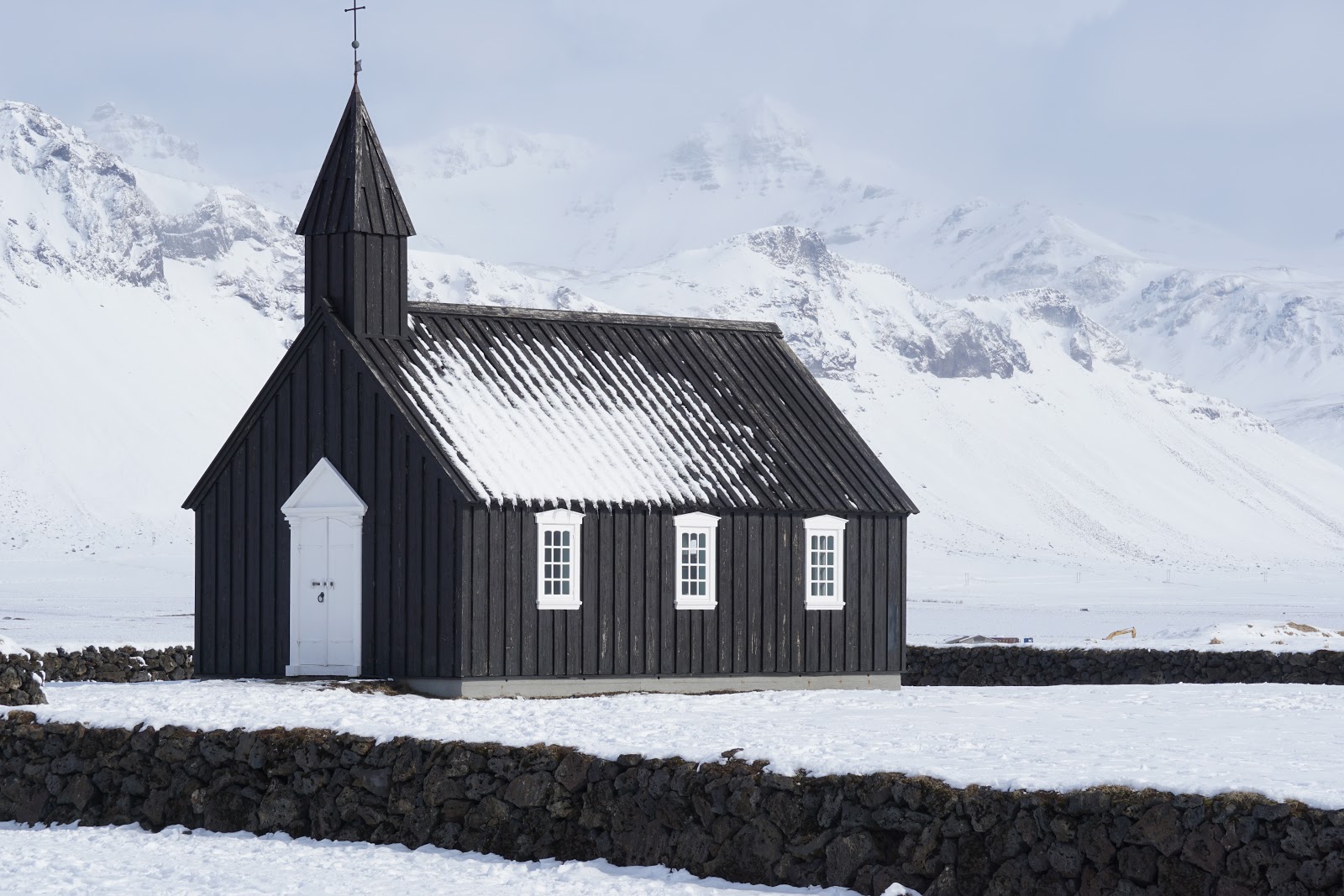
After navigating snowy roads and crunching, frozen lanes around grand rocky mountains, they arrived at Búðakirkja, a lonesome, simple raven-black church standing guard over its stone-walled cemetery, basking in the sun despite the frozen landscape around it.  

Bjorn went through his usual routine of getting out of the car, leaving the car door open (despite hefty winds), Astrid reaching over to shut it because she was freezing, then Bjorn opening the hatch in the back and filling the car with -3 degree Celsius air, while picking out his camera equipment as the car occupants shivered. 


Astrid eventually extricated herself from her heated seat, got out and walked around the church, but not before a bus full of tourists pulled up and, much to the dismay of the photographers there, peopled the church’s pristine landscape with bodies. It was cold but sunny, the light reflected off the snow and lit up the air around them. It was windy, the gusts pushed through Astrid’s coat as she walked around the cemetery. One man tried to fly a drone, only to be frustrated by the frigid gusts. 

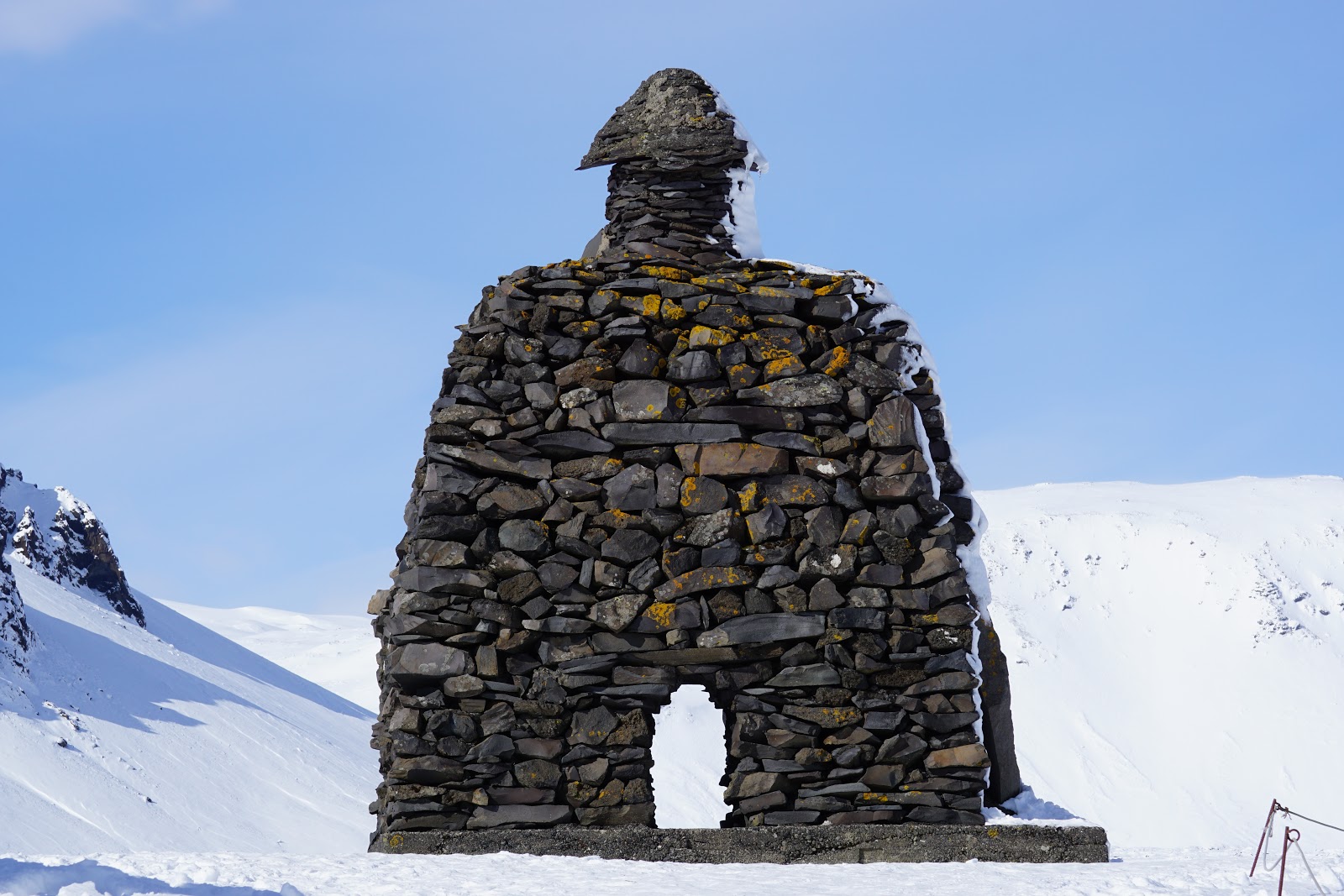
Bárður Snæfellsás monument

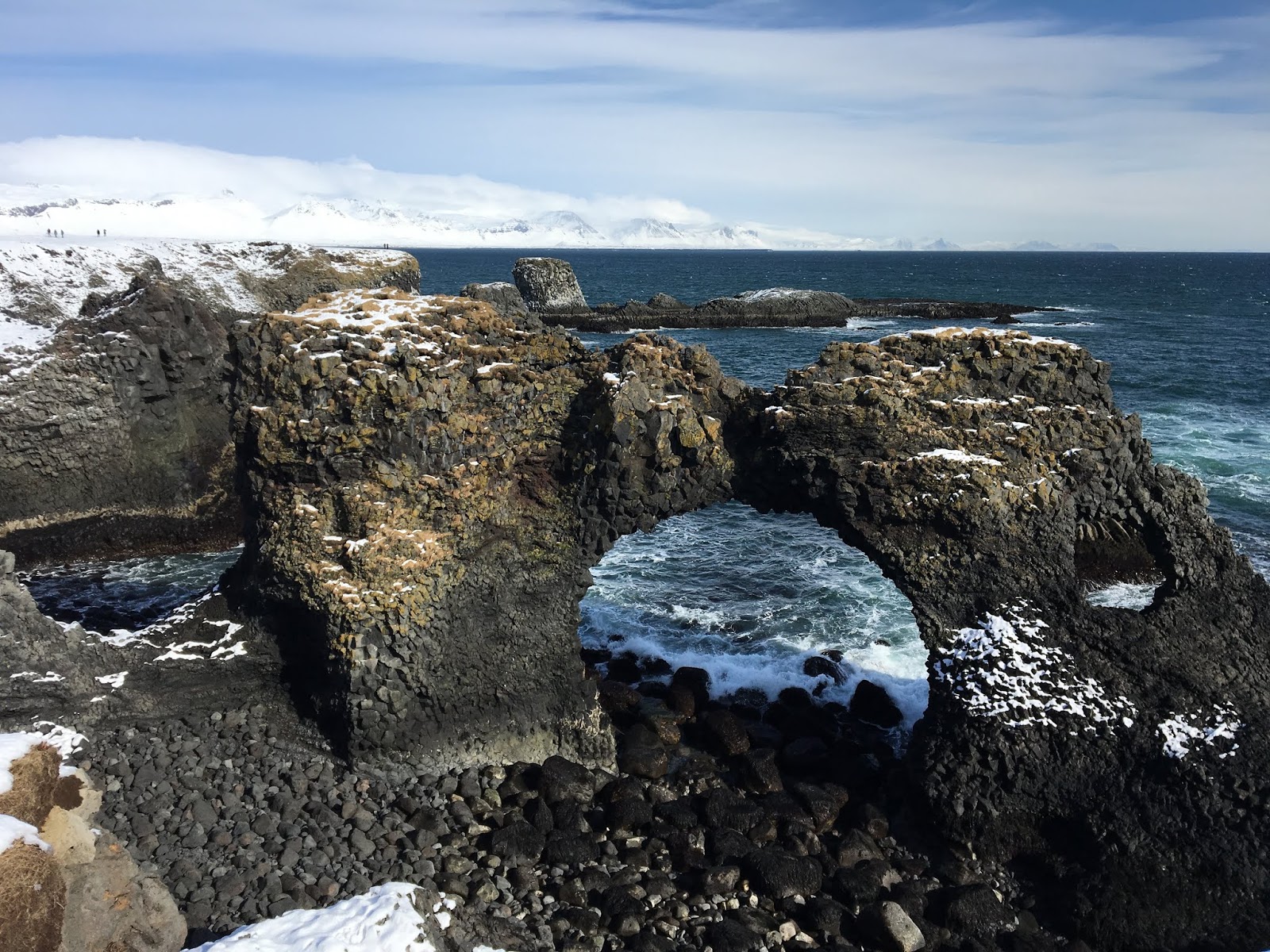
They drove around the vast countryside, along roads that thread through white, snowy mountains, along icy deserted plains, on roads bisecting small frigid towns to Arnarstapi Sea Arch area. At the cafe there, Bjorn gave in to bodily and vendor demands and paid three dollars (300 kronur) to use the bathrooms, which is a common occurrence in Iceland. 

A little off the parking lot stood a stone structure that at first Astrid thought was a tribute to the stone arch, but later found out that it is a statue-like representation of a legendary Icelander (half titan, half human) and the monument stands as protector of Iceland. 


The family unwittingly walked past the stone monument without noticing the giant man Bárður, camouflaged in stone, up a packed, icy trail to the edge of the ocean and stood resisting the strong winds as they watched the bird-be-speckled ocean cliffs below. 

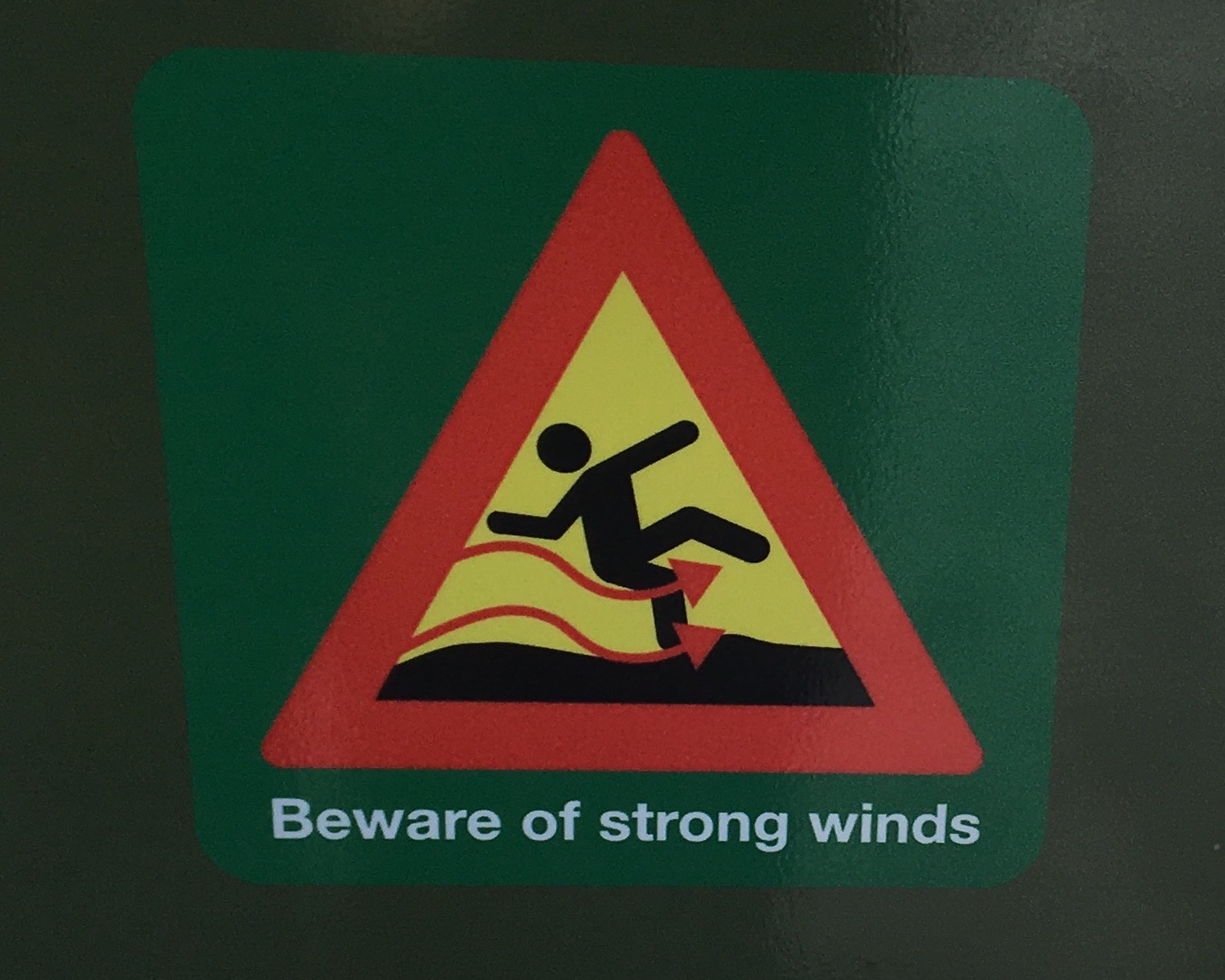
They marveled at the roundness of the sea arch  and at the various perfect shapes nature constructed in her geology. But the wind was the foremost force that acted on Astrid at this site. She enjoyed a brisk breeze in the summer, warm air  that whisked over her skin and thread through her hair. It was pleasant to let the earth affect her in that way, with gentle nudges and caresses as it outlined the boundaries of her physical self on the planet. But there, at the demarcation of earth and ocean, the cruel, cold wind buffeted and bullied, it pushed and prodded warm-bodied animals and humans to take cover and get out of its way. 

“There’s a Jules Vernes memorial somewhere around here,” he suggested when they got back into the car. 
“It’s okay, I don’t need to go. Jules Verne was French, it would mean more if we were in France. In his Journey to the Center of the Earth, he had his adventurers arrive to Iceland at Reykjavik and descend into the Snæfellsnes volcano to start their subterranean journey. I’m not too interested.” Later, she would have a hard time confirming whether Verne actually visited Iceland or not.    

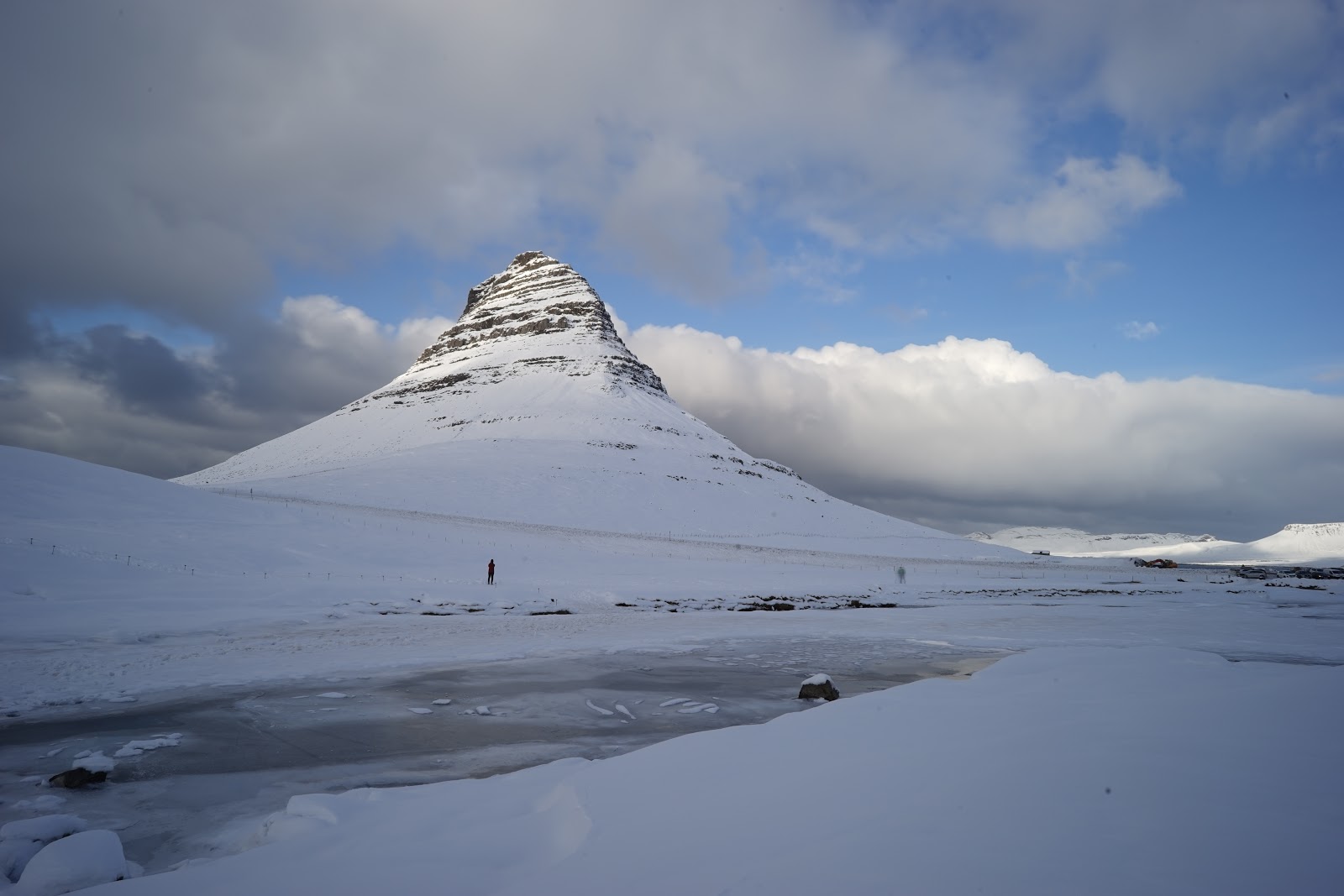
Kirkjufell Mountain

They drove to a dead end overlooking the coast, then leisurely made their way to waterfalls that lie in the shadow of the towering Kirkjufell Mountain. The parking lot was small and packed, so that the family had to wait for a parking spot, hovering until someone left the place. It reminded Astrid of the over crowded parking places in Scotland.


The icy walking path made a u-shaped trail around the Kirkjufellsfoss (waterfalls). There were plenty of tourists, slipping, hanging onto an unsubstantial peg-and-rope fence as they made their way up the hill. 


Bjorn was there for sunset pictures, so they stood shivering, waiting for the sun to bow out for the day. A couple who either just got married or were going to a formal dance were there in fancy clothes with a photography crew. 

 After shivering in the shadow of the Kirkjufell Mountain peak, GPS lead them to a restaurant called Bjargarsteinn in the nearby town, set in an old house by the sea, with an outrageously stunning view of the mountain. Bjorn ordered the fish, Snorri the lamb, and Astrid a seafood medley and tea. The tea came with chocolate and was mostly to warm her hands and body. 


On the way back to their cabin, Bjorn stopped the car a few times along the snow-blown highways to catch photos of the landscape bathed in the evening sun–the best sun, supposedly, in which to take pictures. 

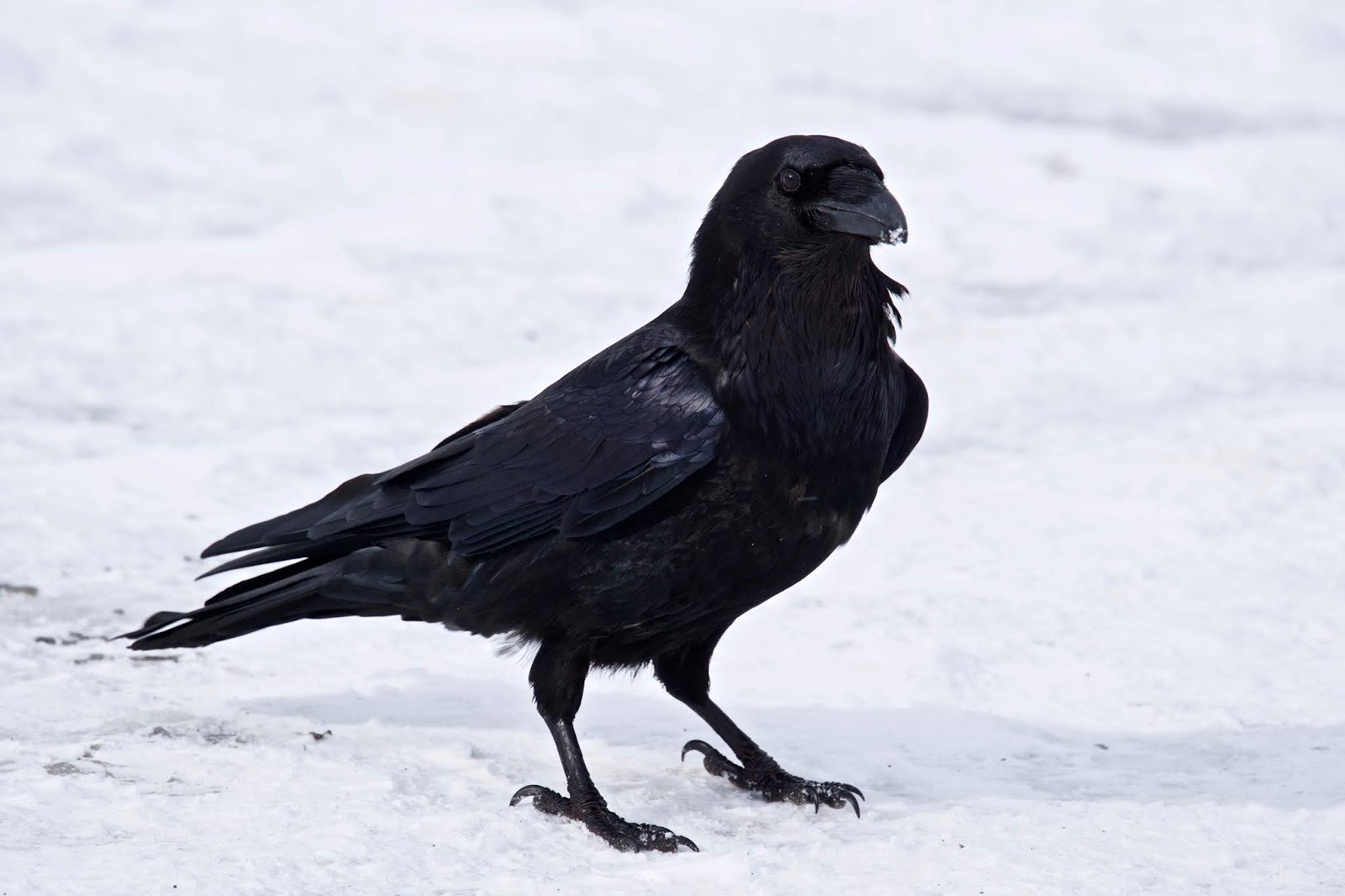
At one pull off, a large raven sat on a bench and when Bjorn stopped the  Viking Toe, the bird started acting out what it wanted. It picked at the ground and hopped cautiously around the car. It had not been doing that until the family stopped nearby. Bjorn threw it a few almonds in exchange for taking its picture, then it flew off. 

“Horses win,” Astrid said as they passed yet another snow covered pasture with a bunch of horses crowded around a feeding rack. “We’ve seen two sheep and possibly hundreds of horses … horses win.” 

“We even saw more churches than sheep,” Snorri added. 

\”More ravens than churches,\” Astrid said.

*Just a literary FYI: Jules Verne\’s 20,000 Leagues Under the Sea refers not to the depth Captain Nemo\’s (the main character) submarine sank, but to the distance (length) it traveled while under the sea. The Saga Family traveled 19000 feet in distance under the fjord, which is about one (1) measley league.

** Apologies if the geographical names and places in this blog are not accurate. As discovered in recalling the Hawaiian adventure, the beautiful native names of places and towns on this island do not stick in the author\’s Anglicized speech and memory as well as she\’d like, but she has worked to be as accurate as possible, post-adventure. 

The Gift of Snow

April 2, 2018 

 Astrid the Red and Bjorn the Light Catcher had two sons, the elder one was named Olaf the White for his light complexion, and the younger was Snorri the Fair-Haired because of his long locks. Olaf grew up to be a strong man and resembled his father. Snorri, big for his twelve years, resembled his mother’s side of the family. At the time of this saga, Olaf was apprenticed to a university to learn a living, therefore he did not accompany the family on the journey to Iceland, and is out of this saga. 
 The first night after arriving in Iceland, while the family slept, the skies worked hard above and in the morning gifted them with a light dusting of snow that turned the landscape white and shimmering. 
“I’m kinda glad it’s snowing, it covers up all the ‘spring-ugly,\’’’ Astrid said as she looked out the window of their cabin. Spring ugly is when all the snow melts in early spring, revealing dormant, brown, depressing plants that have not yet grown green and lively. 
“It’s better than rain,” Bjorn said. 
“Absolutely.” They were going to be outside the whole day. 
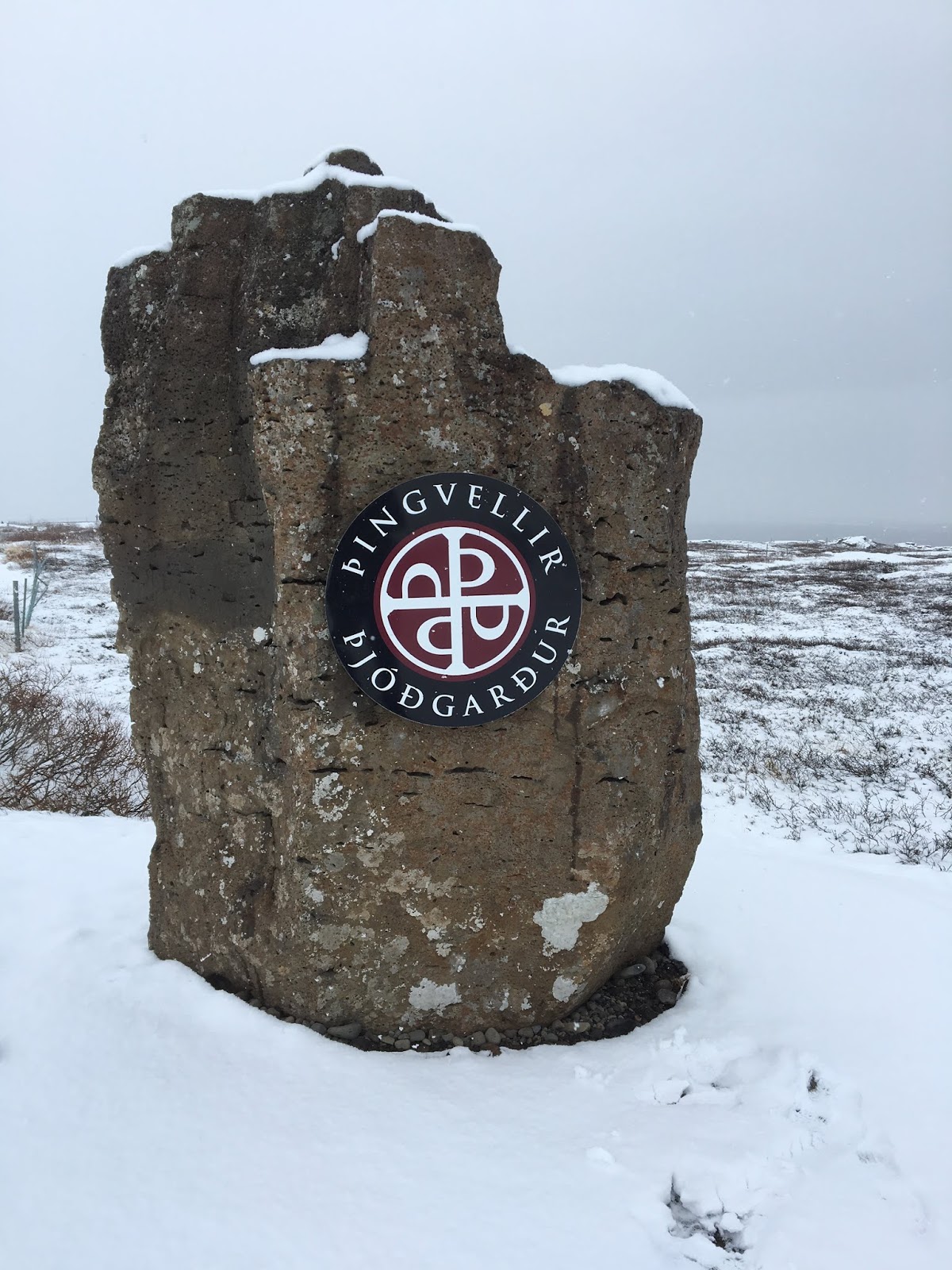
After trying to navigate Thingvellir National Park themselves, indecision and uncertainty drove them back to the information center for more direct directions. They were presented with an excellent presentation of the park, the whys and hows of its geology and history by a tall, light-haired young park ranger with excellent English. Visitors didn’t have to pay to get in, but had to pay to park, so they picked up a pass while they were there.
Part of the mid-Atlantic Ridge and the junction of the American and Eurasian tectonic plates lie all within this national park. 

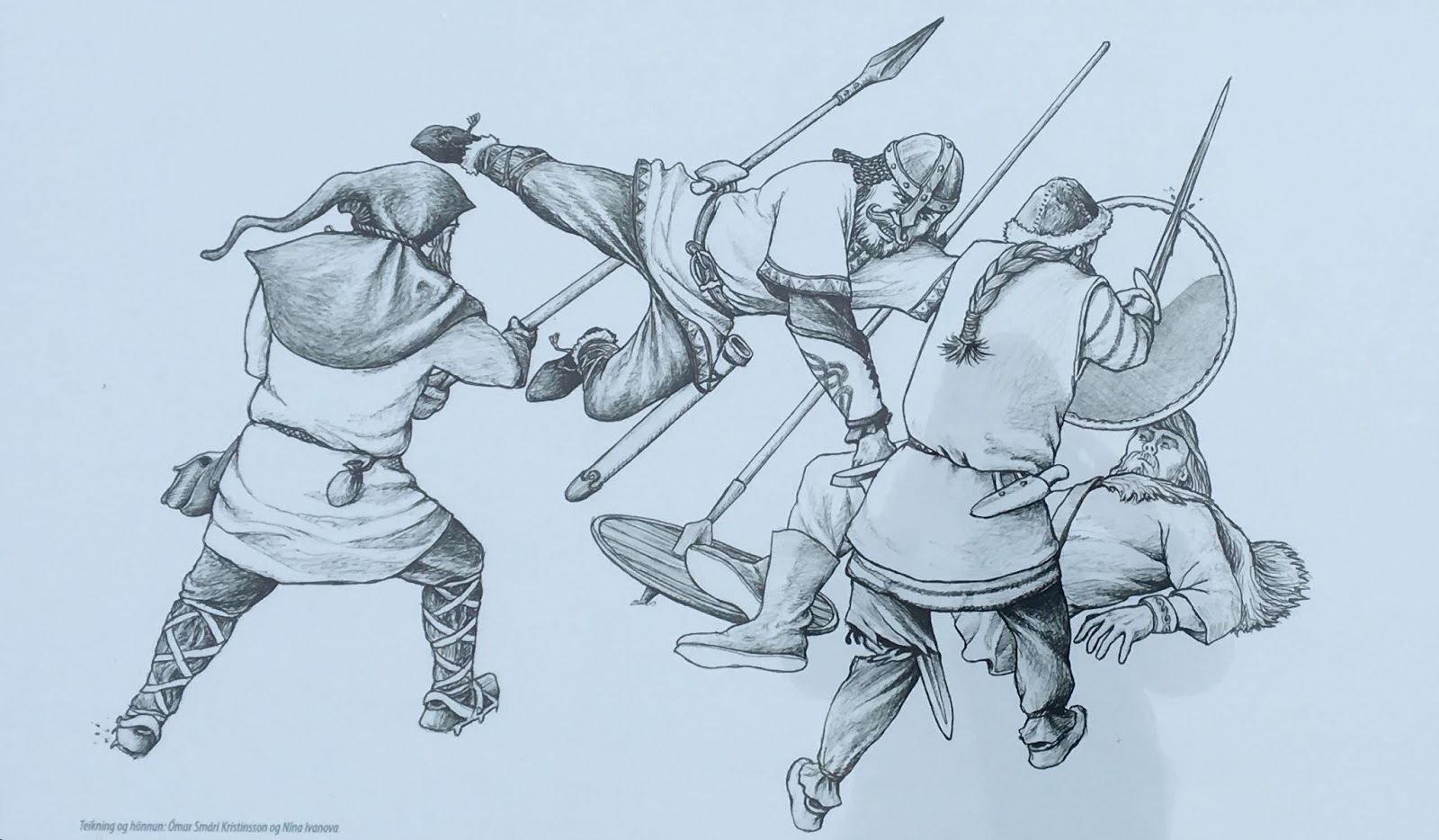
The family first stopped at a viewing platform overlooking a deep chasm in the earth, located on the western end of a volcanic rift valley. It was the place where the original Icelandic inhabitants held their Althingi, or Viking legislature of sorts, making and reciting laws, settling disputes and handing down sentences to offenders of the law.

At the Althingi, the Vikings in the Sagas stayed in tent-like booths for days, participating in the gathering, making marriage matches, and like typical Vikings, they often settled scores there using violence, cunning and/or mediation. The Lawspeaker, a Viking trained in law, would stand on top of the ledge and recite the laws of Iceland. 

After admiring the view from the top, the family drove down to the bottom and took an icy hike to the waterfall down the cliff. They didn’t stay for days like the Vikings of old, but moved on to see other, larger waterfalls.
Their directions to Gullfoss, one of Iceland\’s most famous waterfalls, were contrary to what everybody else was doing, but they followed Miss GPS’s instructions anyway, only to be turned away from the small parking lot by a man shaking his head in prohibition while they parked. 
Astrid rolled down her window at the frowning man. 
“You can’t park here,” the bubble-vested man said, in a tone that implied that they should know better.  
“Why?” the indignant Bjorn asked. 
“For buses only.” 
So they drove out, discussing the motives of the man who policed the parking lot (which was closer to the falls) without any apparent authority except that he drove a really big truck (not a bus, mind you). 
But the upper parking lot was spacious, with lots of room and it fronted a gift shop/restaurant, with a nice paved path that lead down to the falls.  
Gullfoss

Because of the snow and ice, the lower paths leading down to an up-close view of the falls was closed because Gullfoss is notorious for drowning errant, renegade tourists.  The falls, along with the whitened landscape around it, was a majestic sight. The water from Hvítá River leaped down ledges, then ascended a tall angular cliff of rocks. As Bjorn took pictures, a class trip congregated around him, Astrid and Snorri, trapping them against the fence while they squeezed together for a group photo. 

After taking in all of Gullfoss as was possible, the family visited the gift shop to warm up. There was a woolen horse blanket for sale there, just like the one they had at home, from the same company (here). The wool sweaters, an Icelandic icon, at 200-300$ a piece were a little bit pricey for Astrid, so she would just make due with her horse blanket (she received from her in-laws, who, to her knowledge had never been to Iceland). 
They ate lunch at the gift shop cafe, where Astrid and Bjorn had the Icelandic lamb soup (with cabbage, carrots, rutabaga, potatoes and lamb) and skyr (Icelandic yogurt), while Snorri ate a ham and cheese sandwich. 
In the parking lot, they went to get into what they thought was their car, but on closer inspection found that it wasn’t. There were so many white Kia rental SUVs, that it was hard to tell which one was theirs. But Snorri knew. 
“Our license plate is VKTO5. Viking Toe 5. That’s how I remember it,” he said, as we scanned the license plates for the alpha-numeric. 
“Nice. I like that name. The Vikings in The Sagas often named their boats. Good idea,” Astrid said.

The ship, Stigundi is one example, the name meant \”high stepper.\” The family\’s “boat” was the Viking Toe 5.  
The nomenclature would come in useful every time they parked, as they easily identified their rental car from a sea of identical ones. Bjorn had ordered an SUV-type specifically for use off-road. They learned from their trip to Hawaii about how treacherous off-paved-road driving on a volcanic island can be. But here, it also helped with snowy roads and strong winds. 
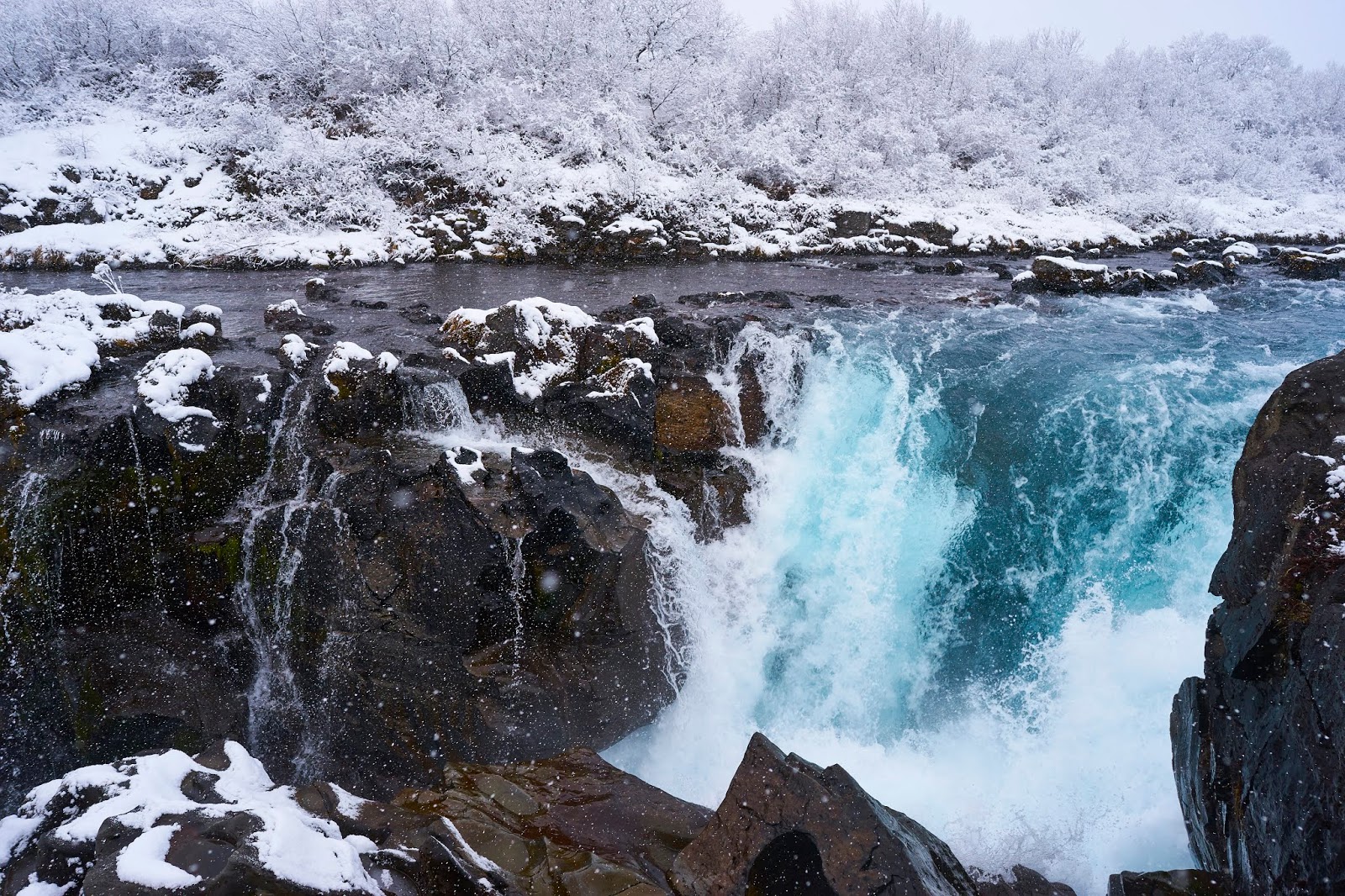
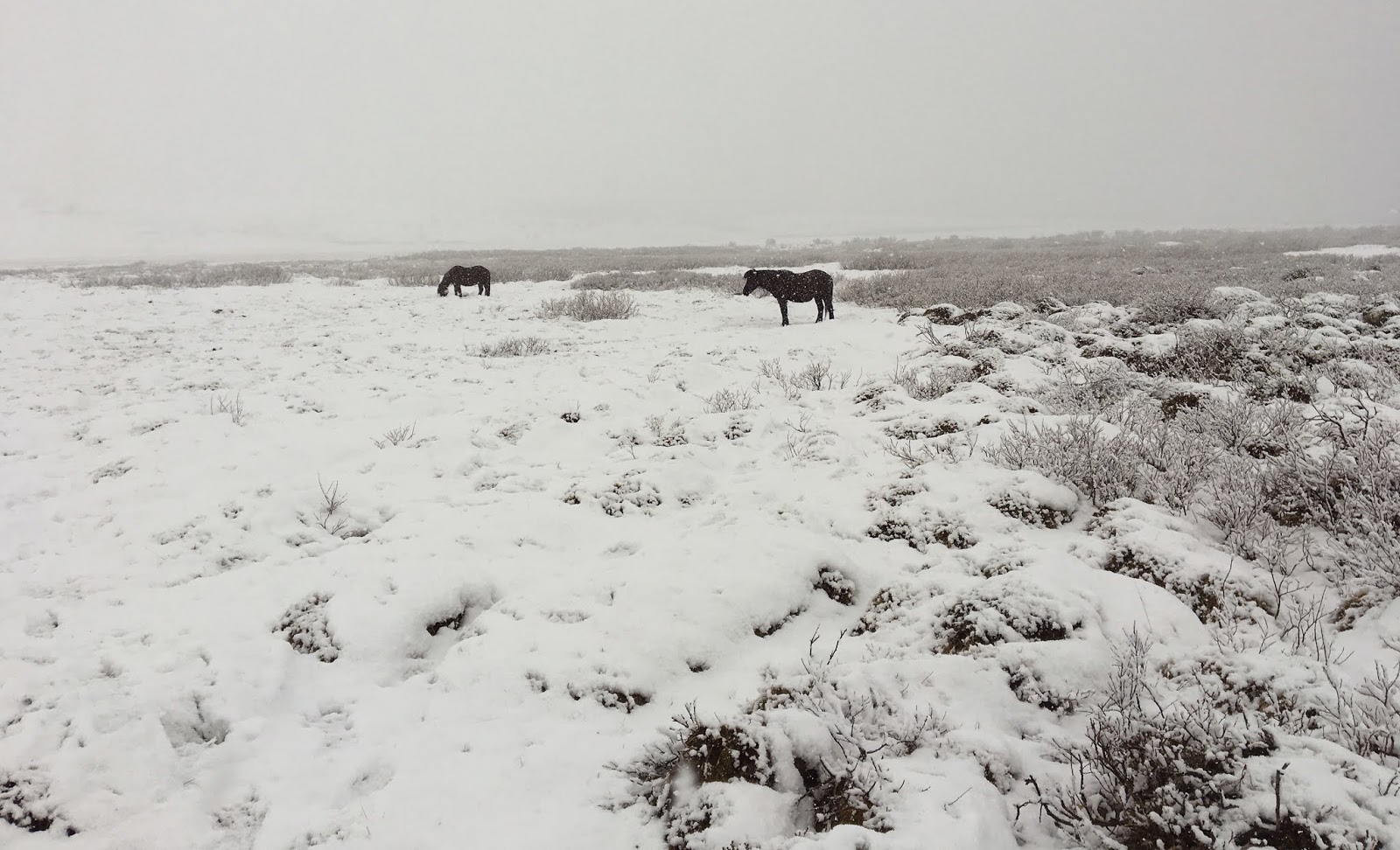
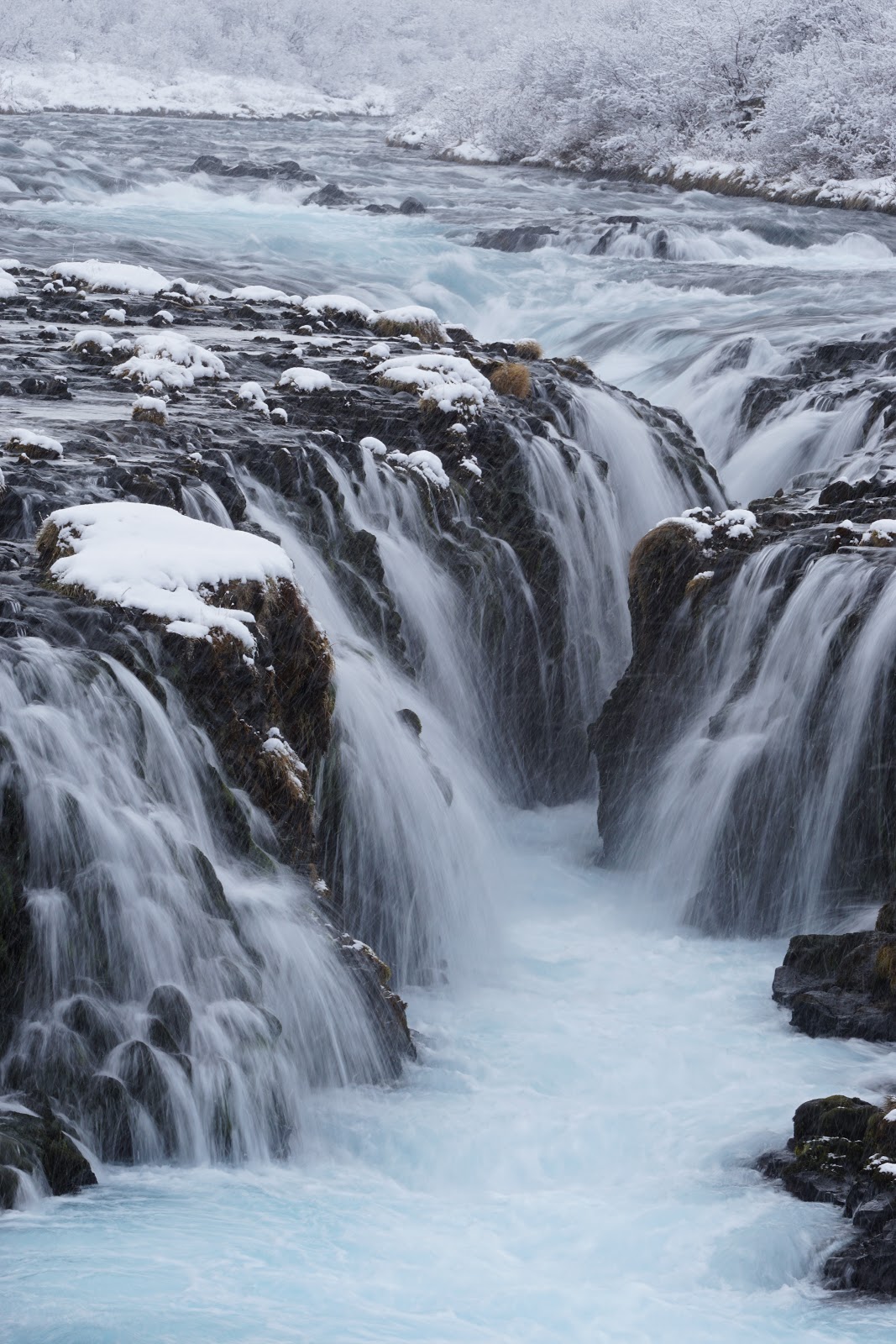
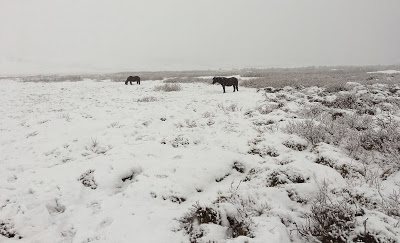
As they drove to the next stop, it was starting to snow harder, but they pressed on. They parked in a small lot off the highway 37 (Bruaurfoss Waterfall Official Parking Lot), carefully crossed a cattle-grate and followed footprints in the snow that lead to barely visible white path, past a group of small but hearty horses who didn’t acknowledge the hikers and went about searching for nibbles under the snow. 
They trudged by a stream for about a half mile, their feet sinking in the snow-covered mud, then made their way through high shrubs, then up a ladder-like stile over a fence and came out close to a cliff overlooking the rapidly running water. B stopped at the first waterfall as the lagging Astrid and Snorri caught up. 
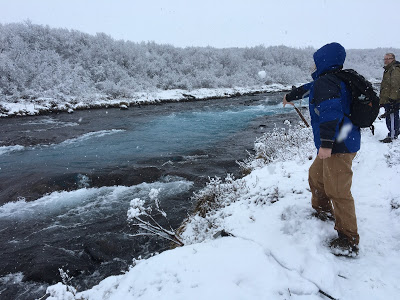
“This isn’t ‘it’, it’s just one of the three water falls along the way,” he said, without setting down Tripod. Snorri took some time to throw snowballs into the blue-green rushing water. 
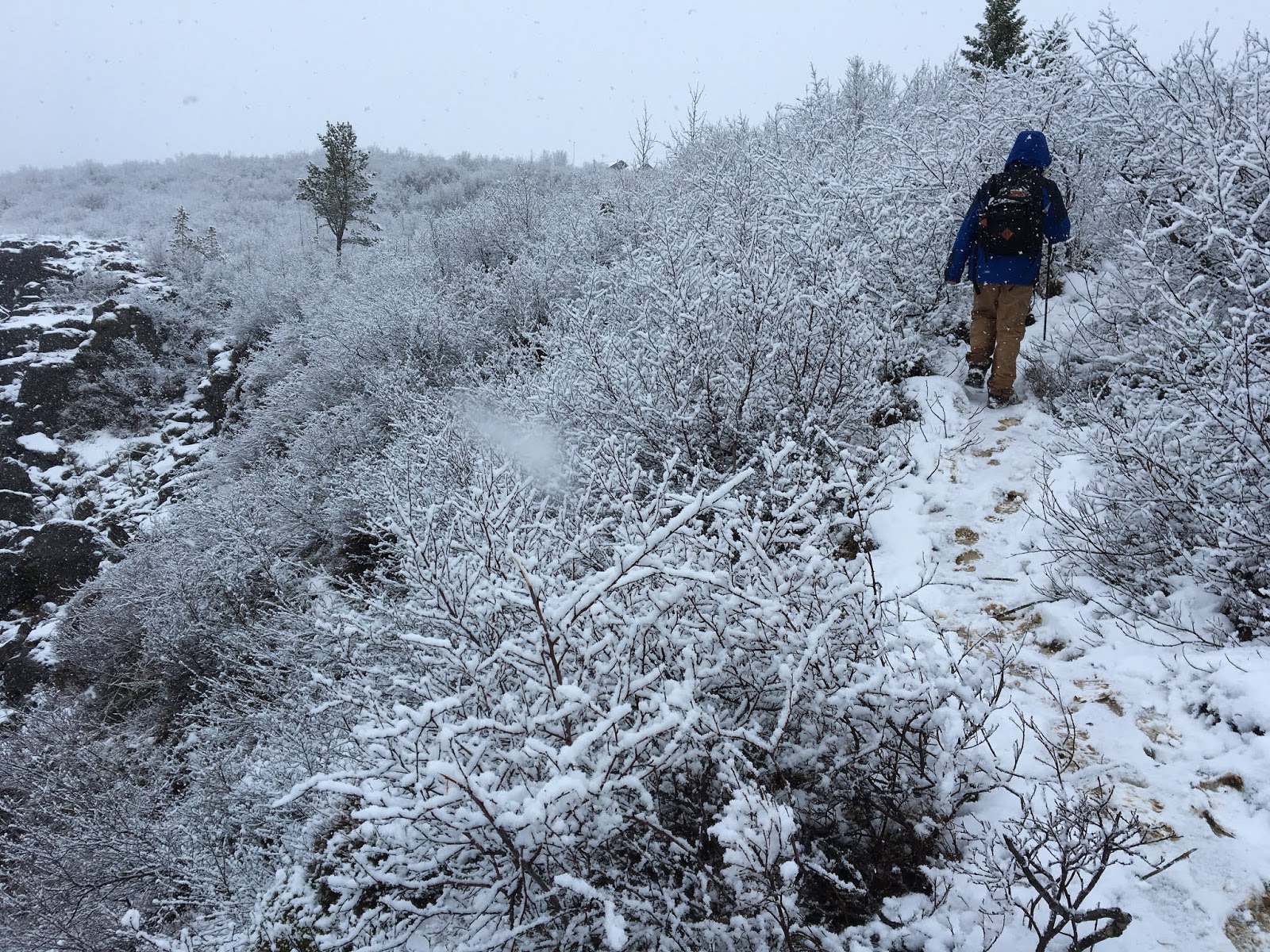
It wasn’t a difficult hike, there were no long, steep inclines and no impossible vegetation. It was muddy, but the snow, falling slow and faery like, covered the branches of the shrubs in fluffy white, giving the trek a magical aura. Snow accumulated on hats, heads, shoulders and bags, while boots collected mud and water. 
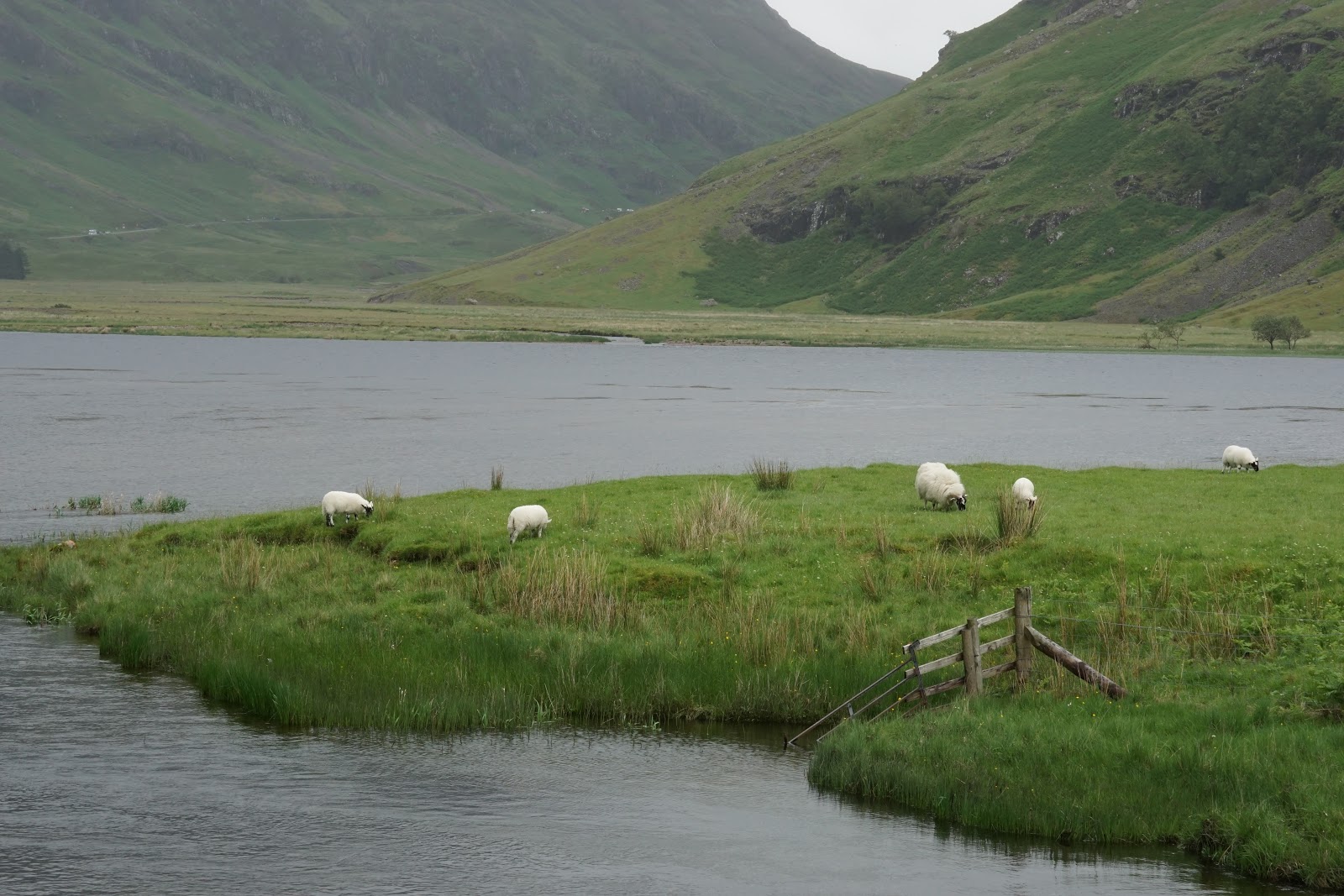
One-third of the way into the hike, Bjorn stopped and pointed to a small peninsula jutting out into the stream. At the tip stood two sheep–one white, one black–standing, staring back at the bipeds as they passed. They were heavy with a winter wool coat and seemed nervous and wary of the hikers. 
Bjorn, eager to get to the last and most famous waterfall, went on ahead of the leisurely Snorri and Astrid, disappearing from view after passing the second waterfall.
So when Astrid and Snorri came to a fork in the path, they were faced with a very big question. 
“Where is he? Which way did he go?” Astrid asked, scanning the horizon for the familiar head. Nothing. “Did he know he was passing a fork? How are we to know which way to go?” 
Snorri just shrugged. 
Sometimes it’s the littlest thing, one tiny moment, that make or break us in quandaries like this, put us on the right track or get us lost forever. 
Weeks before, Bjorn bought water-proof boots in preparation for the trip.
“Can I buy you cramp-ons? You know, those things you put on your shoes that give you more traction in snow and ice? Because Snorri and I were discussing it, and we think you should have a pair, seeing as you like to go so near cliffs to take pictures, and Iceland has some dangerous things, like slippery, icy, windy cliffs,” Astrid pelted him with sound reasoning. 
“Hmmm. No, I’ll be okay.”

“People die by getting blown off cliffs into freezing water. They get grabbed by waves and eaten by the North Atlantic. I hear the Icelandic people are awesome and kind (to your face, but really, who doesn’t get impatient and annoyed by clueless tourists?), but Icelandic Mother Nature is crabby and vindictive. Are you sure you don’t want crampons? You don’t have to get the actual spikes on your shoes, there are ones that have metal springs that increase your traction.” 
“I’ll be fine, I have good traction on my hiking boots. No need for anything else.”
“Really? I’ll have to take a look.” 
And she did take a look at the bottom of his new hiking boots, noticing first that, no, the tread was not impressive traction-wise, and that second, it was full of angular squiggles and odd geometric shapes. 
“Well, let’s look at the footprints … I think I can remember what his shoe treads looked like,” Astrid said, head down, squinting at the white-on-white tracks going both ways under a white-grey light from the overcast, snowy sky. “Those aren’t his … nope … definitely not. There, there it is, squiggles and angular shapes, I’m pretty sure those are his tracks.” 
“How can you be sure?” Snorri asked. 
“In a turn of good luck, I took a look at his tread before we came, because I didn’t think it was good enough. I still don’t think they are good enough, but we’re sure lucky I did.” 
They followed his tracks though a few more forks, sorting his treads from a dozen others to arrive at a wooden bridge spanning the river just below the Bruaurfoss Waterfall, a wide waterfall, frothing white and blue-green in the deep spots. He was busy with Tripod snapping pictures, oblivious to Astrid and Snorri’s adventure. A few other tourists were there, sharing the sight. 
“Didn’t you see the forks in the trail back there? We lost you, and didn’t know which way to go,” Astrid said. 
“What? I didn’t … What? I didn’t realize … What?” 
“I had to pick the right trail by matching your footprints,” she said. 
“Impressive.”
“It was kinda fun.” 
“Why are there so many people here? I didn’t see them on the trail coming in.”
“There is another way you can get here, a shorter way, but you have to park in a neighborhood. They recently made the trail we hiked in on to discourage people from parking there.”
“No one wants a dozen or a few hundred strangers parking in your neighborhood … and don’t they miss the two lower water falls if they only take this short cut?”
“The two lower ones are nicer than this one.” 
“I’m glad we took the long way, it was worth it.”  
On the hike back, their footprints were erased, covered in a dusting of white, but the trail was easy to follow along the river.  
Through the shrub-crowded trail, they came upon the sheep again, this time the woolen creatures were in front of them. The sheep would run ahead, worried about the hikers\’ intentions, but eventually they could run no more because of a fence, and jumped into the shrubs to avoid the hikers.  
The family climbed the ladder-stile over the fence, putting an end to following the sheep. They trudged back through the horse pasture, avoiding road-apples, and over another fence back to the Viking Toe 5. 
At the car, they shook off the snow, dried off essentials with handy micro-fiber travel towels and considered their next move. 
“The mineral pools are open until 10 … or 22:00, you guys want to go?” Bjorn asked. 
Snorri shrugged his shoulders, “Not really.”
“Oh, come on, we should. We never do things like this, we should do it,” Astrid said. 
“If you guys go, I will, I guess,” Snorri said. They had packed swimming suits and microfiber towels just in case. 
Before going through the clean, shiny doors at the Laugarvatn Fontana Geothermal Baths, they wiped the mud off their shoes as much as possible and Astrid folded the muddy part of her pants up, but she still felt a little out of place when she walked into the spa. 
Bjorn ordered three admissions. The cashier hesitated, then asked, “How old is he,” pointing to Snorri. 
“Twelve.”
“Do you have ID?” 
Astrid and Bjorn looked at each other. “Uh … our passports are back at the cabin … “
“It’s just that twelve is the cutoff age for the children’s rate and … he looks like he’s older than twelve,” he said, a little apologetically. 
“Ooh. Well …”
They looked at Snorri and realized that the kid had grown quite a bit in the last year, and didn’t look like a kid anymore. 
“I can understand, he is a big kid. We feed him well. He was born in 2005 … he’s in sixth grade. I guess it’s just our word.” Bjorn finally acquiesced.
In the end, the cashier reluctantly believed them, so they appeased the man by renting three towels even though Astrid had brought her own with her. 
Before they could get into the hot mineral springs-fed pools, they had to shower stitchless so as not to contaminate the chlorine-less water. The showers were clean, with mineral shampoo and soap provided, and warm, rain-like shower heads. 
When Astrid was squeaky clean and had pulled on her swimming suit, she stepped out of the locker room door into a shocking 0 degree Celsius air. She walked swiftly to the first steaming pool she saw and quickly lowered herself down into the 34 degree Celsius water. It was two to three feet deep, so she sunk down to her neck, her wet hair chilled in the air. 
Ten minutes later, Bjorn and Snorri walked out. She waved to them, but it did no good. Bjorn didn’t have his glasses and couldn’t see very well. Eventually they found her and sunk into the heated pool, teeth chattering. 

For the next hour they passed through the cool (32 degrees C), medium (34) and hot pools (38-40), enjoying the warmth and relaxing water after the snowy hike. 

After the dip in the pools and the showering, drying and re-dressing into muddy clothes,  Astrid walked out to the lobby to find Bjork and Snorri looking over a case of desserts. Bjorn got a big slice of gluten-free zucchini avocado cake, Snorri a salted caramel confection. 
By the time they left and walked out into the parking lot, everything was covered with a slick coat of ice, including the Viking Toe 5. 

Bruaurfoss Waterfall

The Longest Day

Day 1 March 31 and/or April 1
At 9:37 p. m. EST, sitting on an obscenely fuchsia colored plane somewhere over the northern Atlantic, Astrid asked herself, “How did I get here?” She used to ask herself that question a lot in the years after she moved from her humble bucolic home in north central Pennsylvania to Virginia, then to Kentucky, then to Michigan.This rhetorical question had visited her less and less in the past few years, so the query surprised her on that bleary eyed over-night, circadian-rythm-destroying trip to Iceland.

She knew how the plan came to be …

“How about Iceland?,” Bjorn asked as Astrid was preparing dinner one evening over Christmas break. 

“What? You mean to go there? What? Why Iceland?” 

“There are some really good deals online, and they expire tonight. We should be more spontaneous,” he said. 

“What’s in Iceland? Ice-land? It has “ice” in the name for a reason. Really?” Inside, Astrid was desperately trying to beat down nervousness and fear as Bjorn explained the photographic draw of the place. “Give it a few hours and think about the pros and cons, then talk to me again,” she said, but she actually meant “Give me a few hours for the fear and worry to dissipate, then ask me again.”  

The Sun Voyager

Most people went south for Spring Break. That was way too easy. An hour later Bjorn mentioned it again. Astrid had gotten over her initial shock, was still not over-enthusiastic but  curbed her reluctance, prayed for courage and dove in. 


“If you think you really want to go … why not?”

Later that night Bjorn told her that he had missed the deadline for the cheap flight, and for a few days, she basked in an uninterrupted-by-challenging-travel future. But there was another sale for flights to Iceland and before too long, the trip was finalized for Snorri’s Spring Break. 

And of course she knew how she got there physically …

The weather was rainy and dull on the drive to Chicago. Music from the iPhone wouldn’t stop playing over the USB along with GPS  in the car. As planned, the family stopped at Jewel Osco to turn in an expired I-PASS transponder, but got a new one instead (they didn\’t want a new one). “I only exchange them, I don’t refund the money,” the sassy Jewel-Osco lady at the desk insisted. So now they had two IPASS transponders. 

As a fitting start to a far-north trip, the family stopped in at Ikea for lunch, but Astrid picked up a dark chocolate bar and a pour-through coffee funnel as well.
Waiting …

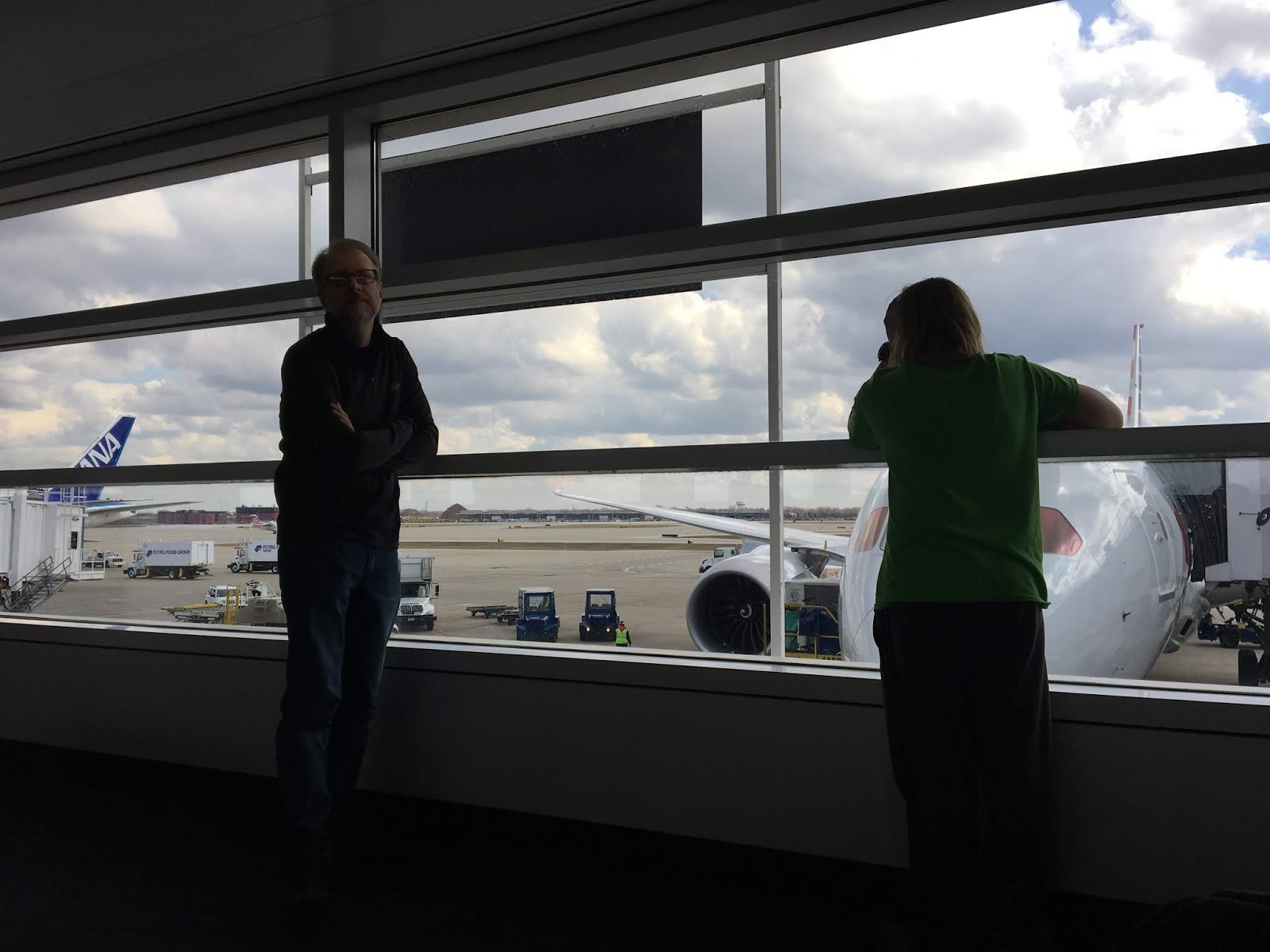
When they arrived at their gate at the airport, their plane wasn’t there. Besides having the gate blocked by emergency vehicle and personel, the microphone at Gate M18 had microphone problems, so the large man there used his sonorous voice to shout announcements at the Iceland-bound passengers waiting there. The flight was delayed forty-five minutes, which gave Astrid time to look and observe, write and wonder. It also extended their landing time to a more humane hour than the originally scheduled 4:20 a.m. 


Astrid waited watching fellow passengers, wondering about them, their lives, their goals, their selves. She gleaned more and more tiny details every time her gaze swept over their faces. A family from Kentucky consisting of mother, dad and son sat across the row of seats. The teenaged son played a Nintendo Switch to burn the time. Further down the row of seats sat a pair of young women friends, together for an adventure, wearing leggings and sparkling new hiking boots.

The airplane attendants walked by, turning heads with their bright, all-pink uniforms. When the plane pulled into the gate, it commanded as many stares: it was the all-fuchsia aircraft of Wow Air.  There was no confusing it (or forgetting it) with another airline.

The slow, impatient loading commenced, and soon the pink plane was in the air. 

… but mentally, she had no clear idea how she came to be flying over oceans to sneak around other countries while trying to be as unobtrusive as possible. In addition to being terrified of strangers, the dark, dogs, bears, roosters, baths and hydrogen peroxide, she was so often scared of her own shadow as a child.


A torturous six hour flight, filled with sleeplessness despite exhaustion, pain from sitting in one spot for too long, RLS and general airplane malaise, landed them in Keflavik Airport, into the general confusion and mild busyness of 5 a. m. in the morning. By the time they went through customs, picked up their luggage and bought a SIM card for their phone, it was closer to 6 a. m. 


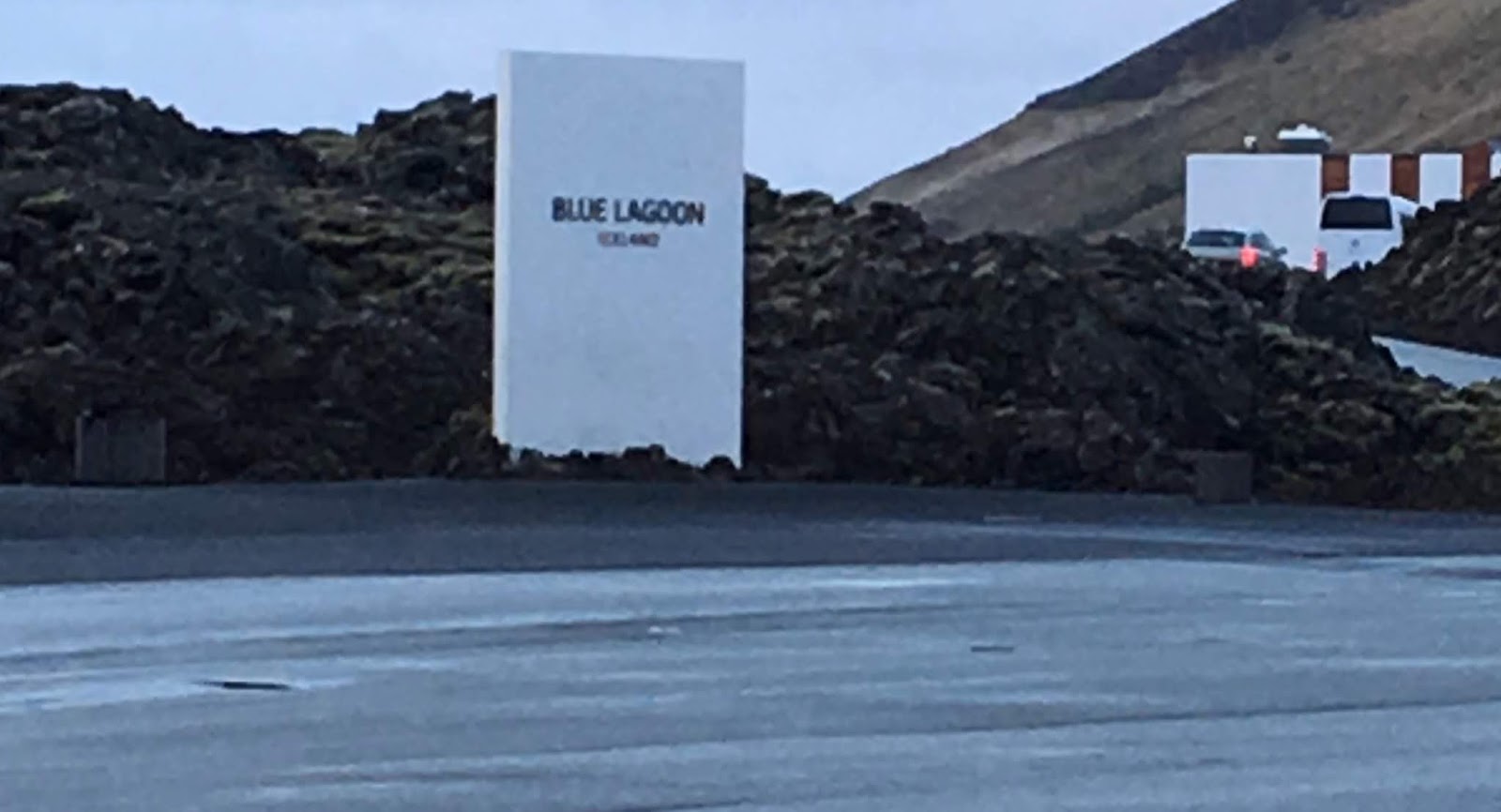
The car-rental place was packed full of eager tourists dropping off and picking up and not enough attendants (it was Easter Sunday morning, two of the employees had called in sick), but the family were more than willing to burn the morning hours waiting patiently. When they got on the road at 7-ish, they headed to their first destination,  The Blue Lagoon

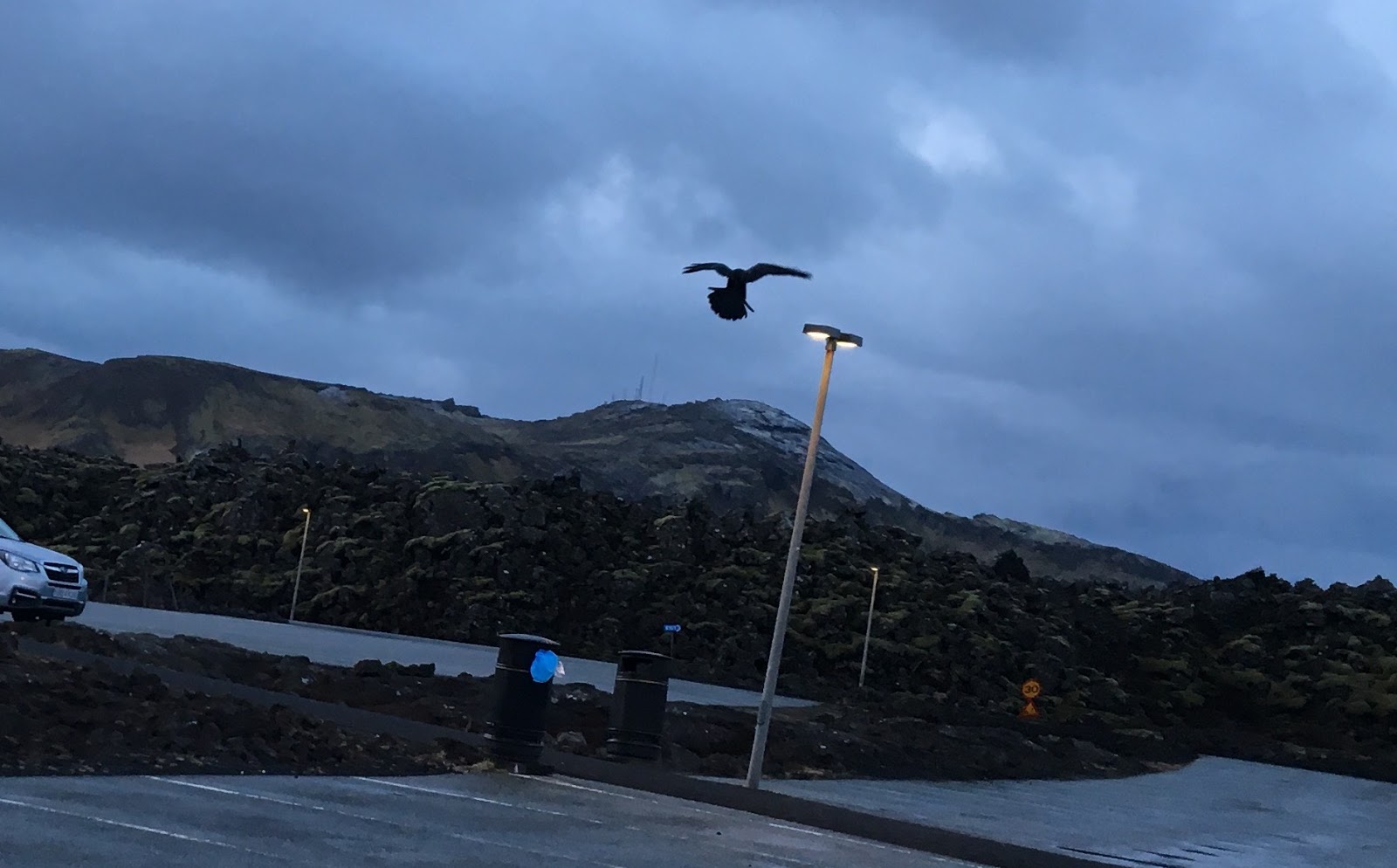
The Blue Lagoon is a geothermal spa, but the family wasn’t there for a dip in the waters that day. As they pulled into the parking lot with their white Kia, fresh with a tank full of diesel and the cab smelling of it, a large, unmistakable, black, bird was waiting in the parking lot, searching for morsels. Astrid watched the raven as Bjorn parked the car and got out, leaving the door open for the extraordinary chill to fill the cab and creep deep into Astrid and Snorri’s clothes. 


“Shut the door, shut the door, shut the door,” Astrid muttered as she stretched over to the driver’s seat and pulled it shut, only to have it open a few seconds later again by Bjorn. 

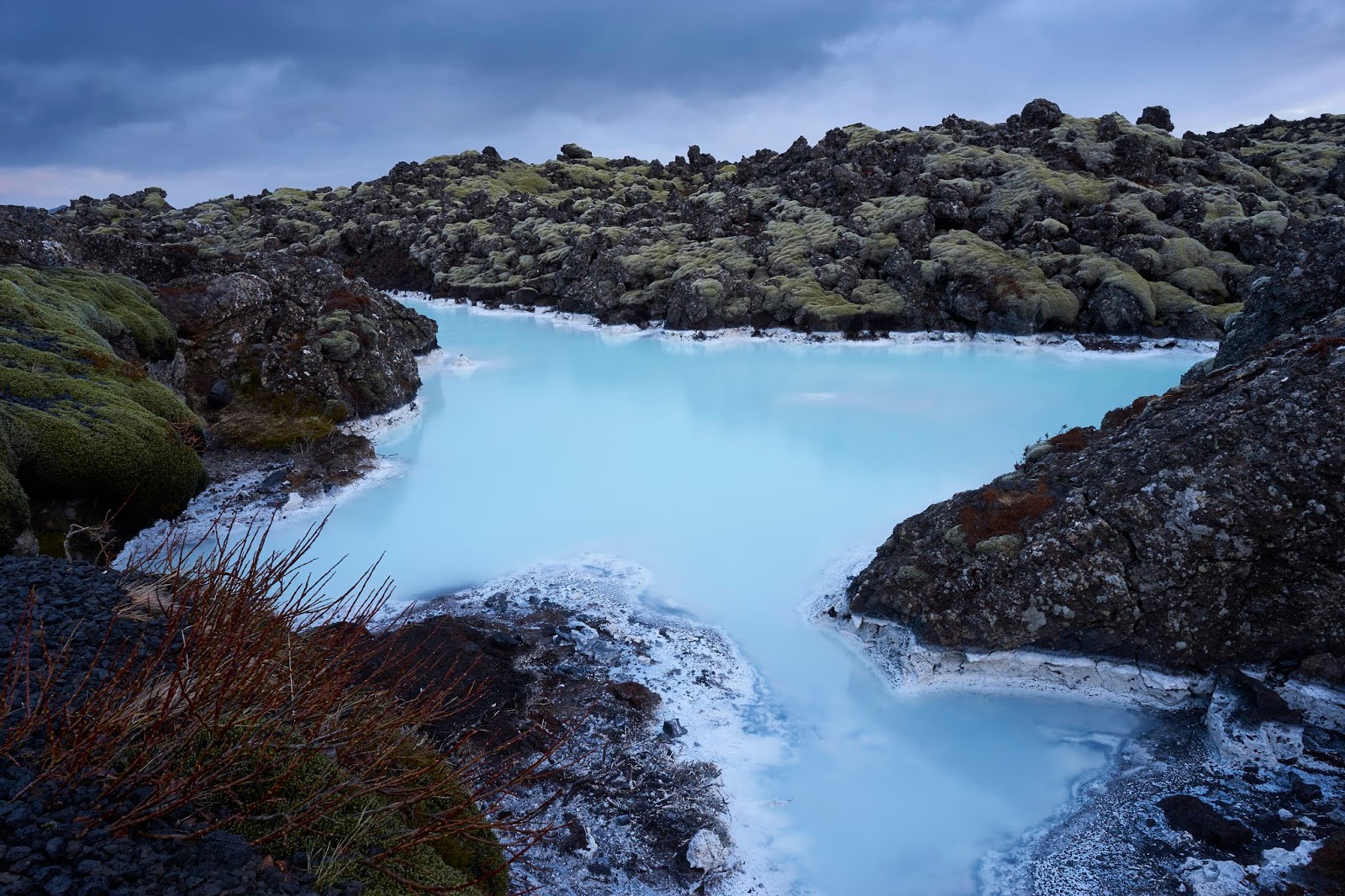
Weird water

“I’m going to walk down and see this water, you should come,” he said, Camera and Tripod in tow. 

“I’m going to warm up a little first,” Astrid said, poking the seat warming button a few times to full heat. Snorri dozed in the back seat. 

She watched as Bjorn walked onto a trail and disappear behind piles of moss-covered lava. The landscape leading up to the spa was flat but covered–like many of the plains in Hawaii–with lava, jagged and sharp, except this lava was draped in an army green moss. Half an hour later, Bjorn re-appeared, encouraging Astrid to go out and see. 

“It’s not far, just a short walk,” he said. 

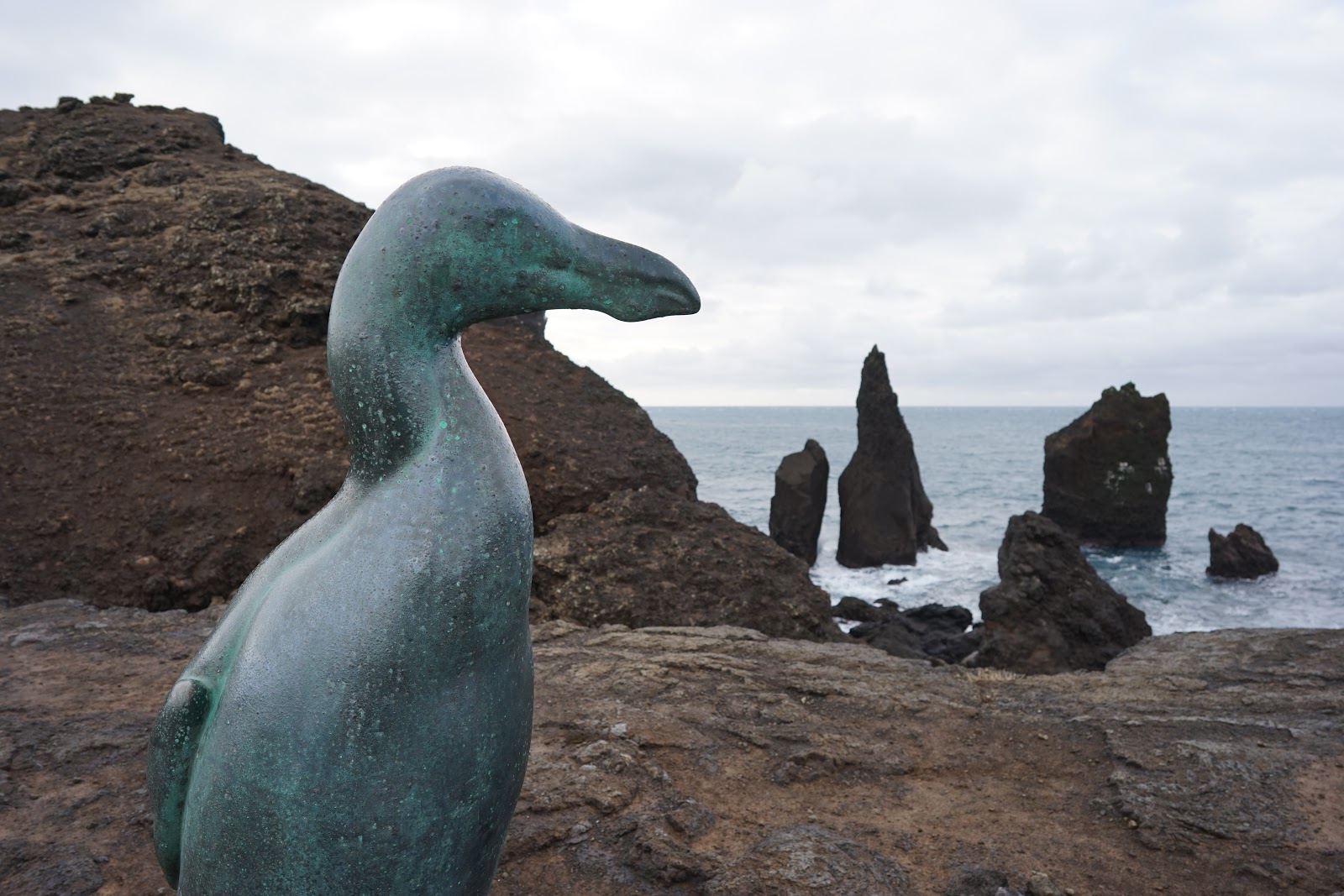
Giant Auk

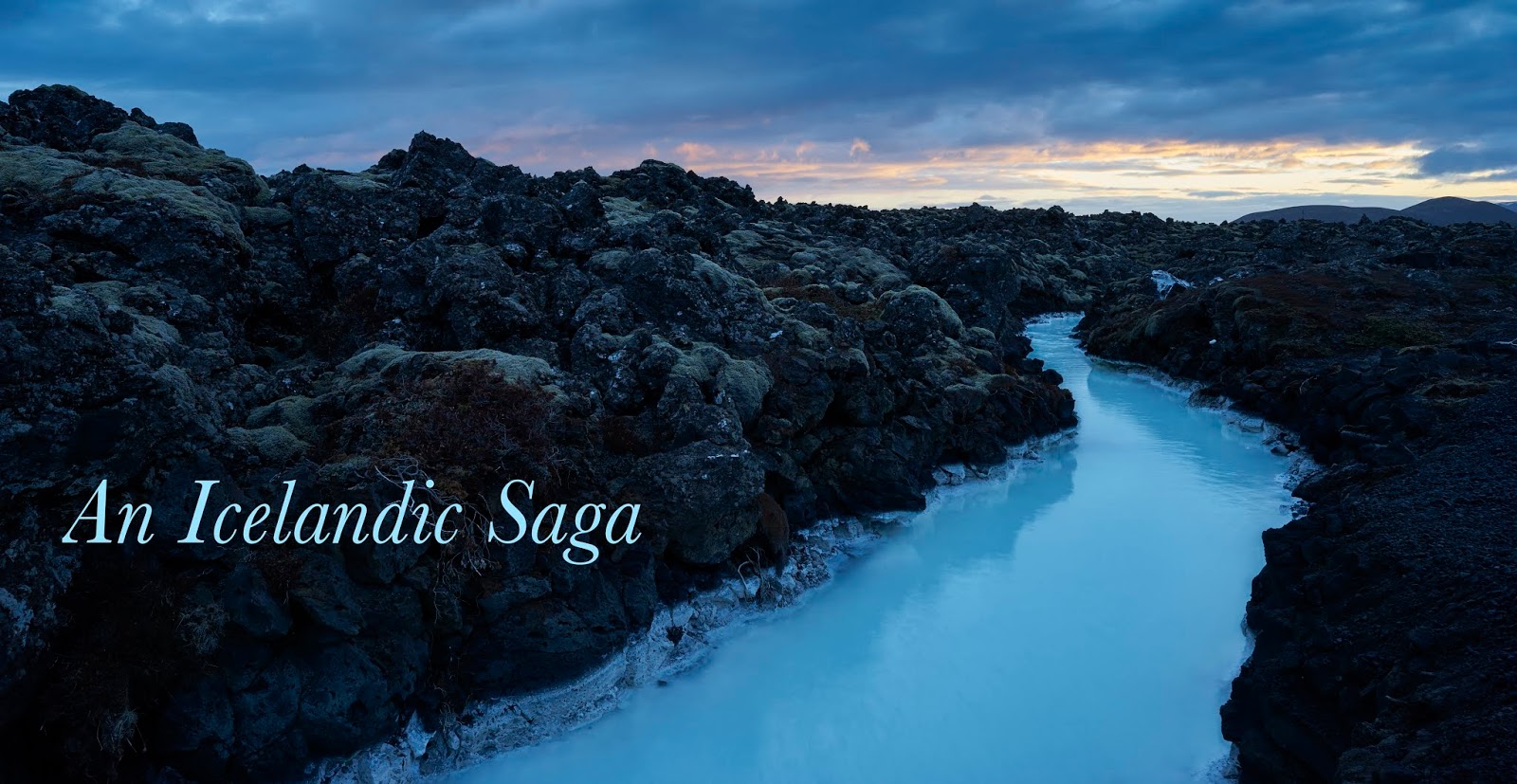
She opened the door against a healthy wind and shut it quick for Snoring Snorri’s benefit, zipped up her coat and walked down the trail to find a blue-green stream running through black lava landscape, steam floating up from who knows where. She took a few iPhone pictures for her “weird water” collection and made her way back to the car. 


Next they drove along the steaming, lava landscape down to a beach featuring a large Great Auk statue and Bird Island, a large rock off the shore where white birds nested, flew and flit. A few minutes after parking, a large van with big tires pulled up in front of them, with “Thor Photography Tours” on the side. It wouldn’t be the last run-in with them. Bjorn opened the door and shut it this time, but didn’t shut it with enough force, and the car told him so with ding noise. A brisk Icelandic breeze blew in through the open hatch as he collected his photography instruments. Astrid and Snorri shivered. 


Astrid and Snorri stayed in the car as he walked off to capture  images. When he came back, Astrid got out for her tour of the beach. 

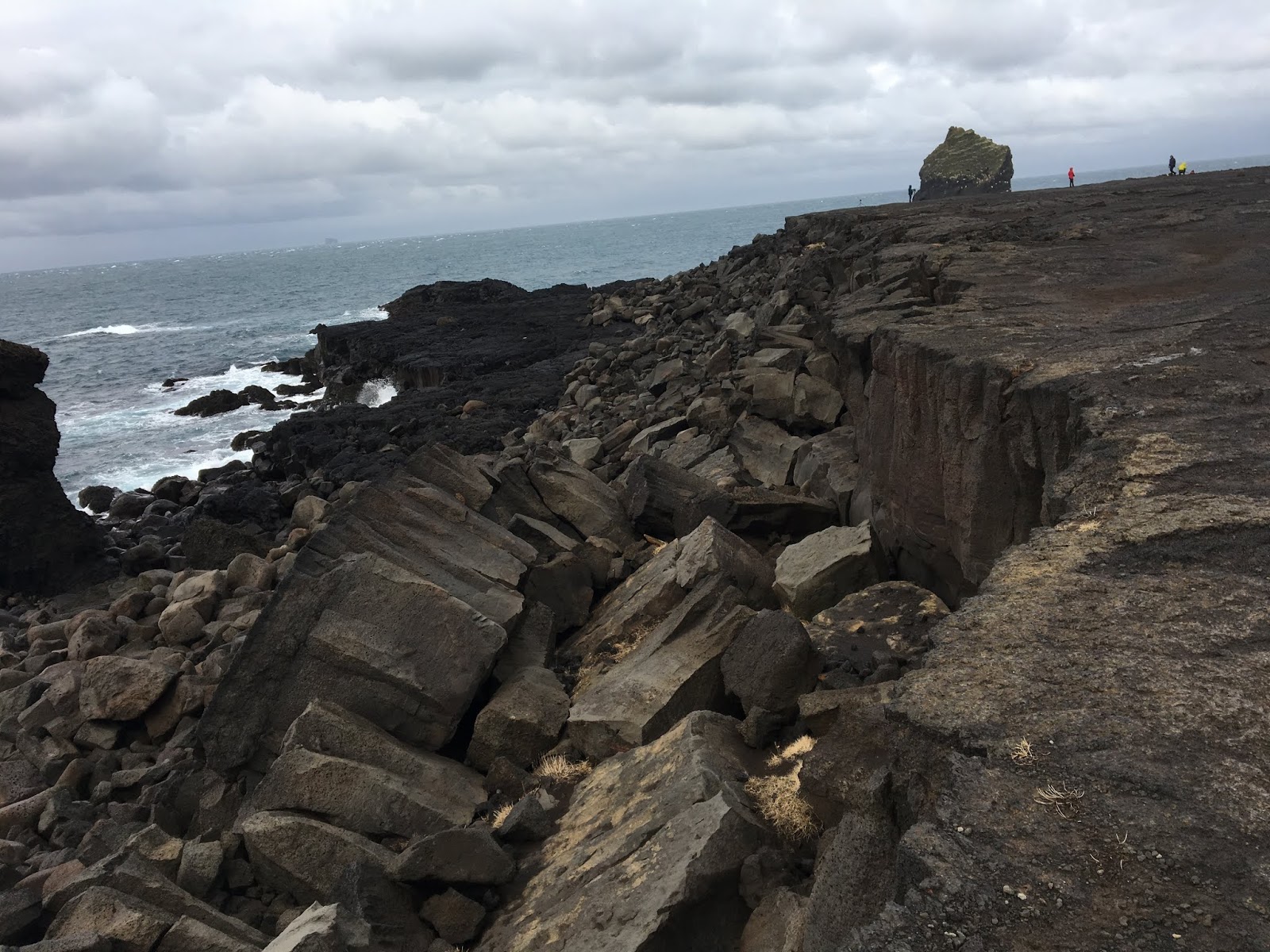
“It’s not that cold, 2 degrees Celsius,” she said after coming back. \”Those rocks, they look like they just fell into the ocean\”, she said. The rocks looked like pillars of stone stood on end, and pushed close together. The ones at this beach look like they toppled, due to the ocean waves.  

Driving in another country will always be challenging. Driving in a country where they drive on the right side of the road, whose language is not English, is less challenging than driving in the UK, but still has grand potential for getting lost. Outside the exemptions of Ás [OUSE] and Vik [VEEK], the names of streets, towns and landmarks in general, rarely have less than ten letters in their names and it would take about a week for Astrid, the navigator’s assistant, to become accustomed to them. Even Miss GPS didn’t specify street names, she just said, “Turn left, veer left, turn right, etc.”

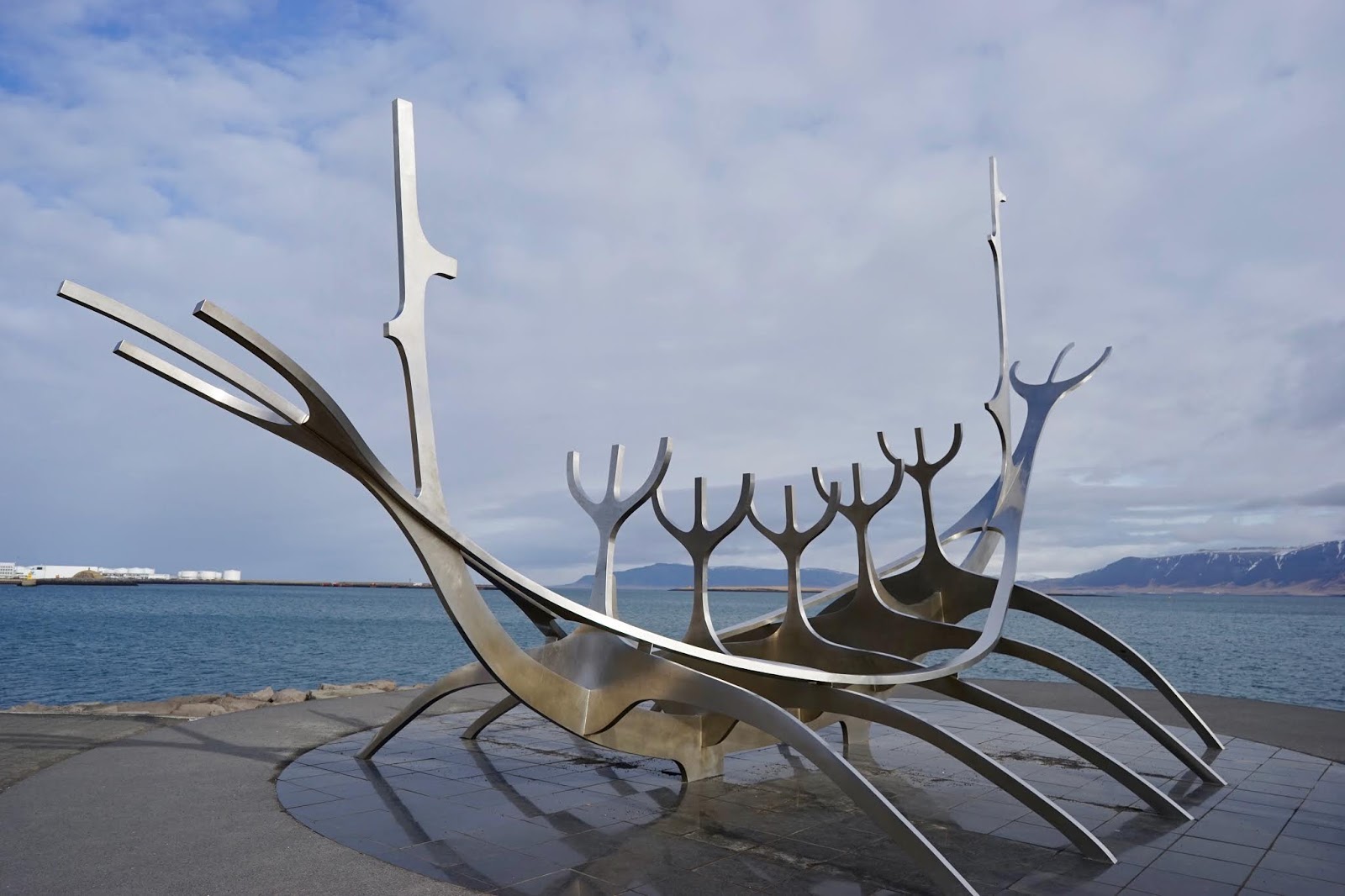
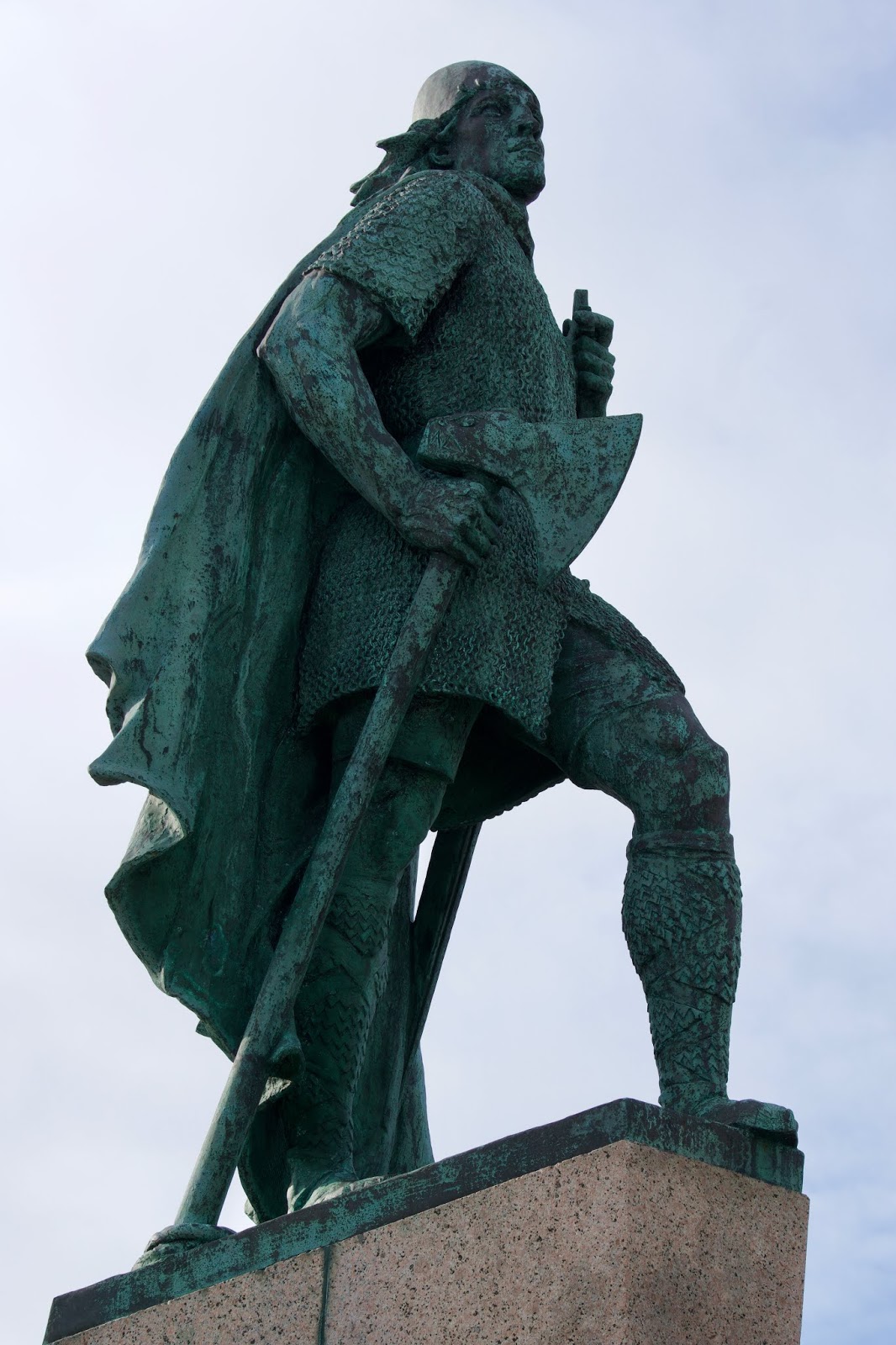
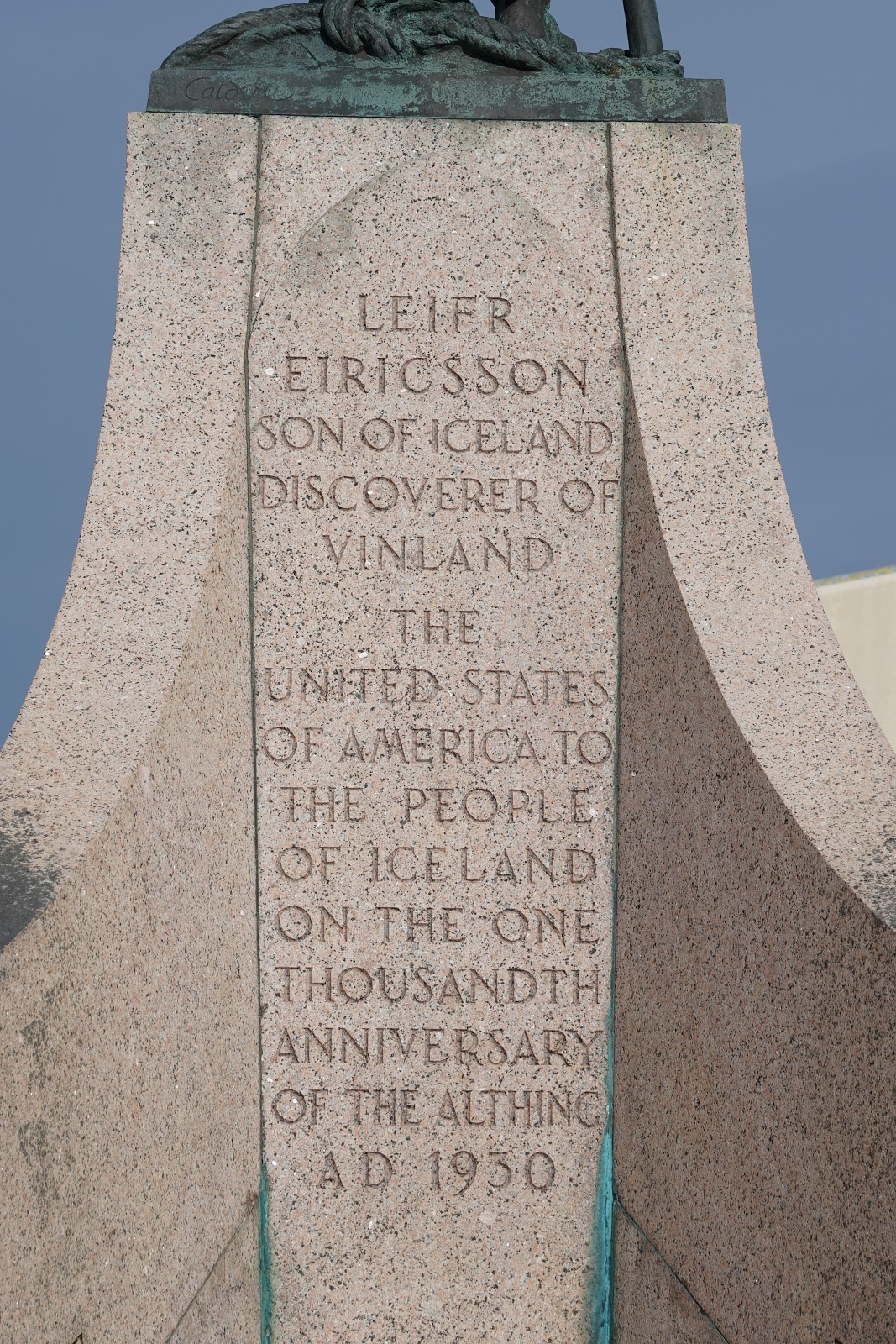
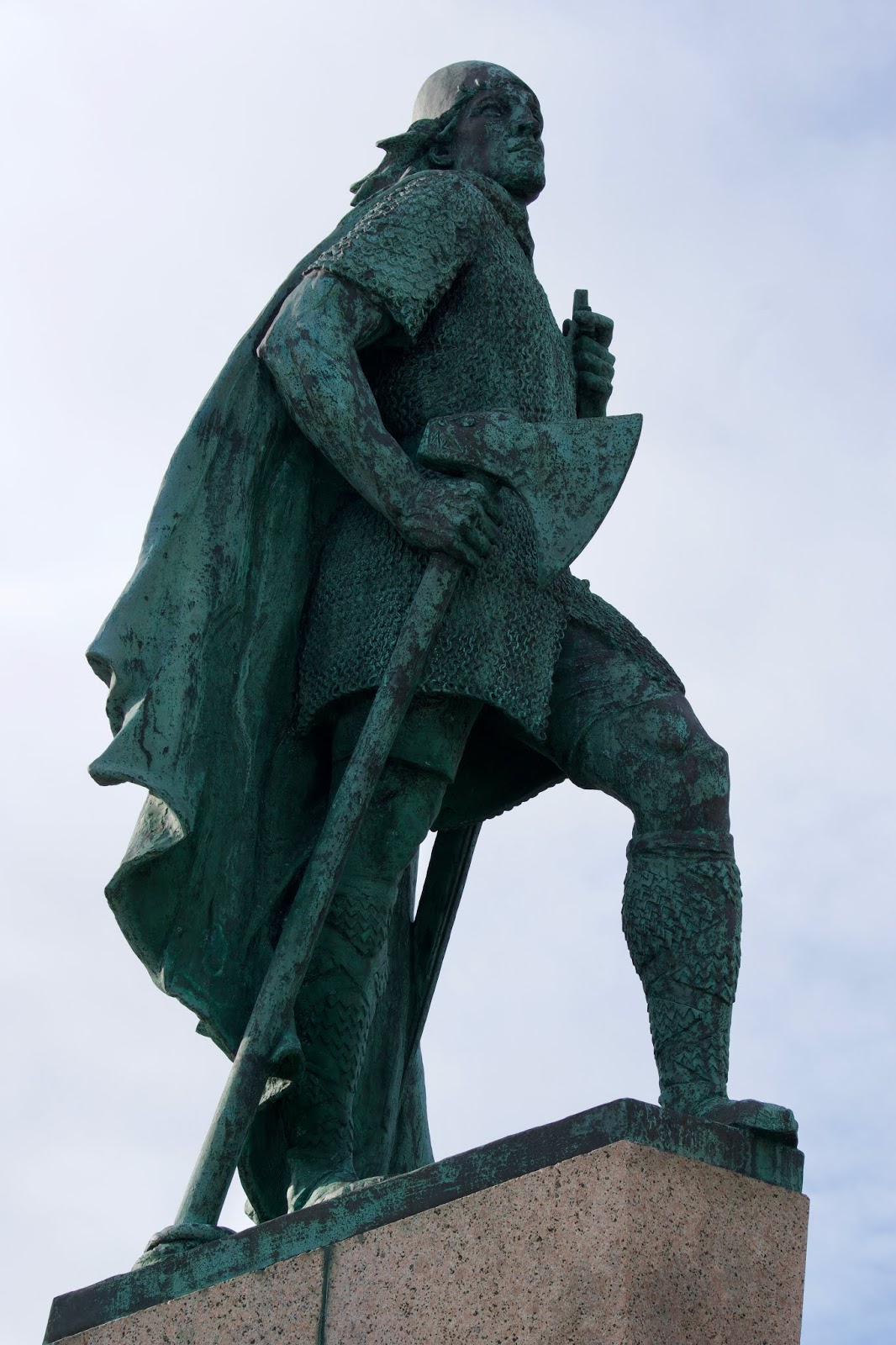
On the way into Reykjavik, they were rerouted a few times before finding a parking spot along a quaint street just a few blocks from Hallgrímskirkja, the Lutheran church built to resemble a Viking longboat.  In the nearby bakery, Brauð*, Bjorn bought two sticky buns from three red-headed bakers, brought them to the car and shared them with Snorri as Astrid gnawed on a protein bar. After their snack, they walked up to the church, admiring the unique architecture, and the Leif Erikson statue sitting victoriously in front of it. A short, cool, windy walk down to the ocean shore, past small houses, tattoo and vape shops, led them to the popular silver long-boat sculpture, The Sun Voyager.

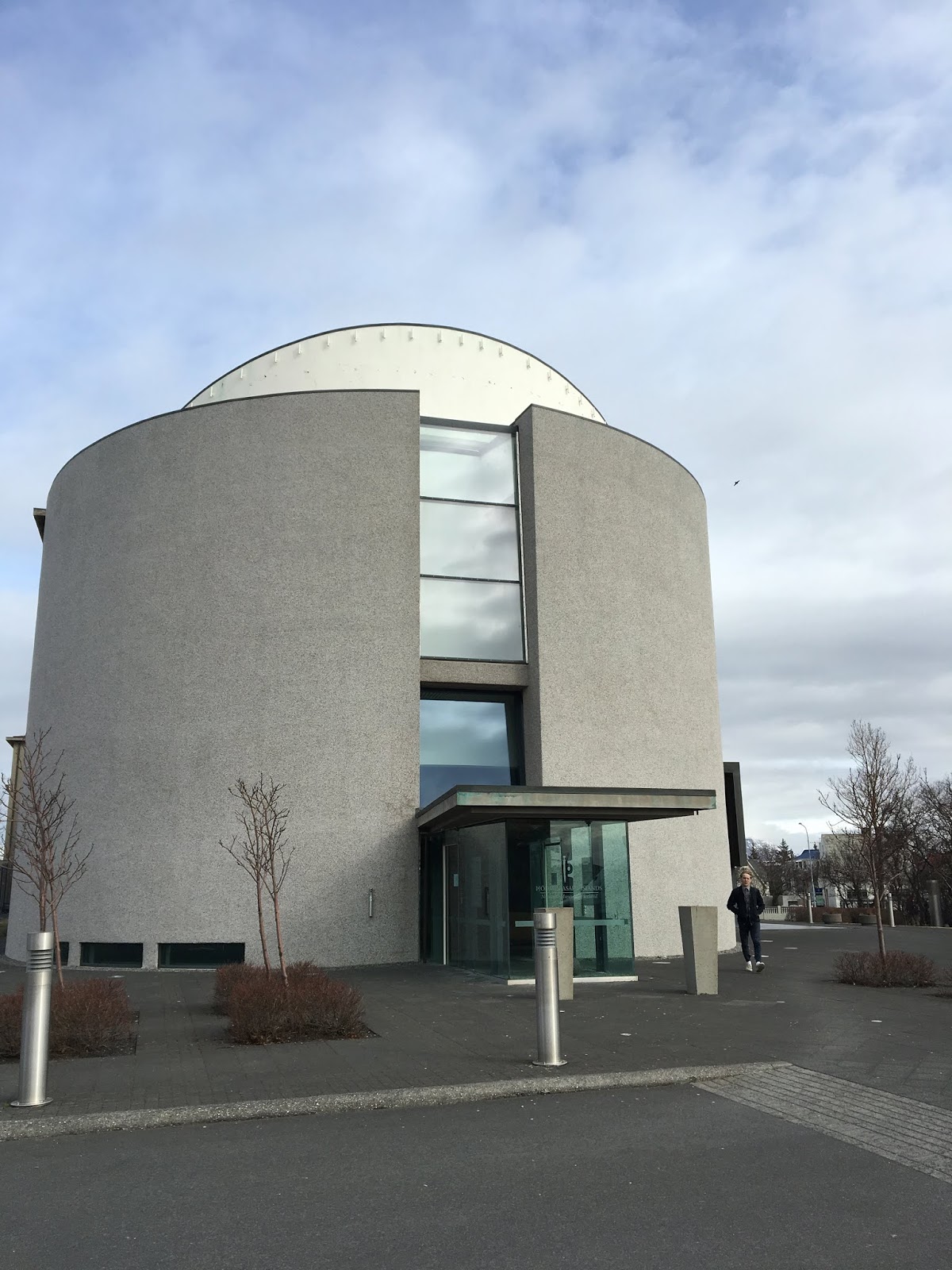
This first day was their only day scheduled to tour Reykjavik, the capital and largest town in Iceland. They weren’t there for the city night life or the food, and finding something to fill the time before they could check into their hotel was a challenge, but they finally decided to tour The National Museum of Iceland
The National Museum of Iceland

Bleary eyed and sluggish, they roamed three floors of the museum displays of ancient Viking artifacts and re-creations of their culture. For Astrid, who reveled in history displays, it was bittersweet. So much information and interesting artifacts lay before her, but fatigue and pain interfered with real absorption and appreciation.  

Astrid was rethinking these double-long days of vacation. They really were torture to her, and by the end of that day she would be using all her strength to fight off sleep to stay awake to give directions. But there seemed to be no practical solutions. 

By the time the family left the museum, the double-day was getting to all of them. After a few more re-routes and missed turns in the car, they found a grocery store, Kronan, where Bjorn walked in a daze, searching for lunch and breakfast foods for the days ahead. They bought apples that came from France, bananas from someplace warm, granola bars and oatmeal cups. 
\”I meant to have the car in the photo!\”


On the hour drive to the AirBnB, Astrid fought hard against fatigue. Her head dipped and jerked as sleep snuck up on her. She couldn’t keep her head up, was in serious danger of whiplash, but was concerned Bjorn, who was driving, would fall asleep. She couldn’t sleep, she had to keep him awake because she didn’t want to be another Iceland tourist statistic. The landscape around them was dramatic and epic, but the lack of sleep was much more prominent. Snorri snoozed in the back seat, not helping with her fight with fatigue. 

Their drive ended at a vast lake surrounded by lofty, snow capped mountains. Their hostess showed them the details of their quaint cabin and  as soon as she left, they promptly settled in for a nap. 

A geyser

Astrid slept so deeply, with dreams so real, she woke up confused as to where she was. For a moment, she thought she was back home in Michigan, but home did not have a pine-clad room, nor did she sleep under a white eiderdown blanket.


She woke with a better attitude, rested and refreshed, but her feet were cold. 

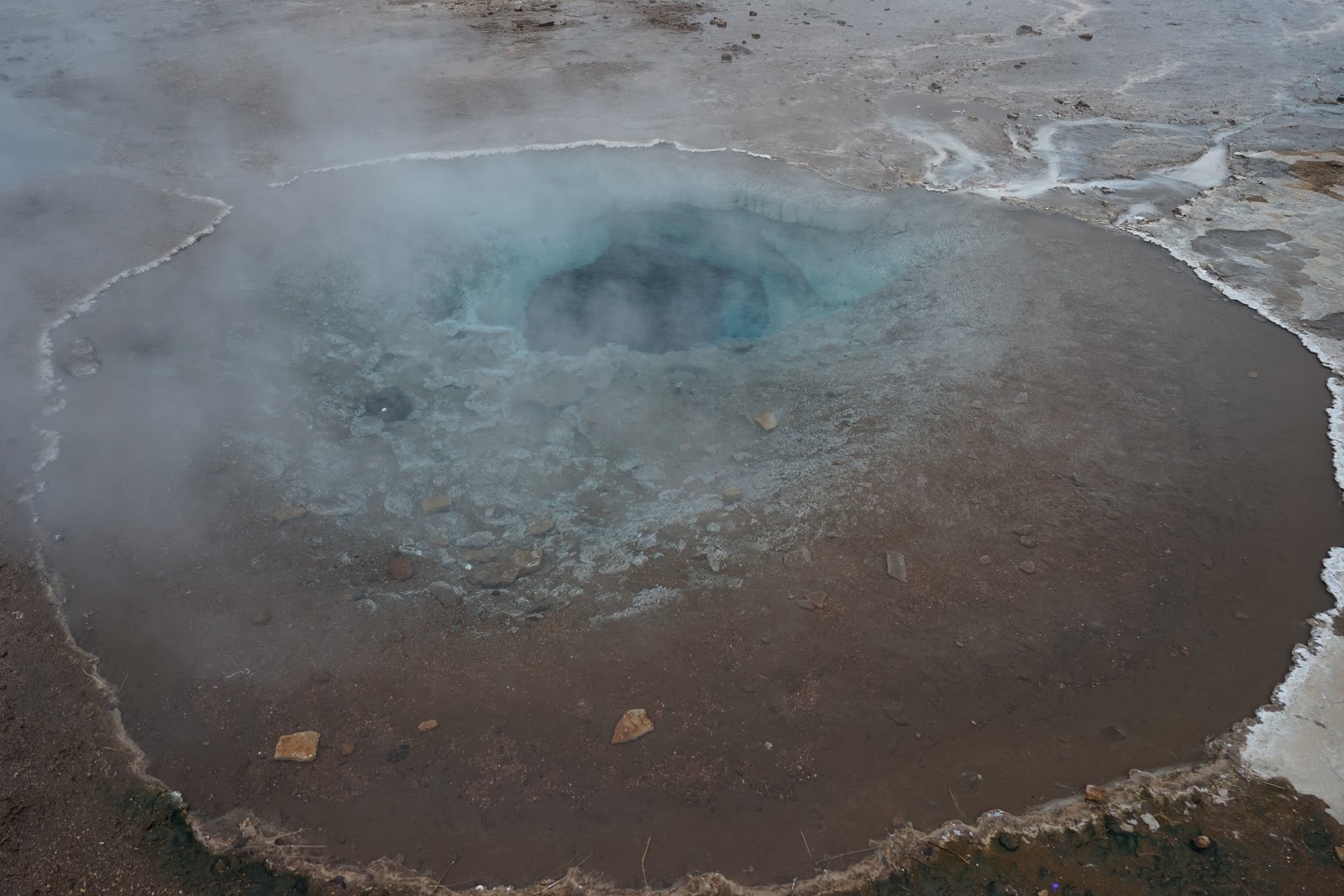
They drove smooth roads to a field of Geysirs, complete with restaurant and hotel, where water boiled and exploded out of the ground. 


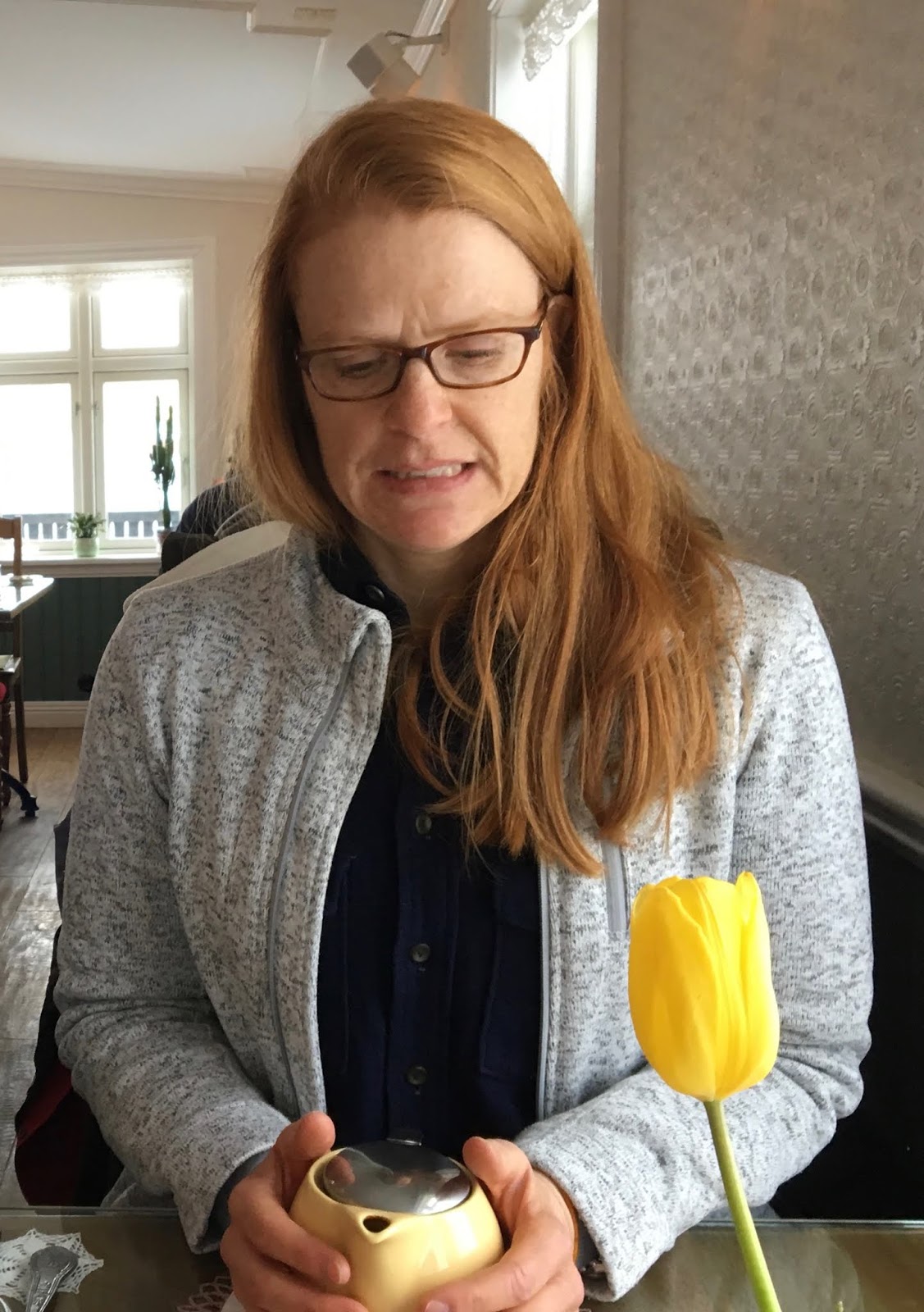
Redheads are fashionable in Icleand

For a late dinner, they stopped at Heradsskolinn Boutique Hostel in Laugarvatne, where it wasn’t \”no shoes no service,\” but the opposite, with a sign greeting them just inside the door saying, “Please take off your shoes”. So, in their stocking feet, Astrid ate a chickpea salad, Bjorn had pizza and Snorri his recurring favorite, ham and cheese baguette, beside a large table of hostel customers. Their server was a tall, bespectacled young man with dark hair, who was polite and helpful. 


“This is the place where they bake the bread in the ground and they have a geothermal spa,” Bjorn said as they ate. Baking bread or dipping into waters of any kind was the last thing on Astrid\’s mind. She just wanted to sleep

*Brauð the last letter of this word is not an o, d or any English letter. It is like a d but with its little stem tilting to the left and with a little cross. It is pronounced \”th\”. 
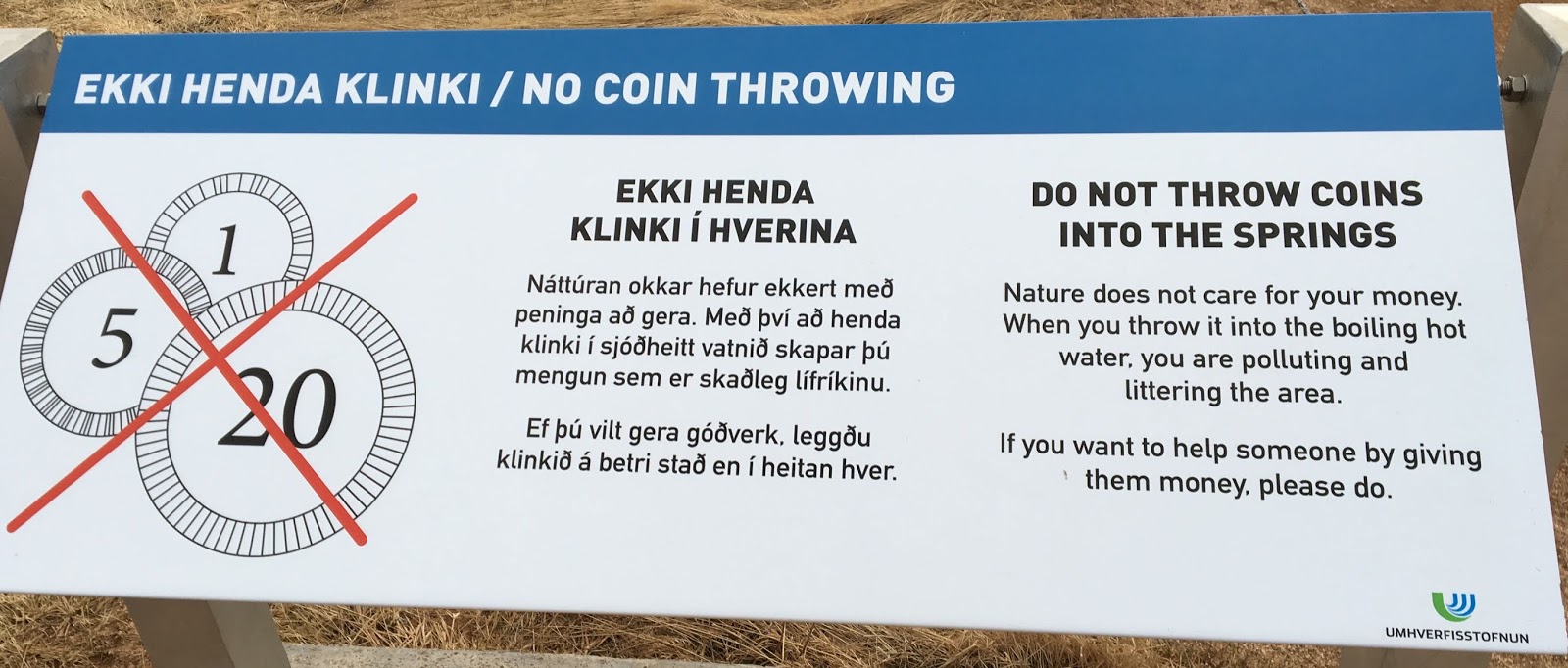
Nature doesn\’t need your money.

Prologue to An Icelandic Saga


Everywhere I go, on plane, train or auto, a story goes with me, playing as a backdrop to my senses, giving an enhanced meaning to the lay of the land before my eyes. So, after plans were finalized for an adventure* to Iceland, I made a trip to the library.


“That’s what you read to get ready for a trip to Iceland?” B asked, looking at the tome of ancient tales I had opened on the table. 


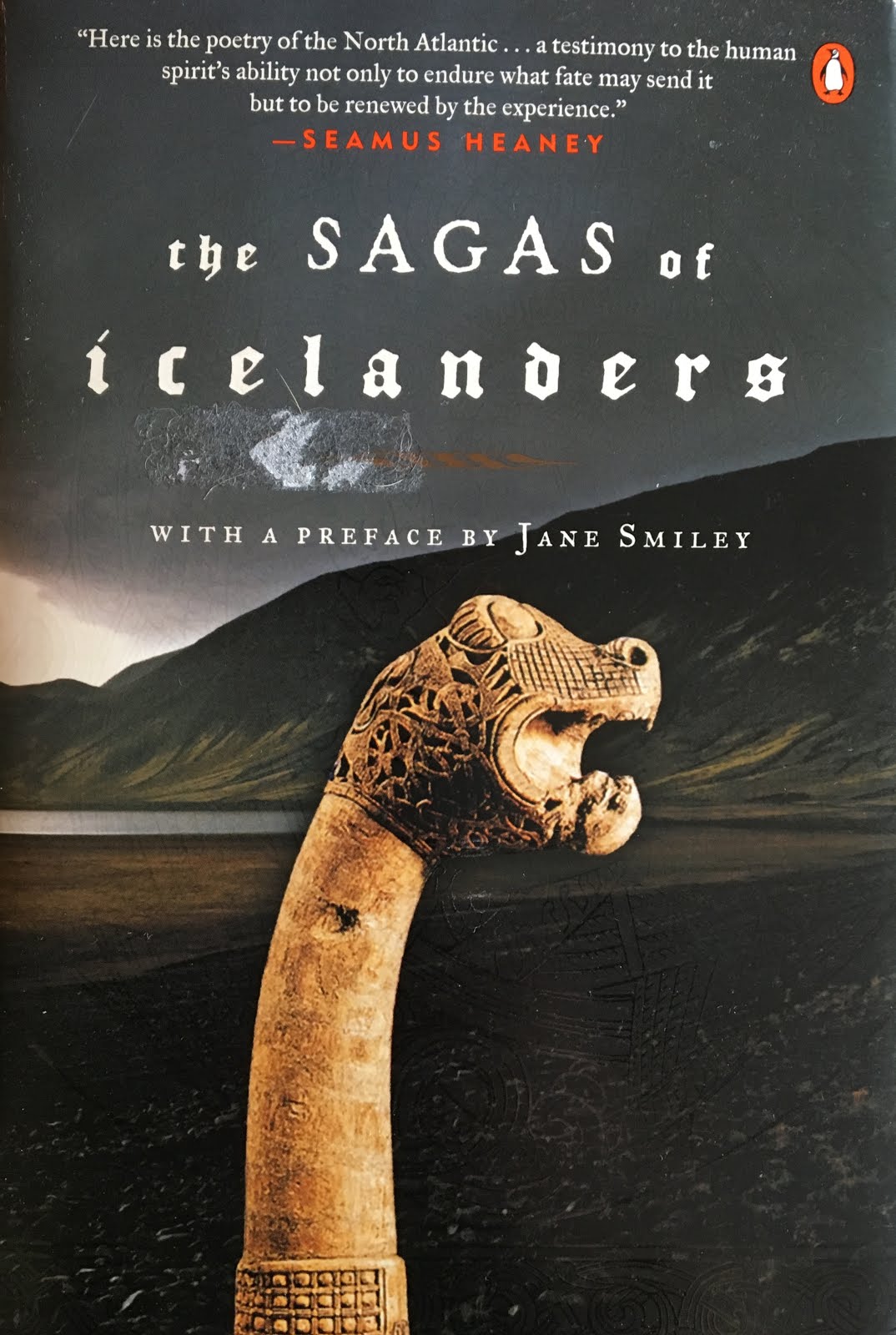
“Well, it’s kinda like history, it gets me familiar with names, helps me understand where I will be,” I defended my choice. I had checked out The Sagas of Icelanders , along with an over-stuffed, tiny-print travel guide. Sagas are a collection of Norse and Icelandic sagas written around 1000AD, when Norwegian Vikings moved to Iceland, fleeing an over-domineering King Harald. 

“I checked out a guide book, too,” I said, holding up the diminutive book. 

A few pages into each, I abandoned the guidebook and devoted more time and attention to the sagas. 

Leif Erickson

The first saga in the book, \”Egil\’s Saga\” was supposedly written by the ferocious Egil\’s ancestor, Snorri Sturluson. After a little research, I was disappointed to discover that the sagas are fiction, (I thought they were based on historical fact), though they illustrate life in Iceland and Norway at the time. All the sagas are written in a markedly curious way, more like a modern novel,as opposed to the way Greek tragedies or other ancient texts were written. 

When the time for the actual trip came, I was glad I chose Sagas over the travel guide book (there was updated info online, and it was more accessible). As my week in Iceland progressed, bits and pieces of the sagas flashed before me in town names, historical sites and museums, adding a fascinating aspect to the trip.


We took three carry on-sized suitcases to Iceland, one green, one with four wheels, and another smallish one that expanded significantly and had a very bad habit of tipping forward when put down, which led me to name it “Tippy.” And if one of the suitcases had a name, they all had to be named, which led to “Greeny” and “Rolly”. 

“When we get back, we should consider replacing Tippy if we see a good deal. It is really inconvenient to have this suitcase falling over constantly … as if it were drunk or something,” I said to B at one point. Then I felt a tinge of guilt. Wait, get rid of Tippy? Tippy, the functional sight-gag, the fun loving, fumbling, clumsy suitcase we took on who-knows-how-many adventures, pulling him tripping and tipping after us wherever we went? 

That’s what happens when you name something; it becomes more personal, there is the tiniest bit of affection that grows and connects you to the named object, which increases every time you use the moniker. Put googgly eyes and a smile on it, then it becomes one of the family with a seat at the dinner table.

At one point as I scribbled in my notebook riding around the dramatic, magnificent landscape that is Iceland, B suggested that the monikers AJ, B, OneSon and TwoSon, as used in my travel blog up to this point, were distracting. So, when considering the form of the travel blog to write for this trip, I strangled my writer’s pride, took B’s critique into consideration and decided that the characters in this Icelandic Saga needed names. It would bring more depth to the their personalities, and present them as more relatable, a little like naming suitcases. But for this blog, they must have Icelandic Viking names. Viking names, besides their rarely used patronymics, often included a descriptive moniker. Therefore, the cast of characters for An Icelandic Saga, my account of our Iceland adventure, is: Astrid the Red (AJ), Bjorn the Light Catcher (B), Snorri the Fair-Haired  (TwoSon) and Olaf the White (OneSon). 

Best Hike Ever

At this point, I have only read a few of the sagas (the book is 2.25” thick), but will try to emulate the ancient stories’ style sometimes, but I can’t guarantee it will be as interesting as the original Sagas of the Icelanders, since the family encountered no  cattle theft, very little intrigue, no pillaging, no knife, sword or cudgel fighting, no treacherous ocean excursions in Viking longboats, and thankfully, no murders.   


*These trips are not vacations. The word \”vacation\” denotes rest, relaxation and recuperation, which these trips rarely include. Our adventures are full of edifying challenges (mental and physical), fatigue, lots of thoughtful planning, preparation and almost non-stop \”going\” (though, admittedly this trip included a lot of car travel time). We hit the ground running and rarely stop until we get back on the plane to leave. 

The Differences


Tuesday, June 20, 2017


 The next morningAJ sat at the desk jotting down details onto her notebook, details which, after sleep and a hot shower, trickled back to her mind, ran up to the present, then to the future to cover the day\’s planned activity: leaving. It would be a long flight back filled with the usual torture of unrest–it was all before her and she was anxious to get it over with.


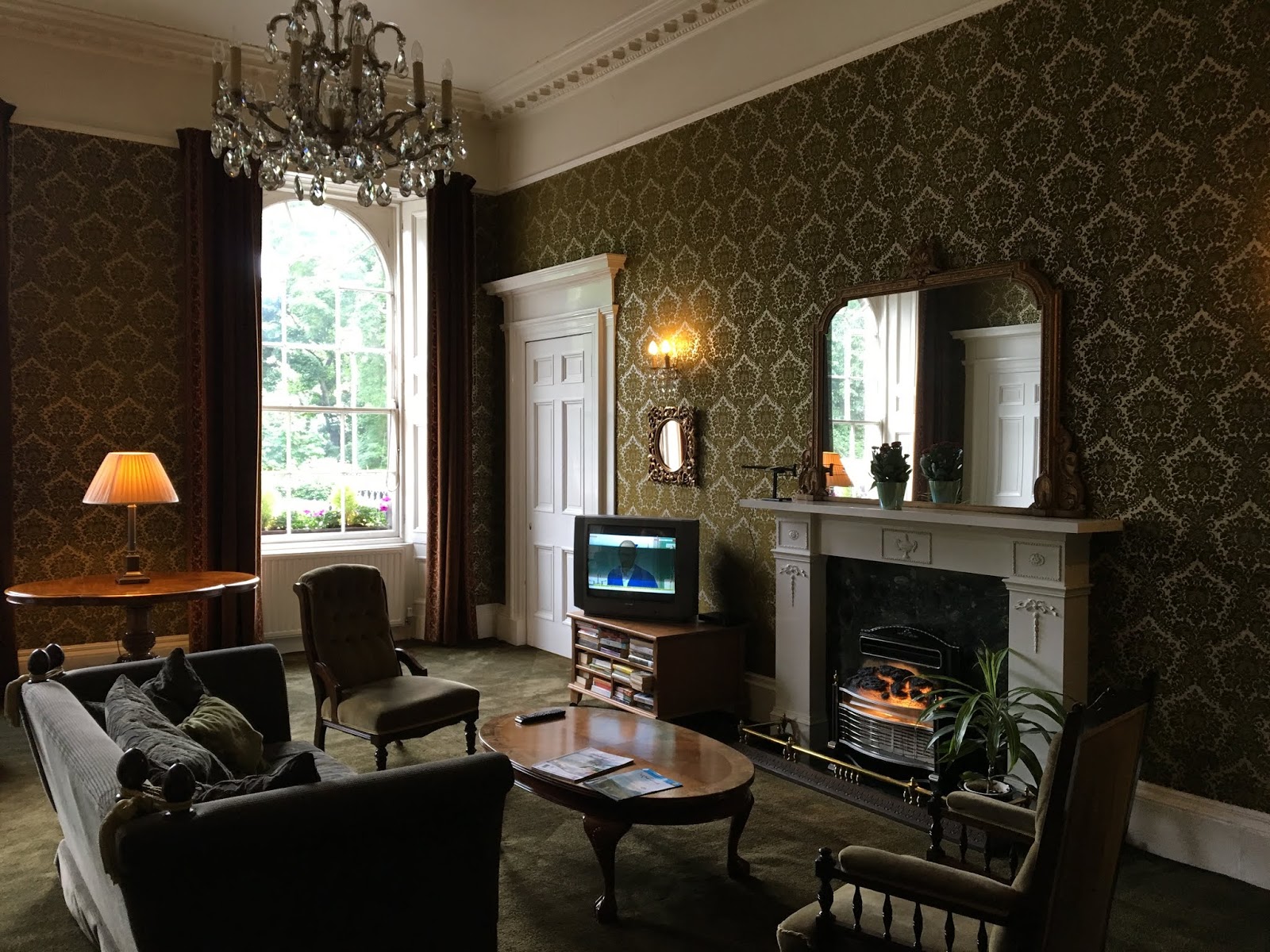
But before all that, AJ explored the building a little more.  The bed and breakfast was in the “newer” houses in Edinburgh, the original domiciles of bourgeois whisky merchants, with elaborately decorated, high-ceilinged rooms with lots of space outside in front and behind the building. She couldn\’t sit in the high clear windows and ponder the details, because the clock was ticking down, they were leaving, there was not enough time to savor the atmosphere. 

She joined B and TwoSon for breakfast, where she ordered her last “full breakfast” of sausage, ham, tomato, beans and oatcakes.


They packed the car and navigated eight miles through muck and mire of tangled Edinburgh streets and turnabouts, through an figure-eight-shaped roundabout twice because they missed the first turn, to the car return. 

“Is this yours,” a car-letting attendant asked, holding up the clear plastic, \”I heart Scotland\” umbrella, as he inspected the car. 

“You can keep it,” B said, not being able to fit it into the lugggage. 

“Not my color,” the attendant replied, and chucked it in the waste bin. 

At airport security, TwoSon was snagged for a random check, and bewildered, confused and a little embarrassed, succumbed to patting down as AJ explained what was happening to him. 


In the airport shops, AJ picked up loose Scottish Blend Tea, and Toblerone for the boys; white chocolate for TwoSon, dark for OneSon and coconut for B. 

During the plane ride home, AJ filled the time with distractions, since an oblivious seat-kicker sitting behind her made sleeping impossible. The seat kicker didn’t tap frequently enough to warrant a plea, but enough to  cause AJ to think undeservedly badly about the clueless young woman.  So she filled some of the time with reviewing and adding to her trip notes, listening to Rob Roy and eating the distracting airline food. 

In Chicago, they trudged through customs, picked up their luggage, rode the shuttle to the parking garage for an extra specially long ride home through Chicago rush-hour, construction and obstructed traffic. 

Along the route through Chicago to her southwest Michigan home, billboards blared obscenely (and about obscene things) from the roadside, in such blaring contrast to the comparably peaceable highways and roads in the UK. 

In Viktor Frankl’s Man’s Search for Meaning, he presents three things that bring meaning to man’s existence. The first is to create a work or to do a deed. The second is to experience something or encouter someone. The third is to change oneself and grow beyond oneself. 

This trip made AJ forget all the worries of home for a while, and replaced them with an new set of worries (challenges), like staying hydrated, navigating one-lane, two-way roads, sheep crossings, not falling off treacherous cliffs, not losing TwoSon on the Tube, etc. They were refreshing worries, worries and challenges that made one’s mind expand and strengthen. For a minute, she forgot about laundry, dinner, exercise, parenting (to an extent) and her neurotic self-worth meter. The trip added meaning to her life by giving her material with which to create something (this blog), letting her experience something different from what she was accustomed to and forcing her to change, to acclimate to UK’s rule, etiquette, conditions, weather and currency.


Sometimes, many times … most times for AJ, the clearest appreciation, enjoyment, satisfaction and lessons learned came in hindsight; when she was going home; when she returned to her routine and the differences floated to the top of her thought and made themselves glaringly clear. It was the differences that made all the difference (what she also refers to as gradients), it was the differences that made her go and risk and experience, and it was the differences that summoned her back home again.


As she looked back on the trip from a distance in time, some differences and lessons still glowed and shone as intriguing to her: 

-popular history isn’t as interesting to AJ as old, obscure, domestic artifacts
-living, breathing, shining wonders were more attractive to her than cold shiny ones
-most people don’t follow the left hand walking rule in the UK, especially in the bigger cities
-there are a lot of sheep in the UK
-all travel hubs like airports and train stations have depressing atmospheres
-one-lane, two-way roads are stressful to drive 
-Scotland’s soft water makes your hair soft
-it’s difficult to not look like a tourist when you are one  
Until the next adventure … 

Thanks for reading! 

Walking the Hills of The Scottish Highlands


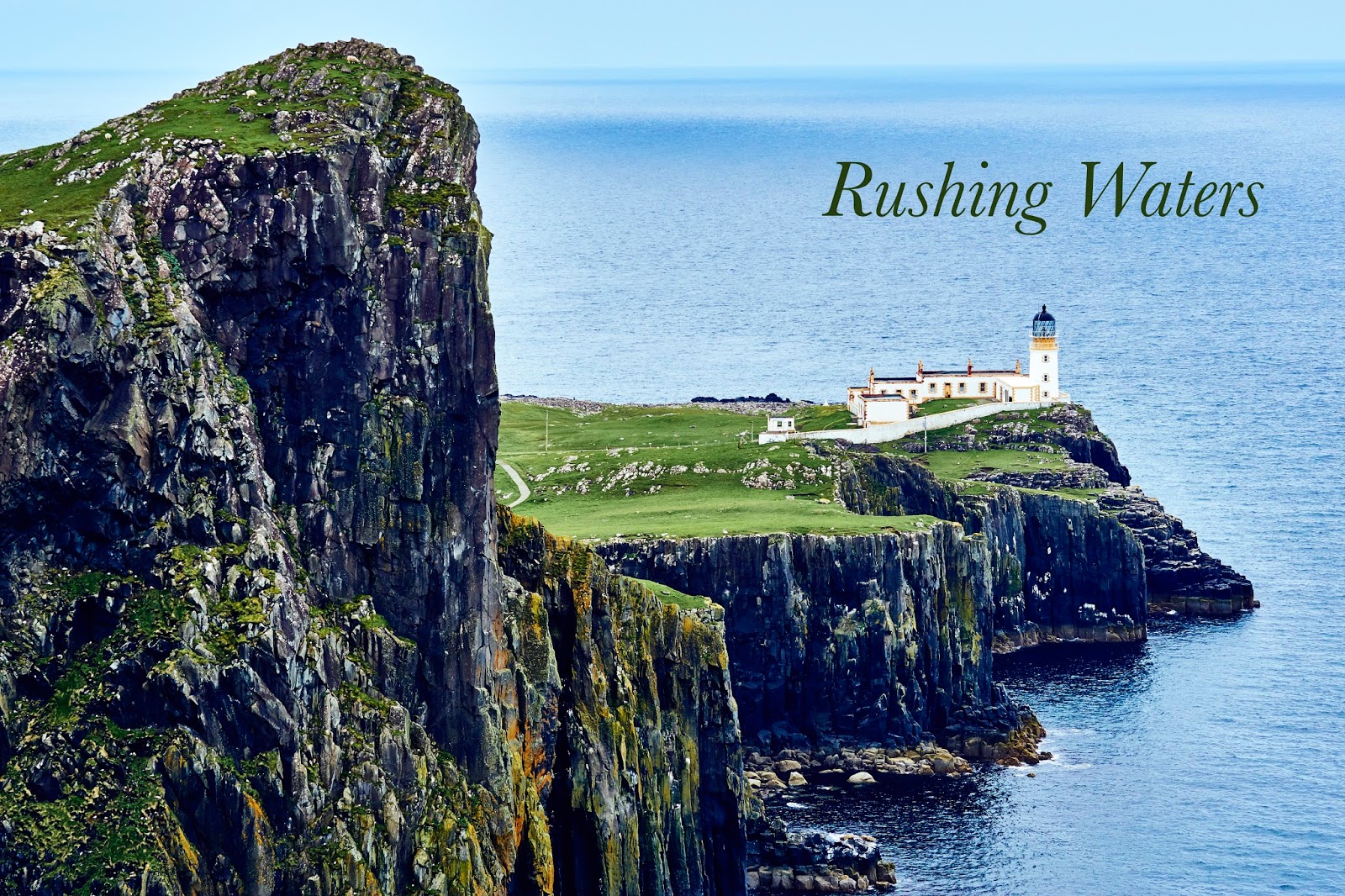
Out of the Fairy Pools and Into Rushing Waters

Monday, June 19, 2017
The family slept late. A grey, gloomy, raining sky greeted them as they walked out of the door of 11 Stormy Hill Road. But a hot breakfast at the Arriba Cafe in Portree warmed their stomachs. B and TwoSon ate sugar-studded waffles; AJ had what the English called a “full breakfast,”: Black pudding, Irish Lorne, fried tomato, baked beans, bacon (more Canadian than American) and sausage. 

In her mind\’s eye, The End, leaving, and the long plane ride home was in sight and though AJ was tired, she kinda didn’t want to leave. She already knew she would be going back with a new perspective; witness to the sights, sounds and feelings culled from her itinerary and reactions. She had learned a lot. She discovered she wasn’t good at helping B out of hairy, left-hand driving situations on one-lane roads because she panicked and made the situation worse. She discovered that B was a very good driver, and that challenges–rain when you needed sun, streams where there should be trails, narrow when you needed wide, hurry when you wanted leisure–and planning and re-planning were what made trips exciting and interesting. 

After packing their bags and loading the car, they set out for their first stop of the day, and last hike on the Isle of Skye: The Fairy Pools. The sun was shining and they had bugspray. 
But the biting, haggling midges were mostly undeterred by bugspray, so the only thing to do was to move. After carefully squeezing the car into the only empty parking space in the gravel lot, the family started on the trail that climbed along the Fairy Pools. The first and biggest challenge of the trail was to cross a decent-sized stream, which obligated the hikers in getting their feet wet. 

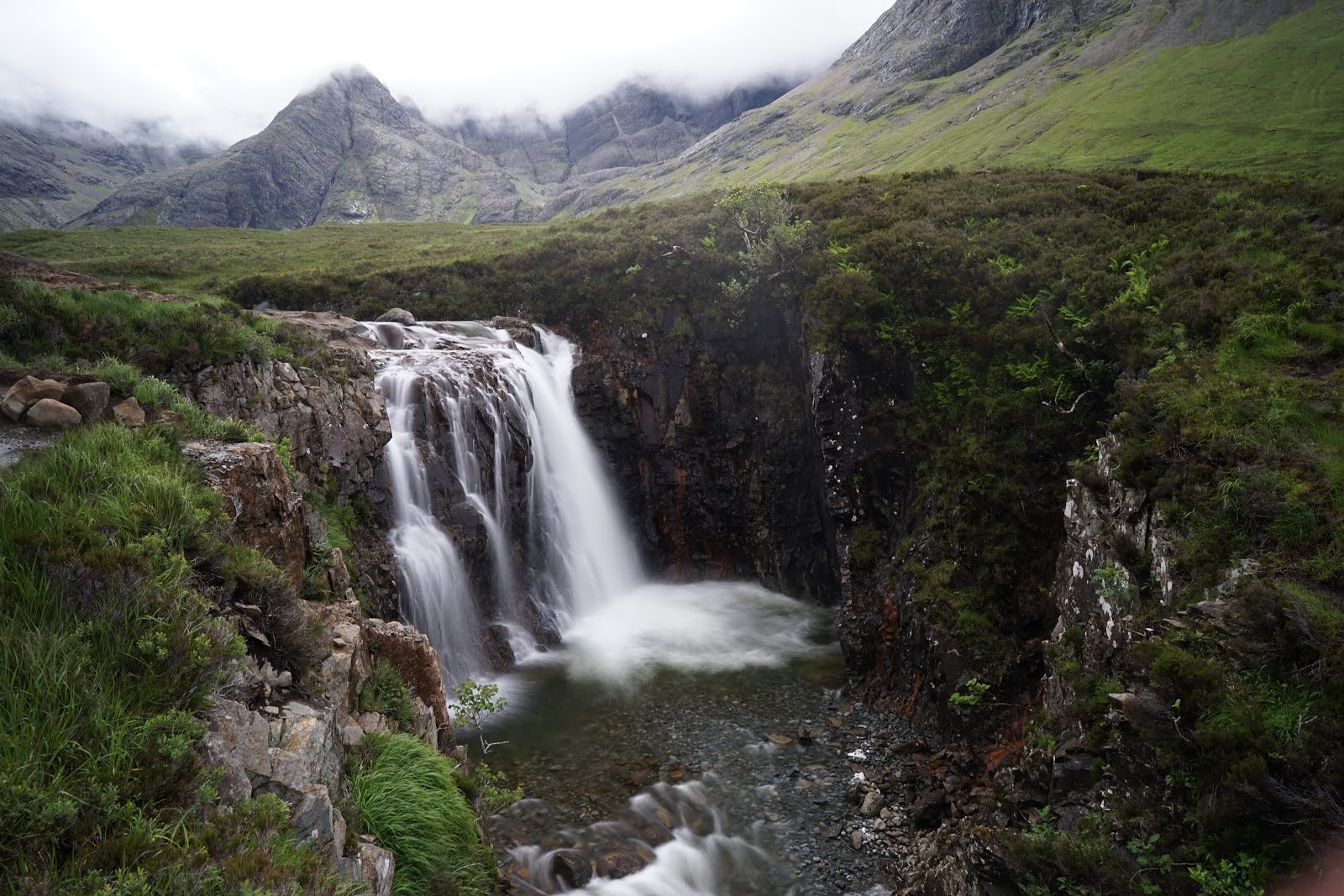
Mist-capped mountains surrounded a sloping valley which was dissected by a large stream that stepped down ledges, making water falls and pools along the way. The ground and even the rock-strewn trail was spongy under their feet due to the peat underlying everything. Every so many meters, the trail traversed smaller streams that intersected the path on their way to join the Fairy Pools in the River Allt Coir\’ a\’ Mhadaidh

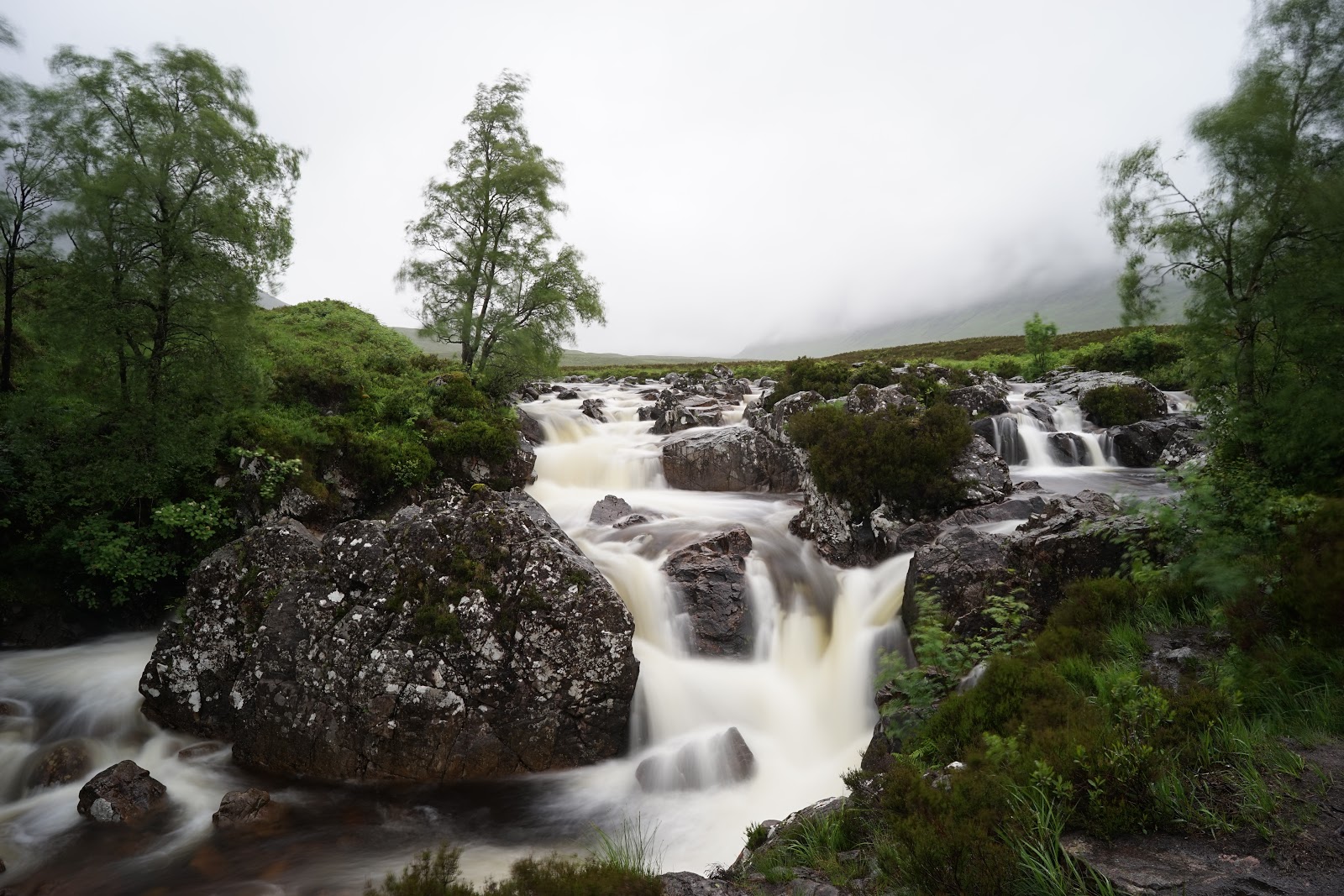
AJ and TwoSon were more than willing to walk and wait, walk and wait, as B filled the camera’s memory card with pictures. They left B and Tripod to walk ahead on the trail, stopping at times to admire the spectacle. The water, rushing, roaring over rocks, fell elegantly down ledges, stopping at deep, clear pools, swirling there a while, as if to rest before continuing their way down mountain. 

Unlike humans and CS Lewis’s Natural Human Law (see Human Law, Left-Driving, and Churches, Castles and Homes), the water followed, to the T, the law of water, and the law of gravity; it waited its turn in glistening, mesmerizing pools before following its course down the mountain, happy, willing and full of energy like the sheep dogs reveling in their work at the Old Man of Storr.

These rushing waters were comforting, awe-inspiring, invigorating, though not dismal like the “rushing waters” of people AJ had experienced in the train stations and airports. 

The difference was, sitting along these rushing waters, she need not go in or join the cheerful chaos, she was free to sit by and watch it all happen. Both kinds of rushing water were marvels: the organized migration of people from scattered regions to densely populated business and metropolitan areas, and the migration of many gravity fueled streams rushing to one spot.  


AJ preferred the Fairy Pools. It would have been interesting to watch the rushing waters of humanity in the London Tube and train stations, but there usually was no time for it and from what she saw, people rarely did it. 

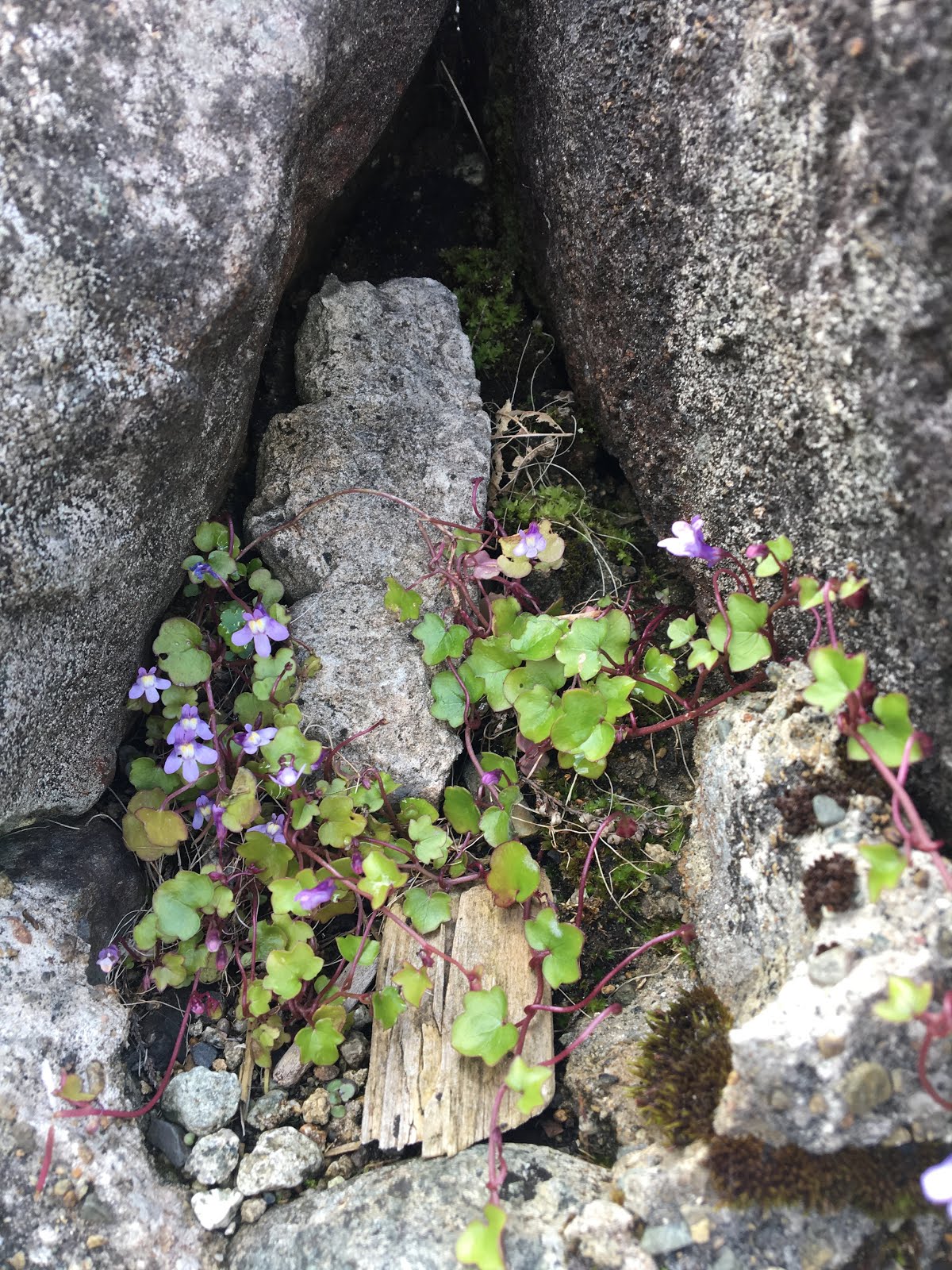
\”Flower in the Crannied Wall*\”

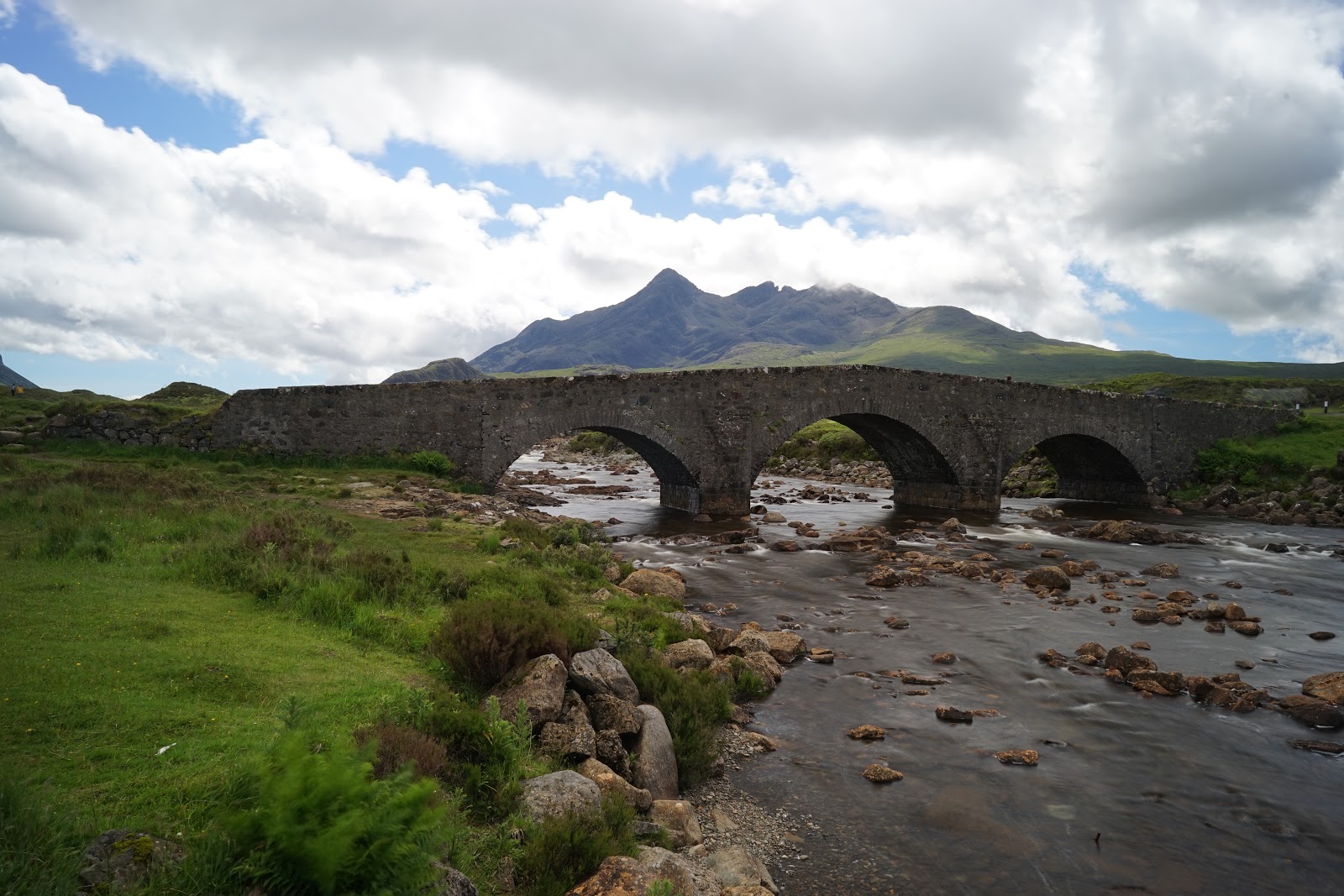
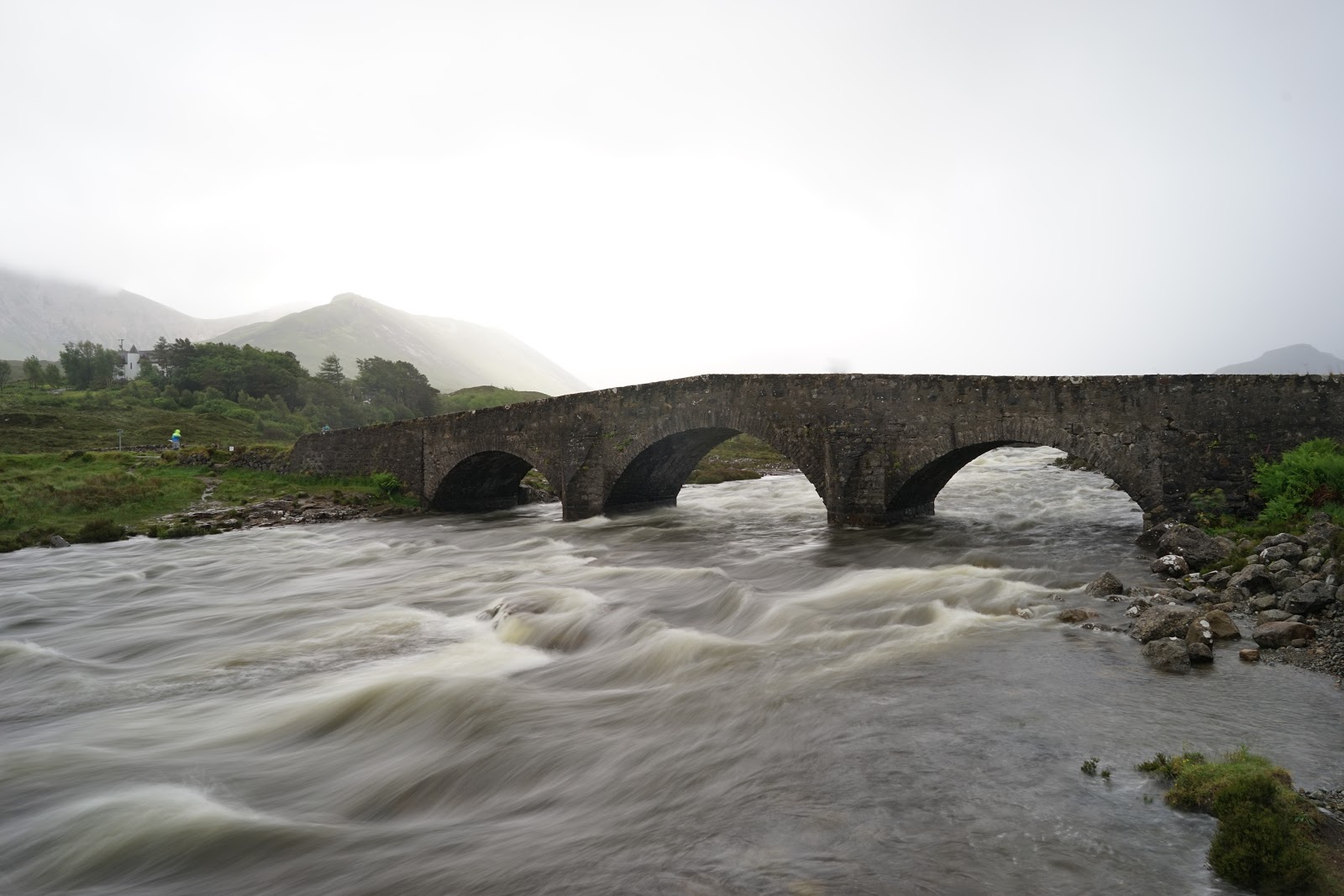
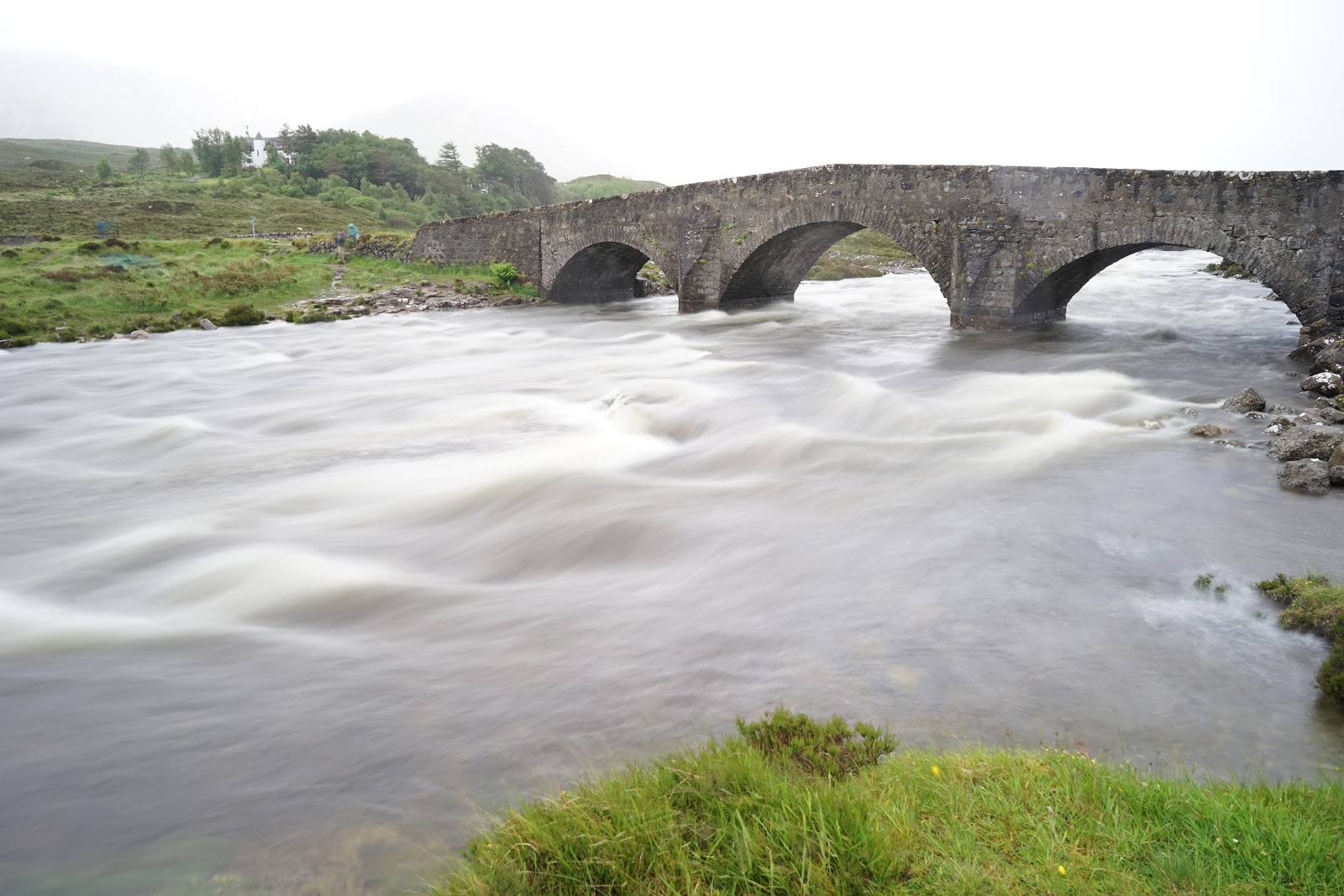
They stopped at Sligachan Hotel and Restaurant on their way off the Isle of Skye where B snuck out to take more pictures of the Sligachan Old Bridge while AJ and TwoSon waited for a good hot lunch, much needed after walking in the cool wind all morning. 


AJ had had her sour (London), then her sweet (Scotland’s sheepy hills, raveny mountain rock outcroppings, countrysides, and small towns), and now she must have her sour again, even if a little bit, in Edinburgh (Edin-boro). 

Outside the tangled snare of roads into the city, the highway to Edinburgh was wide and pleasant, with a notable lack of billboards or advertisements crowding the highways like in the US. 

Trying to get B directions into a city with myriad turns and roundabouts was harrowing and circuitous, but eventually, they made it to 11-12 Royal Terrace, sitting among a row of beautiful Georgian townhouses, in front of an extraordinarily wide brick street, with an expansive park-like area in front and behind. It was a breath of wide open in a town where AJ expected squooshed and squeezed living quarters, as in London. 

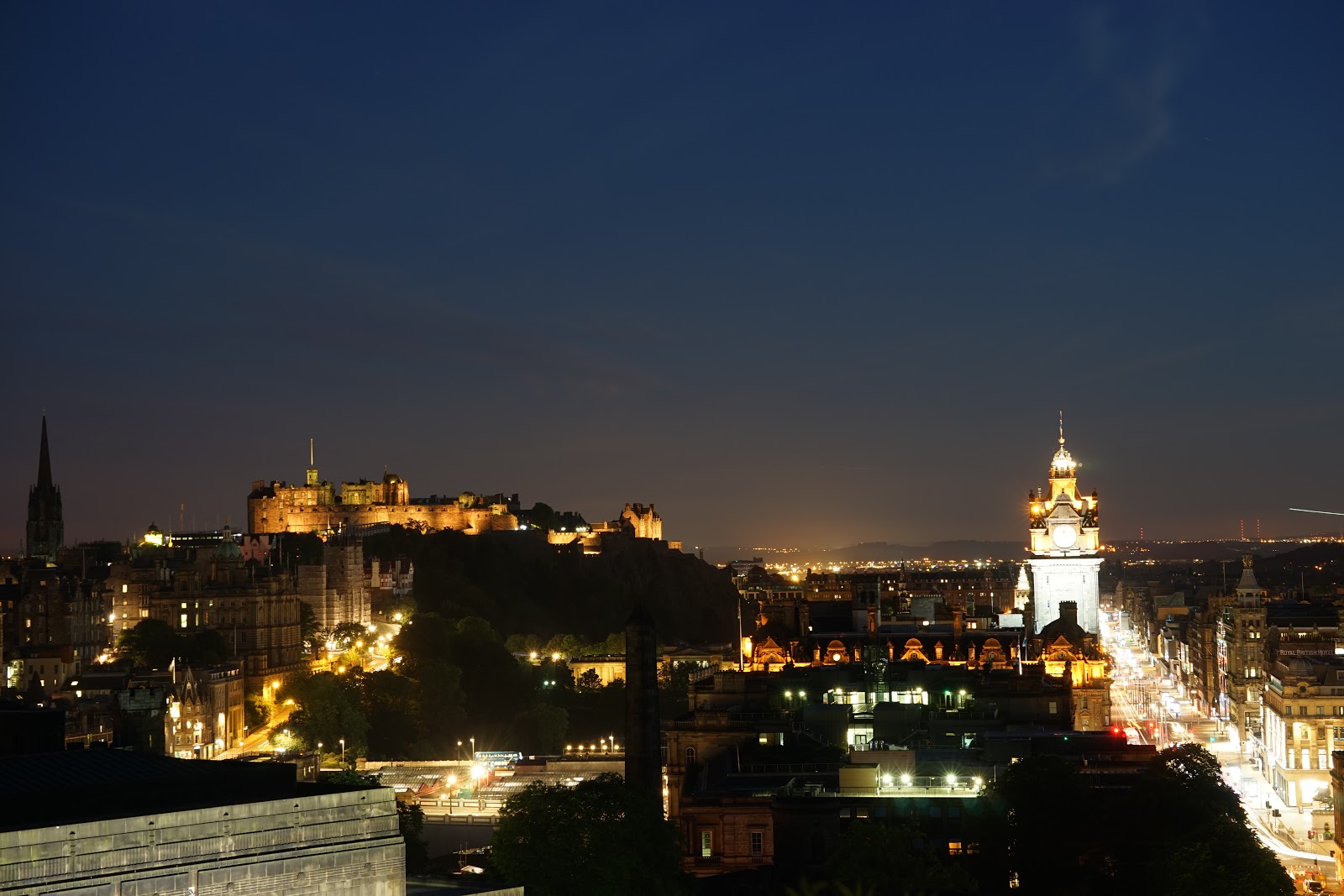
Edinburgh at night

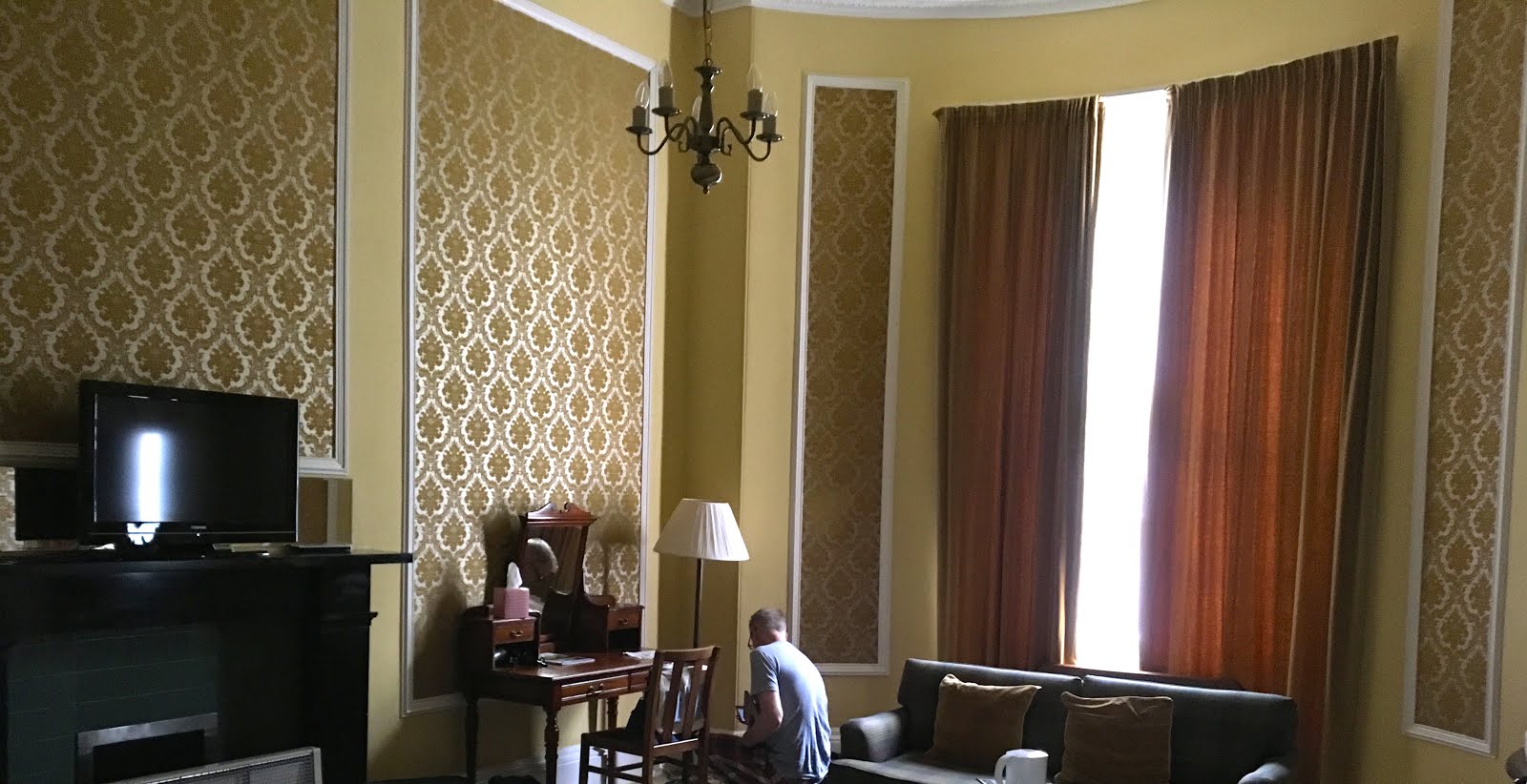
After checking into their room, which was at one time an exquisitely placed and decorated sitting room, the host showed them their bathroom (not en-suite, but down the hall a little ways), the family set out on an evening walking tour of the town. 


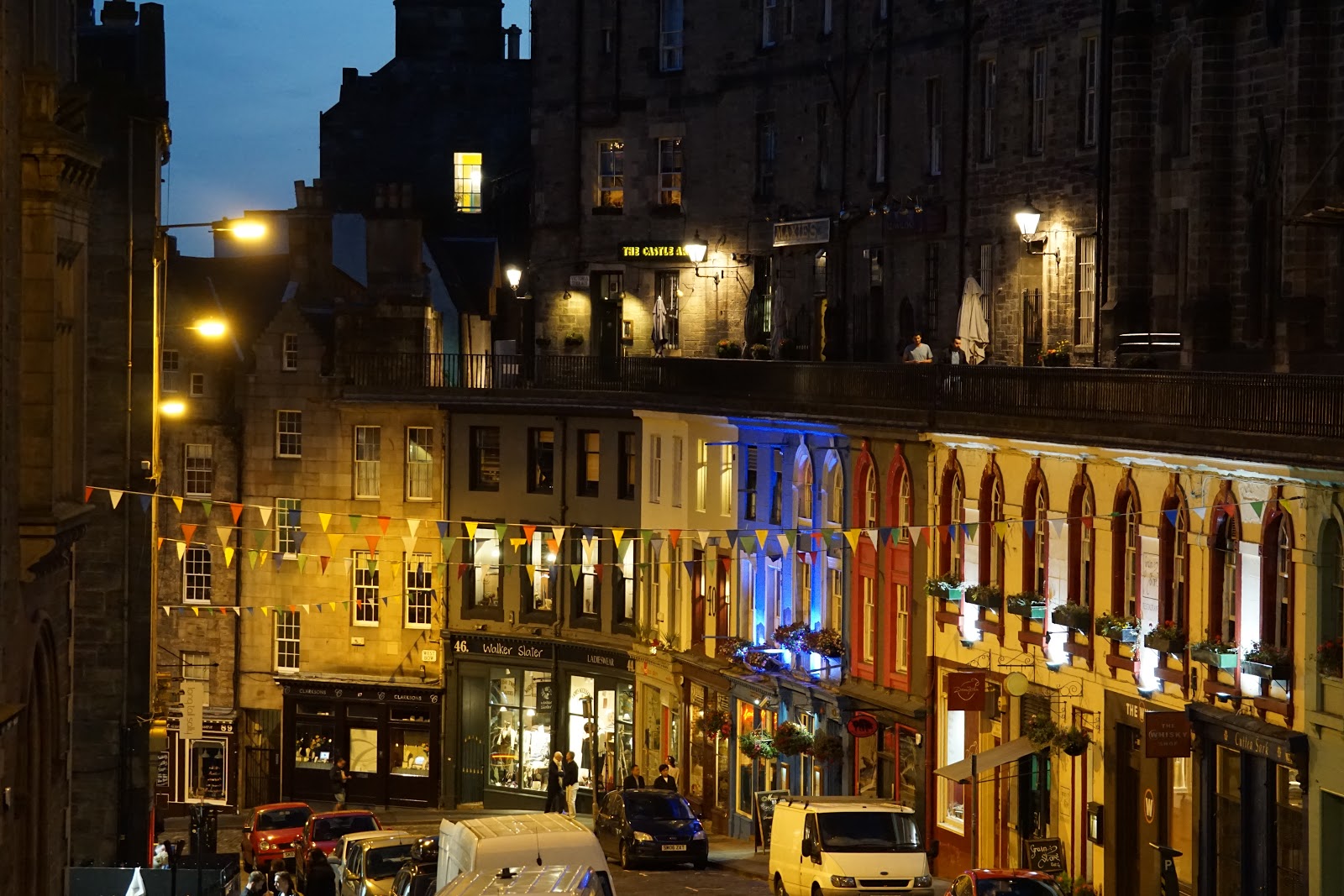
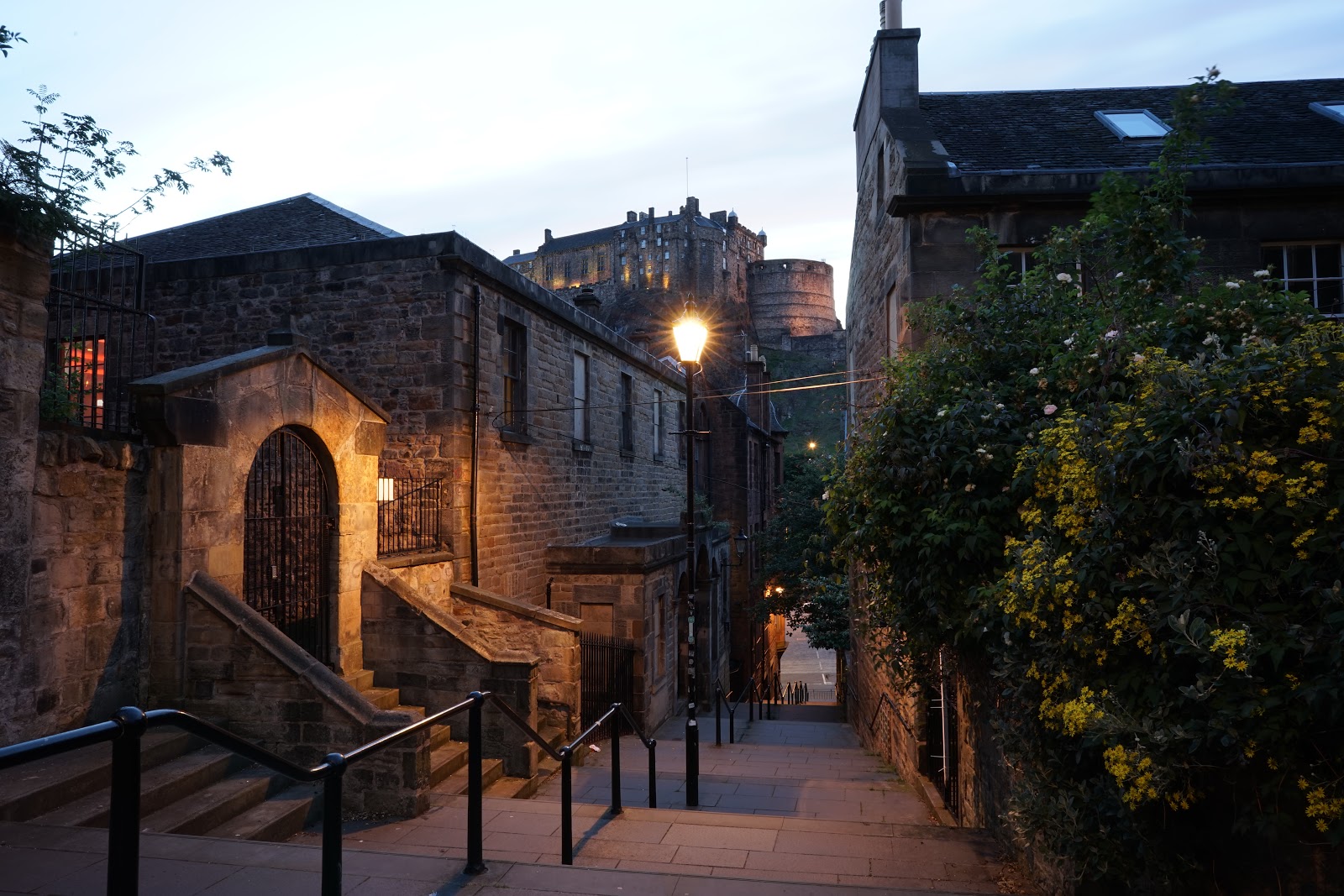
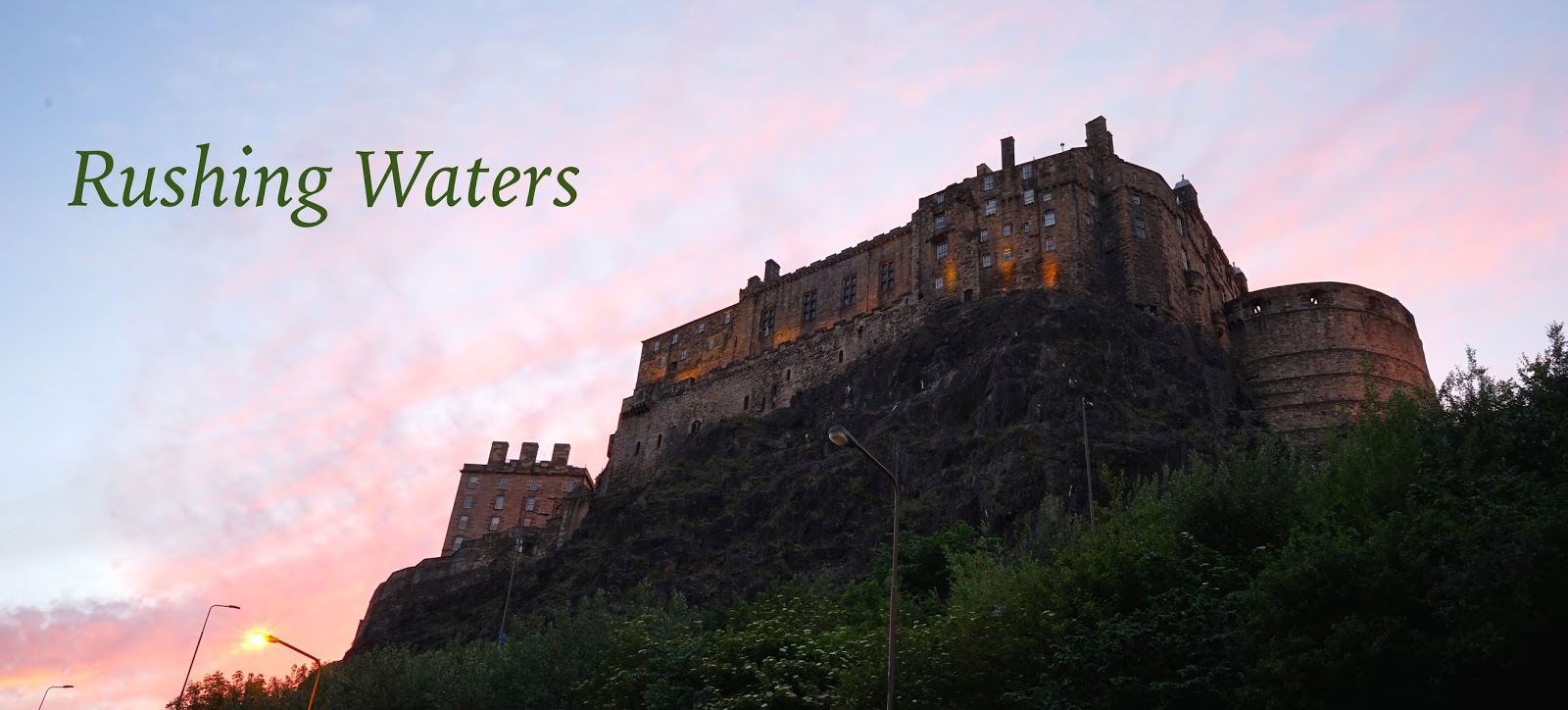
The stone buildings sat heavy and old, uniform in their general architecture, except for a few shiny, new, glassy structures sticking out amongst them. Edinbourgh Castle perched upon a hill looking over the city of shops, homes, brick-lined streets, bars, university students and tourists. It was a nice town, though AJ wasn’t comfortable, and she fought against fatigue to understand the opportunity that lay all around her. 


What she didn’t realize was that Edinburgh was home at one time to some of her most favorite authors, like Robert Louis Stevenson (Travels with a Donkey in the Cevennes (see Painting a Deck with Robert Louis Stevenson and a Donkey), Treasure Island, An Inland Voyage), Sir Conan Doyle of Sherlock Holmes fame, Kenneth Grahame (The Wind in the Willows), and Sir Walter Scott (Rob Roy, etc). And JK Rowling wrote there, too. 

AJ and TwoSon followed B as he visited prime photography spots, to strange old streets, nooks and crannies in the town. Before turning in for the night, he sent AJ and TwoSon back to the room while he snapped photos from the park behind their bed and breakfast.


*Flower in the Crannied Wall
Flower in the crannied wall, 
I pluck you out of the crannies, 
I hold you here, root and all, in my hand, 
Little flower–but if I could understand 
What you are, root and all, and all in all, 
I should know what God and man is. 
–Lord Alfred Tennyson


Hillwalking and Roaddriving


Sunday June 18, 2017

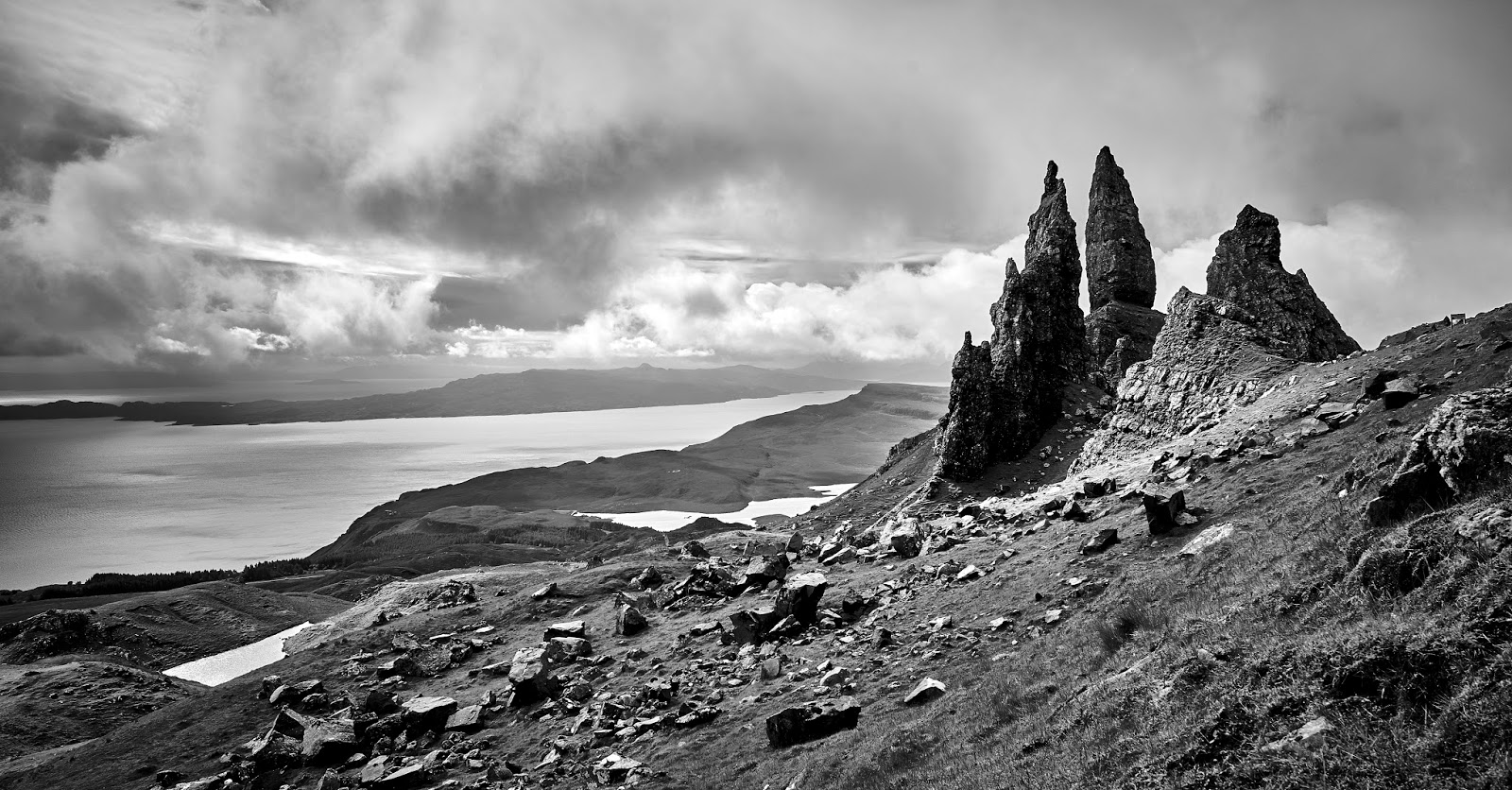
Early next morning, after snatching a light breakfast in the dining room of the B&B, the family drove off into clear blue skies over the Isle of Skye countryside. They were going to see an old man on a mountain. 

Only a few cars dotted the parking lot to the trail-head. Equipped with Tripod and a pair of walking sticks, B, AJ and TwoSon started on the gravel path up the mountain. A cool wind pushed and prodded them as they progressed up the rocky, muddy trail, but soon their destination was in sight: an unusual rock formation protruding from the mountain, bathed in wind and mist. It was The Old Man of Storr. 


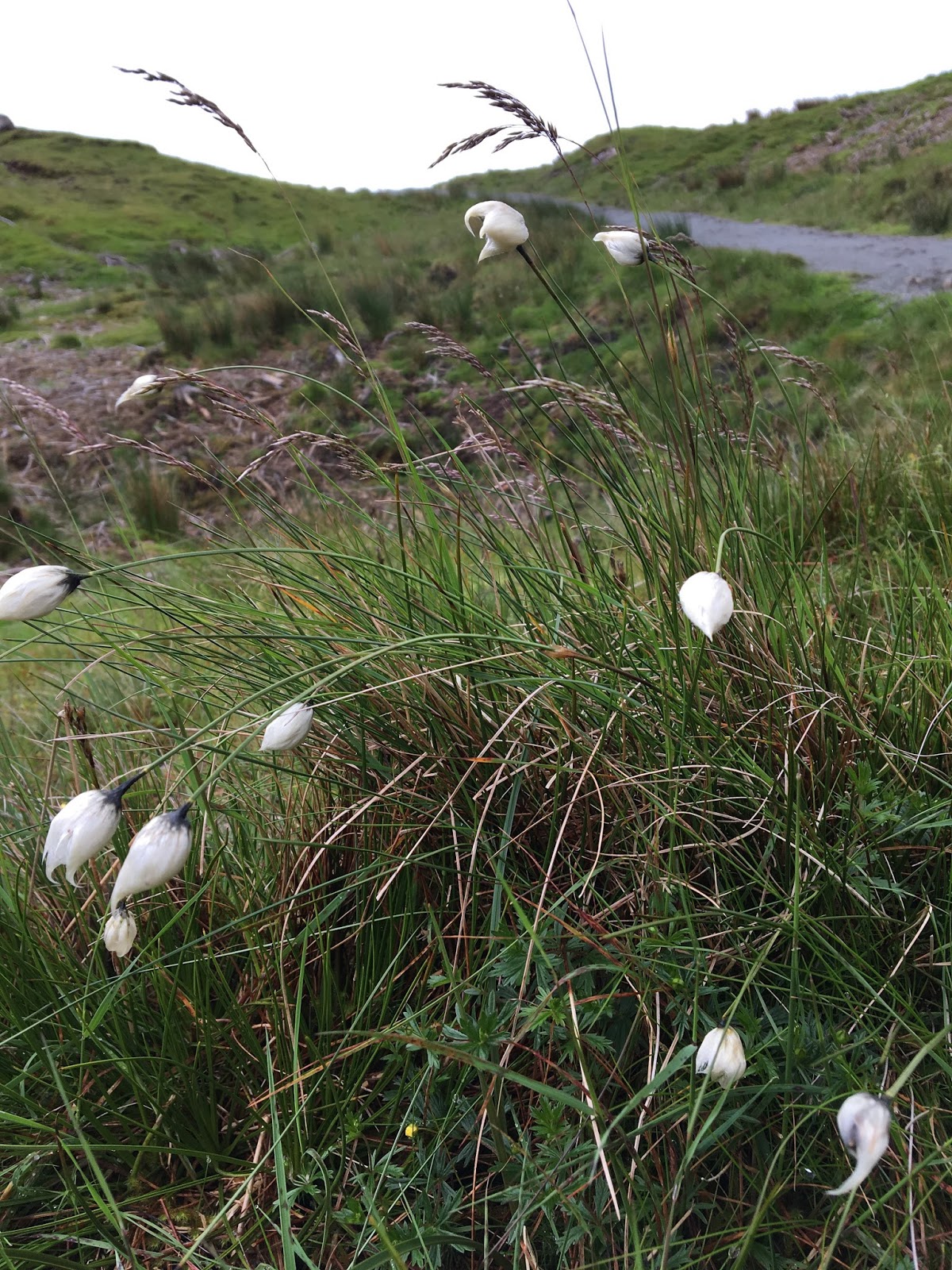
On the way up, AJ took pictures of flowers, known and unknown to her. One, the bog cotton (Eriophorum angustifolium), had tufts of cotton-like material at the end of stems, dotting the hillside and lining the trail all the way up. Beyond a sheep gate and a herd of sheep, the trail grew steep, with ledges of stones to serve as stairs in the mucky peat ground. Loch Leathan, filled with rocky islands, and the Sound of Raasay lay glistening in the sun far below them. 

Above them, near the top of the mountain outcroppings, ravens played and tumbled around the craggy rocks, soaring on the wind, just because they could and God said it was good. 

“We could have made it up to Vernal Falls (in Yosemite National Park) if we had these,” B said. The metal, fold-away sticks provided additional points of balance on the rocky, uneven ground as they climbed. It reduced the amount of balancing and corrections and stumbles that one had to constantly adjust to, and that saved energy. 

The Old Man of Storr (middle rock), and companions

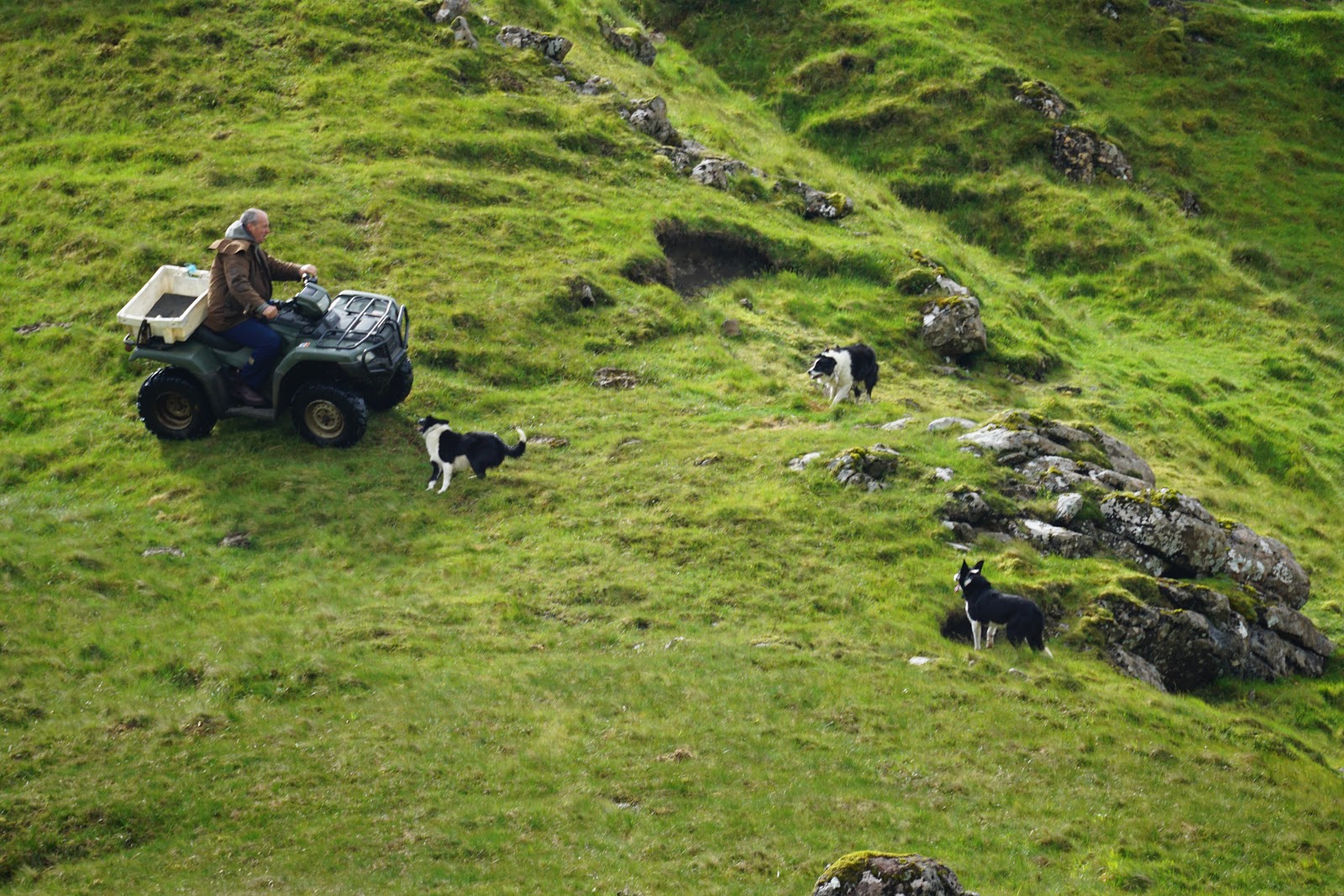
While B was busy getting the perfect shot of The Old Man of Storr, AJ and TwoSon  explored the area. A herd of sheep, pressed close together and running for their lives crossed the path below them, followed by a shepherd on a 4 wheel ATV and his four sheep dogs. 

The black and white shaggy dogs ran with boundless energy over the hills, as if the only thing they wanted to do was to run, and to stop would be treason, though they did pause to lap water from puddles sometimes. The dogs ran like they loved their job, wanting only to do the will of their human master and craving his approval. 


On the walk down, AJ slipped once, B once, incurring muddy hands and pants. TwoSon stayed upright.  

At the bottom of the mountain, they got out of the cold whipping wind, and back to the trailhead parking lot where they waded through a now-packed lot to their warm car. The narrow, one-lane road was also congested with cars parked on both sides.
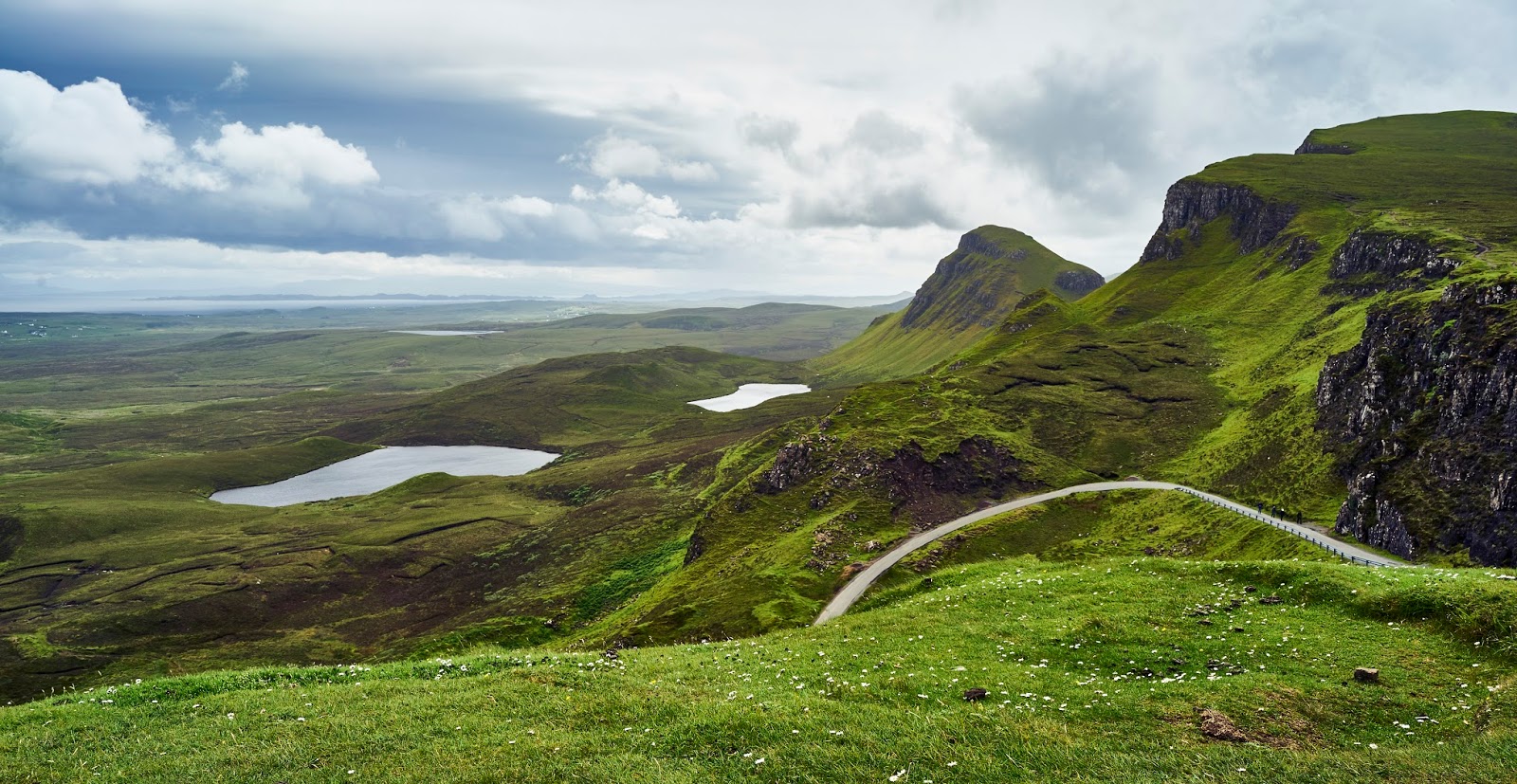
Their next stop was at the Quiraing, a scenic area full of towering mountains with expansive views of the sheep valley below and surrounding lochs. This time they were too late to get a good parking spot and were forced to park off the one-lane, two-way road, in the mud. 

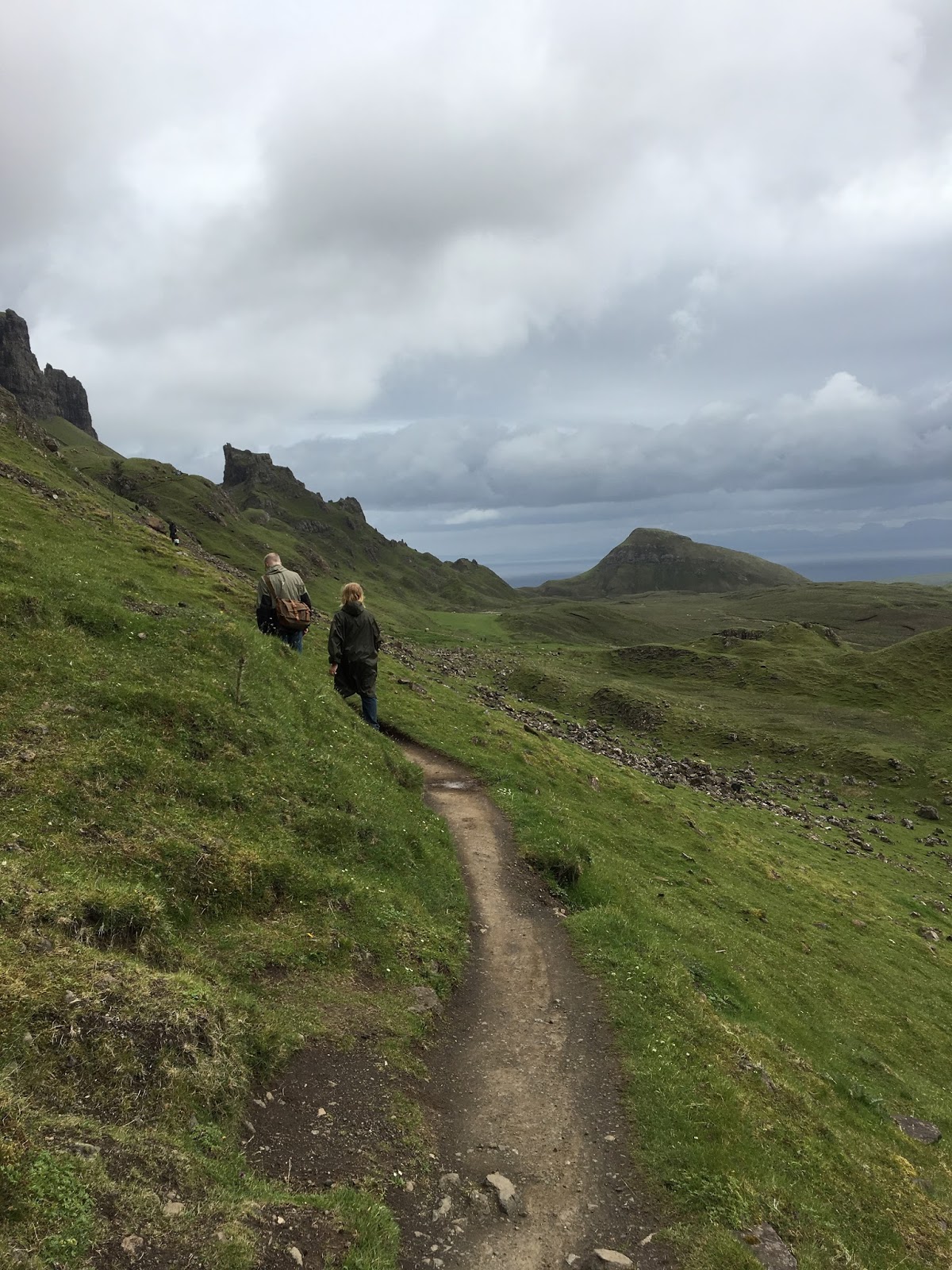
The fresh air revived them, as well as the fact they had to be ultra-vigilant for cars while walking to the trailhead. Short-croppped, tough Heather grew all over the flats and hills. Once on the trail, B walked out toward the edges of cliffs for pictures, AJ and TwoSon stayed safely back. Soon the trail started to hug the mountain side, narrowing, leading through mud, grass, rocks, boulders and once passed over a small water.

Dogs were a common sight on the trail. One enthusiastic dog pulled his man onward to adventure with uncommon exuberance. The family only went a third of the 5 mile trek, turning back when the stunning views and landscape became commonplace in their minds. 

There is something about walking through sheepy, expansive green, rocky landscape, that sinks almost imperceptibly into your soul, lifts the spirit and distracts you from even the most pressing worries of the work. And then when you are done, that magical something is sucked and shocked out of you by the harrowing experiences of driving on the narrow crowded, back roads of Scotland. Is it worth it? Yes.


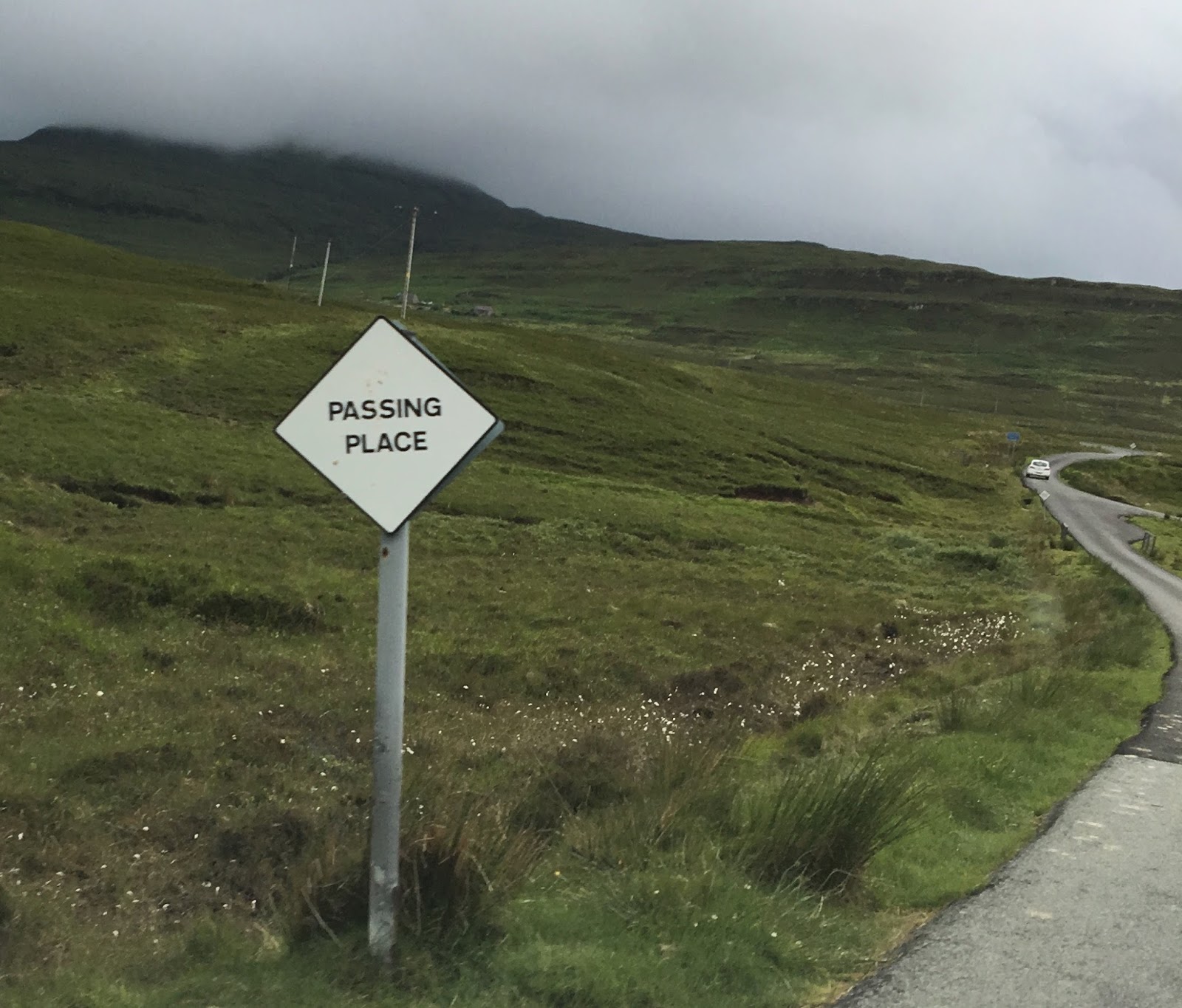
Driving, especially in new and exciting countries, under unfamiliar traffic patterns and laws, and in ultra-crowded conditions was a sort of crucible for B and AJ. Because so many of the “passing places” were filled up with parked cars, it was paramount that drivers use the tiny berm to squeeze past each other, and this caused not a little bit of “freaking out” on AJ’s part, especially when the car was in imminent danger of being stuck in a muddy ditch, with a line of cars wanting to get past. Her “freaking out” would then make B freak out. Ires would eventually settle once they were out of the fray, and that–the ability to get angry, or upset or panicked with one another, then let it go into the wind, forgive if there is something to forgive–is what counts, that is the ultimate teacher and strengthener in these instances. 
A View in the Quirang


Despite the harrowing experiences on the single lane roads, AJ and B were getting used to navigating and driving in Scotland and realized that in UK and probably all of Europe, driving was an intense activity. One didn’t drink coffee, text, phone, or trifle with anything else in the car while driving. It’s eyes on the road, both hands on the wheel, full attention to driving and arriving safely. There are too many hazards, especially for people used to driving on spacious roads with ample, low berms and on the right side. 

They stopped at KiltRock for 5 minutes, a cliff of basalt columns of rock that reminded one of pleats in a kilt. The parking lot was full of buses and the family had to look over the heads of crowds of tourists to see it. There again were ravens playing in the wind, hovering in the updraft as if suspended in midair. 

Back in Portree, they ate lunch at Caledonian Cafe. AJ had smoked salmon, but skipped dessert to visit the Portree Knitwear Shop to search out wooly souvenirs. She walked out with a wool scarf, a wool sweater, a Isle of Skye tee-shirt for the boys (or, if the boys, who don’t like “things” on their shirts didn’t want it, it was hers) and a wool skirt (on sale). She bravely resisted the temptation to buy another wool blanket (she had 2 wool blankets at home, though not in tartan), because it wouldn’t have fit in her suitcase. 
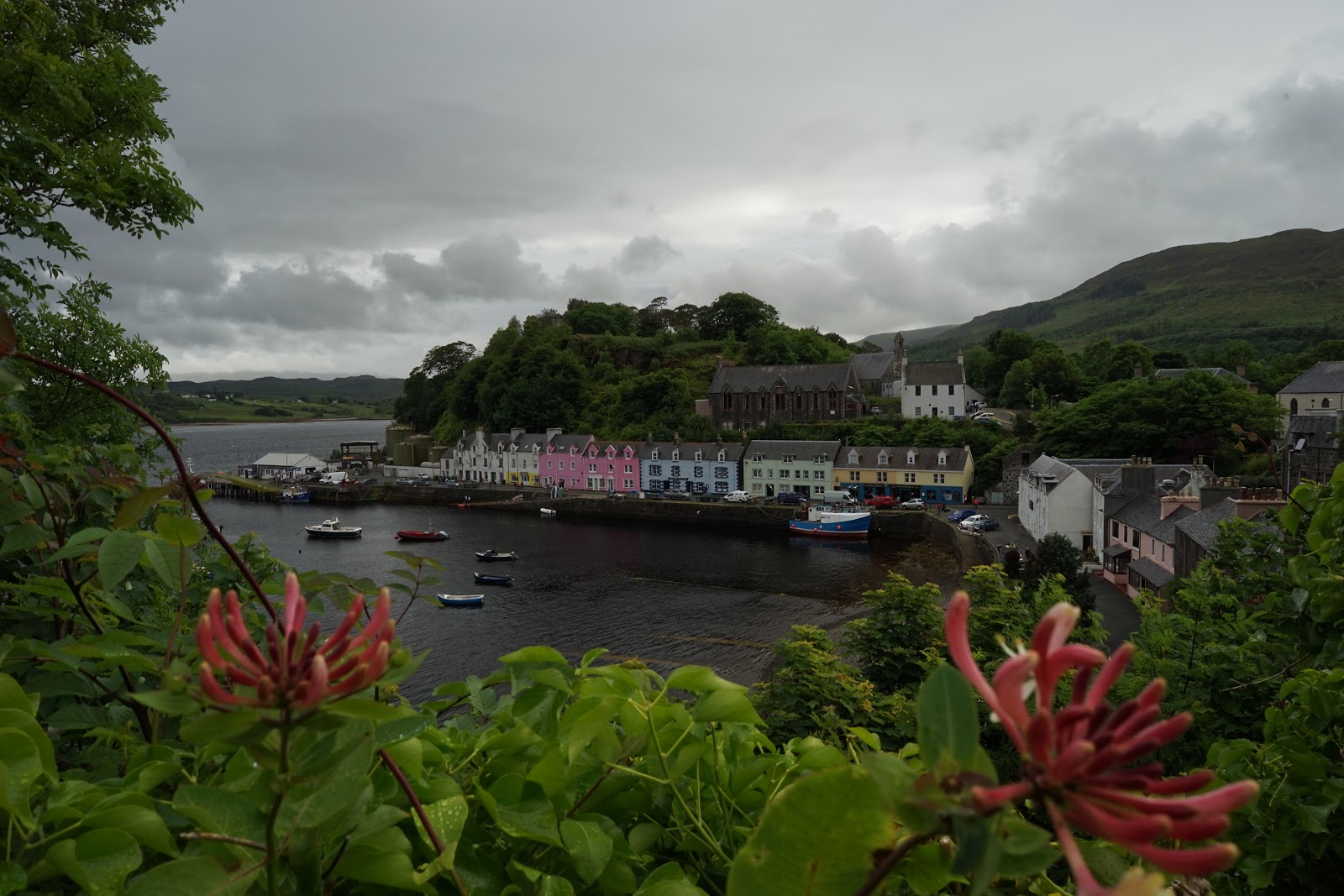
Portree, Isle of Skye


Back at the Stormy Hill B&B, the family rested and read or other wise distracted themselves, since B had planned for a late night watching the sun go down on a coast line cliff. 

Later that day as they drove along the one-lane roads to their next destination, they kept a watch out for Highland Cattle, those beautiful bovines with long shaggy hair, and although they spotted a few, the creatures were never in a good spot for pictures.

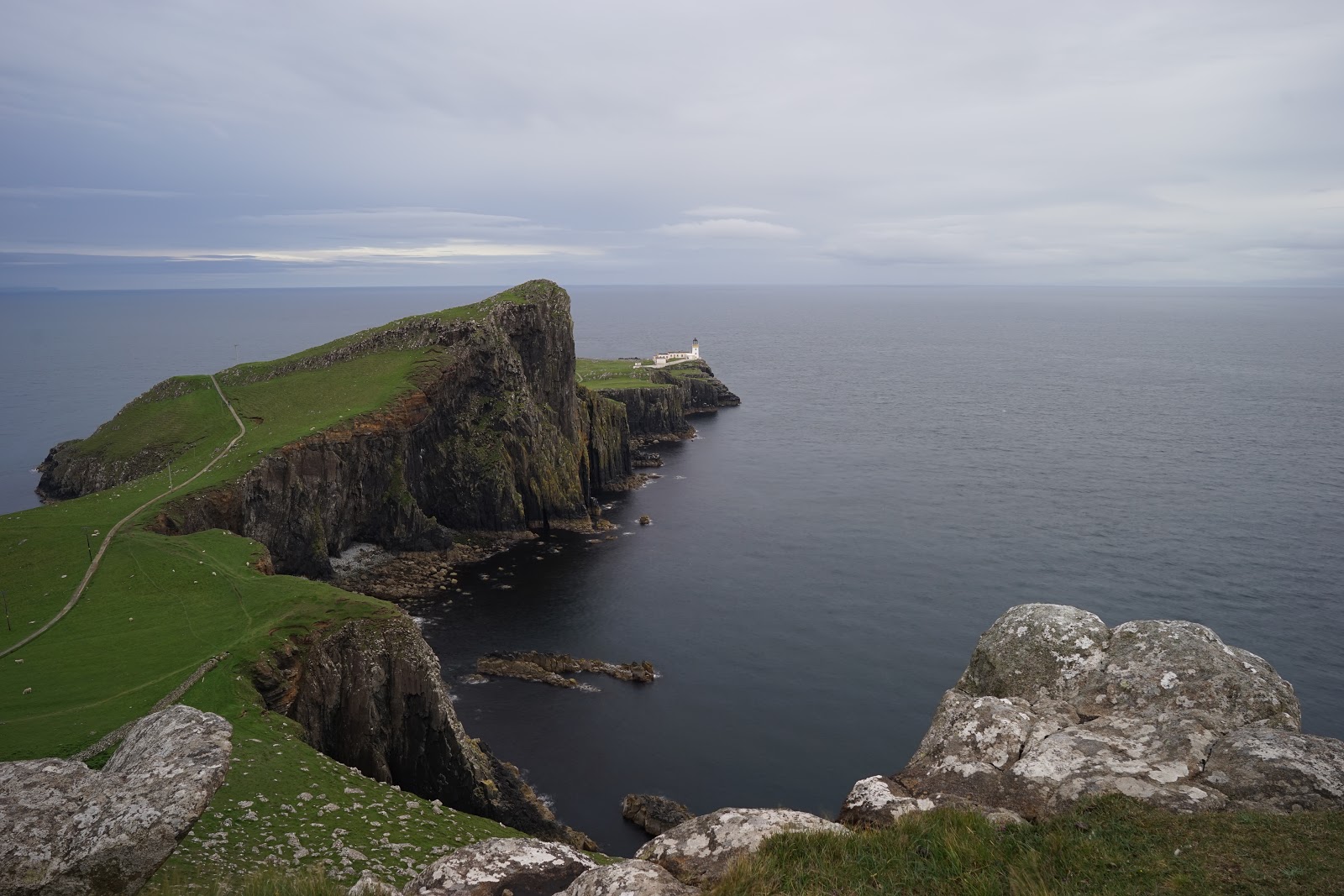
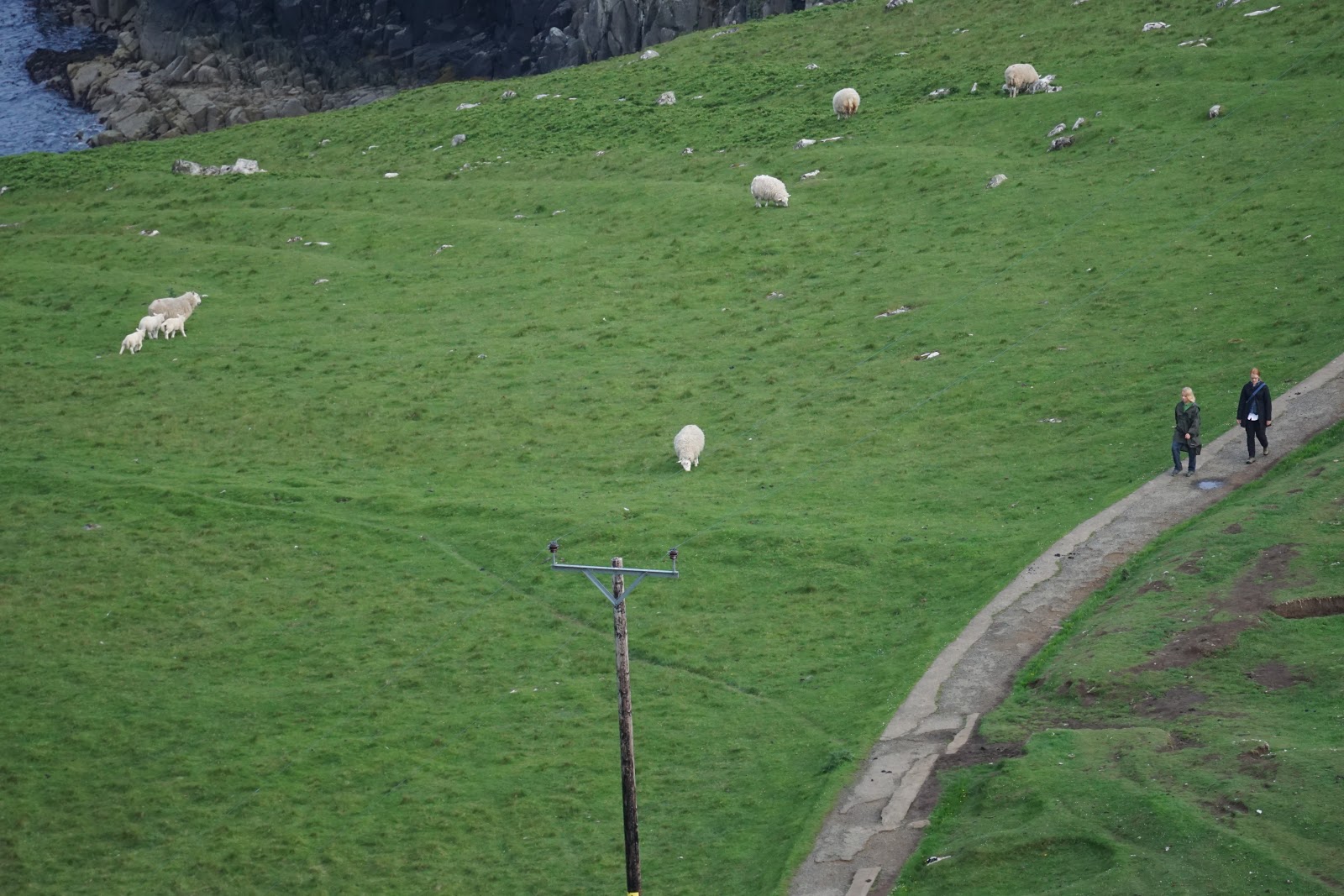
They passed regular cows, sheep in the road, cute white houses and farms to Neist Point Lighthouse where 3-4 RVs had managed to travel (the roads were very narrow) to stay the night. B and Tripod found a spot on a cliff overlooking the lighthouse and peninsula while AJ and TwoSon took a hike to the lighthouse, through sheep pastures.  By then, they had become accustomed to watching out for “cocoa puffs” or sheep leavings everywhere they went. 


Walking back from the lighthouse, AJ and TwoSon encountered a couple and their toddler in mid-meltdown. His parents tried dragging him, then letting him sit and wail. It was melt-down toddler time, past 9pm, but the little guy’s parents probably didn’t realize it; AJ hadn’t, until she looked at her watch. 

Scotland is located around 57 degrees North latitude, and it was close to summer solstice, which meant that light lasted until late into the evening, and sometimes into the morning the next day. Michigan summer days were long, but nothing like Scotland’s.

They met up with B, perched on the side of a cliff waiting for good light for pictures, but the perfect conditions never came. By the time they got back to the parking lot, a group of campers had set up tents in the grass overlooking an amazing view of the sea and were cooking a late dinner. 

AJ and TwoSon walking back from the lighthouse, and sheep

Into The Otherworld


Saturday  June 16, 2017

The family left Letterfinlay hotel amidst rain and grey skies which continued during the two-hour drive to Fairy Pools on the Isle of Skye. The route to the Isle of Skye snaked between sloping mountains lush with Mountain Laurel, wild pink Foxglove, yellow Scotch broom, and farmed pines, planted thickly in neat lines. In some areas the pines had been harvested, leaving a brushy, barren mess of a mountainside. Once in a great while, a strong patch of sun would break through the rainy clouds, bringing a false hope. 

They turned off road A87 onto a narrow one-lane, two-way road, pausing at passing places for other drivers, through sheep pastures, over two cattle grates (to keep the pervasive sheep out), before reaching the crowded parking lot of The Fairy Pools, the first stop on The Agenda that day. They didn’t get out. B sighed. The rain pelted the car, with the wind blew it slanted and heavy against the windows.


“I don’t know … I don’t think this rain will stop,” B said. 

“I’ll go,” TwoSon said, willing to risk getting wet. 

“I’ll go, too, I guess,” AJ added, not looking forward to it, but up for the challenge. 

“Yeah, but it won’t be good for pictures,” B countered, much to AJ’s relief. “We’ll just come back later.” 


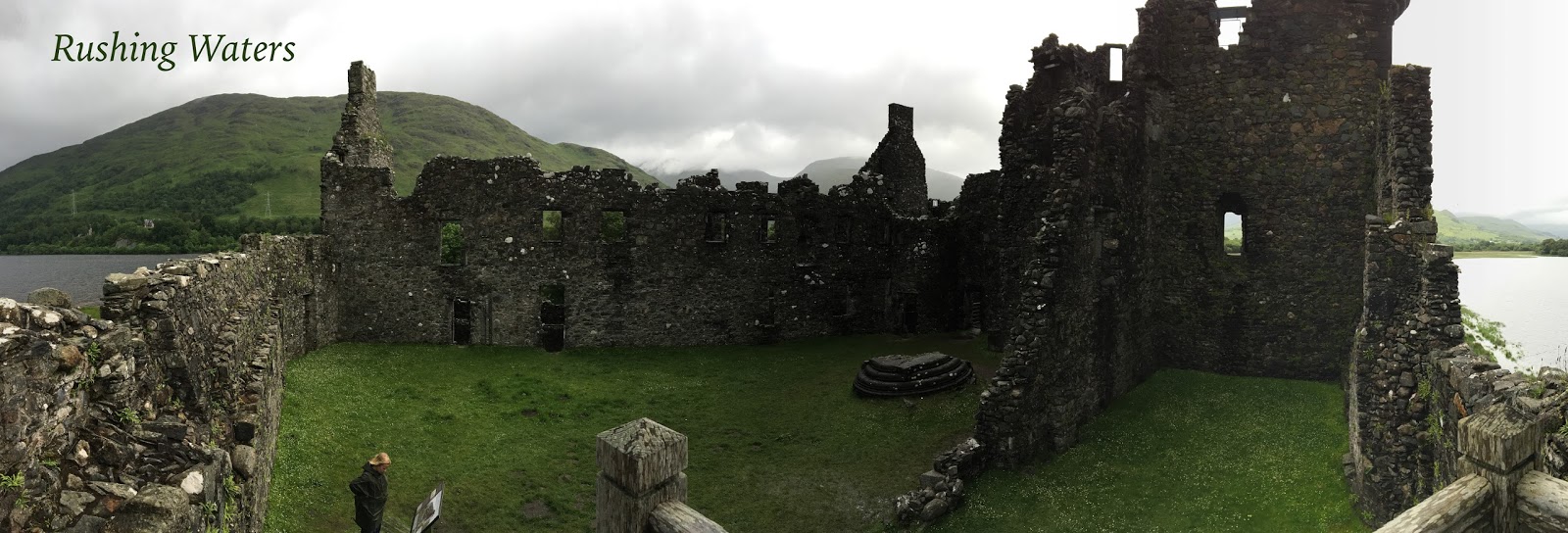
Instead of skipping along the Fairy Pools, they decided to seek shelter and some history at the Eilean Donan restored castle sitting on a tidal island at the intersection of three Lochs: Loch Long, Loch Alsh, and Loch Duich. After buying tickets to the castle, they visited the restaurant for Shepard’s Pie for B, Mac ’n Cheese for TwoSon and a salad and more Ginger Beer for AJ. Before crossing the bridge to tour the castle, they perused the gift shop. 

“I can’t decide between a knit sweater, woven shawl or a blanket,” AJ said as B came back from putting their bottled drinks in the car. At first she had wanted to bring back English loose tea as her souvenir of the trip, but as she encountered more and more sheep and very nice woolen products in the stores, and repeatedly failed to find loose leaf tea, her focus changed. She had a love affair with quality products that worked well and lasted, like cast-iron cooking pans, leather shoes and canvas bags. Despite the new petroleum-based warmth fabrics available, wool was one of her favorite clothing fabrics, and it seemed to be all over the UK, on sheep and store shelves. 

She put off the decision and the family crossed the wind-swept rainy bridge to explore the castle. 

The history of the castle was interesting, but not deeply so. The not-so-ancient aura was interrupted by color photos of the owners\’ family placed around the rooms. The place was involved in the Jacobites rebellions, destroyed by government ships and had been in shambles until restoration started 1919. It was relatively new, but compared to historic buildings in the US, still worthwhile. 

As they left Eilean Donan Castle, the rain persisted, putting a damper on the day. On their way to their next B&B in Portree on the Isle of Skye, they stopped at The Bridge of Sligachan as B took pictures of a bridge and water while TwoSon had fun on a long swing and AJ dozed in the car. 


Their next B&B, Stormy B&B located on Stormyhill Road, just a few blocks from the center of Portree, consisted of a simple second story room with a double and a twin bed and a bathroom. Downstairs was a breakfast room, stocked all day. There, the family rested, read and refreshed themselves, waiting impatiently for the rain to stop. 

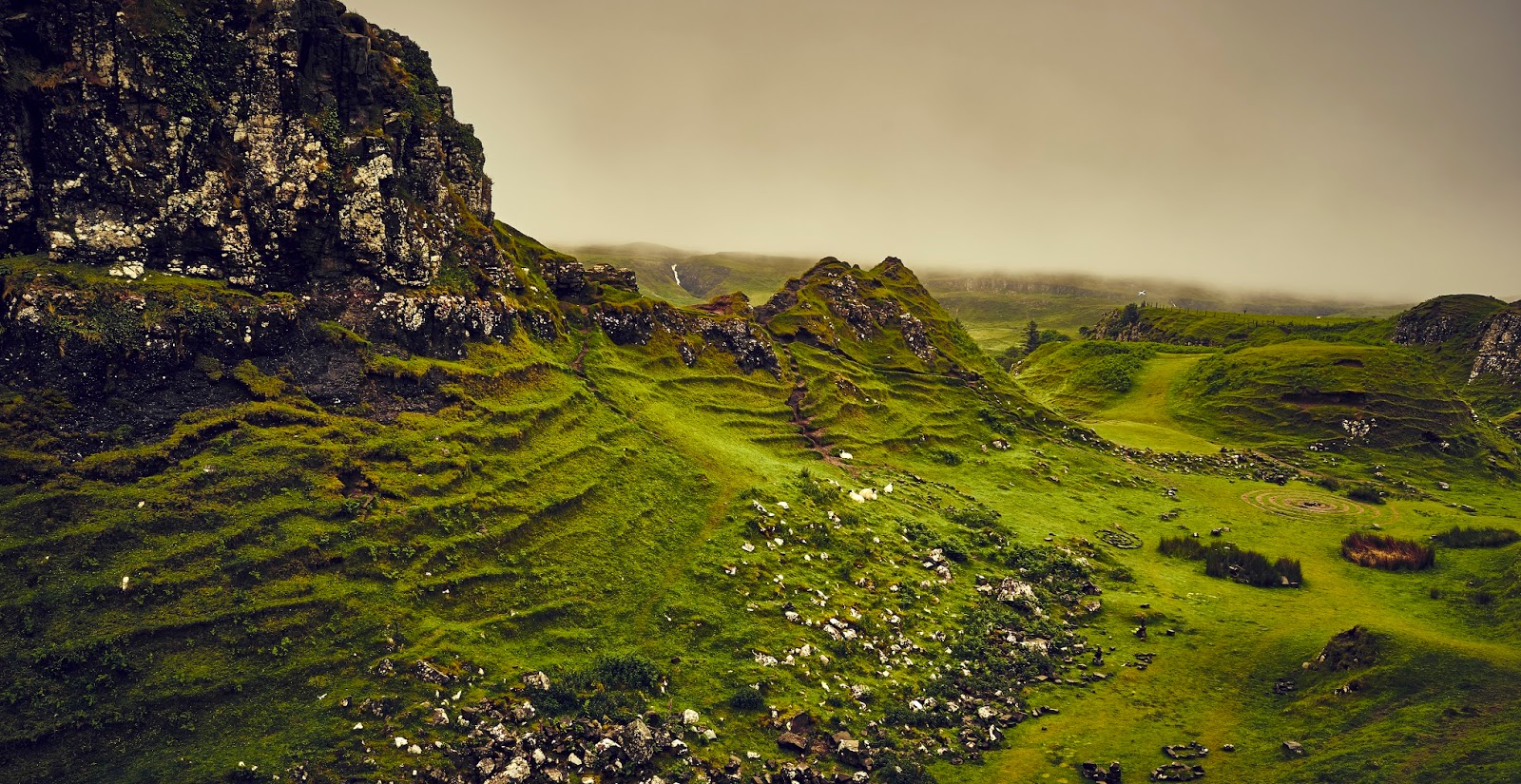
And when it did, they started out, GPS on, AJ navigating and reminding B of the left-driving rule, following the one-lane, two-way roads with passing places, through sheep pastures, and over more cattle grates to a most curious, magical place aptly named Fairy Glens


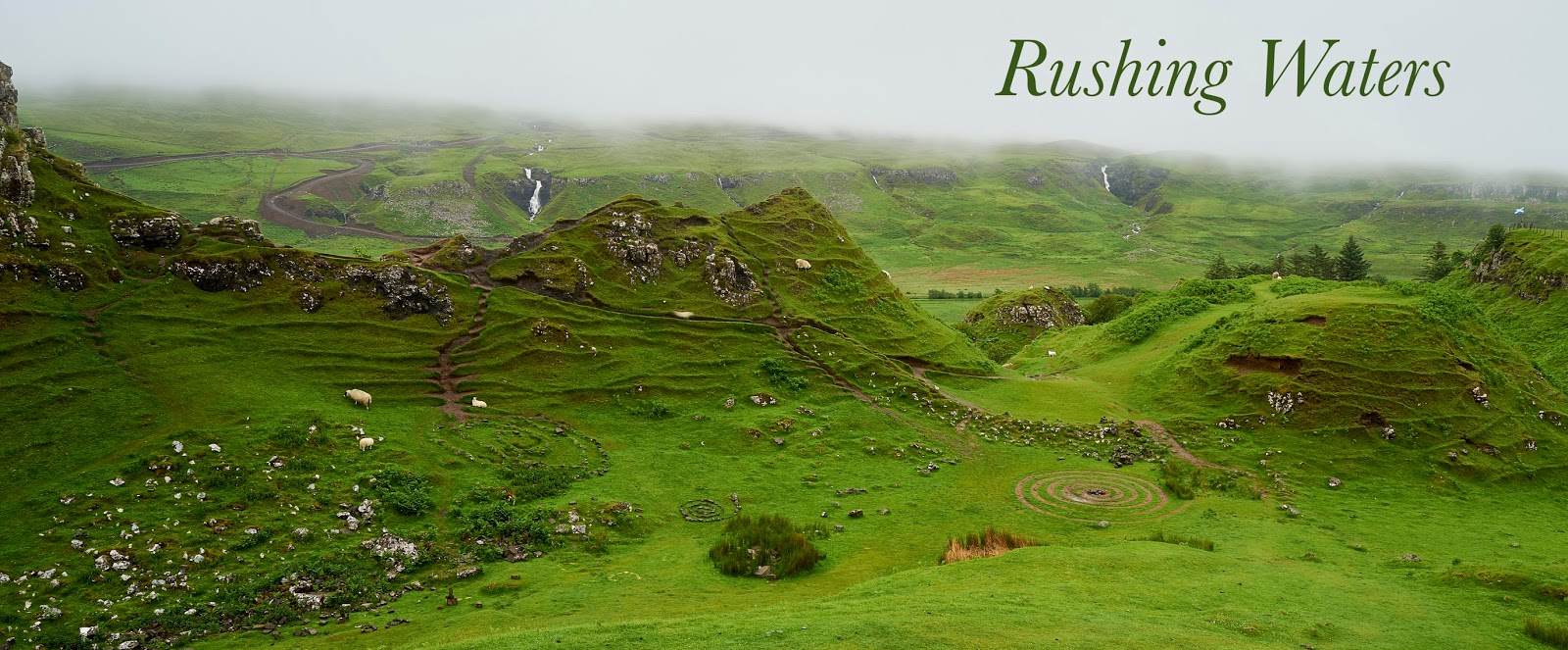
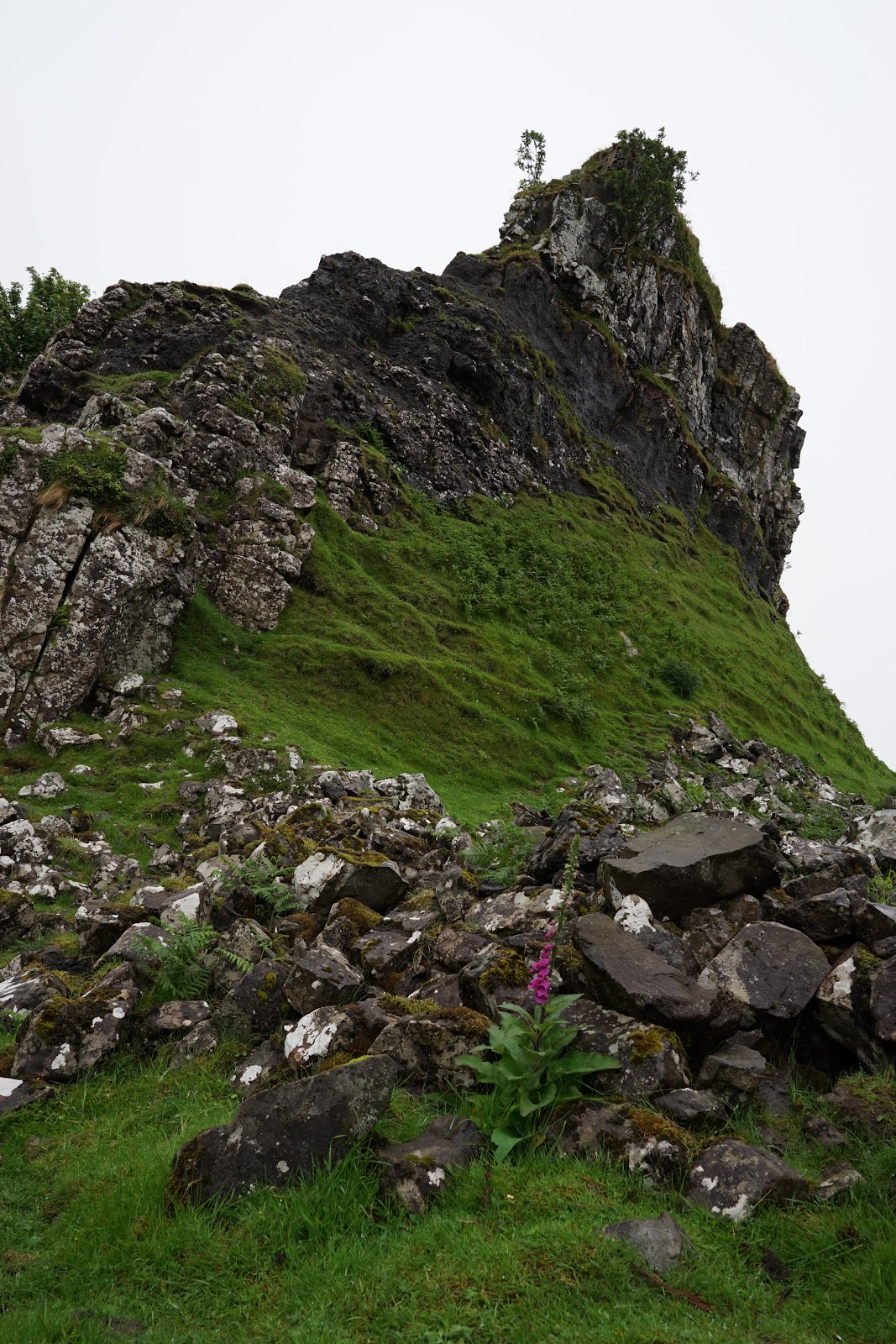
The Fairy Glens is basically a sheep grazing area with strange striated mounds, rock outcroppings and sheep, but the bright green hills, the grey mist and dreary sky worked together to portray an Otherworldly feel.   


AJ rarely traveled anywhere, even down the street to the grocery, without some literary story in mind, ready to make connections to great stories that reflect on the extraordinary-ordinary in her life. On big trips, she made a point of bringing some literary aura with her. Though she was listening to it, Scott’s Rob Roy, wasn’t the story that came to her mind at that place. 

Wikipedia says, \”Sometimes, the Otherworld is said to exist alongside our own and intrudes into this one; signaled by phenomena such as magic mist, sudden changes in the weather, or the appearance of divine beings or unusual animals.\” 


According to Phantastes and Lillith, novels by George MacDonald (and many other folktales, fairytales, myths and legends), there is a wonderful, powerful and sometimes dangerous world over imposed on the UK*, of magical spirits, benevolent and mischievous. Sometimes the boundary between the worlds wears thin at places, exposing the Otherworld to our mortal senses. 


This was a place where atmosphere, weather and geography wore the boundary thin, and it was easy for an imaginative person to see and feel it, maudlin as it seemed under the grey sky. 


If a visitor has even a thread of whimsy, the area will transport them to The Otherworld, or the Land of Faery. The novel Jonathan Strange and Mr. Norrell, by Susanna Clarke is a good illustration. It is  about English magic and where it comes from, and surmises that the north of England and Scotland was filled with strong magic.**

The family traipsed up barrow*** and down, giving the cropping sheep a wide berth as B and tripod took pictures, while AJ and TwoSon explored the area, marveling at the strange spiral formations, and nice, juicy Scottish black slugs dotting the ground.

They crossed the snaking road to more expansive area, passing a quiet flat area with a broken stone fence (old sheep pen) and a decrepit but persistent tree hanging over. AJ stopped to take in the sight, when a low croaking crrrrk filled the air, emanating from somewhere high above their heads. 

“Ravens! There are ravens around here somewhere,” AJ said, looking around for evidence, but finding none. The wall, the tree and the unmistakeable call of the ravens brought a fascinating, but morbid ancient ballad to mind: 


The Twa Corbies


As I was walking all a lane, 
I heard twa corbies making a mane;
The tane unto the t\’other say, 
\”Where sall we gang and dine today?\”

\”In behint yond auld fail dyke, 
I wot there lies a new-slain knight;
And naebody kens that he lies there, 

But his hawk, his hound, and lady fair.


\”His hound is to the hunting game, 
His hawk to fetch the wild-fowl hame, 
His lady\’s ta\’en another mate, 
So we may mak our dinner sweet. 

\”Ye\’ll sit on his white hause-bane,
And I\’ll pick out his bony blue een;
Wi ae lock o\’ his gowden hair 
We\’ll theek our nest when it grows bare. 

\”Mony a one for him makes mane, 
But nane sall ken where he is gane;
O\’er his white banes when they are bare, 
The wind wall blaw for evermair.\”


They climbed the mountainside, eyes skyward, following the gruff bird cries. Eventually two or three ravens took flight from somewhere in the tall spires of rock, spread their wings, circling and calling, spying on the visitors. B and AJ tried to get pictures, but never captured a good one. 

Bad picture of a raven


While it was still light, though very late, they returned to Portree, slipping into an Italian restaurant right before it closed for a hot dinner. 

*And sometimes it shows up in the US. The great walking-advocate and author of Walden, Henry David Thoreau alluded to this Land of Faery in his lecture titled, \”Walking\” (sometimes known as \”The Wild\”).  

** AJ doesn\’t believe that there is another \”world\” superimposed on this one that we can\’t see, in the sense which the referenced novels portray. But she can\’t deny (and even science itself cannot deny), that there are things in this world that move and live and exist which we can\’t see, but can enact great influence on us. One obvious example is the wind. We can\’t see it, but we can feel it and observe it\’s effect on others. This concept is of great inspiration for illustrating real, liveable truths through fiction and metaphor, as so many authors have shown (CSL, Tolkien, MacDonald to note only a few). 

***barrow-used here in a Tolkien-ish way, meaning ancient burial mounds

Thanks for reading

Misty Mountains, Midges and Magic Trains


Friday, June 15, 2017

AJ slept so soundly in the big soft bed at Glenmore Country House B&B that when she woke, it took a while to remember how she got there. When she mentally clawed back to her presence of mind, she smiled. 
Breakfast was served in the sitting room, with fruit, homemade bread, and American bacon, then the family took off on another action-packed nerve-racking drive, stopping first at Stalker Castle overlook. 

Castle Stalker

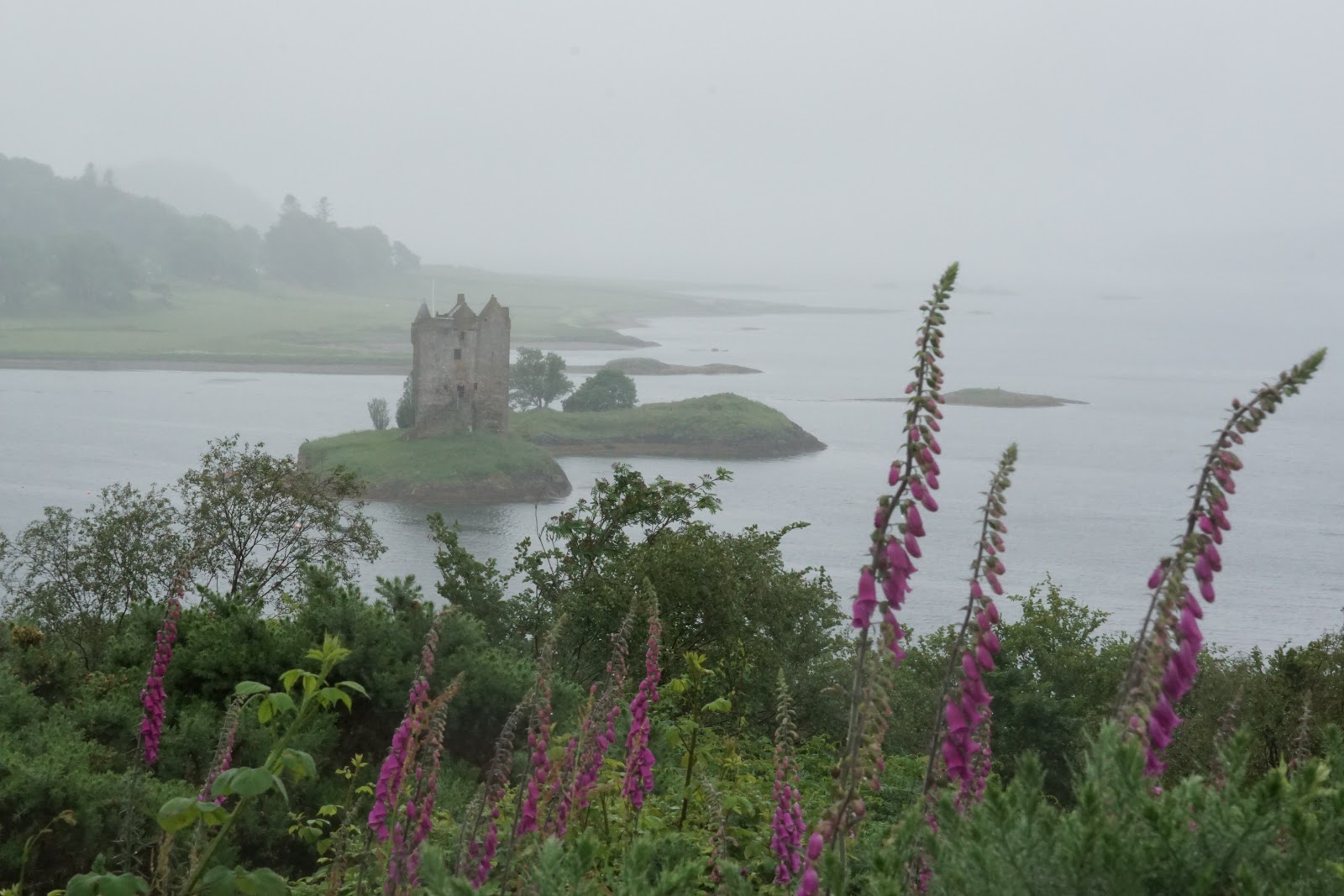
While B tried to get good shots of castle through a dreary grey drizzle of rain, AJ combed the gift shop where she bought a cheap, “I love Scotland” umbrella to keep B’s camera dry. Castle Stalker is a restored castle  in the middle of a tidal islet (only accessible when tides are low). The existing structure, built in the 1400s, changed hands many times, some of those hands being of the Campbell and Stewart families, until it was bought and restored by the present owners. 


The impression (again, quite inaccurate for so short a trip) AJ took from the Scots were that they were a people suspicious of strangers, cautious and not overly or falsely friendly. They were a lot like AJ herself. At times, honest sobriety must forgo superficial joviality, it prohibits false shows and fabricated facades. This can be a good thing sometimes.

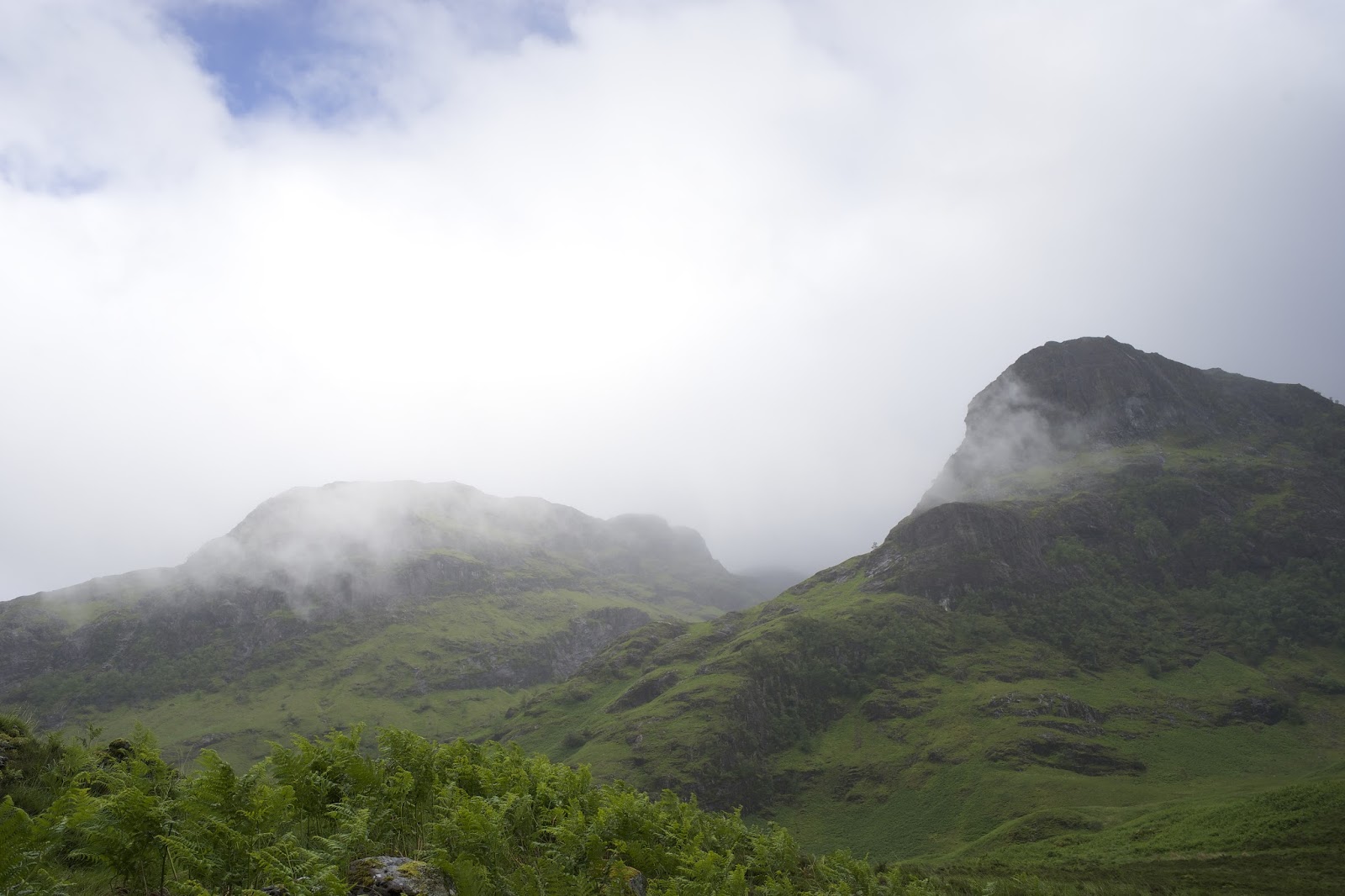
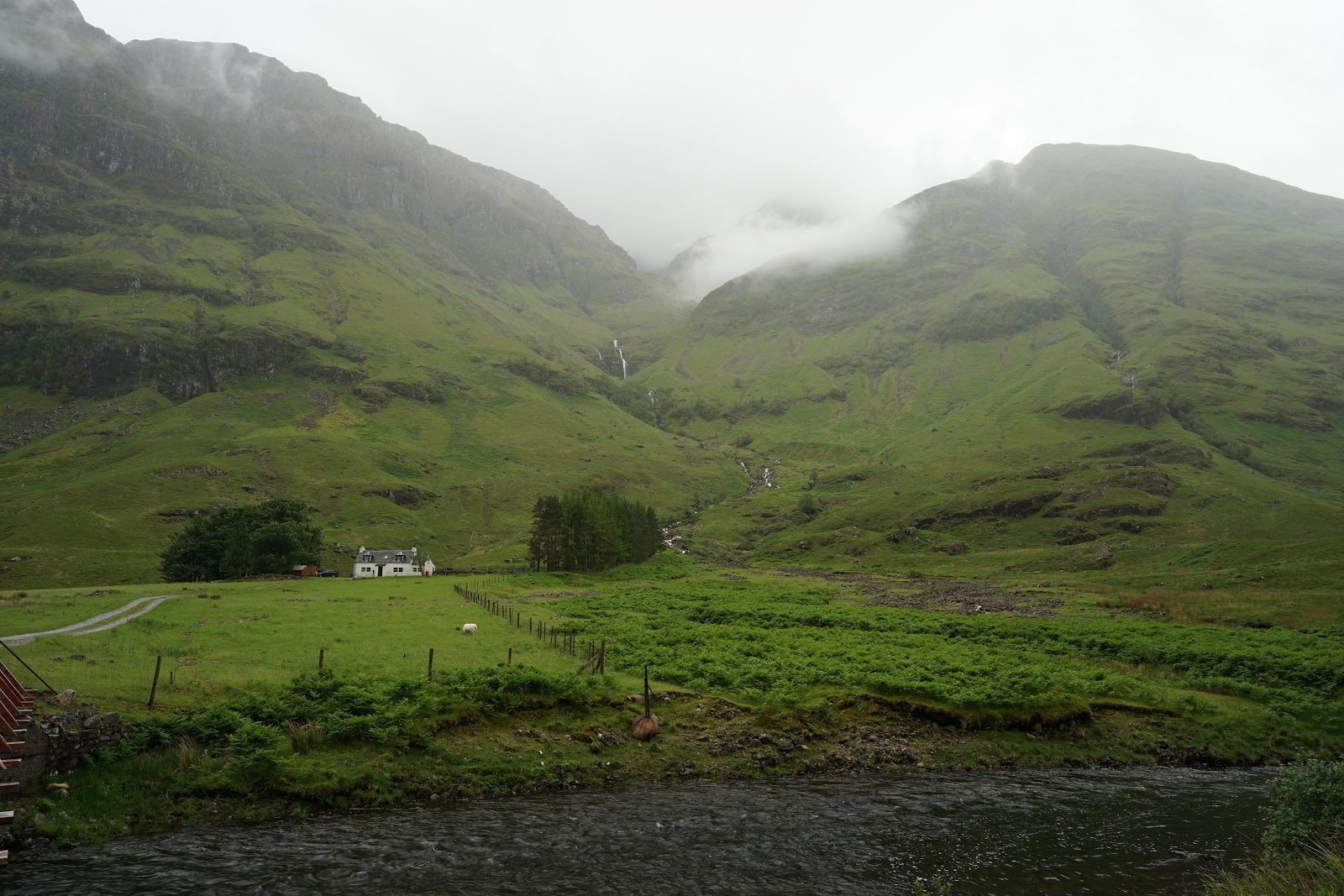
A thirty minute drive brought the family to Glencoe, an area with huge green towering mountains veiled in mist, flanking a picturesque valley dotted with white stone cottages tucked away here and there in the bends of running streams. Heavy mist fell over the area, putting a damper on the best photo shots for B. 

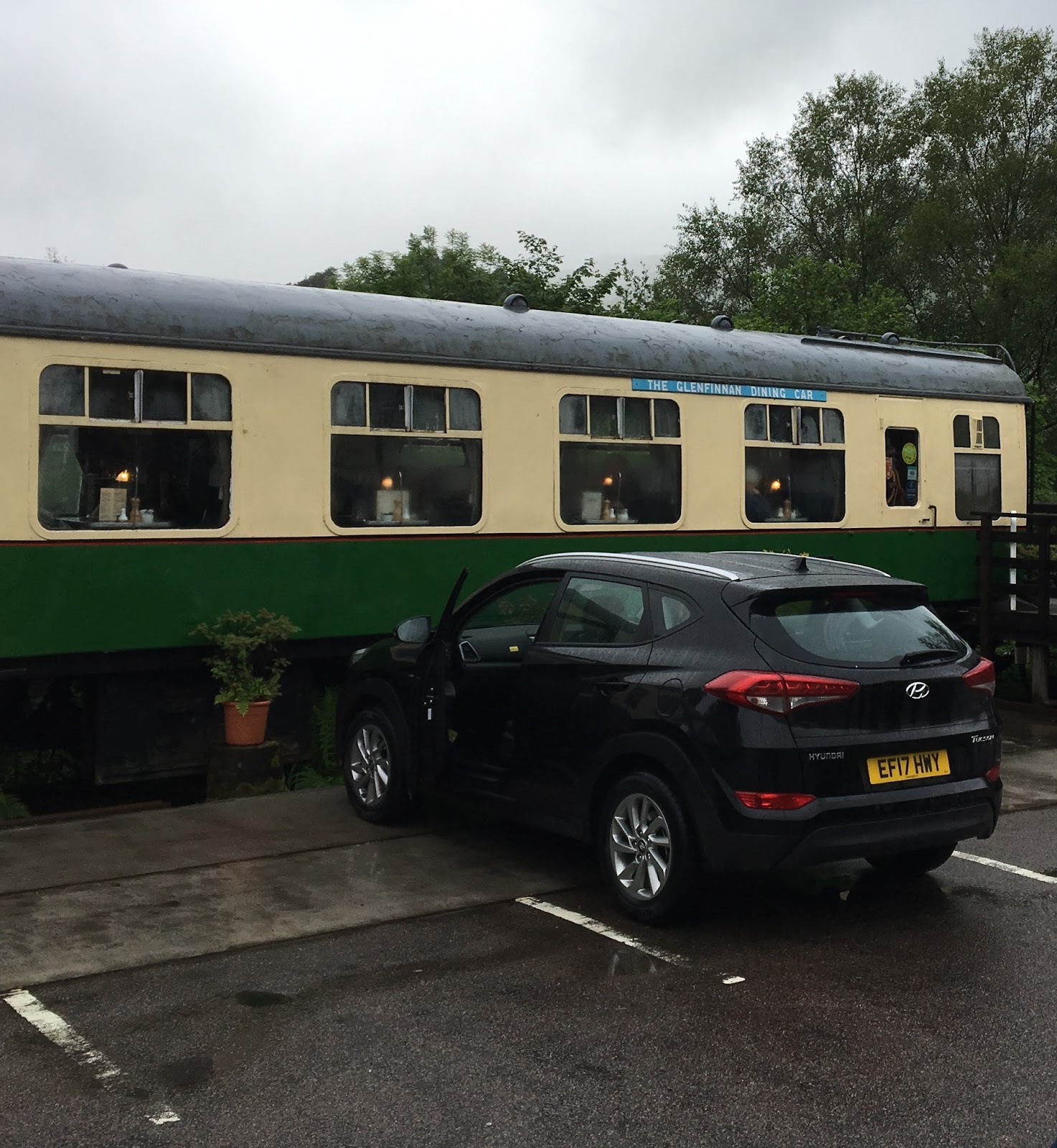
The Glencoe mountains were perforated with deep cavernous rills and water falls ribboning down into the valley. B parked along the narrow pull offs and got out for pictures, with TwoSon holding the recently acquired Umbrella. After a few stops (and one harrowing, ill-advised u-turn), they drove to the Glennfinnan Station Museum Dining Car, a train car diner, but it was full and they couldn’t wait for a seat: they had a train to catch. (Picture) 
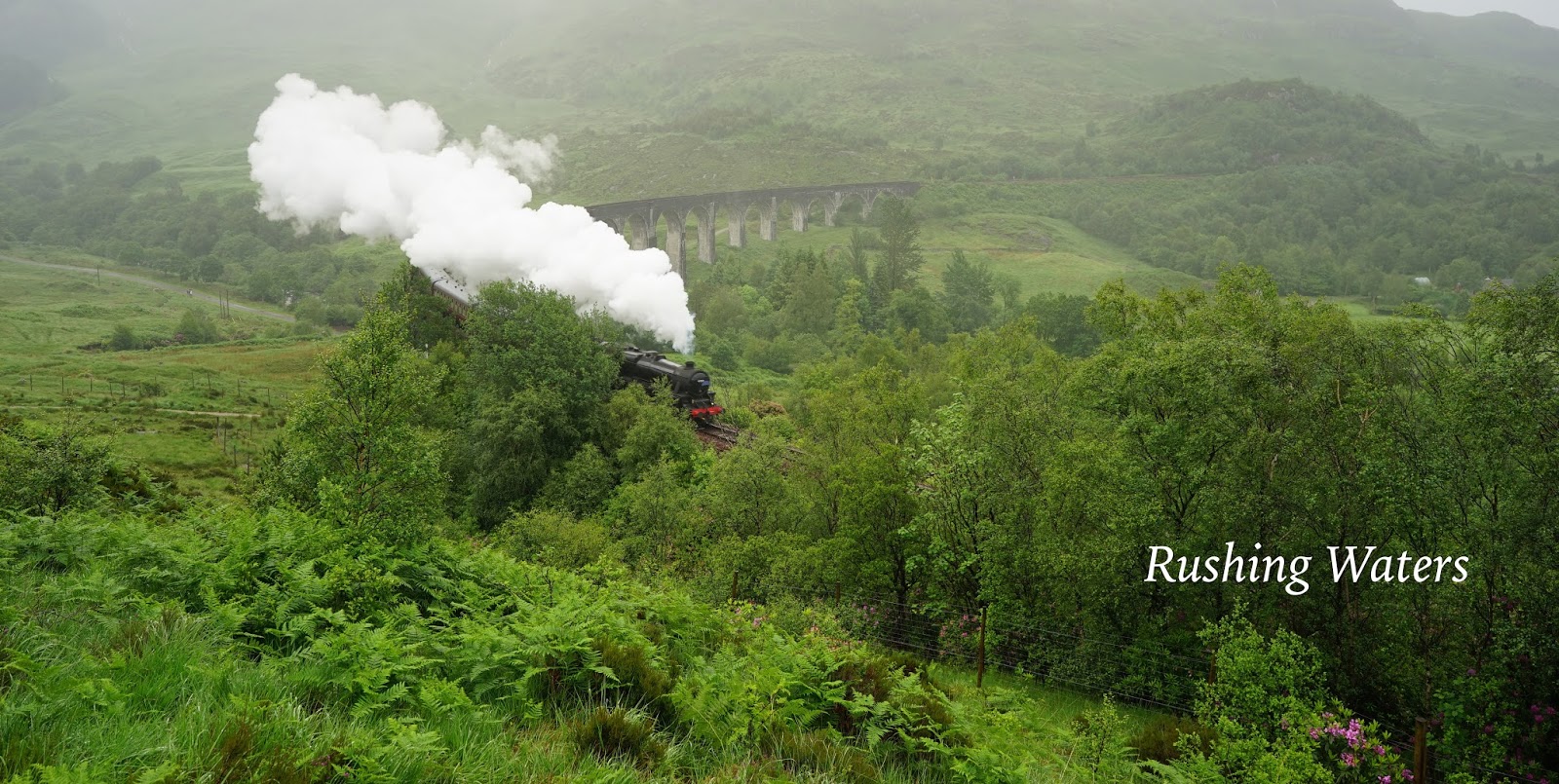
Parking in a small, crowded gravel lot, they walked a nice paved path, then a steep, rocky, sheepy path to find a spot for Tripod to catch pictures of a train crossing the Glennfinnan Viaduct. This is the high, picturesque viaduct seen in Harry Potter movie.

As the family climbed the hill, they passed a man who either had ants in his pants, or restless legs or … something. He was walking back and forth, never standing still for very long. AJ wondered why, until B stopped at the perfect spot for a picture. Within seconds of standing still, the most annoying, painful insects attacked: midges. The famous Scottish midges can only be described as abundant as gnats and painful as mosquitoes, only more aggressive. They swarmed her face, they crawled up her pants legs, and down sleeves and collars. She knew why the man was moving.  
Glennfinnan Station Museum Dining Car
and the rental car.


“We have bug spray in the car,” AJ said, swatting and waving at the tiny black pests. 

“The train will be here in 20 minutes, you won’t have time,” B said. 

“If I hurry, I’ll make it back. Anyway, it’s better than staying here and getting eaten alive,”  she said before hurrying down the side of the mountain, past unsuspecting tourists. 

AJ jogged a little, speed-walked a little, past ambling visitors with umbrellas. She grabbed the insect repellent from the car and hurried back the path, excuse me-ing and pardon me-ing around people. When she was halfway up the hill to where B and TwoSon were, the train came chugging along the viaduct. It was the moment every midge-bitten person clinging to the hillside was waiting for. AJ stopped and watched while spritzing herself with the bugspray. 

“You didn’t make it,” B said as she met them coming down. 

“Yeah, I did. I saw it, and that’s what counts. I just didn’t get the bug spray to you in time.” After spritzing the anti-midge spray all over them, they made there way down the mountain, back to the car, only slightly harassed by midges now. When they returned to the dining car, there were plenty of seats for them to eat warm soup and tasty sandwiches. 
Then it was back to Glencoe again for foggy, misty pictures of the Three Sisters (three large mountains in a row). AJ sat in the car for an after-lunch rest while B and TwoSon and Tripod and Umbrella disappeared down a trail. 

The road through Glencoe was curvy and very busy, with speeding cars and big trucks (lorries) and vans and busses and RV’s. The roads weren’t like the roads in the US National Parks where cars crawled past every 10 minutes or so. This made getting on and off the road very tricky. 

The mountains flanking the road were, in some ways, like so many AJ had seen and grown up around, but in all the important ways, they were different. They were bigger. Wind blew white mist around and over the tops, patches of exposed rocks showed through the green in places and white streaks of jagged white water falls accented the behomoths. 

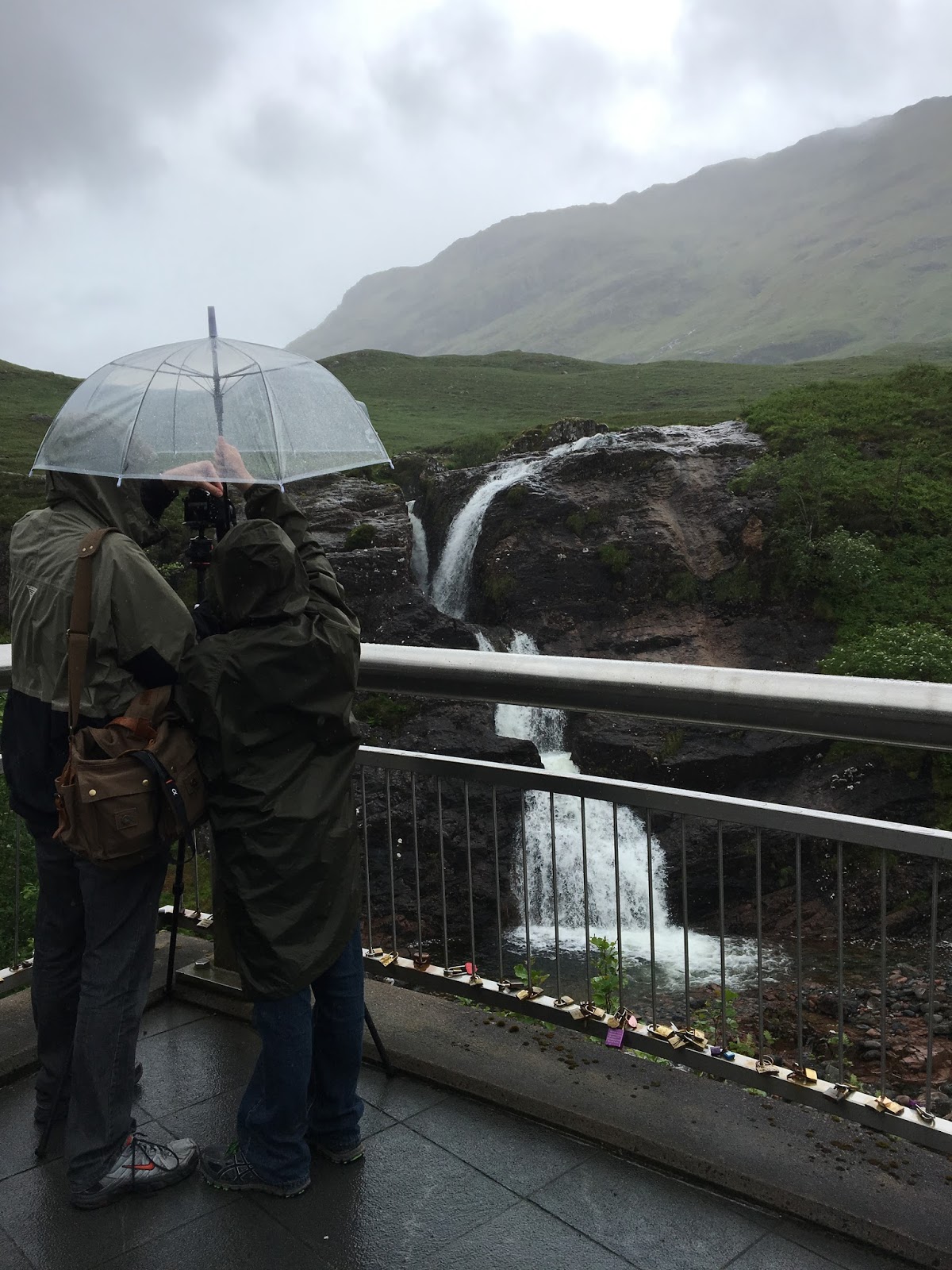
Their last stop before traveling to their next B&B was to an out-of-the-way water falls at the end of a short, marshy, mucky walk from a small parking area. As they walked TwoSon tried to use the umbrella as a shield from the rain, but in an ill-fated turn of events, he held it the wrong way and the wind blew it inside out, crippling the handy thing for the rest of the trip.  


Letterfinlay Hotel was situated along Loch Lochy and was probably once a hunting lodge of some kind. They checked in, then proceeded to heave their luggage up the stairs, but B stopped at the top of the last landing, bent down, his eyes close to the ground. 

“Why’d we stop?” AJ asked, last in the line and impatient to get to the room. No answer. “B, are you okay? … B?” 

“Yeah, but there’s something … alive under this door here.” 

AJ pushed past TwoSon to look at the tiniest, yet very significant roadblock. “Oh, okay. Ummm, I’ll go get someone.” 

“There is a small … creature at the top of the stairs,” AJ told the desk attendant when he came to the summoning bell. After a more detailed explanation, the man sent a young woman up to take care of the poor, misguided critter and without much more to-do, the family settled in the  room. (P.S. It wasn’t a mouse, or common rodent, but a tiny black baby bat.) 
The room was adequate, but the bathroom could have used a rigorous scrubbing down with bleach. All the floors were covered with tartan wall-to-wall rugs.

After a small argument about misinterpreted packing advise (AJ and TwoSon had run out of shirts because of the unexpectedly tiny washing machine capacity in the London Flat), the family visited the dining room  for bedtime snacks and tea before turning in for the night. 

Thanks for reading!


Human Law, Left Driving, and Churches, Castles and Homes


Thursday, June 14, 2017

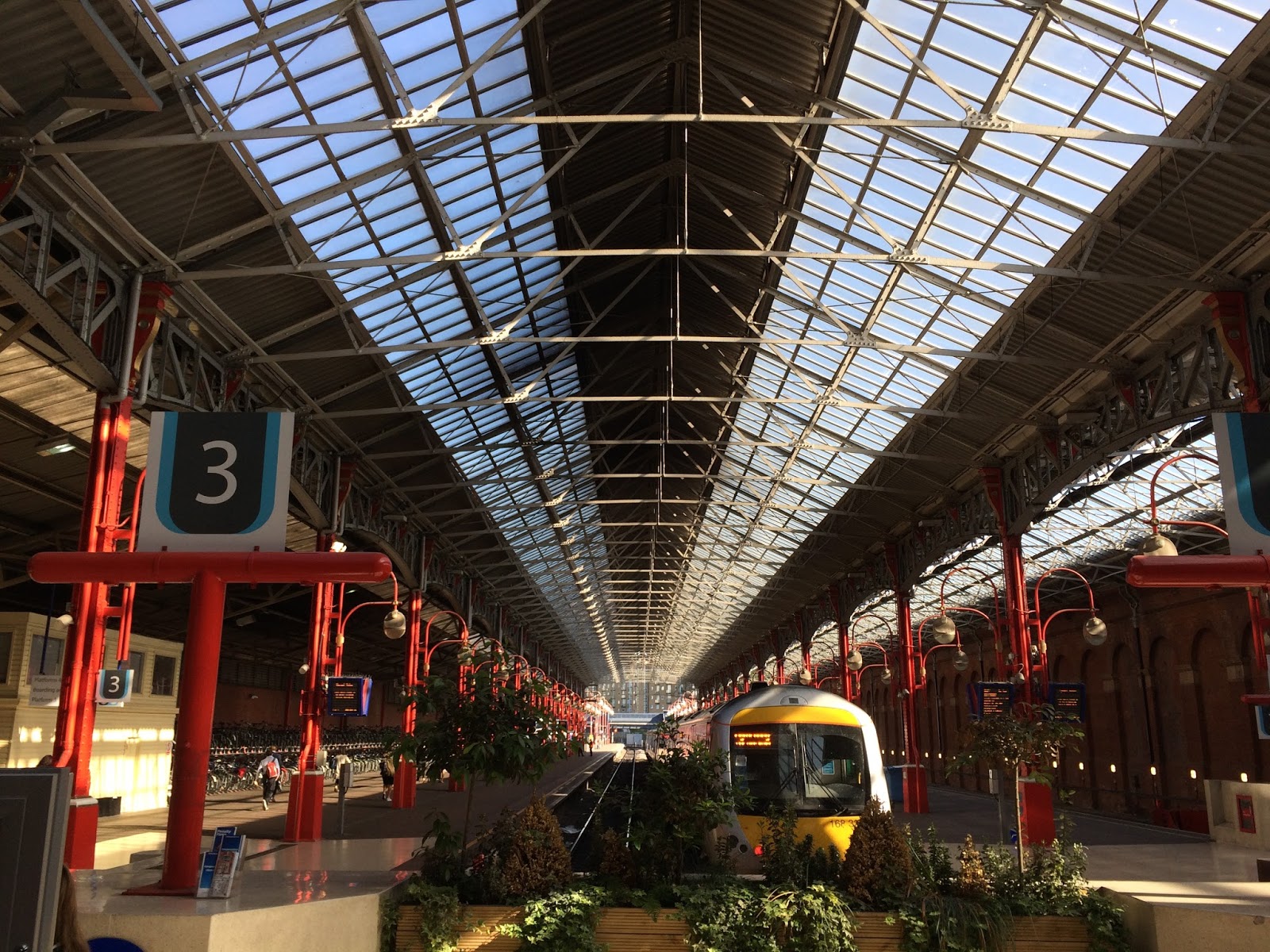
After packing suitcases, tidying their London flat and finding and boarding the correct train at Marylebone Station, the family  sat down in their assigned seats and let out a collective sigh. Soon they started to move, the carriage rocking gently as the train crawled out of the station. 

Marylebone Station

When AJ settled into her seat  on the 8:30 am train to Glasgow, Scotland, she opened her journal and tried to write, but  realized that sometime during the night and busy morning preparations, she had lost track of the days. 


“What day is it?” she asked. 

“Thursday,” B said, “after this, no more ‘mind the gap’ for us.” 

“Never happier to leave a city,” AJ thought, then checked herself. It wasn’t all bad. The history was mesmerizing, the people, not so much. 

In London, there was always a rush of people, everywhere. There was always someone behind you wanting you to get out of their way. There was always someone in front of you, blocking your way. You were always one of these two people, sometimes both at once. And in this rush, the finer points of etiquette were dropped for the sake of survival and basic movement from one point to another. 

Every morning in London,  business people rushed (always, always rushing) through underground stations with looks of perpetual annoyance and depression on their faces (apparently train stations had the same disease as airports). Most men wore white shirts and dark jackets, reminding AJ of herds of penguins–crabby, stern, depressed, rushed penguins, who moved more like buffaloes. 

Since arriving in London, AJ tried to observe people for the answer to one question: UK people drive on the left, do they walk on the left?” It was a silly question, in retrospect, but it reminded her of C S Lewis’s discussion in Mere Christianity about the inconsistency of human law in morality. 

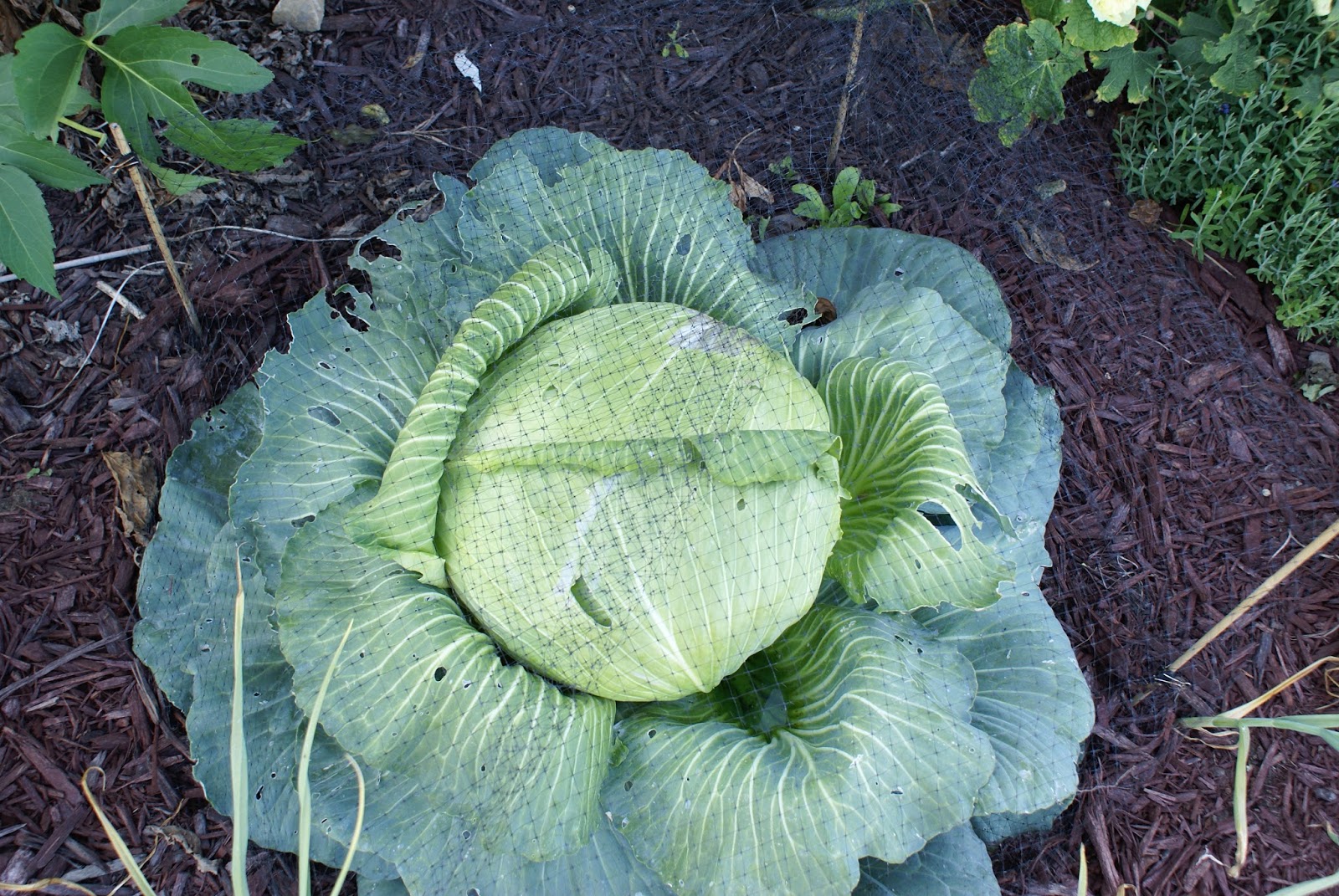
Anyone studying Man from the outside as we study electricity or cabbages, not knowing our language and consequently not able to get any inside knowledge from us, but merely observing what we did, would never get the slightest evidence that we had this moral law. How could he? For him observations would only show what we did, and the moral law is about what we ought to do. In the same way, if there were anything above or behind the observed facts in the case of stones or the weather, we, by studying them from outside could never hope to discover it.”  CS Lewis, Mere Christianity 


For four days she watched people around London to see what side of the stairs, escalators, sidewalks they walked on. She could detect no discernible pattern. They were all over the place. In a few places, she went down escalators on the right side of a pair (probably because of construction). 


The mystery continued until that morning, their last day in London. After getting the balance on their Oyster cards (Underground tickets) refunded, B started up a pair of stairs on the right side (not unheard of in the London), AJ and TwoSon lagging behind. A grumpy penguin came down the left side of the stairs, had to navigate around B and his luggage, and mumbled, “wrong way up the steps, wrong way up the steps …” 

AJ and TwoSon had yet to pick a side, so they went up the left side (the correct side) of the steps to absolutely no one’s pleasure. “So, now we know. They do walk on the left … in general … sometimes … but rarely in the London Underground … and really, rarely in London,” AJ mumbled. * 

In the train, AJ stared out the windows as England passed by:  canals with long boats moseying along them, the backsides of industries and businesses no one wanted to see, weedy hedgerows filled with wild foxglove and more elderberry. Hedges and fences partitioned green hills dotted with sheep and cows.  Highways raced parallel to the train. The hills grew so steep and high, one might want to start calling them mountains, with stone fences ascending them. 


When they reached Glasgow, they picked up lunch at another Pret A Manger and ate on the train station benches because there was no room in the restaurant for them and their luggage. 

The Glasgow train station was no different than any other travel hub, it had the airport/train station disease of rushing, stern, unfriendly faces wherever one looked. AJ’s impression of Glasgow was of an angry depressed, downright unfriendly city, but again, she had to admit the unfairness of the impression, only experiencing the train station. 

Their Uber driver also had the airport/train station disease, which lead to a  quiet, quick Uber ride to the Arnold car-letting place (car-rental). Here, the heart-racing adventure really began. They were given a Hyundai Tucson, which, in UK terms, was a wide, road-hogging beast of a car. But it had lane-assist (when engaged, it alerted the driver if the car went outside the lane of traffic), which was helpful, especially when AJ and B figured out what it was and how to turn it on. 
Kilchurn Castle


B programmed their route into Google maps GPS and because of some technical difficulty, Miss GPS decided to give them the silent treatment, so AJ had to translate and verbalize the directions on the phone. This is harder to do than one might think, especially when a native, right-side-of-the-road, left-side-of-the-car driver is driving in a strange land on the left side of the road in a right-side-steering-wheel car, on treacherously narrow and harrowing roads.

As B drove, AJ kept reminding him, “Stay left, stay left …” and generally interpreted the foreign traffic patterns and signs without much confidence, despite having studied Scotland driving rules and signs before the trip. They made it through the myriad, dreaded roundabouts with getting honked at only once. As they drove farther away from the city, the roads became increasingly narrow and were usually lined on one side by sheer rock walls of mountains. On the other was usually a steady stream of fast moving cars, lorries and big trucks.


Their first stop was St. Conan’s Kirk. A heavy mist fell from the grey skies, but it only added to the mystery and allure of the place. After pulling off the busy road and parking, they walked a little way to find the hidden church of massive stone and ancient-looking structures. AJ walked in, pausing at the decorative elements that inundated every feature, even the roofing. After contemplating two graves in small closed-off side rooms, she walked outside where buttresses* leaned to hold up the walls, out to where the waters of Lock Awe shimmered, slowly passing by under the grey sky. 


Outside, back of St. Conan\’s Kirk


AJ went back inside and sat down in a pew, zipping up her black raincoat and buttoning it to the top. It was damp and cool inside (the doors were open and there were leaks in the roof). She picked up a worn, tape-bound Bible from the pew-back in front of her, leafing through the damp pages to Psalm 32. Sitting on the bench in the dampness, for a moment, her soul opened and the church, its leaky roof and all the beauty crafted for God seeped in, mixing with her rushed and overwhelming experiences from the previous days. She read the Psalm again, this time verse 6-7 flowed into her mind: “… surely in the rush of great waters, they shall not reach him. You are a hiding place for me; you preserve me from trouble…”

St Conan\’s Kirk


It was as if she suddenly realized where she was and the significance lifted a genuine smile to her lips. The church, hidden slightly, off the very busy (and narrow) road was a temporary, but exquisite resting place, a hiding place of sorts from the rush and hectic pace of the big cities. 


After surveying most of the church and its beautiful craftsmanship, she dropped a few pounds in the church coffer for the roofing fund, then continued walking around in awe, stopping briefly at the Robert the Bruce Chapel, containing a fragment of bone of the ancient king of Scotland. 


The kirk, or church was built in 1886 (not old in UK terms) in a mix of stoney styles, Roman to Norman. 

The next stop involved a little hike to Kilchurn Castle, on the edge of Loch Awe, once and long ago the abode of the Campbells of Glenorchy. The ruins were now a shell of strong stone walls, but to read of the violent and war-fueled history off the placards filled AJ\’s and TwoSon\’s mind with wonder and awe. AJ wasn’t very far into Rob Roy by Walter Scott, but had listened to enough of the story to catch the adventurous spirit of the area and to understand the descriptive portions, especially in the misty rain and drear that lay over the area. The Scottish Robin Hood’s mother was a Campbell, his father, a MacGregor. 


The last stop that day was to their B&B, Glenmore Country House, in Kilmelford by Oban. By the time they pulled up to the house, it was well past 8 pm, though it didn’t really feel late, the daylight was nowhere near being dim. After checking in with the hostess, and giving some pats to the family’s cat dozing in a nearby chair, they politely turned down walking to the village (they were hungry and disoriented, and although the hostess’s directions were clear, the path simple and short, AJ was sure they would get lost) and drove a few minutes to Cuilefaile Hotel for a hot plentiful dinner in the pub, complete with a friendly dog. 

The B&B room was inside an old family home, part of which was shut off for family, part reserved for paying guests. AJ had dreamt of this place–well, not exactly this place, but one very much like it–so many times, even wrote stories about it. And now she was there, but in Scotland, for one night as a guest. The minute she saw it her heart broke, already mourning the short time she had to spend there. 

The lane up to the house was flanked by tall old pines and passed by a windowless, expansive, grey stone barn. The house, of the same grey stone and thick walls, looked out over a loch. Inside, wood floors creaked under colorful rugs, thick wooden doors opened with elaborate glass doorknobs, every room was adorned with a tiled fireplace, and the aroma of exquisite old-wood smell haunted every corner and crevice. The bathroom was covered with white tile, contained a porcelain bathtub and was accented with old fashioned fixtures. Their\’s was a large main bedroom and a little bedroom next door, next to their very own sitting room. The view outside the main bedroom window was the tail end of Lock Melfort.

That night she sat down to write, trying to recollect everything that had made a mark on her that day. She needed more time to appreciate the beauty, history and existence of the little village and the beautiful house, but The Agenda wouldn\’t allow it. There was so much she wanted to write, but fatigue and a little sadness veiled her clarity of thought, so she snuggled down in the soft giant bed and fell immediately asleep.  


*A note about angry penguins: Now, this is admittedly a superficial, first visual impression. These men and women, in a highly civilized, modern way, make the world go around. AJ admired and respected them for that. B was an angry penguin (except he usually wore patterned shirts, no overcoat, and she hoped he was a little more tolerant of the tourists that dawdled along the lakeside roads in their hometown).These businesspeople walk London streets, commute on the Underground day in and day out, working their brains dry, and tourists were always in the way and they’d rather quite do without them going the wrong way up stairs with their cow-ish luggage and getting in the way of their morning rush, thank you very much. 

She understood and couldn\’t blame them too much. It’s the same reason AJ’s patience was put to the test when she drove behind crawling, rubber-neckers on the road that leads along Lake MI near her home. It takes tourists time to get in rhythm of a different place. Tourists are the slow-learners, the bumps in the road.